




Patent e-filing in India means submitting a patent application to the Indian Patent Office through its online portal rather than in paper form, signing documents electronically instead of by hand. It is mandatory for registered patent agents and, for the application itself, optional for every other applicant; physical filing attracts roughly 10% higher government fees.
The portal is run by the Indian Patent Office, and the rules on who must use it, what it costs and which forms follow the application are in the Patents Rules, 2003 as amended in 2024. This guide walks through the signature options, registration, the forms, the fees against paper filing, and the post-filing dates you need to track. For the wider procedure from filing to grant, see the patent filing procedure in India.
Quick answer: Get a Digital Signature Certificate or e-Sign, register on the IP India e-filing portal, complete Form 1 with your specification and supporting forms, and pay online. Natural persons, startups, small entities and educational institutions pay a base application fee of ₹1,600 by e-filing; other applicants pay ₹8,000, and longer specifications and larger claim sets add to both. Registered patent agents must e-file, and a request for expedited examination can be filed only electronically whoever makes it; other applicants may still file the application itself on paper, at roughly 10% more. Verified against the fee schedule as of September 2026.
Who Must E-File a Patent Application in India
Registered patent agents have no choice in the matter. The Rules provide that “a patent agent shall file, leave, make or give all documents only by electronic transmission duly authenticated”, subject to a proviso: a document asked for in original must be submitted within fifteen days, failing which it is treated as not filed at all.
If a patent agent is filing on your behalf, the Rules require the documents to go by electronic transmission, which in practice means the e-filing portal.
Every other applicant can choose how to file the application. In the Patent Office’s own account of the rule, a document may be tendered by hand, sent by post, registered post or speed post, or transmitted electronically, with only the electronic route required to be “duly authenticated”. An individual inventor, a startup, a small entity or a company filing without an agent may file on paper at the appropriate patent office. Doing so is entirely lawful; it simply costs roughly 10% more under the physical-filing column of the fee schedule.
One route is closed to paper whoever files it. A request for expedited examination on Form 18A may be made only by authenticated electronic transmission, and the fee schedule marks physical filing “Not allowed” for it, and for converting an ordinary request into an expedited one. Startups and small entities are among those eligible, as are natural-person applicants where the applicant, or at least one of joint applicants who are all natural persons, is female.
Which patent office branch has jurisdiction over your application depends on where you, or the first-named applicant, normally reside, are domiciled, have a place of business, or where the invention originated; only if you have no domicile or place of business in India does your address for service become the deciding factor. That office then handles all proceedings under the Act for your application, and once fixed it does not ordinarily change. The e-filing portal itself is one central system, so you are not filing “at” a particular city when you file online.
What You Need Before You Start
Not every application needs every form. Which ones apply depends on your application type (ordinary, convention, PCT national phase, divisional, or a patent of addition), each covered in our guide to the types of patent applications in India, and on your applicant category.
Form 1 is the application for grant of patent itself, with applicant, inventor and priority details.
Form 2 is your specification. A provisional specification needs a title and a description of the invention, though, subject to the Rules, drawings may accompany either a provisional or a complete specification, and must be supplied if the Controller, the official who decides the application, requires them; a complete specification must also fully describe the invention and the best method of performing it, end with a claim or claims, and include an abstract. If you file a provisional, the complete specification must follow within twelve months of the filing date, or the application is deemed abandoned. For what a provisional secures and what it does not, see our guide to the provisional patent application in India.
Form 3 is your statement and undertaking on corresponding foreign applications, if one exists. You have six months from your filing date to submit it, so it does not have to be ready when you e-file the application, and the Controller may condone delay or extend the time for filing Form 3 by up to three months on a Form 4 request. The disclosure duty continues afterward: you must update the Controller on other foreign applications within three months of the first examination report (the first statement of objections), and the Controller may separately direct a fresh statement, for reasons recorded in writing, which you then have two months from that communication to file.
Form 5, the declaration of inventorship, is needed where a complete specification follows a provisional, and for convention and PCT national phase applications; an ordinary application filed with a complete specification from the start does not need it. Where required, it goes in with the complete specification, or within one month after it with the Controller’s leave on a Form 4 request.
Form 26 is the Patent Office’s own template for authorising an agent to act for you; the Rules also accept a separately drafted power of attorney in its place. This can follow within three months of filing; miss that window and the Rules halt further processing of the application until it is filed.
Form 28 is the declaration of startup, small entity or educational institution status, required with every fee-bearing document if you are claiming that fee category. None of the three is a self-description: a startup here means an entity recognised as a startup by the competent authority under the Startup India initiative (in practice, DPIIT recognition). Small entity status turns on the investment limits set for a medium enterprise under the MSME Development Act 2006, not on how the business feels day to day; see our guide on patent benefits for MSMEs if you are unsure which category applies to you.
For the full document checklist and the wider filing procedure beyond e-filing itself, see our guide to the patent filing procedure in India.
Step-by-Step: Patent E-Filing in India on the Online Portal
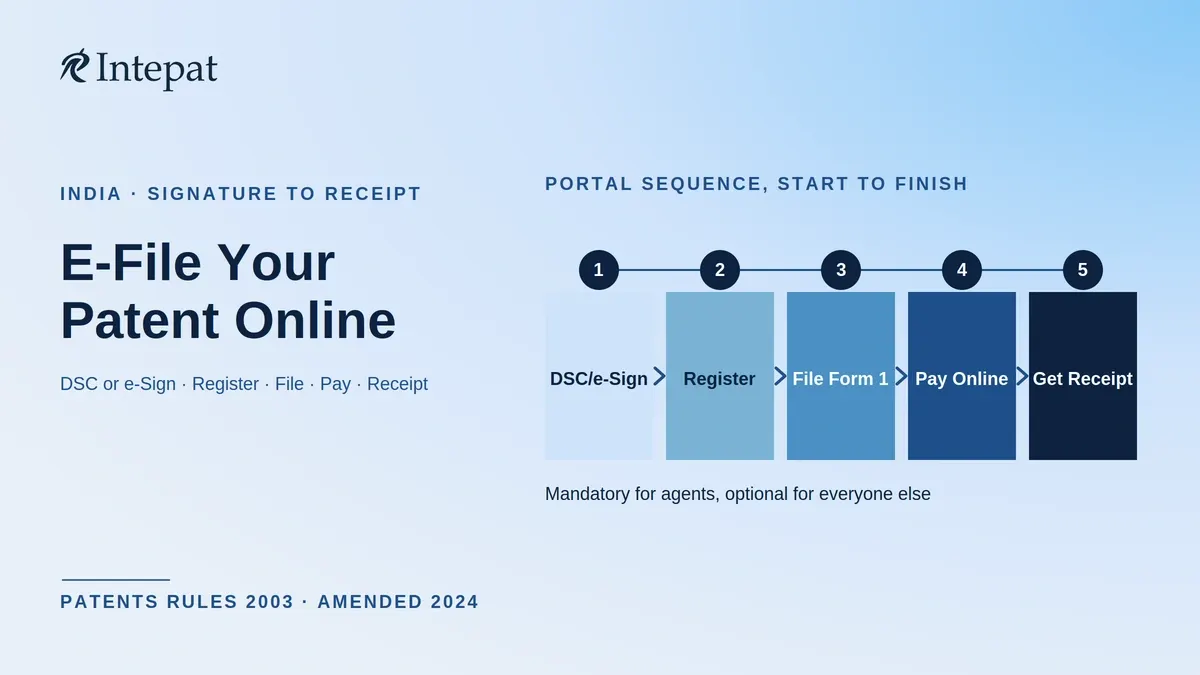
The portal sequence is signature, registration, form, upload, sign, pay, receipt. The signature options, registration and online payment below are confirmed against the Patent Office’s own filing process page as of September 2026; the remaining steps describe how the portal and the current Form 1 work in practice.
The two signature options are the one step in the sequence you have to arrange with an outside vendor before you start.
- Get a Digital Signature Certificate or set up e-Sign. A Digital Signature Certificate is a certificate-based electronic signature obtained from an authorised vendor; the portal requires a Class II or Class III certificate without encryption. e-Sign, an Aadhaar- or PAN-based electronic signature obtained from an authorised vendor, is the alternative.
- Register on the e-filing portal, which is reached from the Patent Office’s filing process page linked below. Create a user profile with a user ID and password.
- Log in and select your form. Choose Form 1 for a fresh application and mark the type of application; the current form carries separate fields for the particulars of a convention application, a PCT international application, an original application for a divisional, and a main application for a patent of addition.
- Fill in Form 1 and upload the specification. The mobile number and email fields on the current Form 1 are marked for mandatory OTP verification. Attach Form 2, together with Form 3, Form 5 or Form 26 where they apply, plus drawings and the abstract.
- Sign every document electronically. Each uploaded document needs your Digital Signature Certificate or e-Sign before the portal accepts it in place of a handwritten signature.
- Pay the prescribed fee online. The amount depends on the applicant category and, where applicable, excess pages and claims, and electronic payment is one of the routes the Rules provide for paying fees. The Rules also allow payment in cash at the appropriate office or by bank draft or banker’s cheque drawn on a scheduled bank at that place, and the entire fee must accompany the document; in practice those routes go with a paper filing.
- Keep your acknowledgment. After successful payment the portal generates an acknowledgement receipt; retain it for your records and later filings.
Both signature options come from an authorised vendor outside the portal itself, a Digital Signature Certificate on the vendor’s own issuance process and e-Sign on the strength of your Aadhaar or PAN, so it is worth arranging whichever you will use before you are up against a deadline. The options and requirements above are confirmed on the Patent Office’s own filing process page.
Patent E-Filing Fees vs Physical Filing Fees
Start with the application fee, which shows the gap most directly. Under the fee schedule as substituted in March 2024, e-filing Form 1 costs ₹1,600 for a natural person, startup, small entity or educational institution and ₹8,000 for every other applicant; the schedule charges a multiple of the applicable figure where an application claims more than one priority.
Filing the same form on paper costs ₹1,750 and ₹8,800. The Rules set a flat rate: “ten per cent additional fee shall be payable when the applications for patent and other documents are filed through physical mode”. Worked through the schedule’s actual rupee figures, that comes to exactly 10% for the ₹8,000 row, and a touch under it (9.375%) for the ₹1,600 row, because the schedule prints its own rounded figure.
A patent of addition gets a different rate again: the schedule’s note to the application fee gives such an application “a reduction of 50 per cent in fee as compared to other applications”, so the application fee for that type is half the figures above.
A similar gap, between about 9% and 12.5%, runs through the smaller fee lines inside the application fee, for example the charge for each specification sheet beyond 30, sequence listing pages excluded (₹160 or ₹800 by e-filing), and each claim beyond 10 (₹320 or ₹1,600 by e-filing). If you are claiming the lower rate as a startup, small entity or educational institution, rather than simply as a natural person, Form 28 must accompany every fee-bearing document making that claim. For the fees that apply at later stages, such as examination and renewal, see our full breakdown of patent fees and costs in India, or estimate your own filing cost with the patent fees calculator.
Verified as of September 2026 against the fee schedule; the figures can change, so confirm the current amounts before you pay. They cover the government fee only. Any charge a vendor makes for issuing a Digital Signature Certificate or an e-Sign, both of which are obtained from an authorised vendor, is separate from it.
What Happens After You Submit
Beyond that twelve-month date for a provisional, filing comes with two more dates to track, though only one is a deadline you must personally meet. Your application ordinarily remains off the public record for 18 months from its filing date or its priority date, the date of the earliest application from which it claims priority, whichever is earlier.
The Controller then ordinarily publishes it in the official journal within one month after that period expires, without anything required of you. You can ask the Controller to publish it sooner by filing Form 9, an optional step some applicants take when early publication suits their funding or licensing timeline.
The deadline that is yours to meet is the request for examination. For applications filed on or after 15 March 2024, the request, on Form 18, is due within 31 months of the priority date or the filing date, whichever is earlier. Applications filed before that date keep the earlier 48-month period, under the amendment’s own transitional clause.
If the request is not filed in time the application is treated as withdrawn. The Controller’s general power to correct procedural irregularities cannot reach that period; the only express route in the Rules is a discretionary request on Form 4 within six months of the expiry, which the Controller may grant or refuse, and whether a condonation displaces the withdrawal is not settled; see the guide to the request for examination in India. That request is not free: condonation is charged per month of delay, ₹10,000 by e-filing for a natural person, startup, small entity or educational institution and ₹50,000 for any other applicant. The Patent Deadline Tracker computes both dates from your filing and priority dates.
When to E-File Yourself and When to Use a Patent Agent
The Act’s chapter on patent agents expressly does not prohibit an applicant from drafting a specification or acting before the Controller, so an individual inventor, a startup or a small company may e-file without one.
The Act allows a person claiming to be the true and first inventor, a person to whom that inventor has assigned the right to make the application, or the legal representative of a deceased person who was entitled to apply, to apply either alone or jointly with someone else.
That entitlement is subject to a reciprocity rule that bars nationals of a country the Central Government has notified as non-reciprocating from applying for or holding a patent, being registered as an assignee, or applying for or holding a licence.
What a patent agent adds is not the ability to e-file; it is the specification itself, and the judgment behind claim scope, prior art, and how objections get answered later. In practice, applicants confident in their own drafting and comfortable with the Digital Signature Certificate or e-Sign process often file straightforward applications themselves. Those who are not tend to instruct a registered patent agent, who is required to e-file in any event.
Either way, the portal mechanics are the easy part. Getting the specification, the supporting forms and the fee category right the first time tends to be where most delay comes from, whichever route you choose.
Frequently Asked Questions
No. The Rules make electronic filing mandatory for registered patent agents, who must file every document by authenticated electronic transmission, and for a request for expedited examination whoever makes it. Other applicants may still file the application itself on paper at the appropriate patent office, though physical filing costs roughly 10% more.
For a standard application, natural persons, startups, small entities and educational institutions pay ₹1,600 to e-file Form 1 against ₹1,750 on paper; other applicants pay ₹8,000 against ₹8,800. A similar gap, between about 9% and 12.5%, applies to the per-sheet and per-claim fees for longer specifications, verified against the fee schedule as of September 2026.
You need either a Digital Signature Certificate or e-Sign. The IP India e-filing portal accepts a Class II or Class III Digital Signature Certificate without encryption from an authorised vendor, or e-Sign obtained from an authorised vendor using your Aadhaar or PAN, as confirmed on the official filing process page as of September 2026.
Applications filed on or after 15 March 2024 need Form 18 within 31 months of the priority date or the filing date, whichever is earlier. Applications filed earlier keep the earlier 48-month period. Miss the deadline and the application is treated as withdrawn; any relief is discretionary and must be sought within six months of that deadline expiring.
e-Sign is the alternative the IP India filing process page lists, and like a Digital Signature Certificate it must be obtained from an authorised vendor, using your Aadhaar or PAN. Arrange whichever second option you may need before you start filing, so a certificate failure does not cost you a filing date.
Small entity status depends on whether your investment in plant and machinery (for manufacturing) or in equipment (for services) stays within the limit set for a medium enterprise under the MSME Development Act 2006; our guide to patent benefits for MSMEs sets out the categories. If you qualify, Form 28 must accompany every fee-bearing document claiming that status.
Legal Disclaimer
This post is for informational purposes only and is not legal advice. Statutory provisions are cited for reference based on the Patents Act, 1970 and Patents Rules, 2003 as they stand at September 2026, verified against the instruments listed under Sources, including the Patents (Amendment) Rules, 2024. Government fees, forms and procedures change; confirm current figures with the Indian Patent Office before you file, and consult a registered patent agent for advice on your specific invention.