




Trademark registration in Canada is open to an Indian business through the Canadian Intellectual Property Office (CIPO), directly or via Madrid. The mark is examined, advertised for opposition, and registered if no opposition succeeds. You need not use the mark yet, but must genuinely intend to use it in Canada. The 2026 online fee is CAD 491.06 for one class.
This guide follows Canada’s Trademarks Act and the Trademarks Regulations as consolidated to 30 September 2026, with CIPO’s published fees. It is written for Indian businesses choosing between a direct CIPO application and a designation of Canada under the Madrid Protocol, the treaty that lets one international application, filed through the Indian Trade Marks Registry, extend to other member countries. Fees are verified as of October 2026.
Quick answer: Run a clearance search first, then apply directly to CIPO, or designate Canada in a Madrid international application based on your Indian application or registration. Direct filing usually suits a Canada-only plan or goods wider than your Indian filing; Madrid suits several countries at once from an Indian base that already covers the Canadian goods. Either way CIPO examines the mark, an opposition window follows advertisement, and a direct registration lasts 10 years, renewable.
Who can apply, and whether the mark must already be in use
Any person who uses or proposes to use a trademark in Canada, and is entitled to use it, can apply to register it for the goods or services concerned. Use is not a precondition of registration: once examination is cleared and the opposition period ends without a successful opposition, the Canadian Registrar of Trademarks must register the mark.
That makes Canada accessible to a business that has not yet launched there. The applicant must genuinely propose to use the mark in Canada. An opponent can argue that, at the filing date, the applicant was neither using nor proposing to use the mark in Canada for the listed goods or services, and bad faith in filing is a separate ground of opposition.
Use also matters after registration. Once three years have passed from the registration date, any person can pay a fee and ask the Registrar to send the owner a notice requiring evidence, within three months, of use in Canada during the three years before the date of that notice. Where the owner cannot, and no special circumstances excuse the absence of use, the registration can be expunged, meaning removed from the register, or cut back to the goods or services in use. Keep records of Canadian use for each registered good or service so that evidence can be produced if such a notice is issued.
Earlier Canadian use can support an entitlement objection to a later application. A later applicant is not entitled to register a mark that was confusing, at its filing date or first use in Canada, whichever is earlier, with a mark someone else had already used or made known there, unless that earlier mark had been abandoned by the time the application is advertised. Keep dated evidence of Canadian sales and advertising, since it can support an opposition against a copycat application.
Filing directly with CIPO or designating Canada through Madrid
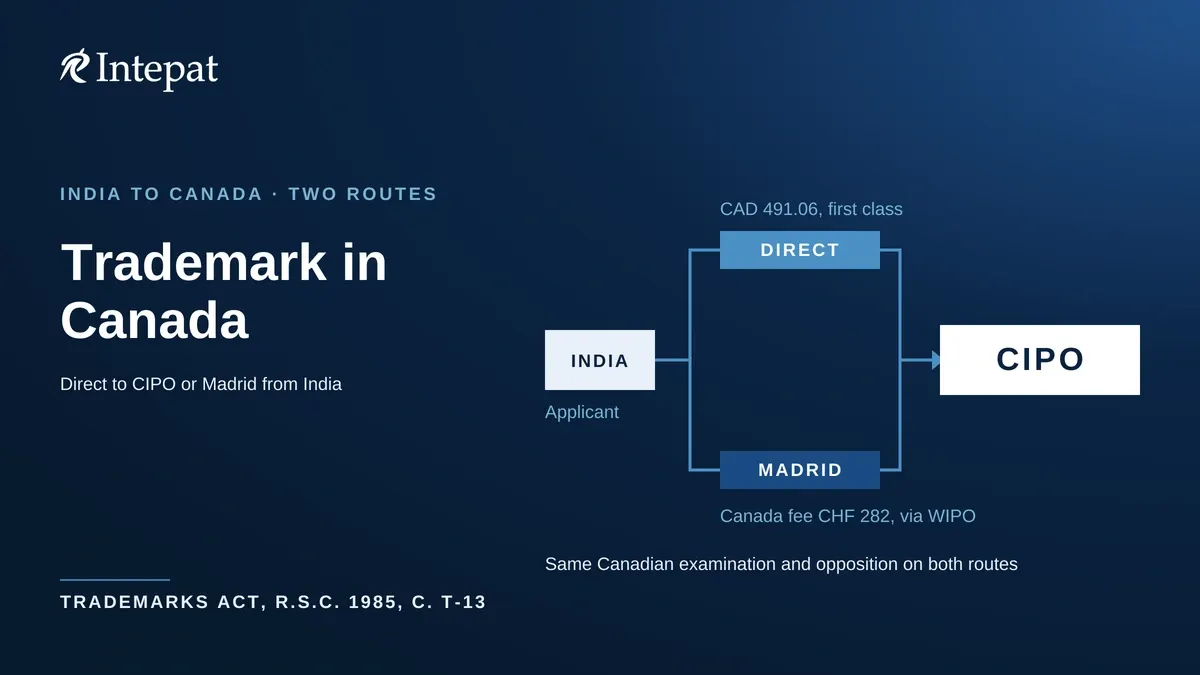
There are two routes. A direct application is filed with CIPO and costs CAD 491.06 online for the first class in 2026, plus CAD 149.04 for each further class. A Madrid designation adds Canada to an international application filed through the Indian Trade Marks Registry, with Canada’s own fee, the individual fee, paid to WIPO in Swiss francs.
Under the Madrid route, Canada’s individual fee is CHF 282 for one class and CHF 86 for each further class until 31 December 2026, rising to CHF 291 and CHF 88 where the international application is received by the Indian Registry, or a later designation is received by the holder’s office or filed directly with WIPO, on or after 1 January 2027. On a new international application these sit on top of WIPO’s basic fee of CHF 653, or CHF 903 where the mark is shown in colour, and the Indian Registry’s handling fee of Rs 5,000. A business that already holds an international registration can add Canada later by a subsequent designation, for which WIPO’s basic fee is CHF 300.
Once WIPO registers the international application, the designation of Canada is treated as a Canadian application. It is examined and opened to opposition under the same Canadian standards as a direct filing, with some Madrid-specific procedure described below. The international application must rest on an Indian application or registration, and the Indian Registrar certifies that the particulars match, so the Canadian specification can be no wider than the Indian base. The Canadian designation must remain within the scope of the Indian base and the international registration; the list can be limited for Canada, but where broad class-heading wording is carried over unchanged it is likely to meet the objection described in the next section.
For five years, the Madrid route also depends on the Indian base. If, within five years of the international registration, the Indian application is finally refused or withdrawn, or the Indian registration is cancelled or expires, for all or some of the goods or services, the protection falls away to the same extent, including in Canada. The same applies where an opposition or similar action begun within the five years is decided afterwards. The holder then has three months from the date of cancellation recorded in the International Register to file a transformation application with CIPO, a period that cannot be extended, which revives the Canadian designation as a Canadian application or, if it had already registered, as a Canadian registration. Our guide to the Madrid Protocol from India explains the international filing itself, and the Madrid fee calculator guide shows how to price a designation list.
Either route can claim priority from an earlier application for the same or substantially the same mark and the same kind of goods or services, filed in a Paris Convention or WTO member country, which includes India. Priority gives the Canadian application the earlier date, so it ranks ahead of anyone who applied for or began using a similar mark in Canada in between. On a direct filing, the CIPO application and the priority request must both be made within six months of the earliest application. On the Madrid route, priority must be declared in the international registration, and the Canadian filing date must fall within those six months: for Canada designated in the international application, that is the international registration date; for Canada added later, it is the date borne by that later designation. An international registration obtained within the priority period does not preserve priority for Canada if Canada is added after the period expires.
What the application must contain
The application must list the goods or services in ordinary commercial terms, grouped by Nice class (the international classification of goods and services) with each class number shown, and include a representation or description that defines the mark. The Registrar decides any question of class, and that decision cannot be appealed.
Ordinary commercial terms is a requirement that catches many foreign applicants. A specification copied from a class heading, or from an Indian application drafted broadly, may not describe goods the way they are actually sold, and the Registrar can raise that as an objection. The same requirement is a ground of opposition, although a defect in class grouping alone is not. The list can be narrowed later but never broadened beyond the list as filed; once the application is advertised it cannot go beyond the advertised list, and anything deleted after that cannot be restored, so draft it fully at the start. Our trademark classification tool, built for Indian filings, can help identify candidate Nice classes; check the Canadian wording against CIPO’s Goods and Services Manual, where active terms are accepted without further specification and retired terms are not.
A mark written wholly or partly in Devanagari or another non-Latin script needs a transliteration into Latin characters, and any words in a language other than English or French need a translation into one of them. On a direct filing, CIPO gives a filing date only once it has an indication that registration is sought, information identifying and allowing contact with the applicant, a representation or description of the mark, the list of goods or services and the fee. Missing items must be supplied within two months of the Registrar’s notice, a period that cannot be extended, or the application is treated as never filed and the fee is not refunded.
Examination and how objections are handled
The Registrar examines each application and must refuse it if it does not meet the content requirements, if the mark is not registrable, if it is confusing with a mark in an earlier pending application, or if it is not distinctive. Before refusing, the Registrar must state the objections and give the applicant an adequate opportunity to answer.
Neither the Act nor the Regulations fixes the period for answering an examiner’s report, but CIPO’s practice is to allow six months; record the deadline stated in the report. CIPO generally grants an extension of that period only in exceptional circumstances, and charges no fee for the request. If the deadline passes without a proper response, CIPO sends a notice of default, and the applicant then has two months from the date of that notice to cure it or the application can be treated as abandoned. Deadlines fixed by the Act or the Regulations are different: extending one costs CAD 150 for each act, and a request made after the deadline succeeds only if the delay was not reasonably avoidable.
Where examination raises doubt because of a registered mark, the Registrar can still advertise the application but must notify the owner of that registered mark when it is advertised. A refusal can be appealed to the Federal Court within two months from the date the Registrar dispatched notice of the decision, or within any further time the Court allows.
For a Madrid designation, CIPO sends its examination objections to WIPO as a provisional refusal, which WIPO passes to the holder of the international registration. CIPO must do so within 18 months of the date WIPO notified it of the extension to Canada, and a response is required to contest that provisional refusal under Canadian law.
Representation matters here. Anyone the owner authorises can file an application, pay fees or renew for it, and that stays true after a trademark agent is appointed. For other business before CIPO, an owner with no agent can act for itself, but once an agent is appointed only that agent, or an associate agent it appoints, can act. A third party answering an objection or handling an opposition on the owner’s behalf must be a trademark agent as defined in Canada’s College of Patent Agents and Trademark Agents Act, so budget for Canadian agent fees if an objection or opposition arises.
Advertisement, opposition and what the applicant must do
An application that passes examination is advertised, and any person may oppose it within two months by filing a statement of opposition and paying the fee, CAD 1,115.08 in 2026. Grounds include a defective application, bad faith, non-registrability, the applicant not being entitled to registration, lack of distinctiveness, and no use or proposed use.
Extensions of the opposition period may be available. A would-be opponent can ask for more time, and for a Madrid designation that extension is capped at four months. Entitlement can turn on an earlier confusing mark or application belonging to someone else, which is why a clearance search before filing, covering the same or related trades, can identify conflicts before the applicant commits to filing costs or a Canadian trademark opposition.
If an opposition is filed and forwarded to you, you have two months to file and serve a counter statement, or the application is treated as abandoned. The opponent normally has four months from effective service of the counter statement to submit and serve its evidence, or a statement that it will submit none. The applicant then normally has four months from effective service of the opponent’s evidence or statement to submit and serve its own evidence or statement, and an applicant that does not submit and serve either its evidence or that statement within the four months is deemed to have abandoned the application. For a Madrid designation the opposition must be filed online, in English or French, it leads CIPO to send WIPO a provisional refusal, and the opponent cannot add new grounds after that notice.
Either side can appeal an opposition decision to the Federal Court within two months of the date the Registrar dispatched notice of the decision.
Registration and the cost at a glance
When the opposition period ends without an opposition, or an opposition is decided in the applicant’s favour, the Registrar registers the trademark and issues a certificate. No separate registration fee applies to current applications.
Neither the Act nor the Regulations sets an overall processing time. CIPO’s performance target for April 2026 to March 2027 is a first action, which may be an approval or an examiner’s report, within 14 months of the filing date for direct applications and within 14 months of WIPO’s notice extending protection to Canada for Madrid designations, in 90% of cases. That is a target, not a promise of registration, and CIPO’s separate client-service-standards page still lists longer periods.
CIPO trademark fees are, with some exceptions, adjusted each January under the Service Fees Act. CIPO has published its 2027 fees: certain fees increase by 1.7% on 1 January 2027, and for an indexed fee the amount payable depends on when CIPO receives payment. The current amounts are on CIPO’s trademark fees page.
| Government fee (verified as of October 2026) | 2026 | From 1 January 2027 |
| Direct filing, first class, online | CAD 491.06 | CAD 499.41 |
| Direct filing, first class, other means | CAD 640.10 | CAD 650.98 |
| Direct filing, each additional class | CAD 149.04 | CAD 151.57 |
| Statement of opposition (paid by the opponent) | CAD 1,115.08 | CAD 1,134.04 |
| Section 47 extension of a statutory deadline, per act | CAD 150.00 | CAD 150.00 |
| Extension to answer an examiner’s report | No CIPO fee | No CIPO fee |
| Direct renewal, first class, online | CAD 595.06 | CAD 605.18 |
| Direct renewal, first class, other means | CAD 744.10 | CAD 756.75 |
| Direct renewal, each additional class | CAD 185.49 | CAD 188.64 |
| Madrid designation of Canada: individual fee, first class and each additional class | CHF 282 and CHF 86 | CHF 291 and CHF 88 |
| Madrid renewal: Canada’s individual fee, first class and each additional class | CHF 342 and CHF 107 | CHF 353 and CHF 110 |
For CIPO fees the year turns on when CIPO receives payment; for Canada’s Madrid individual fee it turns on when the international application or later designation is received, or when the international registration is renewed. A Madrid filing also carries fees shared by all the countries designated: WIPO’s basic fee of CHF 653, or CHF 903 in colour, and the Indian Registry’s handling fee of Rs 5,000 on a new international application; a basic fee of CHF 300 for adding Canada to an existing registration; and a basic fee of CHF 653 on renewal.
These are government fees only. Professional fees, including Canadian agent fees for any objection or opposition, are separate.
Term, renewal and keeping the registration alive
A direct Canadian registration lasts 10 years from the registration date and can be renewed for further 10-year periods. The renewal window opens six months before expiry and closes six months after it, or two months after the Registrar’s renewal notice if that is later. An unrenewed registration is expunged.
The renewal fee in 2026 is CAD 595.06 for the first class renewed online, CAD 744.10 by other means, and CAD 185.49 for each additional class. The window is strict: an owner cannot ask for more time until it has closed, and even then the Registrar cannot extend it by more than seven days.
A Canadian registration obtained through Madrid is renewed through WIPO as part of the international registration, not with CIPO. Renewal follows the international registration’s ten-year cycle; adding Canada later does not start a fresh ten-year term. Canadian protection remains subject to cancellation or expungement under Canadian law: it falls away if the Indian base fails within the first five years, and if WIPO tells CIPO that Canada was left out of a renewal, the Canadian registration is expunged from the date the international registration expired for Canada. WIPO allows a six-month grace period for renewal, at a surcharge of half the basic fee.
Choosing a route for trademark registration in Canada
The decision usually turns on three questions: how many countries the business needs, whether the Indian base has an acceptable scope and manageable dependency risk and already covers the Canadian goods in commercial terms, and whether the business already holds an international registration. Priority is a timing point that applies to both routes.
A direct CIPO filing suits a business that needs Canada alone, whose Indian application is still under objection or opposition, or whose Indian specification is narrower than its Canadian plans, because a direct filing does not depend on the Indian base. A Madrid designation suits a business filing in several Madrid countries at once from such an Indian base, and a business that already holds an international registration can add Canada by subsequent designation. Either way, check the priority timing above, write the specification in ordinary commercial terms, and keep using the mark in Canada once registered.
For how the Canadian process compares with its neighbour, see our article on the differences between US and Canadian trademark procedure. Intepat IP’s trademark team in Bengaluru files Madrid designations, including Canada, as part of our Madrid Protocol filing service.
Frequently asked questions about trademark registration in Canada
No. Use is not a precondition of registration, so a business that has not launched in Canada can apply. You must genuinely propose to use the mark there for the listed goods or services, because an opponent can argue that you neither used nor proposed to use it at the filing date.
In 2026, a direct CIPO application costs CAD 491.06 online for the first class and CAD 149.04 for each further class. A Madrid designation of Canada carries an individual fee of CHF 282 for one class and CHF 86 for each further class, on top of WIPO’s basic fee and the Indian Registry’s handling fee.
Neither the Act nor the Regulations sets an overall time. CIPO’s target for April 2026 to March 2027 is a first action, an approval or an examiner’s report, within 14 months in 90% of cases. That is a target, not a promise, and an opposition or an objection that needs answering adds time.
File directly if you need Canada alone, your Indian application is still under objection or opposition, or your Canadian goods are wider than your Indian filing. Choose Madrid if you are filing in several Madrid countries at once from an Indian base that already covers the Canadian goods.
The examiner sends a report. CIPO’s practice is to allow six months to respond and to extend that only in exceptional circumstances, with no fee for asking. If the deadline passes, a notice of default gives two months to cure it. On a Madrid designation the objection arrives as a provisional refusal through WIPO.
Yes. Any person may oppose within two months of advertisement by filing a statement of opposition and paying the fee, CAD 1,115.08 in 2026. If an opposition is forwarded to you, file and serve a counter statement within two months, or the application is treated as abandoned.
A direct registration lasts 10 years and can be renewed for further 10-year periods. The renewal window opens six months before expiry, and an unrenewed registration is expunged. A registration obtained through Madrid is renewed through WIPO as part of the international registration, not with CIPO.
For five years from the international registration, the Madrid route depends on the Indian base. If the Indian application is finally refused or withdrawn, or the registration is cancelled, protection falls away to the same extent, including in Canada. You then have three months, which cannot be extended, to file a transformation application with CIPO.
This article explains Canadian trademark registration as at October 2026 and is for general information only. It is not legal advice. Many Canadian fees are adjusted each January and the law and CIPO practice change; confirm the current fee schedule before you file. For advice on a Canadian filing strategy, consult a trademark attorney.