




On 18 May 2026, a Division Bench of the Delhi High Court in K K Bansal v Koninklijke Philips Electronics NV set aside the 2018 single-judge decree that had directed two small DVD player makers to pay royalty to Philips at FRAND rates for alleged infringement of a Standard Essential Patent (SEP). Pronounced by Justices C. Hari Shankar and Om Prakash Shukla, the 150-page judgment reverses India’s first post-trial SEP decision and lays down a strict evidentiary template for every step of an SEP infringement claim.
| What the Division Bench held |
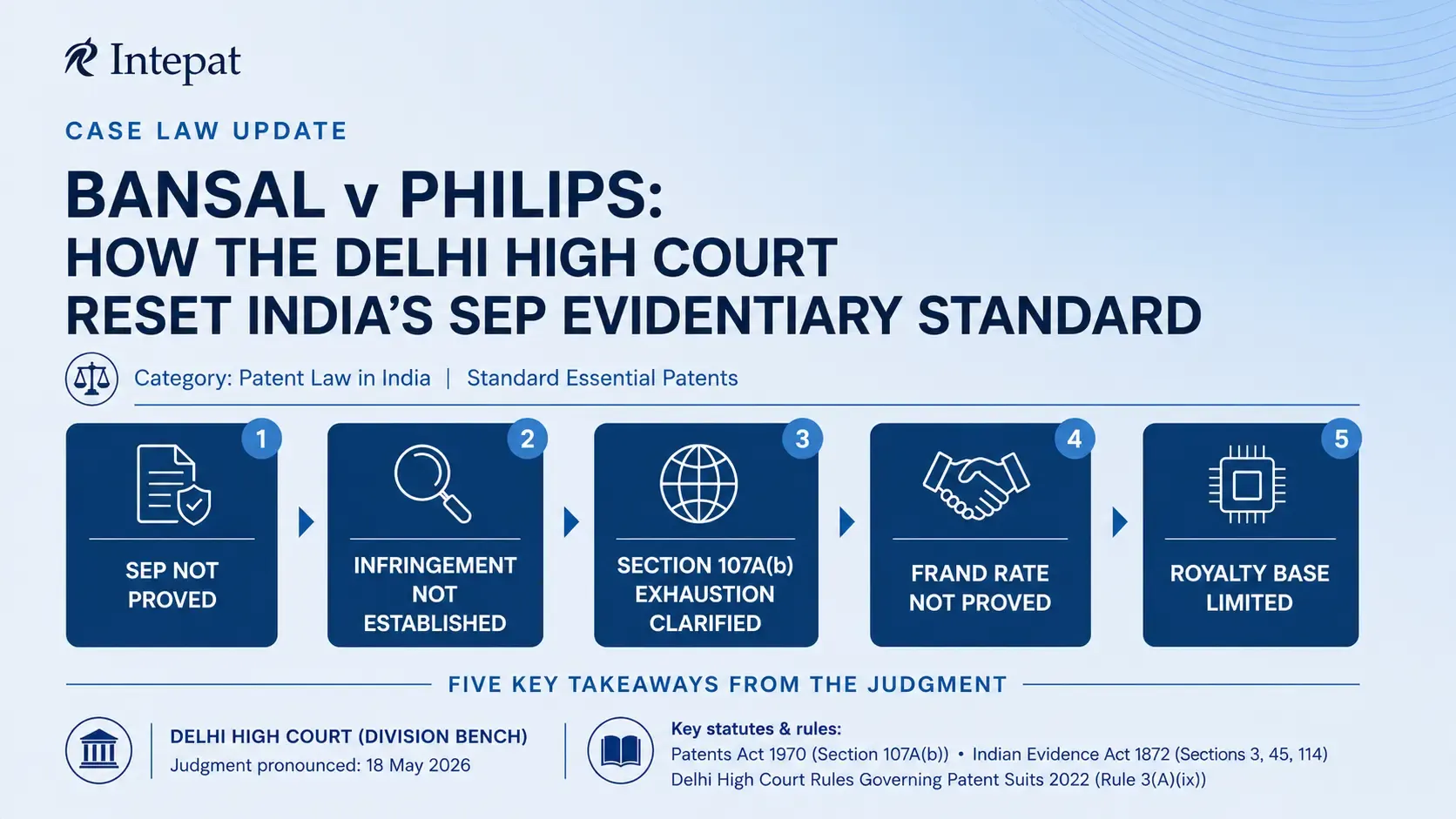
| The suit patent (Indian Patent IN-184753) was not proved to be a Standard Essential Patent because no claim charts mapped the patent claims to the DVD Forum standards, and the Essentiality Certificates relied on by Philips were not proved in accordance with Section 45 of the Indian Evidence Act 1872. Infringement was not established by either the direct test (no product-to-claim mapping was produced; Mr Ravi Babu’s affidavit was unusable because he never entered the witness box) or the indirect test (which depends on essentiality being proved). Section 107A(b) of the Patents Act 1970, as amended in 2003, bars infringement claims where the patented product has been purchased from a person duly authorised under the law to sell it. There is no requirement that the seller be a licensee of the patentee. A plaintiff claiming FRAND damages bears the burden of proof and, therefore, ought to produce its third-party licence agreements on record before the Court. Philips failed to do so, and the Court consequently drew an adverse inference under Section 114 of the Evidence Act. Royalty cannot be computed on the entire end-product when the patent claims a single component. |
The dispute, in brief
The proceedings arose out of two suits filed by Koninklijke Philips Electronics NV in 2009 against K K Bansal (proprietor of Bhagirathi Electronics) and his son Rajesh Bansal (proprietor of Mangalam Technology), both based in Haridwar. Philips alleged that the Bansals’ DVD players, sold under the brand names SOYER and PASSION, infringed Indian Patent IN-184753 for a “Decoding device for converting a modulated signal to a series of m-bit information words”. The patent was granted on 20 April 2001 under the Patents Act 1970, expired on 12 February 2015 during the pendency of the suits, and corresponded to US Patent 5696505 and European Patent EP 745254 B1.
By common judgment dated 12 July 2018, Justice Mukta Gupta decreed the suits in favour of Philips and directed the Bansals to pay royalty at the rate of USD 3.175 per DVD player up to 7 May 2010 and thereafter at USD 1.90 per DVD player up to 12 February 2015, from the date of institution of the suits, together with interest at the rate of 10% per annum from the end of the month for which the royalty became due until the date of payment, in respect of each video player manufactured or sold. Punitive damages of Rs. 5 lakh were also awarded against Rajesh Bansal on the ground that he had been a former Philips employee. The Bansals appealed. The Division Bench reserved judgment on 17 December 2025 and pronounced its decision on 18 May 2026.
A product patent for a chip-level device
The Division Bench’s first task was to characterise what the suit patent actually claimed. All six claims read on a “decoding device” (para 73). However, the opening descriptions in the complete specifications used the word “method”, creating a textual inconsistency with the claim wording and the title of the patent (paras 74 to 75).
The Court resolved the inconsistency by reference to Section 10(4)(c) of the Patents Act 1970, which provides that every complete specification shall end with a claim or claims defining the scope of the invention for which protection is claimed. Even where elsewhere in the complete specifications the patent was described as relating to a method, only what is claimed in the claims is entitled to protection (para 78). The suit patent was therefore a product patent, not a method patent.
Philips’ own witness PW-2 confirmed during cross-examination that the patented invention resided in the chip, or in the printed circuit board (PCB), inside the DVD player (paras 81 to 82). The Court’s holding was unambiguous: the device claimed in the suit patent “resides in the chip, or in the PCB, which is contained in the DVD Video Player. Any item or circuitry outside the PCB is, therefore, equally, outside the suit patent” (para 82). This classification framed every subsequent issue.
The patent was not proved to be a Standard Essential Patent
To establish the suit patent as an SEP, Philips had to prove two things: that a standard had been set by a Standard Setting Organisation (SSO), and that the suit patent mapped onto that standard (para 83). The first leg posed no difficulty. The Bansals had themselves admitted in their written statement that the DVD Forum was the SSO which set the standards for DVD-ROM and DVD video playback (para 84).
The second leg collapsed. The Division Bench refused to read Philips’ Essentiality Certificates in evidence. Philips had relied on certificates issued by Proskauer Rose LLP (for the corresponding US patent) and Cohausz & Florack (for the European patent), describing them as “independent expert patent evaluators”. The Court held these were expert evidence within Section 45 of the Indian Evidence Act 1872, and that expert opinion does not come into evidence automatically (paras 92 to 94), applying State of HP v Jai Lal and Ramesh Chandra Agrawal v Regency Hospital. No representative from either firm entered the witness box, and no affidavit from either firm vouchsafed the contents of the certificates (para 95).
Equally fatal was the absence of claim charts. The Division Bench in Intex Technologies v Telefonaktiebolaget LM Ericsson (2023) had held at paragraph 95 that to show a patent maps onto a standard, courts take into consideration claim charts demonstrating that the claims of a patent are present in the technical features of the standard. Philips produced no such claim charts, neither for the suit patent nor for its US and European counterparts (para 97). The Court concluded that without credible evidence of essentiality, the suit patent could not aspire to the status of an SEP (para 98).
Infringement was not established
Infringement in an SEP case can be proved by either the direct test (product-to-claim mapping) or the indirect test (mapping both the patent and the defendant’s product onto the standard, on the law of transitivity). Both tests failed.
The indirect test was unavailable because the suit patent had not been proved to be an SEP. With essentiality unproved, the law of transitivity has no foothold (paras 101 to 104).
The direct (or classical) test failed on evidence. The classical test, as set out by an earlier Division Bench in F. Hoffmann-La Roche v Cipla and reaffirmed by the same bench in Zydus Lifesciences v E.R. Squibb & Sons (2026), requires the plaintiff to map the features of the defendant’s product to the claims of the suit patent. Rule 3(A)(ix) of the High Court of Delhi Rules Governing Patent Suits 2022 requires this mapping to be set out in the plaint (paras 106 to 107).
Philips had filed an affidavit dated 22 May 2009 by Mr Ravi Babu, said to be its technical expert. Mr Ravi Babu never entered the witness box. Applying Ayaaubkhan Noorkhan Pathan v State of Maharashtra (2013), the Division Bench held that an affidavit is not evidence within Section 3 of the Evidence Act unless the deponent is produced for cross-examination (para 110). PW-2 deposed that he had independently tested the Bansals’ DVD players but never placed the test logs or analysis on record. Oral evidence cannot be led of the contents of a document, and withholding the best evidence available invites an adverse inference under Section 114 Illustration (g) of the Evidence Act (paras 116 to 119).
Section 107A(b) exhaustion: the central clarification
The doctrinal centrepiece of the judgment concerns the international exhaustion defence under Section 107A(b) of the Patents Act. The Patents (Amendment) Act 2002, with effect from 20 May 2003, made a decisive change to the wording of this provision.
| Pre-2003 wording | Post-2003 wording |
| “duly authorised by the patentee to produce and sell or distribute the product” | “duly authorised under the law to produce and sell or distribute the product” |
The Division Bench held that after the 2003 amendment, an implementer who imports a patented product from a person legally authorised to sell that product is protected from infringement liability, regardless of whether that seller is licensed by the patentee (para 135).
The Bansals had purchased the printed circuit boards containing MediaTek chips from Shuntak (HK) Trading Company and Sheen Land Corporation, both registered vendors of MediaTek. Rajesh Bansal had deposed on affidavit to this effect and was not cross-examined on the central assertions. Applying Muddasani Venkata Narsaiah v Muddasani Sarojana and Browne v Dunn (cited in State of UP v Nahar Singh), the Division Bench held that uncrossed assertions are taken as accepted (paras 130 to 133). PW-2 had also acknowledged in cross-examination that DVD players of Onida, Weston, Videocon, Philips, and the Bansals all contained the same MediaTek chip, and that Philips knew MediaTek was commercially selling such chips (paras 142 to 143). The single judge had rejected the exhaustion defence on the ground that the Bansals had not proved Shuntak and Sheen Land to be Philips’ licensees. The Division Bench held this reasoning was contrary to the post-2003 Section 107A(b), which does not require the seller to be authorised by the patentee, only that the seller be authorised under the law (para 144). Philips’ rights in the suit patent stood exhausted.
FRAND rate was not proved, and royalty cannot ride the end-product
A patentee asserting an SEP must prove that the rate it offers is fair, reasonable, and non-discriminatory (FRAND). The Division Bench placed this onus “squarely on the plaintiff” (para 19). It held that such proof would ideally require the plaintiff to disclose its third-party licence agreements so that the Court may verify that the rate is not skewed by extraneous factors (para 20). In practice, this requirement becomes effectively mandatory, since the plaintiff bears the burden of proof, and failure to produce such agreements may lead the Court to draw an adverse inference. Where confidentiality is required, the Delhi High Court (Original Side) Rules 2018 envisage confidentiality clubs as a partial remedy (para 21). The reasoning also touches the wider SEP and competition law debate.
Philips did not file a single third-party licence agreement, although PW-1 had admitted on cross-examination that Philips possessed the agreements. The Court drew an adverse inference under Section 114 Illustration (g) of the Evidence Act (para 155). A 20 September 2010 interim order, in which the Bansals had agreed to deposit Rs. 45 per DVD player without prejudice, did not constitute the basis for final FRAND adjudication (para 154). Informal pre-suit negotiations cannot constitute the basis for final adjudication of royalty rates at trial (para 158).
The royalty base posed a separate problem. The suit patent claimed only a decoding device, residing in a chip or PCB. The single judge had reasoned that the decoding device was an integral part of the DVD player and that royalty on the entire DVD player was therefore permissible (impugned judgment, para 13.3). The Division Bench rejected this reasoning, holding that royalty on the entire DVD player would amount to Philips obtaining payment for components in respect of which it held no patent (paras 165 to 167). The royalty base must match the claim scope. Punitive damages of Rs. 5 lakh against Rajesh Bansal, awarded by the single judge solely because he was a former Philips employee, were also set aside (para 168).
What this means for SEP litigants in India
For SEP plaintiffs, the judgment sets out an evidentiary checklist that must be satisfied before relief is granted:
- File claim charts with the plaint that map the suit patent onto the relevant SSO standard, in accordance with Rule 3(A)(ix) of the Delhi High Court Rules Governing Patent Suits 2022.
- Produce a witness from the issuing firm to prove any Essentiality Certificate; expert opinion does not come into evidence automatically.
- File third-party licence agreements on record to support the FRAND rate claimed. If commercial sensitivity is a concern, request a confidentiality club at the outset.
- For product-to-claim mapping, file the test logs and underlying analysis, and ensure the deponent of any technical affidavit is produced for cross-examination.
- Plead and prove the royalty base by reference to the claim scope, not the end-product.
For implementers in telecom, electronics, and MedTech sourcing components from foreign suppliers, the Section 107A(b) defence has been clarified in implementers’ favour. A foreign vendor authorised under the law of its country to sell the patented component triggers exhaustion, regardless of whether the vendor holds a formal licence from the Indian patentee. Documentation of the supply chain, including invoices, customs records, and vendor authorisations, should be preserved at the time of import.
Among the four post-trial Indian SEP judgments delivered to date (Ericsson v Lava, Philips v Sukesh Behl, Philips v M Bathla, and Bansal v Philips), two have now gone against the patentee. Pending pro-tem deposit applications will be argued in the shadow of this decision.
Where this leaves Indian SEP jurisprudence
The Division Bench’s discipline is consistent with its approach in Zydus Lifesciences, where it reversed an interim injunction for lack of product-to-claim mapping. Read together, the two decisions signal that the Delhi High Court will not accept assumptions in patent litigation where evidence is required. SEP cases are no different from any other patent infringement claim in that respect: each step of the cause of action, from essentiality through infringement to FRAND, must be proved by evidence that meets the standards of the Patents Act and the Evidence Act.
The judgment does not unsettle Intex or the earlier SEP framework. It applies that framework to a record where the patentee chose not to file the evidence the framework requires. SEP holders preparing to assert their patents in India will need to construct their evidentiary record before suit.
Disclaimer: This article is for general information only and does not constitute legal advice. Readers should consult qualified counsel for case-specific guidance.