




When Zee Entertainment filed suit against Nykaa in April 2026 for using its copyrighted music in promotional Instagram reels, the Delhi High Court case put a question many Indian brands have avoided squarely on the table: does accessing music through a platform’s licensed library give a business account the right to use it commercially? Under Indian copyright law, the answer is no.
Scope: This article covers Indian copyright law as applicable to the Zee Entertainment v. FSN E-Commerce Ventures Ltd. litigation pending before the Delhi High Court, with reference to comparative US precedent where it illuminates the Indian position. Case status as at July 2026.
Background of the Case
On 3 April 2026, Zee Entertainment Enterprises Ltd. approached the Delhi High Court seeking damages of approximately Rs. 2 crore against FSN E-Commerce Ventures Ltd., the parent company of Nykaa, alleging copyright infringement through the unauthorised use of Zee’s copyrighted songs in Nykaa’s promotional Instagram reels. Zee’s core contention was that it had entered into a licensing agreement with Meta (Instagram’s parent company) that permitted use of its music catalogue only for personal and non-commercial purposes. Nykaa, by using those tracks on a brand account for product promotion, had exceeded the scope of that licence.
Following the filing, Nykaa took down twelve of the reels identified by Zee. In May 2026, Nykaa filed an application before the Court to implead Meta as a party to the proceedings, arguing that only Meta could confirm whether the specific use exceeded the licence terms. Nykaa also filed a request for mediation. Both applications were pending as at July 2026, with the next hearing listed for 21 July 2026.
Two Copyrights in Every Song
A single commercial track carries two distinct copyrights under Indian law, and clearing only one is a frequent source of licensing disputes.
The first is copyright in the musical work. Under Section 14(a) of the Copyright Act 1957, the owner of a musical work holds the exclusive right, among others, to perform it in public and to communicate it to the public. The owner is typically the songwriter or their publisher.
The second is copyright in the sound recording. Under Section 14(e) of the same Act, the owner of a sound recording holds the exclusive right to make copies of the recording, to sell or commercially rent those copies, and to communicate the recording to the public. The owner is typically the label or producer who financed the recording. In the Zee v. Nykaa dispute, Zee Entertainment is the rights holder in the sound recordings at issue.
To synchronise music with video (what the industry calls a “sync”), permission from both rights holders is required. A master licence, granted by the sound recording owner, covers use of the actual produced recording. A sync licence, granted by the composition rights holder, covers use of the underlying musical work. For a reel built around a well-known track, both are required. This is why cover versions appear frequently in advertising: commissioning a fresh recording avoids the master licence and leaves only the sync licence to clear.
What Platform Blanket Licences Actually Cover
Short-form video platforms now strike blanket licences directly with music labels and publishers, allowing individual users to add licensed music to their content without negotiating individual clearances. Meta’s arrangement with rights holders including Zee Entertainment operates on this model.
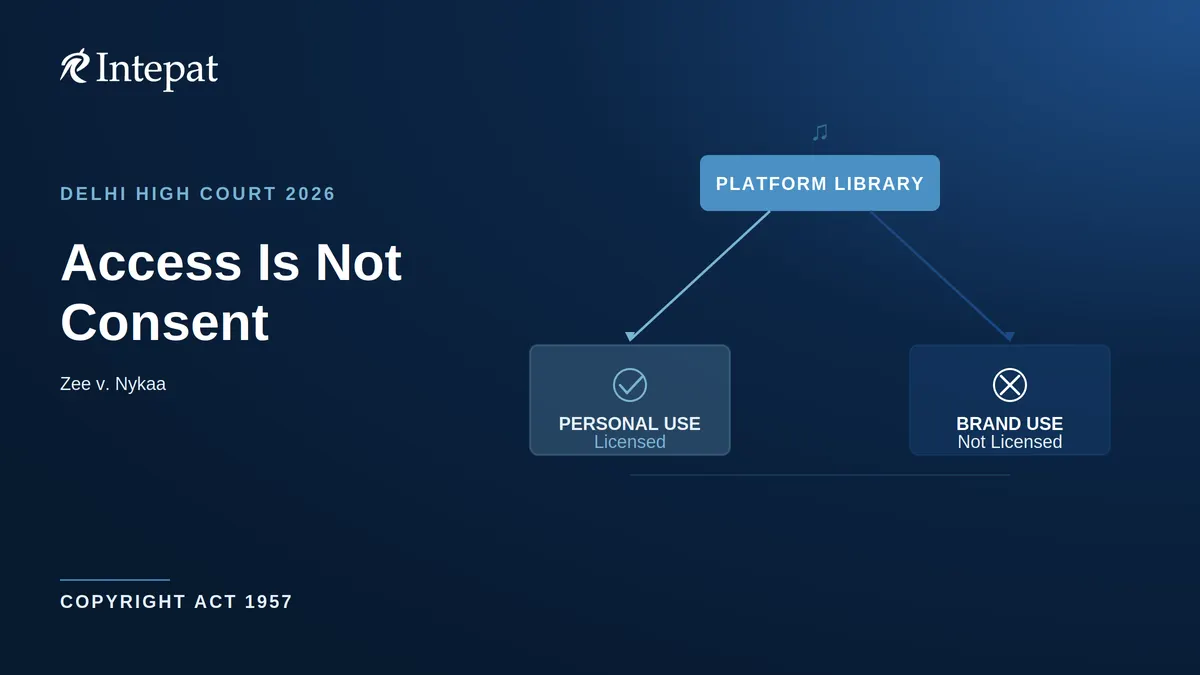
The scope of Meta’s blanket licence is central to this dispute. As stated in Meta’s publicly available music guidelines, the licence covers personal and non-commercial use. It was not negotiated to cover promotional content published by business accounts.
Instagram offers a separate library, the Sound Collection, containing tracks cleared for commercial and advertising use. The existence of that separate library reflects the platform’s own recognition that the personal-use blanket licence does not extend to commercial posts.
This is the gap at the centre of the Zee v. Nykaa case. Nykaa’s Instagram account is a business account used to promote its products. It is not a personal user within the scope of the blanket licence Zee granted to Meta. Using tracks from the in-app library for a product-promotional reel on a brand account is a use for which Zee’s licence to Meta did not provide authority.
Direct Infringement: The Section 51 Framework
Under Section 51 of the Copyright Act 1957, copyright is infringed when a person, without the licence of the owner, does anything that is the exclusive right of the owner to do or authorise. For a sound recording, this includes communicating it to the public (Section 14(e)(iii)).
Section 51(a)(ii) extends infringement liability to a person who, without licence and for profit, permits a place to be used for the communication of an infringing work to the public, unless that person was not aware and had no reasonable ground for believing that the communication would be an infringement. Whether an Instagram profile qualifies as a “place” under this provision is an open question in Indian courts. The primary infringement claim against Nykaa, however, rests more directly on Section 51(a)(i): that Nykaa itself communicated the copyrighted sound recordings to the public without the licence of the rights holder.
Nykaa has raised two defences in the proceedings: first, that it used songs from Meta’s licensed library and therefore had the platform’s permission; and second, that Meta, as the intermediary, should bear responsibility. Neither defence is straightforward under Indian law.
The Intermediary Question: Where Meta Fits
Nykaa applied to the Delhi High Court to implead Meta as a party to the proceedings, arguing that only Meta can confirm whether the specific clips exceeded the scope of its licence with Zee. This application was pending as at July 2026.
The intermediary liability framework relevant here operates across two statutes. Section 79 of the Information Technology Act 2000 provides a conditional safe harbour to intermediaries: a network service provider is not liable for third-party content it stores or transmits, provided it observes due diligence, does not conspire or abet, and acts on actual knowledge to remove infringing content. The safe harbour is not blanket immunity; it is conditional on the intermediary not having actual knowledge of the specific infringing act.
The Delhi High Court addressed this framework in MySpace Inc. v. Super Cassettes Industries Ltd. (2016), holding that an intermediary acting as a pure conduit is not liable until it has actual knowledge of specific infringing content, at which point the obligation to remove arises. Meta’s position in the Zee v. Nykaa proceeding is likely to track this logic: Meta provided the platform and the licensed library; it did not direct or review Nykaa’s specific content decisions.
Section 52(1)(b) of the Copyright Act 1957 reinforces this structure: transient or incidental storage in the technical process of electronic transmission or communication to the public is not an infringement, but the person responsible for the storage must refrain from facilitating access within twenty-one days of receiving a written complaint from the copyright owner, or until a court order is received.
The contractual difficulty for Nykaa is structural. Its agreement with Meta is separate from Zee’s agreement with Meta. There is no direct contractual link between the two that would allow Nykaa to borrow Zee’s licensing terms through the platform as though there were a direct licence running from Zee to Nykaa. The platform’s licence explains how the tracks were technically accessible; it does not authorise commercial use that falls outside the scope of what Meta is itself permitted to grant.
When the Brand Is Not the One Posting: Influencer Campaigns
The Nykaa dispute involves a brand using music directly on its own handle. The broader and more common question is what happens when the same track appears on a creator’s personal account as part of a paid collaboration.
The Advertising Standards Council of India (ASCI) Guidelines for Influencer Advertising in Digital Media treat any material connection between a brand and a creator, including payment, free product, discounts, or a commercial relationship, as sufficient to make a post commercial in substance. These guidelines are written for disclosure rather than copyright, but their framing of what constitutes “commercial” use is instructive for licensing purposes too. A personal account that would ordinarily fall within the platform’s non-commercial blanket licence stops qualifying as non-commercial once a paid brand relationship sits behind it.
Under Indian copyright law, a brand’s potential exposure in influencer campaigns extends to secondary liability. Section 51(a)(ii) of the Copyright Act 1957 provides that infringement may arise where a person, for profit, permits a place to be used for the communication of an infringing work to the public, unless the person had no awareness and no reasonable ground for belief that the communication would infringe. A brand that reviews, selects, and approves influencer content before publication may, depending on the facts, be found to have permitted that communication for profit.
The US case Sony Music Entertainment Inc. v. OFRA Cosmetics LLC (S.D.N.Y. 2023) addressed analogous facts: a brand that actively reviewed and reposted influencer content was found to bear secondary infringement liability. Indian courts have not yet decided facts of this kind in a reported case. The Sony Music v. OFRA Cosmetics position is comparative, not binding, but it is consistent with the direction the Section 51(a)(ii) framework points.
What This Means for Music Rights Holders
Rights holders such as Zee Entertainment are treating social media enforcement as an active priority rather than an afterthought. The case illustrates two practical considerations for labels and publishers.
First, platform licensing agreements should specify with precision where personal use ends and commercial use begins. Blanket agreements that describe the permitted use only in general terms leave the enforcement boundary ambiguous and may require litigation to establish it, which is precisely where the Zee v. Nykaa case now sits.
Second, monitoring of catalogue use across short-form video platforms has historically been reactive, triggered by complaint or manual review. Audio fingerprinting tools and brand-account tracking now make proactive detection more feasible. The sooner a specific infringing use is identified and the rights holder notifies the intermediary, the sooner the intermediary’s actual knowledge is established for Section 79 IT Act purposes, reducing the period during which infringing content remains accessible.
Practical Takeaways for Brands and Marketing Teams
Brands and marketing teams that use music in social media content should be aware of several points arising from this dispute.
In-app music libraries on platforms such as Instagram are licensed for personal, non-commercial use. Promotional use by a business account falls outside that scope. Existing content published on brand accounts should be reviewed for music sourced from platform libraries, and any track used for commercial or promotional purposes should be flagged for clearance review.
For campaign content that synchronises a specific track with brand visuals, a sync licence from the composition rights holder and a master licence from the sound recording owner should be obtained independently of the platform’s terms. Instagram’s Sound Collection, which contains tracks cleared for commercial and advertising use, is one lower-risk alternative for standard posts.
Influencer agreements should require creators working on brand-connected content to use only royalty-free or properly cleared tracks. The right to review music selection before content goes live should be reserved in writing. If a dispute arises, both the brand and the creator benefit from documented evidence that music clearance was addressed in the brief and that a specific cleared or royalty-free track was required.
This article explains Indian copyright law as it applies to the Zee v. Nykaa matter, as at July 2026, and is for general information only. It is not legal advice. The case remains pending before the Delhi High Court; the legal position may change as proceedings develop. For advice on your specific licensing position or dispute, consult a qualified IP practitioner.
Written by Vaishnavi, Intern @ Intepat IP