




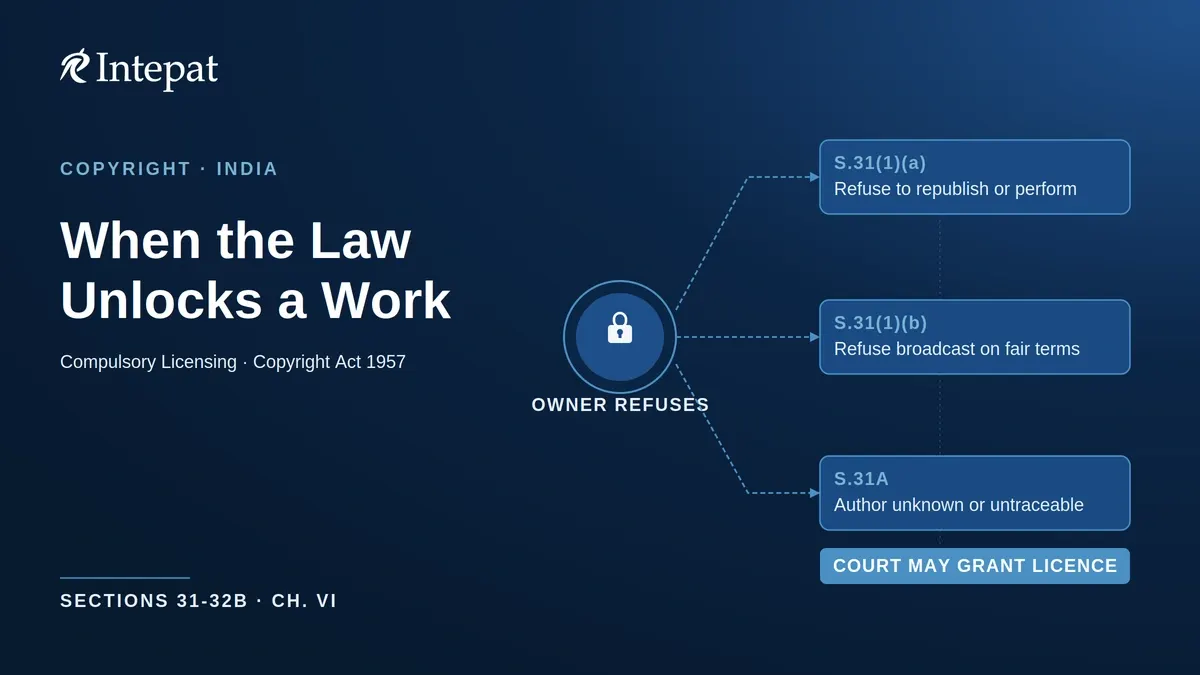
When a copyright owner refuses to republish a work, allow its public performance, or grant broadcast access on terms the applicant considers reasonable, Indian law allows any person to apply for a compulsory licence under the Copyright Act 1957. The Commercial Court may then direct the Registrar of Copyrights to grant the licence, with compensation paid to the owner, provided it is satisfied after inquiry that the owner’s refusal is not reasonable.
What is a compulsory copyright licence in India?
A compulsory copyright licence is a court-directed authorisation allowing use of a copyrighted work without the owner’s voluntary consent, granted where statutory conditions are met and compensation or royalty is payable to the owner.
Key points
- A compulsory licence is available under the Copyright Act 1957 when a copyright owner refuses to republish a work, allow its public performance, or grant broadcast rights on terms the applicant considers reasonable.
- Applications are now filed before the Commercial Court, following the 2021 tribunal reforms.
- Additional provisions cover works whose author is dead or untraceable, works needed by persons operating on a commercial or business basis for persons with disabilities, cover-version sound recordings, and broadcasting of published literary and musical works.
- The Supreme Court confirmed in 2008 that imposing unreasonable licence terms can itself constitute a refusal.
This article explains how voluntary and compulsory licensing differ, which provisions of the Act apply to each situation, and what the Supreme Court’s judgment in the Radio Mirchi case says about the limits of an owner’s right to refuse.
| Voluntary licence | Compulsory licence | Statutory licence | |
| Who initiates | Copyright owner, by agreement | Any person, by complaint or application to the Commercial Court | Any person who meets the Act’s conditions |
| Owner consent needed | Yes | No; Court directs the Registrar to grant | No, but prior notice and advance royalty required |
| Compensation | As agreed | Set by the Commercial Court | Royalty rate fixed by the Commercial Court |
| Governing provision | Section 30 | Sections 31, 31A, 31B | Sections 31C, 31D |
Voluntary licensing: the starting point
The owner of a copyright in any existing work, or the prospective owner of copyright in any future work, may grant any interest in the right by a licence in writing. Where the licence relates to a future work, it takes effect only when that work comes into existence.
A licence is different from an assignment. In an assignment, the original owner transfers ownership of the right; the assignee becomes the new owner. In a licence, ownership stays with the copyright owner. The licensee receives permission to use the work within whatever limits the licence agreement specifies, without the risk of an infringement claim.
A licence can therefore be voluntary, where the owner chooses to grant it on agreed terms, or compulsory, where the law steps in because the owner is withholding the work from the public or refusing to grant broadcast access on reasonable terms.
When can compulsory licensing of copyright be granted in India?
A compulsory licence is an authorisation to use a copyrighted work without the prior permission of the owner. The Copyright Act 1957 provides for this in situations where the owner’s refusal to license is causing the public to be denied access to the work, or where the terms being demanded are unreasonable.
Works withheld from the public
Where a published work or a work that has been publicly performed is being kept from the public, any person may complain to the Commercial Court. The ground for complaint is that the copyright owner:
- has refused to republish the work or allow its republication, or to allow its public performance, with the result that the work is withheld from the public; or
- has refused to allow communication of the work to the public by broadcast, on terms the complainant considers reasonable.
The Commercial Court, after giving the owner a reasonable opportunity to be heard and conducting such inquiry as it considers necessary, may, if it is satisfied that the grounds for refusal are not reasonable, direct the Registrar of Copyrights to grant a compulsory licence. The licence may cover republication, public performance, or broadcast, as the case may be, and is subject to payment of compensation and such other conditions as the Commercial Court determines.
Works whose author is unknown or untraceable
Where a work, whether published or unpublished, is being withheld from the public in India and the author is dead, unknown, or cannot be traced, or the copyright owner cannot be found, any person may apply to the Commercial Court for a licence to publish the work or a translation of it in any language.
Before applying, the person must publish a notice of the proposal in at least one daily English-language newspaper with circulation across most of the country. If the translation is into a regional language, a notice in that language’s newspaper is also required. The Commercial Court may then direct the Registrar of Copyrights to grant the licence, subject to royalty and conditions it determines.
Persons with disabilities
Any person working for the benefit of persons with disability on a profit basis or for business may apply to the Commercial Court for a compulsory licence to publish a copyrighted work in a format suitable for those persons. This route applies where the disability-access exception under Section 52(1)(zb) of the Act does not cover the proposed use. The Commercial Court must satisfy itself as to the applicant’s credentials and that the application is made in good faith, and is required to aim to dispose of such applications within two months of receipt.
Statutory licences: a related but distinct category
Alongside compulsory licences, the Copyright (Amendment) Act, 2012 introduced statutory licences for two situations where consistent, predictable access matters more than case-by-case negotiation.
Cover versions. Any person who wants to make a sound recording of a literary, dramatic, or musical work, where that work has already been commercially recorded with the owner’s consent, may do so under a statutory licence. Prior notice must be given, royalties must be paid in advance at the rate fixed by the Commercial Court, and a minimum of 50,000 copies per calendar year is the threshold at which royalties are calculated (the Commercial Court may fix a lower minimum for works in particular languages or dialects). A cover version must also comply with the statutory conditions on medium, labelling, alterations, and records, and may not be made until five calendar years after the end of the year in which the first sound recording of the work was made.
Broadcasting. Any broadcasting organisation that wants to communicate a published literary or musical work or sound recording to the public by broadcast may do so under a statutory licence, on payment of royalties at the rate fixed by the Commercial Court. Separate rates are fixed for radio broadcasting and television broadcasting. The licensing framework under this provision does not affect licences or agreements already in place before the 2012 Amendment.
Translation and reproduction for education
Two further provisions address access to knowledge. A licence to produce and publish a translation of a literary or dramatic work may be applied for after seven years from the work’s first publication. For non-Indian works, a licence for translation into a language in general use in India, for purposes of teaching, scholarship, or research, may be applied for after three years (or one year, if the translation language is not in general use in a developed country).
A separate licence may be sought to reproduce and publish certain literary, scientific, or artistic works for systematic instructional activities after the relevant waiting period, but only where copies of the work are not made available in India, or have not been on sale in India for six months, at a price reasonably related to that normally charged for comparable works. The relevant periods are: three years for natural science, physical science, mathematics, or technology; five years for most other works; and seven years for fiction, poetry, drama, music, or art.
What the Supreme Court said about refusal
The leading case on compulsory licensing under the Copyright Act is Entertainment Network (India) Ltd. v. Super Cassette Industries Ltd. ((2008) 13 SCC 30), decided by the Supreme Court of India on 16 May 2008.
Radio Mirchi (operated by Entertainment Network (India) Ltd.) had been broadcasting sound recordings belonging to T-Series (Super Cassette Industries Ltd.) believing T-Series was part of the Phonographic Performance Ltd. copyright society. When that proved incorrect, Radio Mirchi sought a direct licence; negotiations failed, and it applied to the Copyright Board for a compulsory licence under the broadcast-refusal provision.
The Supreme Court held that a refusal under that provision includes the imposition of terms so unreasonable that taking a licence on them is commercially not possible. In the broadcast context, the Court also held that a compulsory licence is not limited to a single broadcaster; restricting the provision to one licence would create a monopoly that the provision exists to prevent. The matter was referred back to the Copyright Board for fresh inquiry and a reasoned order.
The case established that a copyright owner cannot defeat the purpose of the provision by demanding commercially impossible conditions. The mere offer of a licence does not close the door to a compulsory licence application if the terms being offered are unreasonable.
Forum: the Commercial Court
Compulsory and statutory licence applications under Chapter VI of the Copyright Act are now heard by the Commercial Court. This follows the 2021 tribunal reforms, which substituted the Commercial Court for the earlier Appellate Board and Copyright Board references in the licensing provisions, effective April 2021. The full text of Chapter VI of the Copyright Act 1957, which contains all the licensing provisions discussed here, is published by the Copyright Office at copyright.gov.in.
How compulsory licensing fits into the copyright framework
Copyright law grants an exclusive right to allow the creator to benefit from their work. Compulsory licensing does not remove that right. It makes the work available where the owner’s exercise of the right is keeping a published work from the public or denying broadcast access on fair terms, while preserving the owner’s entitlement to compensation. The royalty or compensation is determined by the Commercial Court, not fixed by the applicant.
For publishers, broadcasters, educators, and organisations working with disabled persons, understanding which provision applies to their situation, and whether voluntary negotiation can reach a fair outcome before a formal application becomes necessary, is part of managing copyright in practice. Where negotiations are at an impasse, the compulsory licensing framework provides a structured path forward.
Frequently asked questions
A compulsory licence is an authorisation granted by the Commercial Court under the Copyright Act 1957 that allows a person to republish, publicly perform, or broadcast a copyrighted work without the owner’s prior permission. It is available where the owner has refused access on grounds the Court finds unreasonable after inquiry, and it requires payment of compensation to the owner.
Applications for compulsory licences are decided by the Commercial Court. Before April 2021, these applications were heard by the Copyright Board. Following the 2021 tribunal reforms, the Copyright Board and Appellate Board references in the Copyright Act’s licensing provisions were replaced with the Commercial Court.
Yes, but under a different provision. Where a work is unpublished and the author is dead, unknown, or cannot be traced, or the copyright owner cannot be found, any person may apply to the Commercial Court for a licence to publish the work or a translation of it. The applicant must first publish a notice in an English-language daily newspaper with national circulation.
No. The Supreme Court, in Entertainment Network (India) Ltd. v. Super Cassette Industries Ltd. ((2008) 13 SCC 30), held that imposing unreasonable terms on a licence offer can itself constitute a refusal. A copyright owner cannot prevent a compulsory licence application by making conditions so demanding that a licence on those terms is commercially not workable.
Compulsory licences require a complaint or application to the Commercial Court, which then decides whether the statutory ground is made out. Statutory licences, introduced by the Copyright (Amendment) Act, 2012, operate differently: any person who meets the Act’s conditions (prior notice, advance payment of royalties at the Court-fixed rate) may proceed without the Court first finding that access has been refused. Sections 31C and 31D cover cover-version sound recordings and broadcasting respectively.
In the broadcast context, yes. The Supreme Court confirmed in Entertainment Network (India) Ltd. v. Super Cassette Industries Ltd. ((2008) 13 SCC 30) that in the context of Section 31(1)(b), the Commercial Court may grant compulsory licences to more than one broadcaster for the same work. Restricting the provision to one broadcaster would create a monopoly that the provision exists to prevent.
| This article explains the law on compulsory licensing of copyright in India as at June 2026 and is for general information only. It is not legal advice. For advice on your specific work or dispute, consult a qualified IP practitioner. |