




Expedited patent examination in India is a statutory fast-track mechanism under Rule 24C of the Patents Rules, 2003, allowing eligible applicants to file Form 18A and request priority examination ahead of the standard queue at the Indian Patent Office.
When funding discussions are live, a licensing negotiation is open, or a competitor is moving fast, the time between filing a patent application and receiving examination feedback can be commercially critical. Expedited patent examination under Rule 24C of the Patents Rules is the statutory mechanism available in India to compress that wait. Eligible applicants file Form 18A and the application moves from the standard chronological queue into a separate priority channel at the Indian Patent Office, where the First Examination Report (FER) issues in a fraction of the ordinary time.
The fast-track route is not open to every applicant. Eligibility is restricted to specific categories under Rule 24C, and the request must be supported by the correct declarations and fee on the date of filing. In practice, the most common reason eligible applicants fail to benefit is not an eligibility problem: it is a preparation problem. Applications that reach examination without a resolved publication status, a correctly declared applicant category, or a clearly drafted specification neutralise the time advantage before it begins. This guide sets out the eligibility framework, the filing procedure, and the fee structure. For the underlying examination procedure that governs both routes, see Patent Examination in India: Procedure, Timelines and Key Deadlines (2025).
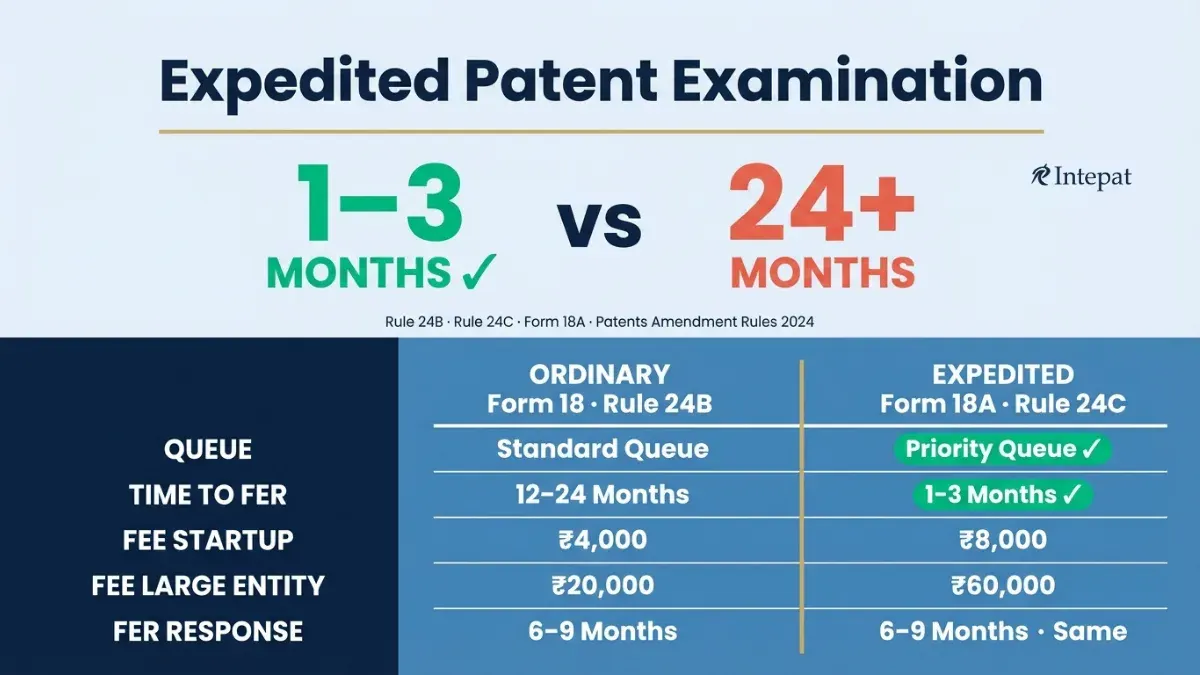
Fees at a Glance: Form 18A and Conversion
The government fee for expedited examination under Rule 24C depends on applicant category. Startup, small entity, and individual applicants qualify for the concessional rate. If a Form 18 (ordinary examination) request has already been filed, conversion to the expedited route is permitted on payment of a differential fee. All fees are payable to the Indian Patent Office at the time of filing. Use the Patent Fee Calculator to estimate total official costs across all prosecution events.
| Applicant Category | Form 18A — New Request (INR) | Conversion from Form 18 (INR) | Ordinary Form 18 (INR) |
| Natural Person / Startup / Small Entity | 8,000 | 4,000 | 4,000 |
| Other than Natural Person / Startup / Small Entity | 60,000 | 40,000 | 20,000 |
All fees are prescribed under the First Schedule to the Patents Rules 2003 for e-filing. Physical filing attracts a higher schedule.
What Is Expedited Patent Examination Under Rule 24C?
Under the standard examination route, once a Request for Examination (Form 18) is filed, the application enters a general queue and is examined in chronological order. Under Rule 24C of the Patents Rules, 2003 (as amended by the Patents (Amendment) Rules, 2024), eligible applicants may instead file Form 18A to request priority examination. The application then enters a separate fast-track channel and an examiner receives it on a priority basis. The First Examination Report (FER) issues earlier, and the applicant enters the substantive prosecution phase sooner.
Ordinary vs. Expedited Examination: Key Dimensions
| Aspect | Ordinary Examination (Form 18) | Expedited Examination (Form 18A) |
| Governing rule | Rule 24B | Rule 24C |
| Request form | Form 18 | Form 18A |
| Queue | Standard chronological queue | Separate priority queue |
| Eligibility | All applicants | Restricted categories only |
| Time to FER (current IPO) | 12 to 24 months or more | 1 to 3 months (priority queue) |
| Patentability standard | Identical | Identical |
| FER response deadline | 6 months (extendable to 9 months) | 6 months (extendable to 9 months) |
| Conversion option | Can convert to Form 18A (fee applies) | Cannot revert to ordinary queue |
How Long Does Expedited Patent Examination Take in India?
The Patents Rules require the Controller to communicate the First Examination Report within approximately one month of receiving the examiner’s report, on both the ordinary and accelerated routes, although in practice this timeline may vary depending on examination workload. The difference between the two routes is not in that statutory clock: it is in how long the application waits before an examiner is assigned. Under the ordinary route, that wait currently runs to 12 months or more depending on queue position and technology area. Under the expedited route, priority assignment means the practical wait is 1 to 3 months in most cases under current Indian Patent Office conditions.
| Stage | Ordinary Route | Expedited Route (Rule 24C) |
| RFE filed to examiner assignment | Months to over a year (queue position dependent) | Priority assigned on Form 18A acceptance |
| Practical RFE-to-FER gap (current IPO) | 12 to 24 months or more | 1 to 3 months |
| FER response window | 6 months (max 9 months with Form 4) | 6 months (max 9 months with Form 4) |
| Overall RFE to grant (indicative) | 3 to 5 years (varies significantly) | 1 to 3 years (varies significantly) |
Timelines reflect current IPO conditions and may vary. Statutory deadlines are fixed.
Who Is Eligible for Expedited Examination in India? (Form 18A)
Expedited patent examination under Rule 24C is a privilege-based mechanism, not a universal right. Form 18A may be filed only by applicants falling within one of the prescribed categories on the date the request is submitted. Eligibility must be supported by the correct declarations: an incorrectly claimed category results in rejection of the fast-track request and loss of priority queue position. The Patent Office does not refund the filing fee on rejection; the applicant must refile under the ordinary Form 18 route and rejoin the standard queue.
Category 1: Startup Applicants
An applicant recognised as a startup under the relevant Government of India notification (issued by DPIIT) may file Form 18A. The DPIIT recognition certificate must be valid on the date of filing; an expired certificate does not satisfy the eligibility requirement. Where startup recognition is pending renewal, the request should be deferred until renewal is confirmed. Startups claiming the concessional fee of INR 8,000 must ensure that the applicant category declared on the form matches the status recorded in the patent application.
Category 2: Small Entity Applicants
Applicants qualifying as a small entity under the Patents Rules may file Form 18A at the concessional fee. A declaration of small entity status must accompany the request. The declaration must reflect the applicant’s status as at the date of filing the request, not the date of original application. If status has changed since filing, the higher fee applies and an incorrect declaration risks invalidating the request.
Category 3: Female Applicants
Where the applicant is a natural person who is female, this route is available. Where the application has multiple applicants, all natural person applicants must satisfy the relevant eligibility condition. Supporting documentation confirming the applicant’s status may be required depending on Patent Office practice at the time of filing.
Category 4: Government Applicants
The following entities are eligible to file under Rule 24C: Government of India; State Government; Government company (as defined under the Companies Act); and institutions wholly or substantially financed by the Government. Applications filed by these entities must reflect the correct legal name and status in the application records.
Category 5: PCT Applicants with India as ISA or IPEA
Applicants who have filed a corresponding PCT application and selected India as the International Searching Authority (ISA) or International Preliminary Examining Authority (IPEA) may file Form 18A on entry into the national phase in India. The PCT application reference and the ISA or IPEA selection must be clearly identified in the request. This category is available regardless of the applicant’s commercial status. For PCT national phase entry requirements, see PCT National Phase Entry in India: 31-Month Deadline and Filing Guide.
Category 6: Bilateral and Special Arrangement Applicants
Applicants eligible under specific bilateral agreements or special arrangements notified by the Government of India may also file the expedited examination request. Eligibility under this category requires confirmation of the applicable arrangement and supporting documentation at the time of filing.
Category 7 — Educational Institutions
Educational institutions established by a Central or State Act are eligible to request expedited examination under Rule 24C. This includes universities and technical institutions constituted under statute. The institution must be named as an applicant in the patent application. A declaration confirming the institution’s statutory basis may be required at the time of filing.
| Practical Note |
| The most common eligibility error at the Indian Patent Office is a mismatch between the applicant category declared on the form and the status recorded in the original application. Where the application was filed under a higher-fee category and the applicant later qualifies as a startup, the application records must be updated before the request is filed. A rejected fast-track request cannot be appealed on eligibility grounds through the priority channel. The applicant must address the deficiency, refile the request with correct documentation, and pay the applicable fee again. |
When Should You Consider the Expedited Route?
The accelerated route is most effective where earlier access to examination feedback has direct commercial value. Accelerating the queue reduces the wait for the First Examination Report; it does not guarantee a grant outcome, shorten the FER response period, or reduce the patentability threshold. The question is whether earlier examination is worth the additional fee and the administrative preparation it requires.
Situations Where the Expedited Route Adds Value
- Investment and funding discussions: Investors treat patent prosecution status as a due diligence factor. An application already in examination, with an FER received and a response filed, is a stronger signal than one sitting in an ordinary queue.
- Licensing and technology transfer: Licensing negotiations often require a clearer picture of claim scope before terms are agreed. An FER identifies objections and shapes the negotiation; earlier examination makes that picture available sooner.
- Competitive market positioning: Where a competitor is actively filing in the same technology space, earlier examination feedback allows the applicant to assess freedom to operate and adjust prosecution strategy before the competitive landscape hardens.
- Product launch and regulatory timelines: In sectors such as pharmaceuticals and medical devices, patent status intersects with regulatory clearance. Earlier examination can align prosecution milestones with commercial ones.
- PCT national phase entrants (ISA or IPEA selection): Applicants in this category are already eligible and have prior art assessed under the international phase. Filing the request on national phase entry is typically low-risk and often strategically justified.
Situations Where the Expedited Route May Not Be Advisable
| Situation | Why the ordinary route may be preferable |
| Specification not finalised | Accelerating examination exposes disclosure gaps without additional preparation time. A poorly drafted application reaches examination faster but is not better positioned for it. |
| Prior art landscape not assessed | The priority route may produce a First Examination Report before the applicant understands how to respond to it. Particularly relevant for first-time filers. |
| No commercial urgency | If no commercial event or deadline drives the timeline, the additional fee for this fast-track route may not produce proportionate benefit. |
Prosecution Readiness Checklist Before Filing Form 18A
The fast-track route delivers the most value when the following conditions are met before filing:
- Claims are clearly drafted and the scope of protection is well-defined
- Prior art has been reasonably evaluated and claim scope is calibrated accordingly
- Complete specification is filed and sufficiency of disclosure has been reviewed
- Publication status is resolved (see Section 4, Step 2 below)
- Applicant category is confirmed and supporting documentation is ready
- The FER response team is identified and can respond promptly once the FER issues
How to File Form 18A Under Rule 24C: Step-by-Step Procedure
From a practical standpoint, this route works smoothly only when timing and documentation are handled correctly. Most delays arise not because the mechanism fails, but because publication status or eligibility declarations are overlooked before filing.
Step 1: Confirm Eligibility and Prepare Documentation
Before anything is filed, the correct applicant category must be confirmed against the eligibility list in Section 2. The category on the date of filing is determinative: if eligibility is incorrectly claimed, the Patent Office rejects the filing and the application reverts to the ordinary queue without a fee refund. Where startup or small entity status is claimed, the DPIIT certificate or entity declaration must be current.
Step 2: Resolve Publication Status
Form 18A cannot be processed unless the publication requirement is satisfied. If the application has already been published (either after the 18-month automatic publication period or through an earlier early publication request), this step is complete. If the application has not yet been published, a request for early publication must be filed simultaneously with the request. Check publication status on the Indian Patent Office InPASS portal before filing.
| WARNING |
| Publication Status Must Be Resolved Before Filing The most common procedural error in expedited examination filings is submitting Form 18A before the publication requirement is resolved. If the application is unpublished, prepare the early publication request alongside the expedited examination filing and submit both together. An expedited request delayed by an unresolved publication requirement loses its priority queue advantage until publication is confirmed. |
Step 3: File Form 18A With Correct Fee and Declarations
Form 18A must be filed with: (a) the correct applicant category declaration; (b) supporting documentation where required (DPIIT certificate, small entity declaration, or PCT application reference); and (c) the prescribed statutory fee as set out in Section 5. The request may be filed at the time of the original patent application or at any point within the examination request period. Earlier filing improves queue positioning within the priority channel. The request is filed on the Indian Patent Office’s online e-filing portal.
Step 4: Placement in the Expedited Queue
Once the request is accepted, the application enters the separate accelerated examination channel. The Controller refers the matter to an examiner on a priority basis. Under Rule 24C, the First Examination Report must issue within one month of the Controller receiving the examiner’s report. The practical wait before examiner assignment is 1 to 3 months under current IPO conditions.
Step 5: Converting from Form 18 to Form 18A
If a Form 18 request for ordinary examination has already been filed, conversion to expedited patent examination is permitted on payment of the conversion fee and filing the Rule 24C request. The applicant must qualify under an eligible category at the time of conversion, and the application must not yet have been taken up for examination under the ordinary route. Once ordinary examination has commenced, conversion is no longer available. The conversion option cannot be reversed: once an application is on the accelerated route, it cannot revert to the ordinary queue.
Step 6: Receiving the FER and Next Steps
The fast-track route brings the First Examination Report forward in time. It does not change what the FER contains, how it is structured, or what the response must cover. The same 9-month response window, the same Section 59 amendment constraints, and the same SER process apply on both routes. For a complete guide to reading and responding to the FER once it issues, see: First Examination Report India: How to Respond (2025).
Fees for Expedited Examination Under Rule 24C
The statutory fees for expedited patent examination are prescribed in the First Schedule to the Patents Rules and are payable at the time of filing the request. The applicant category determines the fee. Paying under an incorrect category risks rejection of the request; fee shortfalls must be rectified before the request is processed.
Form 18A — New Expedited Examination Request
| Applicant Category | Statutory Fee — Form 18A (INR, e-filing) |
| Natural Person | 8,000 |
| Startup (DPIIT-recognised, valid on date of filing) | 8,000 |
| Small Entity | 8,000 |
| Other than Natural Person / Startup / Small Entity | 60,000 |
Conversion from Ordinary to Expedited Examination
| Applicant Category | Conversion Fee — Form 18 to Form 18A (INR) |
| Natural Person / Startup / Small Entity | 4,000 |
| Other than Natural Person / Startup / Small Entity | 40,000 |
| Practical Note |
| The government fee is only one component of the cost of expedited examination. The commercial value of the route depends on whether the time advantage is actually used: an FER that issues in 2 months is no faster than one that issues in 18 months if the applicant’s team is not prepared to respond promptly. Budget for FER response costs at the time of deciding to accelerate examination, not after the FER arrives. |
Expedited Examination in India: Making the Route Work
Expedited patent examination under Rule 24C delivers a real time advantage for eligible applicants with a genuine commercial reason to accelerate. The route fails when preparation does not match the speed it creates: unresolved publication status, mismatched eligibility declarations, or a specification not ready for scrutiny each turn an early FER into an early problem.
File Form 18A when the application is ready for examination, the eligibility category is confirmed, and the prosecution team is in place to respond. For applications already in the ordinary queue, the conversion option remains open as long as eligibility is met and ordinary examination has not yet commenced.
Confirm Form 18A Eligibility
Share your applicant category (startup, small entity, or PCT), current Form 18 status, and the commercial objective driving your timeline.
Get a response within 24 hours. All consultations remain 100% confidential.
LEGAL DISCLAIMER
This post is for informational purposes only and does not constitute legal advice. For advice specific to your situation, consult a registered patent agent. Laws and procedures may change: verify current requirements with the Indian Patent Office (ipindia.gov.in) before acting. The content reflects the Patents Act, 1970 and Patents Rules, 2003 as amended by the Patents (Amendment) Rules, 2024.
Frequently Asked Questions
Form 18 is the request for ordinary examination under Rule 24B, available to all applicants. Form 18A is the request for expedited examination under Rule 24C, restricted to eligible categories including startups, small entities, female inventors, government applicants, qualifying PCT applicants, and educational institutions. Filing Form 18A places the application in a separate priority queue; Form 18 places it in the standard chronological queue. The FER typically issues in 1 to 3 months on the fast-track route, compared to 12 to 24 months or more on the ordinary route under current IPO conditions. For a full comparison of the two examination tracks, see Filing the Request for Examination in India: Deadlines, Consequences and Procedure.
A startup for expedited examination eligibility is an entity recognised by the Department for Promotion of Industry and Internal Trade (DPIIT) under the Startup India scheme. The DPIIT recognition certificate must be valid on the date of filing the request. Startups whose recognition has lapsed do not qualify under this category and must file at the higher fee rate or under another eligible category.
Yes. Conversion to expedited examination is permitted by filing Form 18A and paying the prescribed conversion fee (INR 4,000 for natural persons, startups, and small entities; INR 40,000 for others), provided the applicant qualifies under an eligible category at the time of conversion and ordinary examination has not yet commenced. The converted application enters the priority queue from the date of filing. Conversion cannot be reversed.
No. Expedited patent examination accelerates queue priority, not the legal standard applied to the application. The invention must still satisfy novelty, inventive step, industrial applicability, sufficiency of disclosure, and all other patentability requirements under the Patents Act, 1970. For the full patentability criteria framework, see What Can Be Patented in India: Patentability Criteria Explained.
If Form 18A is rejected (typically because the eligibility claim is not supported or the publication requirement is not satisfied), the applicant must file Form 18 and pay the ordinary examination fee. The filing fee is not refunded. The applicant may refile the request once the eligibility or documentation issue is resolved, subject to paying the full fee again. Priority queue position is calculated from the date the valid Form 18A request is accepted.
Yes, provided the applicant of the divisional application meets one of the eligible categories under Rule 24C at the time of filing the request for the divisional. The eligibility assessment for a divisional is independent of the parent application’s examination route. The publication requirement must also be satisfied for the divisional application separately.