




Disputes over geographical indications in India turn on who is on the register, what the registration covers, and which forum hears the case. Registered proprietors and registered authorised users hold the infringement action, suits go to a District Court or higher, and a registration is challenged by rectification.
This article covers geographical indications (GIs) registered under India’s Geographical Indications of Goods (Registration and Protection) Act, 1999, using GI Registry records and rulings on Darjeeling Tea, Kolhapuri chappals, Tirupathi Laddu, Navara rice and the two rasgulla registrations. Foreign GI systems are outside its scope. For the basics, see the guide to how India’s GI system works.
Quick answer: Check who is on the register first. An infringement or passing-off suit goes to a District Court or higher, a challenge to the registration goes to the Registrar or the High Court, and a public interest petition is the wrong first step. Any claim has to fit the registered goods, the registered area and the way the name is actually used.
Who can sue in disputes over geographical indications
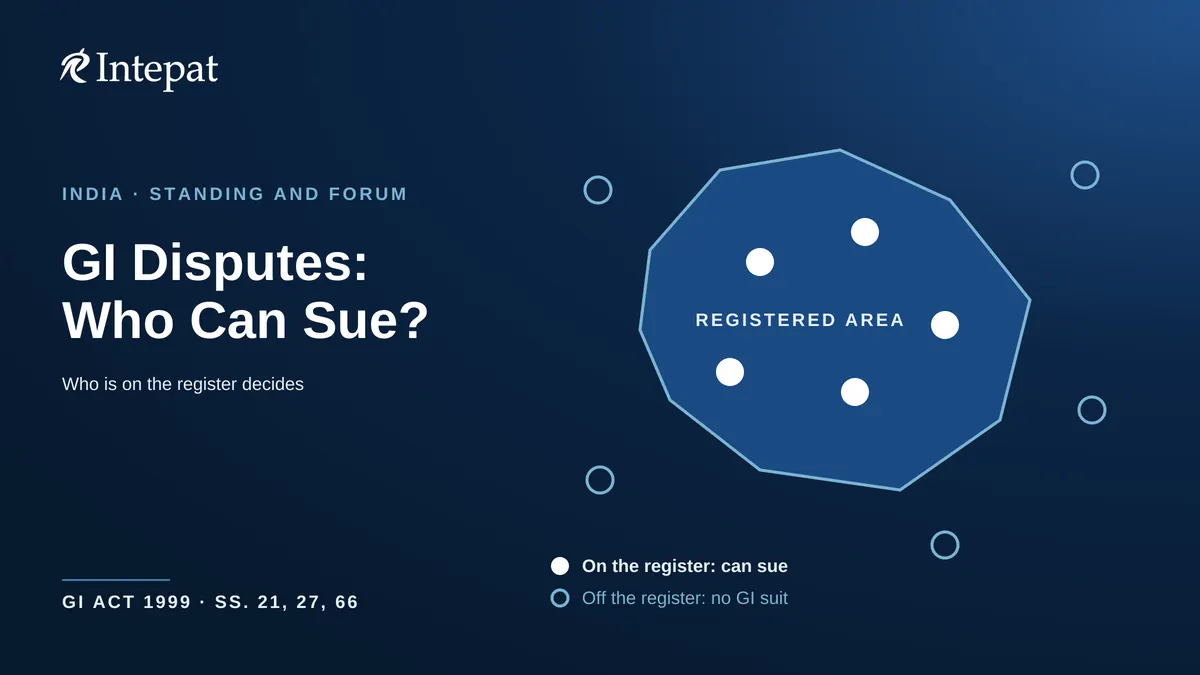
The registered proprietor of a GI and its registered authorised users hold the right to sue for infringement. An unregistered GI cannot support a GI infringement action, although a claim for passing off remains open. Where a case is filed depends on what is being challenged.
| Proceeding | Where it goes | Section of the Act |
| Infringement suit, or passing off over a GI | A District Court or a higher court | 66 |
| Rectification application by a person aggrieved | The Registrar or the High Court | 27 |
| Validity of a registration disputed in an infringement suit | A rectification application to the High Court | 58 |
| Appeal from a Registrar’s order | The High Court, within three months of the order being communicated | 31 |
The Tribunals Reforms Act 2021 abolished the Intellectual Property Appellate Board, and its GI functions passed to the High Courts and the Registrar. The Delhi High Court’s public notice of 7 July 2021 sets out how its IP Division now takes rectification applications and appeals; other High Courts follow their own rules.
A producer of the goods can apply to be registered as an authorised user, and the Act gives authorised users both the right to relief and the exclusive right to use the indication. Under the fee schedule notified on 3 November 2025 (G.S.R. 812(E)), registering an authorised user costs Rs 10 and renewing one costs Rs 10. Applying for a GI costs Rs 1,000 for one class, and renewing the registration costs Rs 500.
Darjeeling Lounge: a GI protects goods, not a place name on services
A GI protects the goods named in its registration, not every use of the place name. In Tea Board v ITC, the Calcutta High Court refused to stop a five-star hotel calling its lounge the Darjeeling Lounge, holding that the claim was out of time, fell outside a goods-only GI, and lacked evidence of confusion.
Darjeeling Tea holds certificate number 1 on the GI Registry, dated 29 October 2004, in the name of the Tea Board. At the end of September 2010 the Tea Board sued ITC Limited (the judgment records both 30 September and 1 October 2010) over the lounge at its ITC Sonar hotel in Kolkata, which had operated under that name since 1 January 2003. Justice Sahidullah Munshi dismissed the suit on 4 February 2019 in a judgment of the Calcutta High Court, more than eight years after it was filed, with costs of Rs 1,00,000, which the court directed to the High Court Legal Aid Services Committee.
The judgment rests on four grounds. First, the lounge opened before the GI Act took effect in September 2003, and the court held that the Act’s saving for a trade mark used in good faith before the Act applied. Second, the Act bars an action against the use or registration of a trade mark five years after the conflict became known to the registered proprietor, or, if earlier, five years after the mark was registered where it had been published, unless the GI was used or registered in bad faith; the Tea Board’s own plaint put its knowledge at April 2005, more than five years before it sued. Third, the Tea Board’s certification trade mark was registered under the older 1958 law, which covered goods only, and its right was to certify tea as Darjeeling Tea; the GI Act itself extends to goods, so lounge services fell outside it. Fourth, no evidence of confusion, passing off or dilution was led, and the court described the guests as high-end customers unlikely to be misled.
The Tea Board appealed. The Division Bench admitted the appeal on 17 September 2019 without interim relief, and on 26 July 2022 dismissed it as not pressed after the Tea Board’s counsel said it did not wish to proceed. The 2019 reasoning therefore stands as a Single Judge’s decision that was not tested on appeal. It did not decide that the name Darjeeling can be used freely on tea, and a claim against a business that does not sell the registered goods will need evidence of confusion or passing off.
Kolhapuri and Prada: infringement was left undecided
The Bombay High Court dismissed a public interest petition against Prada on 16 July 2025 because the registered proprietors could sue and infringement raises disputed questions of fact. It did not decide whether Prada’s sandals infringed the Kolhapuri Chappal GI.
The petition concerned toe-ring sandals said to resemble Kolhapuri chappals. The court noted that the registered proprietors are two state leather corporations, LIDCOM of Maharashtra and LIDKAR of Karnataka, that the Act gives them the right to relief, and that a petition cannot decide the disputed facts an infringement claim raises or take the place of an infringement suit. It left both corporations free to act against Prada in accordance with law.
The GI Registry record for Kolhapuri Chappal shows that the application was filed on 4 May 2009 and registered by certificate number 329 dated 11 December 2018, for handicraft footwear (class 25), valid to 3 May 2029. The GI Journal notice of August 2018 names LIDCOM and LIDKAR as the applicants, with the Central Leather Research Institute as facilitator, and limits the area to Sholapur, Sangli, Kolhapur and Satara in Maharashtra and Dharwad, Belgaum, Bagalkot and Bijapur in Karnataka. The Registry’s details page shows the institute in its applicant field.
The Act defines an indication to include a geographical or figurative representation, not only a name, and it treats unfair competition, including passing off in respect of a registered GI, as infringement. Whether a look-alike sold under a different name infringes therefore depends on the registered indication, how the goods are presented and whether the origin is misrepresented. The Bombay court did not examine these questions, and similarity of the goods is itself a disputed question of fact. The Week reported in December 2025 that Prada and the two corporations had signed a memorandum of understanding for a limited-edition collection, and Prada’s announcement of 27 April 2026 says the collection was launched, developed with LIDCOM and LIDKAR, alongside a three-year training programme for 180 artisans. The announcement does not mention the GI or any proceedings.
A GI also stops at the border. The GI Act extends to India, and rights in Italy or elsewhere depend on the law of each country, so a producer group that wants protection abroad has to pursue it market by market.
Tirupati Laddu: a public interest petition against a GI was dismissed
A registered GI can be attacked on the grounds the Act lists, through rectification. SpicyIP reported that the Madras High Court dismissed a 2009 public interest petition against the Tirupati Laddu GI because that remedy had not been used, and that a rectification petition then failed before the Registry in 2012.
The GI Registry record for Tirupathi Laddu shows it registered to Tirumala Tirupati Devasthanam under certificate number 107, dated 4 September 2009, for food stuffs (class 30) from Andhra Pradesh, valid until 30 March 2028. The petition was filed by J. Mohanraj, the general secretary of a political party, and SpicyIP reported that the court dismissed it on 8 June 2010 because the remedy of rectification had not been exhausted.
A rectification petition was then filed by R.S. Praveen Raj. SpicyIP reported that the Registry dismissed it on 30 July 2012 with costs of Rs 10,000, after proceeding without his appearance. Both reports say the final orders had not been seen, and the orders were not available for this article, so the reasons are not stated.
The reported reasoning is specific to that GI tag dispute: a petition was premature where rectification was open. It does not mean that a court cannot hear a GI matter outside the Act. Since 2021 rectification lies to the Registrar or the High Court. In June 2025 the temple board also reportedly sent legal notices to online sellers using the Tirupati Laddu name, according to The South First; the report describes notices, and no suit is described.
Navara rice: a GI protects the name, not the variety
A GI gives rights over a registered name for goods from a defined area. It does not give ownership of the variety, which is a different right under a different law. Navara rice carries a Kerala GI held by a farmers’ society, while a separate plant variety application over the same rice has drawn an opposition.
Navara Rice was registered on 23 November 2007 to the Navara Rice Farmers Society of Palakkad, Kerala, and the registration runs to 24 November 2034. In a separate proceeding under the Protection of Plant Varieties and Farmers’ Rights Act, 2001, an application filed on 12 December 2013 seeks registration of Golden Yellow Glumed Navara-MNA-1 as a farmers’ variety, and the Director of Research of Kerala Agricultural University opposed it on 27 October 2023. DownToEarth reported in November 2024 that the objectors argue Navara is a traditional variety grown across Kerala, and that a hearing listed for 28 November 2024 was postponed.
The Plant Varieties Registry’s order of 11 February 2025 reserved judgment on the opponent’s applications for more time. Its order of 24 February 2025 extended the time for the opponent’s evidence from 17 January to 6 February 2025 and directed the registry to examine that evidence before taking it on record. The order records that the opponent’s period for a final opposition had lapsed on 16 January 2025 without one being filed. It was a procedural order and did not decide whether the variety should be registered. Later steps in the opposition are not covered here.
Rasgulla: two registrations and a rectification sent back to the Registrar
The rasgulla dispute produced two registrations, each under its own name, and a rectification application against the West Bengal registration was sent back to the Registrar in 2025 and is still being argued. Each registration covers its own name, area and described product.
The Registry issued Banglar Rasogolla to a West Bengal state corporation in November 2017, and Odisha Rasagola to the Odisha Small Industries Corporation and a sweet makers’ association in July 2019. The table sets out the Registry records, verified as of October 2026.
| GI | Certificate number | Certificate date | Area | Registration valid until |
| Navara Rice | 40 | 23 November 2007 | Kerala | 24 November 2034 |
| Banglar Rasogolla | 303 | 14 November 2017 | West Bengal | 17 September 2035 |
| Odisha Rasagola | 345 | 29 July 2019 | Odisha | 22 February 2028 |
On the Banglar Rasogolla registration, a Deputy Registrar’s order of 31 October 2019 treated the rectification application as abandoned. In Ramesh Chandra Sahoo v West Bengal State Food Processing and Horticulture Development Corporation, decided on 5 June 2025, the Madras High Court set that order aside and sent the matter back to the Registrar. The applicant is to proceed on the documents already filed, the contesting respondents may file evidence within two months, and the Registrar is to issue a reasoned order within six months. The court expressed no view on the merits. The Registry record lists an evidence affidavit of 4 August 2025, a letter and order of 27 November 2025 (contents not stated here), and written submissions from the rectification applicants on 17 August 2026 and from the registered proprietor on 24 August 2026. It shows no decision.
A related cross-border dispute, between India and Bangladesh over Tangail sarees, is covered in a separate piece on the Tangail saree GI dispute.
What this means for a producer or a brand
A producer group should register the GI, register its members as authorised users and keep the registration alive, since the Act gives infringement relief to those on the register. A brand should check the registered goods and area before using a place name.
Record the date a conflicting trade mark first became known, and check the time limit for acting against it early. Challenge a registration by rectification, and avoid a public interest petition where the Act already offers a remedy. Where a place name is also a brand, check whether trademark protection is the stronger tool; the guide to GI and trademark protection for Ayurvedic products shows how the two work together.
Before sending a notice, check three things: whether the other side uses the registered name or only a look, whether the goods are the registered goods, and whether the claimant is the registered proprietor or an authorised user. This article explains the position in India as at October 2026 and is for general information only. It is not legal advice. Laws, fees, and procedures change; verify the current position before you act. For advice on your specific matter, consult a qualified IP professional.