




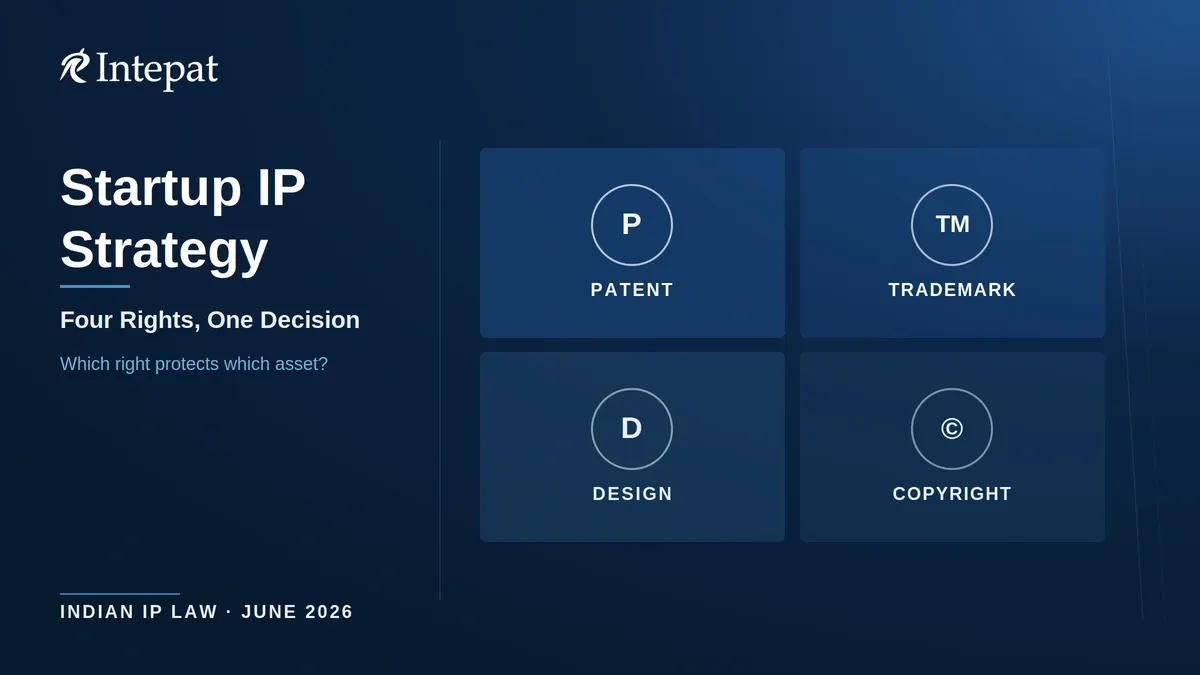
Startups in India can protect their intangible assets through four main IP rights: patents for inventions, trademarks for brand identifiers, industrial designs for product appearance, and copyright for creative works. Each right arises from a distinct statute, carries different requirements, and is enforced through separate proceedings. Knowing which right applies to what you have built is the first practical step.
This article covers the Indian legal framework only: the Patents Act 1970, the Trade Marks Act 1999, the Designs Act 2000, and the Copyright Act 1957.
The table below maps common startup assets to the right that best fits each one.
| Startup asset | Best-fit IP right | File before public disclosure? | Registration required? |
| Technical invention (device, process, architecture) | Patent | Yes | Yes |
| Brand name, logo, tagline | Trademark | Clearance search before use | Strongly advisable |
| Product shape, packaging look, UI applied to article | Industrial design | Yes | Yes |
| Source code, UI artwork, website copy, manuals | Copyright | No; right arises on creation | No |
| Confidential process, algorithm, know-how kept secret | Contract and confidentiality obligations | Keep confidential; no statutory registration | No statutory registration |
Quick Answer
- Patents Patents protect inventions that are novel, involve an inventive step, and are capable of industrial application. Registration is mandatory; there is no unregistered patent right in India.
- Trademarks Trademarks protect brand identifiers (names, logos, slogans). Registration gives the owner the exclusive statutory right to use the mark for the registered goods or services.
- Industrial designs Industrial designs protect the visual appearance of a product. Protection lasts 10 years from registration, extendable by 5 years.
- Copyright Copyright subsists automatically on creation in original literary, dramatic, musical, and artistic works. Registration strengthens enforcement but is not required for rights to arise.
- SIPP SIPP was a DPIIT scheme that covered facilitator fees for eligible startups filing patents, trademarks, and designs. The scheme ran until 31 March 2026. Verify current status with DPIIT before relying on it for a new filing.
Why IP Rights Matter Before Your First External Pitch
Before a startup reaches its first institutional investor, competitor analysis, or licensing conversation, its IP position is already set in a few practical ways. A non-confidential public disclosure of an invention before a patent application is filed will ordinarily destroy novelty in India; the Patents Act 1970 has narrow exceptions (such as disclosures at notified exhibitions under Section 31 and certain involuntary disclosures under Section 29), but these are conditioned and procedural, not a general grace period. A brand name used by a third party before your application date can become grounds for an opposition to your trademark registration. A product design shown publicly without a design application on record may not be registrable. These are not procedural formalities; they are substantive consequences that flow directly from the applicable statutes.
The practical implication is straightforward: IP decisions need to happen before disclosure, not after. This section explains what each right covers and when the clock starts running.
Patents: What Qualifies and What Does Not
A patent in India protects an invention that satisfies three criteria under the Patents Act 1970. The invention must be novel, meaning it has not been disclosed to the public before the filing date. It must involve an inventive step, meaning it is not obvious to a person skilled in the relevant field, having regard to the state of the art. And it must be capable of industrial application, meaning it can be made or used in some industry.
Equally important for startups working in software and business methods is what does not qualify. Computer programmes as such, business methods, mathematical methods, and abstract algorithms are excluded from patentability under the Patents Act. Whether a specific software-implemented invention clears this exclusion depends on whether the claimed subject matter demonstrates a technical contribution beyond a programme or method as such, assessed by the Controller case by case. Examples that may qualify: a device mechanism, a manufacturing process, a novel signal-processing architecture. Examples that typically do not: a pure recommendation algorithm, a mathematical scoring formula, a business workflow.
Filing a patent application in India before any non-confidential public disclosure, investor presentation, or conference demonstration is the safest position. A non-confidential disclosure makes the invention part of the state of the art. An investor pitch shared under a signed non-disclosure agreement may not amount to publication in the same way, but relying on that depends on the terms of the agreement and the circumstances; it is not a statutory safe harbour. Once the subject matter enters the public domain without protection from a statutory exception (such as the notified-exhibition route under Section 31 of the Patents Act, which is conditioned and procedural), the novelty requirement cannot ordinarily be met.
Not every invention warrants a patent. Where the commercial window is short, the cost of prosecution would exceed the return, or keeping the technology confidential is operationally feasible, a defensive publication is worth considering. A defensive publication puts the invention into the prior art, preventing any third party from later patenting it, without requiring the startup to prosecute or maintain a patent.
Trademarks: What Registration Actually Gives You
A trademark is any mark that can be represented graphically and that distinguishes the goods or services of one person from those of others. Under Section 28 of the Trade Marks Act 1999, registration gives the proprietor, if the registration is valid and subject to the other provisions of the Act and any conditions or limitations on the registration, the exclusive right to use the mark for the registered goods or services and to seek relief for infringement. That right is also subject to the prior-user protections in Section 34, which preserve continuous use by a person who adopted the mark before the registered proprietor’s own use, or before the date of that registration, whichever is the earlier. An unregistered mark can be protected through the common law action of passing off, but passing off requires proof of goodwill and reputation built through prior use, which an early-stage startup will not have accumulated.
Registration also provides a public record. A registered mark appears in the Trade Marks Registry’s database, which reduces the probability of a third party unknowingly adopting a similar mark and complicates bad-faith registration of confusingly similar names. A company name, domain name, app-store listing, or social media handle is not a substitute for trademark clearance or registration; each secures a different kind of right through a different mechanism.
The critical preliminary step is a trademark clearance search before filing and, more practically, before choosing the brand name. A search identifies whether any earlier mark, whether already registered or pending registration, is identical or confusingly similar to the mark proposed for the same or similar goods or services. The Registrar’s examiner will conduct this same search before accepting an application, so a pre-filing search surfaces the same conflicts at a stage where corrective action (adjusting the mark or the class specification) is still straightforward. Examples of marks startups commonly register: app name, SaaS platform name, logo device, product tagline.
For a startup that already trades under a brand and is considering trademark registration, the same search logic applies. What types of marks can be registered, what cannot, and how the examination process works are covered in separate articles linked above.
Industrial Designs: Protecting What a Product Looks Like
An industrial design protects the visual appearance of a product: its shape, configuration, pattern, ornament, or composition of lines or colours as applied to an article. The Designs Act 2000 requires a design to be new or original and to be judged solely by the eye. A design that is purely functional, that is, one that exists only to serve a technical purpose with no element of visual appeal independent of function, is not registrable.
Registration is essential: the Designs Act confers no protection on an unregistered design. Once registered, the proprietor has copyright in the design for 10 years from the date of registration. This term can be extended for a further 5 years on application before expiry.
The timing rule is strict. A design that has been disclosed to the public before the application date loses its novelty. For a product startup, this means design applications should be filed before market launch, before product images are published, and before any public exhibition. Public product images, marketplace listings, crowdfunding pages, and social media posts showing the article can create serious registrability risk.
Two statutory qualifications exist. First, under Section 16 of the Designs Act, a confidential disclosure by the proprietor to a manufacturer or designer, made in circumstances that would make further disclosure by the recipient a breach of good faith, does not by itself amount to publication. Second, under Section 21, a design exhibited at an industrial or other exhibition to which the Central Government has extended the section’s provisions by notification in the Official Gazette is not invalidated, provided the proprietor gave prior notice to the Controller in Form 9 and applied for registration within six months of the exhibition opening. Neither of these is a general grace period; both are conditioned and procedural. The industrial design registration process in India covers the procedural steps in detail. Examples of designs startups commonly register: wearable device casing, packaging contour, app icon shape applied to a physical article.
One interaction worth noting: copyright in an artistic work, such as a logo or an original graphic element, and a registered design covering that element on a product are separate rights. If a design is registered under the Designs Act, the corresponding copyright under the Copyright Act does not extend to that registered design. The lines are carefully drawn in the statutes and require separate consideration when a single product element is capable of both copyright and design protection.
Copyright: Automatic, but Worth Registering
Copyright is the one major IP right that arises without any registration. Under the Copyright Act 1957, copyright subsists automatically in original literary, dramatic, musical, and artistic works from the moment of creation. This means that source code, UI artwork, icons, website copy, marketing text, product manuals, and original documentation may attract copyright protection as soon as they are created, without any filing. Raw data and facts are not protected merely because they are valuable or voluminous; a dataset may attract protection only where there is sufficient original selection, arrangement, annotation, labelling, or taxonomy, and that requires separate assessment.
The practical limitation is evidentiary: proving that you created a work first, and when you created it, becomes significantly easier if the work is registered. The Copyright Act provides for voluntary registration through the Copyright Office, and a copyright certificate functions as prima facie evidence (initial proof of ownership in any legal proceeding) of ownership in any dispute. For a startup with significant original software, design assets, or published content, registration is a prudent step.
A foundational principle of copyright law is that it protects only the expression of an idea, not the idea itself. This is not a procedural rule; it is a substantive limit on the scope of the right. A startup cannot use copyright to prevent a competitor from implementing the same concept or building a product that solves the same problem; it can only prevent the competitor from copying the specific code, artwork, or text that expresses that concept. For a fuller explanation of copyright law in India, including the scope of protection and the registration process, see the dedicated article on this site.
Building an IP Strategy Before You Need One
An IP strategy answers a narrower question than it might appear: for each valuable asset in your business, which right applies, when must you act to preserve it, and is the cost of protection proportionate to the commercial value at risk?
Some assets will not warrant protection. An invention with a short market window and low replication cost by a competitor may not justify patent prosecution, which involves filing fees, examination, and ongoing renewal fees. The alternative, a defensive publication, costs significantly less and still prevents the competitor from patenting the same technology.
Some assets carry multiple overlapping rights. A product with a distinctive shape may attract both a registered industrial design and, if the shape also functions as a brand identifier in the market, a three-dimensional trademark. These are separate applications with separate criteria and separate registration processes.
Some assets require pre-disclosure action. Any patent application must be filed before public disclosure. Any design application should be filed before market launch. Trademark clearance should be completed before the name is used publicly. Copyright arises automatically, but registration is best done while the authorship trail is fresh.
The first practical action is a review of what the business has already created and what it is about to disclose or launch, mapped against the four IP categories and their respective timing requirements.
The SIPP Scheme: Background and Current Status
The Scheme for Facilitating Startups Intellectual Property Protection (SIPP) was a DPIIT-administered scheme (DPIIT: the Department for Promotion of Industry and Internal Trade, the Indian government department that administers startup policy and IP schemes) under which eligible startups could access the services of empanelled IP facilitators at no professional charge. The facilitator’s fees were paid by the government through the office of the Controller General of Patents, Designs and Trade Marks (CGPDTM). The startup itself paid only the statutory filing fees, which attracted concessional rates available to startups under the Patents Rules and the Trade Marks Rules.
The scheme covered patents, trademarks, and designs; copyright registration, handled through a separate Copyright Office process, was not included.
| Current status (as at June 2026): The most recent notified version of SIPP ran for three years from 1 April 2023 and ended on 31 March 2026. As of June 2026, no official announcement of an extension or replacement had been made. Startups should verify the current status of the scheme directly with DPIIT or the IP India office before relying on SIPP benefits for a new filing. Applications already initiated under the scheme before 31 March 2026 were expected to proceed through empanelled facilitators subject to government reimbursement rules; applicants in that position should confirm their specific case status with their facilitator. |
The full background on SIPP eligibility and how startups availed the scheme is covered in a dedicated article on this site.
Make Sure the Startup Actually Owns the IP
Before filing any IP application, confirm that the IP is owned by the startup entity, not solely by a founder, freelancer, developer, designer, or outside consultant. Under Section 17 of the Copyright Act 1957, copyright in a work made by an author in the course of their employment under a contract of service or apprenticeship vests in the employer, but this does not automatically extend to work done by independent contractors. For patents, an invention belongs to the inventor unless rights have been assigned in writing. For trademarks and designs, the applicant must be entitled to apply.
This means that founder assignment deeds, employment agreements with IP assignment and confidentiality clauses, and contractor agreements that explicitly assign all IP created during an engagement are as important as the filings themselves. Investors conducting due diligence for funding or acquisition will look for a clean, documented ownership chain. Gaps discovered at that stage are difficult and sometimes impossible to remedy retrospectively.
Before You File: Five Decisions That Determine Your Position
IP rights do not operate independently; they interact, and a decision on one can affect your position on another. Before filing anything, these five questions frame the practical analysis:
- Is this asset publicly disclosed? If yes, patent and design options are narrowed and may be foreclosed.
- Is the invention within patentable subject matter? Software-related inventions require careful claim-framing under the Patents Act.
- Has the trade mark been cleared? An unchecked name may conflict with an earlier registered mark in the same class.
- Is the design new and not functional-only? A purely functional shape does not qualify under the Designs Act.
- Is the authorship trail documented? For copyright, the evidence of who created what and when matters as much as the creation itself.
These questions are not a legal formality checklist; they are the decisions on which subsequent filings, licensing terms, and enforcement positions depend.
Frequently Asked Questions
What are the main types of intellectual property rights available to startups in India?
Startups in India can protect their assets under four main statutes: the Patents Act 1970 (inventions), the Trade Marks Act 1999 (brand identifiers such as names and logos), the Designs Act 2000 (the visual appearance of a product), and the Copyright Act 1957 (original literary, artistic, dramatic, and musical works, including software). Each right has distinct registration requirements and protection periods.
Do I need to register copyright in India for it to be protected?
Copyright subsists automatically in an original work at the moment of creation under the Copyright Act 1957, without any requirement for registration. However, registering a copyright provides a certificate that functions as prima facie evidence of ownership and creation date, which substantially simplifies enforcement in a dispute. Registration is voluntary but advisable for commercially significant creative assets.
When is the right time to file a patent application for a startup invention?
The patent application should be filed before any public disclosure of the invention. Under the Patents Act 1970, novelty is assessed as of the filing date, and any prior disclosure by the applicant, including a presentation, a published paper, or a product demonstration, can destroy novelty and make the invention unpatentable. An inventor who needs to disclose before filing should seek legal advice on provisional filing strategy.
What did the SIPP scheme provide to startups, and is it still available?
The Scheme for Facilitating Startups Intellectual Property Protection (SIPP) allowed DPIIT-recognised startups to use government-empanelled IP facilitators at no professional charge. The startup paid only statutory filing fees at concessional rates. The scheme covered patents, trademarks, and industrial designs. It ran from 1 April 2023 and ended 31 March 2026. As of June 2026, no extension had been announced; verify the current position with DPIIT before relying on scheme benefits.
Is an unregistered trademark protected in India?
An unregistered trademark can be protected through the common law action of passing off, which requires proving existing goodwill in the mark, misrepresentation by the defendant, and resulting damage. Registration under the Trade Marks Act 1999 gives the owner the statutory right to sue for infringement without proving goodwill, a significantly stronger position for an early-stage startup that has not yet built documented reputation.
What should a startup protect first: patent, trademark, copyright, or design?
The sequence depends on disclosure timing. Trademark clearance should happen before the brand name is used publicly. A patent application should be filed before any non-confidential disclosure. A design application should be filed before product images are published or the article launches. Copyright arises automatically, so registration can follow creation. Most early-stage startups should prioritise trademark clearance and, where relevant, a provisional patent application before their first public launch.
This article explains Indian intellectual property law as at June 2026 and is for general information only. It is not legal advice. Laws, rules, fees, and procedures change over time. For advice on your specific assets, consult a qualified IP practitioner.