




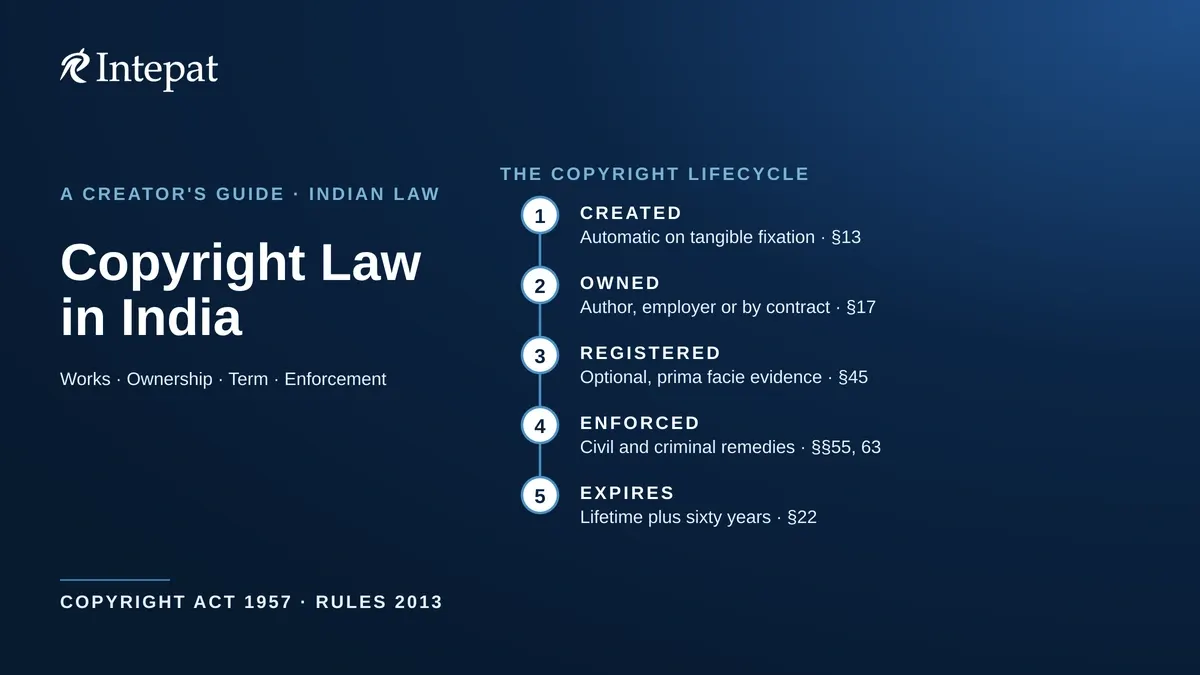
Copyright Law in India protects original literary, dramatic, musical, and artistic works, along with cinematograph films and sound recordings, under the Copyright Act 1957. Protection arises automatically the moment a work is created in tangible form. Registration is optional, but it provides prima facie evidence of ownership and strengthens enforcement.
This guide is written for creators and small-business owners (authors, musicians, designers, photographers, software founders, and content creators) who want to understand what the law actually protects, who owns the rights, how long protection lasts, and what to do when someone copies their work. References are to the Copyright Act 1957 and the Copyright Rules 2013, as currently in force in India.
| Quick answer: copyright in India in sixty seconds |
| Copyright protects the expression of an idea once fixed in tangible form, not the idea itself. |
| Protection is automatic on creation. No symbol, no registration, and no notice are required. |
| The author is usually the first owner, but employment, commissioning, and contracts can change this. Read what you sign. |
| Term for literary, dramatic, musical, and artistic works is the author’s lifetime plus sixty years. Films and sound recordings get sixty years from first publication. |
| Registration is optional but provides prima facie evidence and is often worth doing for commercially valuable works. |
| Enforcement options include platform takedowns, civil suits, customs action against imports, and criminal complaints in commercial-scale cases. |
What does Indian copyright actually protect?
Section 13(1) of the Copyright Act 1957 sets out three categories of works in which copyright can subsist: original literary, dramatic, musical, and artistic works; cinematograph films; and sound recordings. Copyright is one of four IP regimes available in India. If you are not sure whether copyright, trademark, design, or patent is the right protection for your work, our guide on the difference between trademarks, copyrights, and patents explains where each applies.
Two ideas need unpacking. First, “original” does not mean novel or unique in any cosmic sense. Indian courts have interpreted originality to require a minimum degree of skill, labour, and judgement on the author’s part, not absolute novelty. A travel diary, a song recorded on a phone, a logo sketched on paper: all qualify if they are the author’s own work and not copied from somewhere else. The threshold is real but not high.
Second, copyright protects the expression of an idea, not the idea itself. A storyline outline shared at a coffee meeting carries no copyright. The novel written from that outline does. This idea-expression dichotomy is settled judicial doctrine in India, and it is the single most common source of confusion among creators who feel their concept has been “stolen.” The legal recourse exists only once the idea has been fixed in tangible form.
The definitions in Section 2 expand the scope of each category. “Literary work” includes computer programmes, tables, and compilations including computer databases (Section 2(o)). “Artistic work” covers paintings, sculptures, drawings (including diagrams, maps, charts), engravings, photographs, works of architecture, and other works of artistic craftsmanship, whether or not they possess artistic quality (Section 2(c)). The qualifier “whether or not they possess artistic quality” is deliberate: the Act does not ask whether a work is good art, only whether it falls within a recognised category.
Some works fall outside copyright entirely. Under Section 15(1), copyright does not subsist under the Copyright Act in a design that is registered under the Designs Act, 2000. Where a design is capable of registration under the Designs Act but is not registered, Section 15(2) provides that copyright in it ceases once the underlying article has been reproduced more than fifty times by an industrial process. A product designer therefore cannot rely on copyright alone for a mass-produced design; design registration is the right route for that category.
Who owns the copyright in your work?
The default rule under Section 17 is that the author of a work is its first owner. The Act then carves out exceptions that matter in commercial practice.
Where a work is made in the course of an author’s employment under a contract of service or apprenticeship, the employer is, in the absence of an agreement to the contrary, the first owner (Section 17(c)). A separate carve-out applies to journalists: where a literary, dramatic, or artistic work is made by the author in the course of employment with a newspaper or magazine for the purpose of publication there, the proprietor is the first owner in relation to that publication, with the author retaining rights for other uses (Section 17(a)).
The distinction between a “contract of service” (employment) and a “contract for service” (independent commissioned work) is not decided by the label used in the agreement. Indian courts examine the substance of the engagement: control over the manner of work, integration into the engager’s business, ownership of tools, who bears the financial risk, and similar factors. A freelancer engaged for a single project usually retains ownership unless the contract expressly transfers it.
Section 17(b) covers a narrower set of commissioned works: photographs, paintings, portraits, engravings, and cinematograph films made for valuable consideration at the instance of a person. In those cases, the commissioning person is the first owner unless the contract says otherwise. A photographer commissioned to shoot a wedding therefore does not own the photographs by default; the family that engaged them does. A typical commissioned logo or graphic-design output, by contrast, will not automatically transfer to the client merely because the client paid for it, unless it falls within one of the specific Section 17(b) categories (a hand-painted artwork, for example) or the engagement contract expressly assigns ownership.
Joint authorship is treated in Section 2(z): a work produced by collaboration of two or more authors in which the contribution of one is not distinct from the contribution of the others. Each joint author holds rights in the whole work, and commercial exploitation generally requires consent of all.
The practical takeaway for a business owner: contracts matter. If your business depends on owning the copyright in work created by employees, freelancers, agencies, or contractors, the engagement contract should state ownership expressly, in writing, signed by both parties. Section 17 sets the default; a contract overrides it.
Before you hire a freelancer or agency
- Agree ownership in writing before work begins. Section 17 sets defaults that may not match commercial intent.
- For commissioned photographs and paintings, the commissioning person owns by default under Section 17(b). For most other work types (including software, illustration, copywriting, and most logo work), the freelancer owns unless the contract says otherwise.
- A valid assignment must identify the work, list the rights transferred, the duration of the transfer, the territory, and any royalty payable (Section 19).
- “All rights, perpetual, worldwide” language is an assignment, not a licence. Use the right word for the intended relationship.
- If duration is silent, the law assumes five years. If territory is silent, India only. Spell both out.
How long does copyright last in India?
Term of protection varies by the type of work. Chapter V of the Act sets out the rules. The table below summarises the position for the categories that matter most to creators.
| Type of work | Term | Source |
| Literary, dramatic, musical, artistic works (published in the author’s lifetime) | Lifetime of the author plus sixty years from the calendar year following the year of the author’s death | Section 22 |
| Cinematograph films | Sixty years from the calendar year following the year of first publication | Section 26 |
| Sound recordings | Sixty years from the calendar year following the year of first publication | Section 27 |
| Anonymous and pseudonymous works | Sixty years from publication (or from death of identified author if identity is disclosed within the term) | Section 23 |
| Posthumous works | Sixty years from the calendar year following first publication | Section 24 |
| Government works | Sixty years from the calendar year following first publication | Section 28 |
For a work of joint authorship in the literary, dramatic, musical, or artistic categories, the sixty-year clock runs from the death of the author who dies last (Section 22, Explanation).
Once the term expires, the work enters the public domain. Anyone is free to reproduce, adapt, or perform it, subject to any moral rights that continue to apply under Section 57, which the author’s legal representatives may exercise.
Should you register your copyright?
Registration is optional. Under Indian law, copyright arises automatically the moment a work is created in tangible form, and Section 45 makes registration permissive (“may,” not “shall”). A work is protected whether or not it sits on the Register of Copyrights.
That said, registration provides three real advantages.
First, evidence. Section 48 makes entries in the Register of Copyrights prima facie evidence of the particulars recorded, and certified extracts are admissible in court without further proof. This is a useful evidentiary advantage in an infringement suit, although it is not conclusive: the presumption is rebuttable on contrary proof.
Second, deterrence. A registration certificate is a tangible document a creator can show to a publisher, a licensee, or a counterparty considering misappropriation.
Third, customs and platform takedowns. Section 53 enables a copyright owner to give the Commissioner of Customs notice to treat infringing imports as prohibited goods. Online platforms accustomed to acting on copyright notices also tend to act faster on properly documented claims.
The copyright registration procedure in India is governed by Rule 70 of the Copyright Rules 2013. The application is filed on Form XIV, one work per application, signed by the applicant. Filing is in person, by post, or online through the Copyright Office portal at copyright.gov.in. The supporting documents depend on the type of work:
| Filing scenario | Key supporting document |
| Literary, dramatic, musical, or artistic work | A copy of the work |
| Unpublished work | Two copies of the work |
| Computer programme (software) | The first ten and last ten pages of source code, or the entire source code if it runs to less than twenty pages, with no blocked-out or redacted portions |
| Artistic work used or capable of use in relation to goods or services | A search certificate from the Trade Marks Registry confirming no identical or deceptively similar trade mark is registered or applied for by a different person |
| Application by an owner who is not the author | A No Objection Certificate from the author |
After filing, the Registrar gives notice to anyone with a claim or interest in the work. If no objection arrives within thirty days and the Registrar is satisfied with the particulars, the entry is made on the Register. Where objections do come in, the Registrar may hold an inquiry. Rule 70(13) makes clear that registration is complete only when a copy of the entries is signed and issued by the Registrar of Copyrights or a Deputy Registrar.
Government fees as specified in the Second Schedule to the Copyright Rules 2013 (verified as of May 2026):
| Work | Government fee per work |
| Literary, dramatic, musical, or artistic work | Rs 500 |
| Artistic work used or capable of use in relation to goods or services | Rs 2,000 |
| Cinematograph film | Rs 5,000 |
| Sound recording | Rs 2,000 |
These are statutory filing fees only; the cost of copyright registration in India varies where professional assistance is engaged.
Fair dealing: when others can use your work without permission
Section 52 carves out a long list of acts that do not amount to infringement. The core category is “fair dealing.” Indian law uses “fair dealing,” a more circumscribed concept than the American “fair use” doctrine, but the underlying purpose is similar: not every unauthorised use of a copyrighted work is an infringement.
Under Section 52(1)(a), fair dealing with any work (other than a computer programme) is permitted for: private or personal use, including research; criticism or review of that work or of any other work; and the reporting of current events and current affairs, including the reporting of a lecture delivered in public.
Other Section 52 carve-outs that creators encounter often include:
- Reproduction of a work in a judicial proceeding or in a report of one (Section 52(1)(d))
- Reading or recitation in public of reasonable extracts from a published literary or dramatic work (Section 52(1)(g))
- Reproduction by a teacher or pupil in the course of instruction, or as part of an examination (Section 52(1)(i))
- Performance of a literary, dramatic, or musical work in the course of activities of an educational institution with a limited audience of staff, students, and connected persons (Section 52(1)(j))
- Making not more than three copies of a book by a non-commercial public library where the book is not available for sale in India (Section 52(1)(o))
“Fair” is not a fixed quantity. Indian courts assess each case on its facts, looking at indicators such as the purpose and character of the use, the nature of the original work, the amount and substantiality of what was taken, and the effect on the potential market for the original. These are judicially relevant factors, not a mechanically applied statutory four-factor test of the kind found in United States fair use law. A creator using a thirty-second clip of a film for genuine critical review stands on stronger ground than one using the same clip as background ambience in a monetised video.
Computer programmes have their own carve-outs in Section 52(1)(aa) through (ad), permitting backup copies, study of functioning to determine the underlying ideas and principles, and adaptation of a legally obtained copy for non-commercial personal use.
What counts as infringement, and the remedies available
Section 51 sets out when copyright is infringed. The two limbs that matter for most creators are:
- A person doing anything that only the copyright owner has the exclusive right to do, without licence (Section 51(a)(i))
- A person, by way of trade, making, selling, distributing, exhibiting in public, or importing infringing copies (Section 51(b))
Both civil and criminal remedies are available, and the two routes are often pursued in parallel.
Civil remedies (Section 55). A copyright owner can sue for an injunction, damages, accounts of profits, and delivery up of infringing copies. Section 62 permits the suit to be filed in a district court within whose jurisdiction the plaintiff actually and voluntarily resides, carries on business, or personally works for gain, a notable departure from ordinary civil procedure. This special forum, however, is not unlimited. In Indian Performing Rights Society Ltd. v. Sanjay Dalia, (2015) 10 SCC 161, the Supreme Court held that where the plaintiff has a principal office and a subordinate office, and the cause of action arose at or near the subordinate office, Section 62 does not allow the plaintiff to drag the defendant to a forum near the principal office. Section 62 provides an additional forum; it does not authorise forum shopping. Where the defendant proves they were not aware and had no reasonable ground for believing that copyright subsisted in the work, the plaintiff cannot recover damages beyond the defendant’s profits on the infringing sales; injunctive relief remains available.
Criminal remedies (Section 63). Knowing infringement of copyright, or abetment of such infringement, is punishable with imprisonment for a term of not less than six months which may extend to three years, and with a fine of not less than fifty thousand rupees which may extend to two lakh rupees. The court may impose a lower sentence only where the infringement was not made for gain in the course of trade or business and adequate and special reasons are recorded in the judgment.
Section 63A applies enhanced penalties for second and subsequent convictions: imprisonment of one to three years and fine of one to two lakh rupees. Section 63B covers the specific case of knowingly using an infringing copy of a computer programme on a computer, with imprisonment from seven days to three years and a fine from fifty thousand to two lakh rupees, and a discretion to impose no jail term where the use was not commercial.
A police officer not below the rank of sub-inspector may seize infringing copies without warrant under Section 64 where satisfied that a Section 63 offence has been, is being, or is likely to be committed.
Two further provisions are worth knowing. Section 65A penalises the circumvention of effective technological measures applied to protect copyrighted works. Section 65B penalises tampering with rights management information. Together, these form India’s anti-circumvention regime and broadly align Indian copyright law with the WIPO Internet Treaties.
If someone copies your work online
- Document the infringement. Screenshots with the URL and date, downloaded copies of the infringing content, and the platform’s reference number for any complaint.
- Send a take-down notice to the platform. Most major platforms (Meta, Google, YouTube, Amazon) have copyright-claim forms.
- A cease-and-desist letter to the infringer, served on a legally identifiable address, often stops ongoing infringement before litigation.
- For substantial commercial infringement, consider a civil suit under Section 55 seeking injunction, damages or accounts of profits, and delivery up. Add a criminal complaint under Section 63 where the infringement is knowing and on a commercial scale.
- Customs action under Section 53 requires a notice to the Commissioner of Customs treating infringing imports as prohibited goods.
Assignment and licensing of copyright
Copyright is freely transferable. The owner can assign the copyright outright under Section 18 or grant a licence permitting specified uses under Section 30. Both transactions have statutory form requirements that creators routinely overlook.
Under Section 19 (see also our guide on the copyright assignment agreement in India), an assignment is valid only if:
- It is in writing and signed by the assignor or a duly authorised agent
- It identifies the work
- It specifies the rights assigned, the duration of the assignment, and its territorial extent
- It specifies the amount of royalty and any other consideration payable
Three default rules fill gaps in poorly drafted assignments. If duration is not stated, the assignment is deemed to last five years from its date (Section 19(5)). If territory is not specified, it is presumed to extend within India only (Section 19(6)). If the assignee does not exercise the rights within one year from the date of assignment, the assignment is deemed to have lapsed in respect of those rights unless the contract specifies otherwise (Section 19(4)).
A licence differs from an assignment in that it permits use without transferring ownership. The same Section 19 framework applies to licences through Section 30A. An exclusive licence (defined in Section 2(j)) confers a right to the exclusion of all other persons, including the copyright owner. A non-exclusive licence leaves the owner free to grant similar rights to others.
For a creator handing work to a publisher, an aggregator, or a platform, the practical advice is short: read what you are signing. A clause granting “all rights, perpetual, worldwide” is an assignment, not a licence. Where the relationship is meant to be limited (publish in India for five years, retain audio rights, retain merchandising rights), the contract must say so expressly.
| Advanced note: film and music creators |
| The Copyright (Amendment) Act, 2012 introduced an important protection for authors of underlying works in cinematograph films and sound recordings. Section 19(9) and Section 19(10) provide that the author of a literary or musical work included in a film, or in a sound recording not forming part of a film, retains the right to claim an equal share of royalties for utilisation of the work in any form other than communication to the public along with the film in a cinema hall. This royalty share cannot be assigned or waived except to the author’s legal heirs or to a copyright society for collection and distribution. Any contrary agreement is void. Lyricists, music composers, and screenwriters should be aware that this protection operates regardless of how a film or recording contract is worded. |
Frequently asked questions
No. The Copyright Act 1957 does not require the display of the © symbol or any other notice. Copyright arises automatically on creation of an original work in tangible form. Using the symbol is good practice for signalling rights, but it is not a legal precondition.
No. Indian copyright protects the expression of an idea once it has been fixed in tangible form, not the idea itself. A pitch, a concept, or an outline carries no copyright until it is written, recorded, drawn, or otherwise expressed. The idea-expression dichotomy is settled judicial doctrine.
Yes. A logo qualifies as an artistic work under Section 2(c) and attracts copyright protection from creation. Where the logo also functions as a brand identifier, trademark registration under the Trade Marks Act 1999 provides separate, complementary protection. A logo used in commerce is therefore typically protected under both regimes.
Yes. A computer programme is a “literary work” under Section 2(o), which expressly includes computer programmes, tables, and compilations including computer databases. Copyright in software protects the source code and object code, not the underlying functionality or ideas. Algorithmic and functional protection, where available, falls under patent law.
For a published literary work, copyright subsists for the author’s lifetime plus sixty years from the calendar year following the year of the author’s death, under Section 22. For a work of joint authorship, the clock runs from the death of the author who dies last.
No. Section 45 makes copyright registration permissive. Protection exists from the moment of creation. Registration provides prima facie evidence under Section 48 and is useful in disputes, but it is not a precondition for protection or for filing an infringement suit.
Several routes can run in parallel: a take-down notice to the platform, a cease-and-desist letter to the infringer, a civil suit under Section 55 for injunction and damages, and where the infringement is wilful and commercial, a criminal complaint under Section 63. The right combination depends on the value at stake and the identity of the infringer.
India is a member of the Berne Convention and the TRIPS Agreement. Member countries recognise Indian works on national-treatment terms, and Indian law extends similar recognition to works of nationals of Convention countries under Section 40 read with the International Copyright Order. Cross-border enforcement, however, requires action in the country where the infringement occurs.
This article reflects the position under the Copyright Act 1957 and the Copyright Rules 2013 as at May 2026, including the Jan Vishwas (Amendment of Provisions) Act, 2026, which decriminalised certain peripheral provisions of the Copyright Act (notably Section 67 on false entries in the Register) without affecting the core infringement, assignment, or registration provisions discussed above. This guide provides general information and is not legal advice. Specific situations require individual assessment. For advice on your particular work, registration, or dispute, consult a qualified intellectual property practitioner. The official Indian copyright portal is at copyright.gov.in and the full statutory text is available at indiacode.nic.in.