




India is considering significant amendments to the Designs Act, 2000. In January 2026, the Department for Promotion of Industry and Internal Trade (DPIIT) released a Concept Note proposing substantive reforms to India’s design protection framework. The stakeholder comment period has now closed, and the proposals are expected to proceed through the legislative review process.
The timing reflects a major shift in India’s design filing landscape. According to the WIPO World Intellectual Property Indicators Report 2025, design filings in India grew 43.2% in 2024, the highest growth rate among the top 20 jurisdictions, moving India from 11th to 7th globally. Approximately 90% of the 12,160 applications were filed by domestic applicants, signalling increased commercial reliance on design protection.
Against this backdrop, DPIIT’s Concept Note proposes a series of structural changes to the Designs Act, 2000 that could affect filing strategy, portfolio management, and enforcement planning for design owners. This article explains the key proposed amendments and highlights the practical implications for IP practitioners, in-house counsel, and foreign portfolio managers handling Indian design rights.
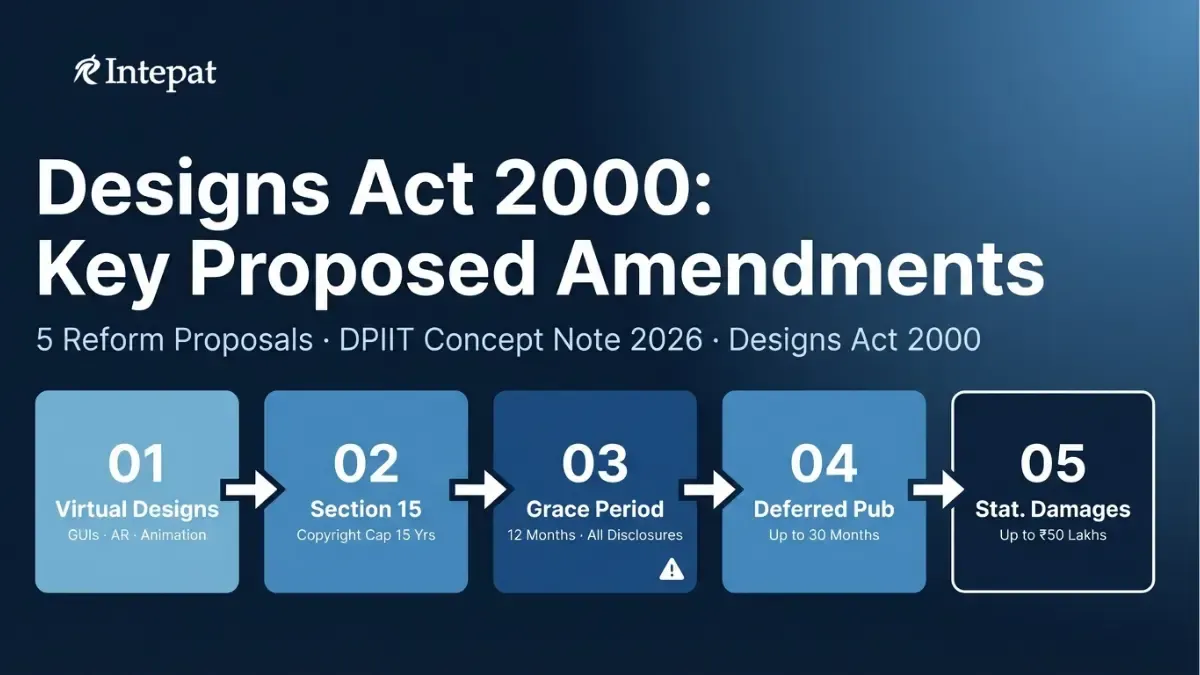
Key Proposed Amendments to the Designs Act, 2000 (Summary Table)
| Proposal | Current Position | Proposed Change | Practical Impact |
| Virtual design protection | “Article” and “design” tied to tangible objects; GUIs registrable under Locarno but substantively uncertain | Definitions revised to cover non-physical designs including GUIs, icons, animations, AR interfaces | Removes registrability uncertainty for digital and screen-based design assets |
| Design-copyright interface (Section 15) | Copyright in registrable but unregistered designs ceases after 50 industrial reproductions | Copyright continues, capped at 15 years | Removes 50-reproduction trap; changes copyright strategy for design-reliant clients |
| Grace period | 6 months, exhibition disclosures only | 12-month full grace period, all disclosures | Designers can test market before filing without losing novelty |
| Deferred publication | Not available; published immediately on registration | Up to 30 months deferment from filing date | Confidentiality during pre-launch phase; innocent infringer defence for third parties |
| Statutory damages | No criminal remedies; actual damage must be proved | Up to ₹50 lakhs for first wilful infringement; enhanced bands for repeat offenders | Shifts enforcement from compensatory to deterrence model |
| Term of protection | 10 years + 5-year renewal = 15 years maximum | 5+5+5 staged renewal = 15 years maximum | Portfolio cost management; lapsed designs enter public domain sooner |
| Multiple designs per application | One design per application | Multiple designs in same Locarno class in single application | Reduced filing costs for product families and design variants |
| Divisional applications | Not available | Applicants may divide pending applications | Prevents objection to one design blocking others in the same filing |
| International registrations (Hague) | Not part of Hague system | Dedicated chapter; India to accede to Hague Agreement | Single WIPO application for multi-country protection including India |
| Riyadh Design Law Treaty (DLT) | India signed Final Act in 2024 | Domestic law to be amended to meet treaty obligations | Aligns procedural framework with internationally accepted standards |
Part I: Substantive Changes Proposed in the Designs Act Amendments
Virtual Design Protection for GUIs and Digital Interfaces
The most consequential proposal is the extension of design protection to virtual and non-physical designs.
Under the Designs Act, 2000, the definitions of “design” and “article” have traditionally carried interpretational ambiguity with reference to tangible objects and visual features applied to them. The 2021 amendment to the Designs Rules aligned India’s classification system with the Locarno Classification, which expressly includes GUIs, icons, and screen-based designs under Classes 14-04 and 32. However, classification eligibility and substantive protectability are distinct questions. This is a gap practitioners will have encountered in client queries regarding GUI protection, animated brand elements, and AR interfaces.
The Concept Note proposes to address this directly by:
- Design definition: Revising the definition of “design” to broaden the scope of “industrial process” and expressly include animation, movement, and transition, extending protection beyond static visual features to dynamic digital elements
- Article definition: Revising the definition of “article” to cover items in both physical and non-physical form, including GUIs, icons, graphic symbols, typefaces, augmented reality graphical user interfaces, and other virtual products listed under the Locarno Classification
- Infringement provisions: Making corresponding amendments to infringement provisions to give operative effect to virtual design protection
The policy intent is technology neutrality: protection would remain conditional on novelty and visual appeal, with purely functional features continuing to be excluded. This mirrors the approach taken or proposed by the EU (following its 2024 design law reform), the UK (consultation paper, September 2025), and Australia. According to a WIPO survey, over 92% of responding jurisdictions already protect GUIs under industrial design law. For current guidance on international design classification, see the WIPO Hague System portal, and Intepat’s guide on the Hague system for international design registration [upcoming].
Prosecution implications.
Applications for GUIs, icons, and animated UI elements that previously faced substantive uncertainty should become more defensible. Practitioners will need to develop representation conventions for dynamic designs: how to disclose animation, transition, or movement in line drawings or image sequences, analogous to EU Community Design practice.
Infringement and the “informed user” test.
Extending infringement provisions to virtual designs requires courts to apply the “informed user” test and overall impression analysis in a non-physical context. This question has generated substantial commentary in EU jurisprudence, and Indian courts will address it without an established domestic body of case law. Early enforcement decisions will be closely watched.
Functional feature exclusion.
For technology and UX-heavy clients, the distinction between protectable aesthetic elements and unprotectable functional features of a GUI will be the central drafting challenge. In fintech, e-commerce, and digital services, the line between aesthetic and functional UI elements is frequently contested, and careful claim scoping will be essential.
Portfolio review.
Clients who have relied on copyright as a fallback for GUI protection should be advised on the interaction between this proposal and the proposed Section 15 amendment below.
The Design–Copyright Interface: Proposed Changes to Section 15
Section 15 of the Copyright Act, 1957 has been a source of persistent doctrinal difficulty and one of the most litigated areas at the intersection of design and copyright law in India. Under Section 15(1), copyright protection is expressly excluded for registered designs. Under Section 15(2), copyright in a registrable but unregistered design ceases once the article has been industrially reproduced more than fifty times. The fifty-reproduction threshold has generated inconsistent judicial treatment, particularly in fashion, packaging, and consumer products, where production volumes vary and businesses may not have received timely advice on the registration-versus-copyright trade-off. Clients weighing these options should refer to Intepat’s overview of design registration in India for background on the filing process and timelines.
The Concept Note proposes amending Section 15(2) to allow copyright protection to continue for designs that are registrable but unregistered, while capping the duration of that protection at 15 years. The policy rationale is to align the term of protection with the commercial lifespan of designs and prevent copyright from being used to extend monopolies over subject matter more appropriately governed by design law.
Displacement of the fifty-reproduction rule.
The proposed amendment removes what has effectively been a trap for unadvised rights holders: a client who applied an unregistered design to an article reproduced more than fifty times had already lost copyright protection, often without knowing it. Replacing the threshold with a 15-year cap from the date copyright subsists provides a more predictable and commercially rational framework.
The 15-year cap as a material departure from general copyright law.
Standard copyright duration for works by legal entities under the Copyright Act is 60 years post-publication. A 15-year cap for design-protectable subject matter is a significant reduction. Practitioners should communicate this clearly to clients in sectors where design assets carry long commercial lives, such as fashion archives, heritage packaging, and jewellery, where the distinction between copyright-protectable artistic works and registrable designs may not be intuitive.
Impact on fashion and applied art sectors.
The fashion industry has long navigated the uncertain boundary between artistic craftsmanship, protectable under copyright without time limit under existing law, and industrial designs subject to Section 15. A 15-year cap on copyright for registrable unregistered designs could materially affect the legal position of fashion houses, textile designers, and applied art businesses that have relied on copyright as the primary protection mechanism for surface designs and patterns applied industrially. These clients will need specific advice on registration strategy in light of the proposed change.
Impact on copyright-first businesses.
For businesses in digital media, interactive design, and creative technology that have historically structured their IP around copyright rather than design registration, the proposed cap creates an incentive, or in some cases a necessity, to integrate design registration into their IP programme. For these clients, the registration-or-copyright question is no longer a cost-versus-term trade-off but a strategic decision with a defined expiry horizon.
Constitutional dimension.
A legislative amendment that truncates existing copyright duration for a category of works raises questions about the scope of Parliament’s power under the Copyright Act and whether vested rights are affected. While this is not the place for a detailed constitutional analysis, practitioners advising clients in ongoing litigation or licensing disputes that turn on Section 15 should monitor how this potential challenge is addressed in the legislative drafting process.
Interaction with virtual design proposals.
If GUIs and other virtual designs become registrable under an amended Act, the Section 15 framework will apply to them as well. Unregistered virtual designs would be subject to the proposed 15-year copyright cap rather than the current fifty-reproduction threshold. For software companies and digital product businesses, this changes the calculus of whether to register.
Introduction of Statutory Damages for Design Infringement
The Designs Act currently provides no criminal remedies for infringement, and civil enforcement has been complicated by the difficulty of proving and quantifying actual damages in design cases, particularly where the infringing use is widespread but diffuse, or where the commercial nexus between infringement and lost revenue is indirect.
The Concept Note proposes introducing statutory damages for wilful infringement, with courts empowered to award damages up to ₹50 lakhs for a first instance, and enhanced bands for repeat offenders, in cases where proving actual damages is difficult or impractical.
A structural shift in enforcement strategy.
Statutory damages represent a transition from a purely compensatory model, where recovery depends on establishing and quantifying actual loss, to a deterrence-based framework where a defined damages ceiling creates predictable risk for infringers regardless of whether actual loss can be proved. For practitioners advising rights holders in sectors with high design infringement rates such as fashion, packaging, consumer goods, and consumer electronics, this changes the cost-benefit analysis of enforcement action materially.
Litigation strategy and settlement leverage.
The availability of a statutory remedy with a defined ceiling improves predictability for both parties in design litigation. Rights holders gain a credible damages claim without the evidentiary burden of proving quantum. Defendants can assess exposure at the pre-litigation stage with greater certainty. In practice, this is likely to improve settlement efficiency: cases that currently drag because damages are speculative become more amenable to early resolution when both parties can anchor negotiations to a statutory range.
The wilfulness threshold.
The proposal does not create strict liability for all design infringement. It targets wilful copying, with enhanced bands reserved for repeat offenders. Courts will need to develop their approach to the wilfulness standard, and the early body of case law under this provision will be important. Practitioners should advise clients that the threshold is not automatic and that factual evidence of deliberate copying will remain central to statutory damages claims.
Defence side implications.
For clients who are potential defendants in design disputes, the introduction of statutory damages increases the risk profile of design infringement significantly. Freedom-to-operate clearance in relation to registered designs, particularly in sectors where design registration is now more commercially common, will become a more standard part of product development diligence.
Part II: Procedural Changes Proposed in the Designs Act Reform
12-Month Grace Period for Design Disclosure
The Concept Note proposes a full 12-month grace period with no pre-conditions, consistent with Article 7 of the DLT, replacing the current Section 21 provision, which is limited to disclosures at Central Government-notified exhibitions for six months. Any applicant disclosure in the 12 months before filing, including online launches, investor presentations, crowdfunding campaigns, pilot sales, and academic publications, would not defeat novelty.
For practitioners, the principal change is in pre-filing advisory risk: a client who disclosed outside the notified exhibition context had, under current law, already compromised novelty. The expanded grace period removes that constraint and allows registration to follow commercial validation rather than precede it.
One qualification to maintain in client advice: a grace period protects the applicant’s own prior disclosure, not against independent third-party prior art that emerges during the same period. Clients who delay filing after disclosure remain exposed to the risk that a competitor files first. The grace period reduces risk; it does not eliminate the first-to-file incentive.
Deferred Publication of Design Applications
Under the current Act, designs are published immediately upon registration. The Concept Note proposes allowing applicants to defer publication for up to 30 months from the filing date, with the deferment request required at the time of filing on a prescribed form with a prescribed fee.
Registration would secure a priority date without triggering public disclosure during the pre-launch phase, resolving a structural tension that has previously made early registration strategically unattractive for technology companies and consumer electronics manufacturers with long development cycles.
The accompanying innocent infringer defence limits damages liability for third parties who infringe an unpublished design without knowledge or reasonable means of knowing. Injunctive relief remains available once the infringer becomes aware, preserving meaningful deterrence throughout the deferment period.
Practitioners should docket the interaction between deferred publication and the grace period carefully. The grace period runs back 12 months from the filing date, while the 30-month deferment clock runs forward from it. Where a client has disclosed publicly before filing, both timelines need to be tracked alongside any priority claims.
Changes to Design Protection Term and Portfolio Management
Term of protection.
The current 10+5 structure would be replaced with a 5+5+5 staged renewal model, maintaining the 15-year maximum. Rights holders may allow designs to lapse at the 5 or 10-year mark where commercial relevance has expired, rather than maintaining registration across the full term.
Multiple designs per application.
Where designs fall within the same Locarno class, the Concept Note proposes allowing multiple designs in a single application. For clients developing product families or design variants, this reduces filing costs and administrative burden without affecting the substantive treatment of individual designs.
Divisional applications.
The introduction of divisional applications, aligned with Article 9 of the DLT, allows applicants to split a pending application where objections to one design would otherwise block the others. This is a meaningful safeguard for portfolio filings, removing the current risk of wholesale loss where a single objection threatens an entire multi-design submission.
Conclusion: What the Proposed Design Law Amendments Mean for Portfolio Strategy
The DPIIT Concept Note represents a substantive rethink of Indian design law across three dimensions: the digital economy (virtual design protection and deferred publication), the copyright-design interface (Section 15 rationalisation), and enforcement effectiveness (statutory damages). The procedural reforms, while less headline-worthy, are operationally significant for portfolio management.
The stakeholder consultation period has closed. The proposals will now undergo further deliberation before any formal Bill is introduced. Practitioners managing active Indian design portfolios should consider conducting a portfolio audit in anticipation of the proposed reforms, particularly in relation to unregistered designs that may benefit from the revised Section 15 framework, GUI and virtual design assets that would benefit from clearer registration eligibility, and designs where deferred publication would have changed the filing calculus had it been available. For a practical starting point, see Intepat’s guide on design registration for digital products in India [upcoming].
One broader observation: the Concept Note signals a policy direction that treats design registration as commercially serious rather than procedurally peripheral. If enacted, these amendments would require IP practitioners to integrate design strategy more actively into client IP programmes, particularly for technology, consumer product, and digital services clients where design has historically been underutilised relative to patents and trademarks.
This article provides a general overview of the DPIIT Concept Note on proposed amendments to the Designs Act, 2000, and is not a substitute for professional IP advice. The proposals outlined here are subject to further legislative process and have not yet been enacted. Verify the current status of any amendment before advising clients.