




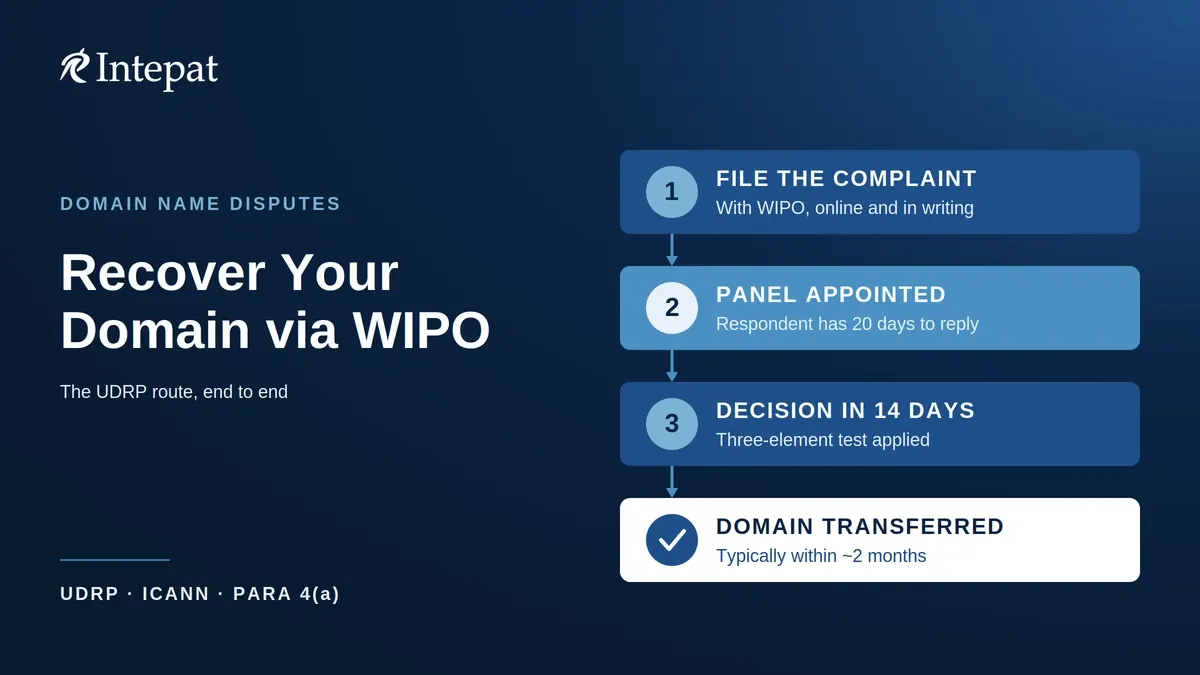
If someone has registered your brand name as a domain, the Uniform Domain Name Dispute Resolution Policy (UDRP) gives you a faster path than litigation. Filed through WIPO’s Arbitration and Mediation Center, a UDRP complaint covers global domains such as .com, .org, and .net, costs from USD 1,500, and typically concludes within two months.
Quick Answer
• You must prove three things: (1) your mark and the domain are identical or confusingly similar; (2) the registrant has no legitimate interest in the name; (3) the domain was registered and is being used in bad faith. All three are required.
• The only remedy available is transfer or cancellation. UDRP does not award damages or legal costs.
• A standard WIPO complaint covering one to five domains costs USD 1,500 (single panelist) and normally resolves in around two months.
• For .in or .Bharat domains, the UDRP does not apply. Those disputes go through INDRP, administered by NIXI under the Arbitration and Conciliation Act 1996.
What the UDRP Is, in Plain Terms
The UDRP is a mandatory administrative policy adopted by ICANN, the organisation that oversees the global domain name system. When you register a domain with any accredited registrar, your registration agreement requires you to submit to UDRP proceedings if a trademark owner files a complaint. That contractual mechanism is what gives the process its reach: once a panel decides in the complainant’s favour, the registrar is required to implement the decision, transferring or cancelling the domain, without the need for a separate court order.
WIPO’s Arbitration and Mediation Center has handled domain name disputes since December 1999 and is the largest of the ICANN-accredited providers by caseload. It covers all major generic top-level domains, including .com, .org, .net, .xyz, and new gTLDs. Over 87 country code top-level domains also use WIPO as their provider, as of end 2025. Across 25 years, WIPO has resolved more than 80,000 cases; in 2024, owners from 133 countries filed 6,168 of them.
The appeal for brand owners is speed and cost relative to litigation. A UDRP complaint is conducted entirely online, in writing, and typically concludes within two months. The trade-off is narrow remedies: you can only get the domain transferred or cancelled, not damages or legal costs.
For disputes involving cybersquatting and brand hijacking on global domains, UDRP is almost always the first route to consider.
The Three Things You Must Prove to Win
Under Paragraph 4(a) of the ICANN UDRP Policy, a complainant must prove all three elements below. Failure on any one results in the complaint being denied.
Element 1: Identical or confusingly similar. The disputed domain must be either identical to, or confusingly similar to, a trademark or service mark in which you hold rights. Panels look at whether the domain incorporates the core of your mark in exact form or with common variations such as added words, hyphens, or misspellings. Both registered and unregistered marks qualify: for an unregistered mark, you must supply evidence of distinctiveness through duration of use, sales figures, advertising spend, or documented public recognition.
Element 2: No rights or legitimate interests. The complainant must make a prima facie showing that the registrant has no valid claim to the name. Once that showing is made, the burden of production shifts to the registrant to come forward with evidence of a legitimate interest; the ultimate burden of proof, however, always remains on the complainant. Paragraph 4(c) of the Policy gives three examples of what can establish a legitimate interest: genuine use of the domain for a bona fide business before receiving notice of the dispute; being commonly known by that name; or legitimate non-commercial or fair use. The panel weighs the full record on this element, including anything the registrant produces in response.
Element 3: Registered and used in bad faith. Both registration and use in bad faith must be proved under Paragraph 4(a)(iii). However, “use” does not require an active website. Under the passive holding doctrine, set out in the WIPO Jurisprudential Overview 3.1 (the consensus guide WIPO panels apply, updated in February 2026), a parked page, a domain-for-sale listing, or email server configuration can count as bad-faith use. What matters is whether the surrounding facts point to targeting of your mark. Panels weigh the totality of circumstances, including the distinctiveness of your mark, the registrant’s failure to show any contemplated good-faith use, and the implausibility of any legitimate purpose for holding the name. Paragraph 4(b) lists four non-exhaustive circumstances panels treat as evidence of bad faith:
- acquiring the domain primarily to sell it to the trademark owner at a profit;
- a pattern of blocking trademark owners from reflecting their marks online;
- registering the domain to disrupt a competitor; or
- using it to attract visitors for commercial gain by creating confusion with your mark.
Filing a complaint you know cannot satisfy all three elements risks a finding of Reverse Domain Name Hijacking, a formal public declaration that the complaint was brought in bad faith. Affiliates, subsidiaries, and exclusive licensees may also file, provided they demonstrate the necessary authorisation. A single complaint may cover multiple domains registered by the same holder.
What Counts as Bad Faith, and What the Registrant Can Argue Back
Panels look at the full picture, not only whether one of Paragraph 4(b)’s four examples is present. Typosquatting (registering deliberate misspellings of your mark), phishing or fake invoices using your brand name, and registering your mark immediately before a known product launch have all been found to constitute bad faith in WIPO proceedings.
The registrant’s counter under Paragraph 4(c) usually rests on one of three claims:
- genuine prior use of the domain for a bona fide offering;
- being commonly known by the name, independently of your mark; or
- legitimate non-commercial or fair use, such as genuine criticism or commentary that does not mislead.
If no response is filed within the 20-day window, the panel decides on the complaint alone. It still assesses whether all three elements are met; a non-response does not automatically result in a transfer order, though it often makes it easier for the panel to draw adverse inferences. A single complaint may cover all domains held by the same registrant, making parallel enforcement more efficient.
What You Can and Cannot Get: Transfer or Cancellation, Not Damages
UDRP remedies are narrow by design. A panel that finds in your favour can order transfer of the disputed domain to you, or cancellation of the registration. Transfer is usually the practical choice: cancellation releases the domain back into the pool where anyone could re-register it.
Even after a transfer order, implementation is not immediate. The registrar normally waits ten business days after receiving the decision before acting. If the registrant files a court proceeding in the specified mutual jurisdiction within that window and provides the registrar with proper documentation, implementation is stayed pending the court’s resolution.
Neither party receives damages or costs through the UDRP process. Filing fees are paid by the complainant and are not recoverable. Paragraph 4(k) of the UDRP Policy preserves the right of either party to go to a court of competent jurisdiction, before the UDRP proceeding begins or after it concludes. So UDRP does not foreclose court action if you need damages, or if the registrant later challenges the panel’s decision.
For situations where the domain is being used to impersonate your brand or mislead consumers, a passing off action through the Indian courts may run alongside a UDRP complaint.
Cost, Timeline, and the New Fast-Track Option
WIPO’s fee for a standard single-panelist case covering one to five domain names is USD 1,500 (USD 1,000 to the panelist, USD 500 to WIPO). The complainant pays the full single-panelist cost. If either party elects a three-member panel, the fee rises to USD 4,000; if the respondent is the one who requests three members, the higher fee is split equally.
The respondent has 20 days from formal commencement to file a response, with a 4-day automatic extension available. After that window closes, the panel is appointed and must forward its decision to WIPO within 14 days of appointment, absent exceptional circumstances. End to end, a standard case normally concludes within approximately two months from WIPO receiving the complaint.
WIPO introduced a priority processing service in early 2026. For eligible cases involving one to five domains where a single-panel decision is appropriate and no contingencies arise, WIPO targets a decision within approximately one month from case commencement to decision notification. The complainant fee is USD 4,000. This suits time-sensitive launches but carries a higher cost and constraints that make it relevant to a narrow set of cases.
| Scenario | WIPO fee (complainant) | Typical timeline |
| Standard, single panelist, 1-5 domains | USD 1,500 | ~2 months |
| Three-member panel, 1-5 domains | USD 4,000 | ~2-3 months |
| Priority service, 1-5 domains | USD 4,000 | ~1 month |
Fees are WIPO administration and panel fees only. Professional fees for preparing the complaint are additional. Verified as of June 2026 from the WIPO fee schedule at wipo.int/amc/en/domains/fees; confirm before filing.
Where the Case Is Heard: Mutual Jurisdiction
UDRP proceedings are administrative, not judicial, and take place entirely in writing with no oral hearings. The mutual jurisdiction clause in the UDRP Rules does not govern the merits; it sets which court has jurisdiction over any legal challenge to the panel’s decision. When you file, you agree to submit to either the court where the registrar’s principal office is located or the court of the registrant’s address shown in the registration records at the time of filing.
This matters if the registrant wants to challenge an adverse decision: they must do so in a mutual-jurisdiction court within ten business days of being notified. Because proceedings run online wherever the parties are located, this is a substantial practical advantage for an Indian brand owner whose infringer is overseas. Understanding how trademarks and domain names interact under Indian law is relevant if you are also weighing a parallel court action in India.
For .in and .Bharat Domains: INDRP and the Indian Courts
The UDRP does not apply to .in or .Bharat domains. Those disputes are governed by the .IN Dispute Resolution Policy (INDRP), adopted by the National Internet Exchange of India (NIXI). Unlike the UDRP’s administrative proceeding, INDRP runs as arbitration under the Arbitration and Conciliation Act 1996. The arbitrator must pass an award within 60 days of the commencement of arbitration, extendable by up to 30 days in exceptional circumstances.
The substantive test is similar in structure but differs on a critical point. INDRP Clause 4(c) uses the disjunctive: the domain must have been registered or is being used in bad faith, or for an illegal or unlawful purpose. The UDRP requires both registration AND use in bad faith. So a complainant who cannot prove bad faith at the moment of registration may still succeed under INDRP on current bad-faith use alone.
A second difference: unlike the UDRP, which lets one complaint cover multiple domains held by the same registrant, INDRP requires a separate complaint and fee for each disputed domain. The official INDRP fee is ₹30,000 plus 18% GST (₹35,400 per domain at current rates); confirm with NIXI before filing, as fee schedules change.
| UDRP (WIPO) | INDRP (NIXI) | |
| Applies to | gTLDs (.com, .net, .org, new gTLDs) and participating ccTLDs | .in and .Bharat domains only |
| Proceeding type | Administrative proceeding | Arbitration under the Arbitration and Conciliation Act 1996 |
| Bad-faith test | Registered AND used in bad faith (conjunctive) | Registered OR used in bad faith (disjunctive) |
| Remedy | Transfer or cancellation | Transfer, cancellation; costs may also be awarded |
| Costs recoverable | No | Arbitrator may award costs |
| Per-domain filing | One complaint may cover multiple domains | Separate complaint required per domain |
| Typical timeline | ~2 months from WIPO receiving complaint | Award within 60 days from arbitration commencement (extendable by 30 days) |
For disputes that also involve trademark infringement under the Trade Marks Act 1999, the Indian courts are an additional route. One precision point on where you can sue: Section 134(2) of the Trade Marks Act 1999 lets the plaintiff file in a court where the plaintiff carries on business. That extended forum applies only to registered trademark infringement suits under clauses (a) and (b) of Section 134(1). It does not extend to a passing off suit under clause (c), where ordinary civil jurisdiction rules apply.
If your brand is active on both .com and .in, the UDRP route for the .com domain and INDRP for the .in domain may need to run in parallel. Understanding how domain name registration interacts with your trademark is useful before choosing a strategy.
Before You File: A Short Readiness Check
Before deciding to file, consider whether UDRP suits your situation:
UDRP is usually a good fit when: the domain copies or closely imitates your brand; the registrant has no genuine independent reason to use the name; and the facts point to cybersquatting, impersonation, resale pressure, phishing, or pay-per-click diversion.
UDRP is usually not the right route when: the dispute is primarily a contract or business disagreement; the registrant registered the domain before your trademark rights arose; the domain is a genuine dictionary-word or descriptive term used for its ordinary meaning; or you need damages, injunctions, discovery, or action against broader conduct.
Prepare the following before lodging a complaint:
- proof of trademark rights (registration certificate or evidence of common law use);
- a screenshot record of the disputed domain and its current use;
- evidence connecting the registrant’s behaviour to one or more of Paragraph 4(b)’s bad-faith circumstances; and
- the registrant’s WHOIS data (the public domain registration database) at the time of filing.
If your mark is unregistered, gather substantially more evidence of acquired distinctiveness: panels apply Element 1 more carefully where the underlying mark has not been formally registered. If the domain is being used for phishing or fraud rather than simple squatting, a parallel complaint to the registrar’s abuse team or a referral to enforcement authorities may run alongside the UDRP proceeding.
A complaint brought without adequate evidence risks a Reverse Domain Name Hijacking finding on the public record. Consulting a trademark enforcement specialist before filing is the recommended step. Understanding WIPO’s broader role in international IP also helps place domain disputes within the wider picture of global trademark protection.
Frequently Asked Questions
Does the UDRP apply to all domain extensions?
The UDRP applies to all gTLDs, including .com, .org, .net, and new gTLDs. Many ccTLDs have also adopted the UDRP or a UDRP-based local variation; the applicable policy for any specific ccTLD should be confirmed with WIPO before filing. The UDRP does not apply to .in or .Bharat domains in India; those go through INDRP, administered by NIXI under the Arbitration and Conciliation Act 1996.
Can I file a UDRP complaint if my trademark is not registered?
Yes. WIPO accepts complaints based on unregistered or common law marks, but the complainant must provide evidence that the mark has acquired distinctiveness and functions as a source identifier, typically through duration and extent of use, sales data, advertising spend, or documented public recognition. A pending trademark application alone is not enough. Unregistered mark cases require substantially more supporting evidence than registered mark cases.
What happens if the registrant does not respond?
If the respondent does not file within the 20-day response window, the case proceeds in their absence. The panel still assesses whether all three elements under Paragraph 4(a) are satisfied; a default does not automatically produce a transfer order. In practice, a non-response often allows the panel to draw adverse inferences from the available record.
How long does a WIPO UDRP proceeding take?
A standard WIPO proceeding normally concludes within approximately two months from the date WIPO receives the complaint. A priority processing service introduced in early 2026 targets a decision within approximately one month from case commencement to decision notification, for eligible single-panel cases covering up to five domains; the complainant fee for that service is USD 4,000.
Can I get my legal costs back through UDRP?
No. UDRP does not award damages, compensation, or legal costs to either party. The complainant pays the WIPO filing fee regardless of outcome. The only relief available is transfer or cancellation of the disputed domain name. INDRP proceedings, by contrast, allow the arbitrator to award costs.
What is Reverse Domain Name Hijacking?
Reverse Domain Name Hijacking is a formal panel finding that the complaint was brought in bad faith, typically to deprive a legitimate domain holder of their name or to harass them. The finding is published in the public case record and arises where the complainant filed knowing it could not satisfy the three-element test.
What is the key difference between UDRP and INDRP?
The UDRP covers gTLDs globally, administered by WIPO as an administrative proceeding; INDRP governs .in and .Bharat domains through NIXI as arbitration under the Arbitration and Conciliation Act 1996. A substantive difference: UDRP requires the domain to be registered AND used in bad faith (conjunctive); INDRP requires registration OR use in bad faith (disjunctive). INDRP also requires a separate complaint per domain and allows the arbitrator to award costs.
Do I need a lawyer to file a UDRP complaint?
UDRP rules do not require legal representation. However, preparing a well-evidenced complaint covering all three elements, and anticipating the registrant’s defences, is where most cases are decided. For a clear-cut cybersquatting situation with a registered mark, self-filing is feasible; for complex bad-faith arguments or an unregistered mark, professional preparation improves the outcome.
Disclaimer: This article is for general informational purposes only and does not constitute legal advice. UDRP fees, timelines, and policy provisions are subject to change; verify current figures directly with WIPO at wipo.int or an accredited dispute resolution provider before filing. For disputes involving Indian trademarks, domain name enforcement, or .in domain names, consult a qualified trademark lawyer or domain name enforcement professional. Verified and updated as of June 2026.