




AI tools can accelerate patent drafting, producing structured, technically fluent text in minutes. What Indian patent law tests, however, is not the polish of the draft but whether it satisfies Section 10 of the Patents Act 1970. A general-purpose AI tool does not by itself verify whether the specification meets that standard, whether the claims are fairly based on the disclosure, or whether the best method has been disclosed. That verification remains a human responsibility.
| Key points |
| – General-purpose AI tools can draft fluent patent prose, organise technical detail, and produce a workable first pass. Verifying that the complete specification satisfies Section 10, that the claims are fairly based on the disclosure, that the best method known to the applicant has been disclosed, and that the claims distinguish current prior art remains a human responsibility. – India follows absolute novelty under Sections 2(l) and 13. Pre-filing disclosure of an invention through a public AI chat link, an indexed page, or a comparable public channel can create publication risk before the Indian filing date. – Section 59 of the Patents Act bars any amendment that would claim or describe matter not in substance disclosed at filing. AI omissions that require adding new technical matter are not recoverable. – The Indian Patent Office’s CRI Guidelines 2025, effective 29 July 2025, treat AI-generated inventions as non-patentable because AI cannot be a “Person” claiming to be the true and first inventor under Section 6. AI-assisted inventions remain patentable if the standard criteria are met. |
What makes AI risky for patent drafting is not that the output looks wrong, but that it usually looks right. The text is structured, technically fluent, and contains the right section headings. The defects sit inside the substance, in places a non-practitioner reading the output cannot see.
Can an AI Tool Draft an Indian Patent Application?
A general-purpose AI tool given a description of an invention will return a document that looks like a patent specification. It will have a title, a background section, a description of the embodiment, and a numbered set of claims. The grammar will be correct. The headings will follow Indian or US conventions, depending on how the prompt was phrased. Some founders use AI as part of a self-drafting workflow to keep early costs low.
What the AI produces is patent-shaped text built from patterns in its training data. It is not a specification grounded in the specific invention’s prior art, in the structural requirements of Section 10 of the Patents Act 1970, or in the claim-drafting conventions accepted by Indian Patent Office examiners.
Three observable defects show up almost every time. First, claims tend to be either too narrow (restating a feature already disclosed in the prompt as if it were the inventive distinction) or impermissibly broad (asserting protection over a field rather than a specific implementation). Second, the description tends to be generic. It explains the field of the invention in the way a textbook would, not in the way a person with average skill in the art would need to actually reproduce the invention. Third, the best method section, if it appears at all, is restated language from the rest of the description rather than the specific best implementation known to the applicant.
A founder reading the output may not detect any of this. The text reads as competent because the model has been trained on millions of competent-looking documents. A patent drafted this way can be technically correct on its face and strategically weak in practice: fluent prose, workable format, but claims that fail to distinguish from the closest prior art or omit the applicant’s best method.
What Section 10 Requires That AI Cannot Verify Alone
Section 10 of the Patents Act 1970 sets the mandatory contents of a complete specification. Each requirement maps onto a task that a general-purpose AI tool structurally cannot perform.
Full and particular description (Section 10(4)(a)). The specification must fully and particularly describe the invention and the method by which it is performed. The test is whether a person in India with average skill in the relevant art can reproduce the invention from the disclosure. The AI does not know what that person already knows in the specific field, what implementation steps are routine in that field, and what gaps in description would force the skilled reader into independent invention.
Best method (Section 10(4)(b)). The applicant must disclose the best method of performing the invention known to the applicant at the time of filing. The AI can only reflect the best method the applicant has already articulated in the prompt. If the applicant omits the best version of the invention, accidentally or because they did not realise it was material, the AI will not surface that omission on its own. For example, if a prototype only works because the applicant uses a particular sensor calibration step, that step must be in the prompt for it to appear in the specification.
Claims (Section 10(4)(c)). The specification must end with claims defining the scope of protection. Indian practice has additional constraints: omnibus claims are not permitted under Section 10(4)(c), per the Manual of Patent Office Practice and Procedure. AI tools trained on US patent corpora tend to produce omnibus claims and other constructions that an Indian examiner will object to, unless the prompt specifically directs Indian claim conventions.
Clarity, succinctness, and fair basis (Section 10(5)). Every claim must be clear, succinct, and fairly based on the matter disclosed in the specification. The fair basis check requires reading the claim against the description and confirming each claim element finds support in the disclosure. An AI generating both the claims and the description in one pass will not independently confirm that support in the way an examiner would; the check remains a human step.
The Prior Art Search Problem
A prior-art search is not a separate filing requirement under Section 10, but it is a practical pre-filing safeguard. Section 13 of the Patents Act 1970 requires the examiner to investigate anticipation by earlier patent specifications and by documents published in India or elsewhere before the filing date. A prudent applicant should search before filing; otherwise the first real prior-art test arrives in the First Examination Report.
A general-purpose AI chat interface has no live access to the Indian Patent Office database, no live access to global patent databases, and no current knowledge of recently published specifications. Its training data has a cutoff. Anything published after that cutoff is invisible to it. Specialised patent-AI platforms with database integrations exist, but the tools most founders reach for do not search patent registers; they generate text that resembles search results.
This produces two specific failure modes. The AI may assert that an invention is novel when prior art already exists; the founder relies on that assertion, files, and receives a First Examination Report (a formal document from the Patent Office setting out every objection to the application) citing the prior art the AI did not know about. Or the AI may hallucinate prior art that does not exist; the founder drafts around a fictitious reference and ends up with claims that distinguish from nothing.
The Manual of Patent Office Practice and Procedure requires that every claim term used be either found in the description or fairly inferable from it. A specification drafted without prior art awareness tends to use generic terminology that does not distinguish from existing patents. Indian examiners read claims against prior art literally. Vague terms like “improved,” “optimised,” or “advanced” carry no distinguishing weight in an examination report.
The reader who wants to file a patent based on AI-drafted text without first commissioning a patentability search is filing into an unknown. The search must be done independently before filing, ideally before a patent agent drafts the specification.
The Disclosure Trap: Public AI Chats and Indian Novelty Rules
India follows the standard of absolute novelty. Section 2(l) of the Patents Act 1970 defines a new invention as one “which has not been anticipated by publication in any document or used in the country or elsewhere in the world before the date of filing of patent application with complete specification.” Section 13 requires examiners to search for anticipation in any document published anywhere before the filing date. Section 64(1)(e) provides a revocation ground if the claim is not new.
Unlike the United States, India does not have a general one-year inventor grace period. The grace exceptions in Sections 29 to 32 are narrow. Section 31 covers an exhibition specifically notified by the Central Government in the Official Gazette, or a paper read before a learned society. Section 32 covers public working in India for reasonable trial. None of these covers a voluntary disclosure on the open internet.
The position elsewhere offers limited refuge. The United States allows a one-year inventor grace period under 35 U.S.C. § 102(b)(1) for disclosures by the inventor. The European Patent Office (Article 55 EPC) provides only narrow six-month exceptions for abuse and notified exhibitions, similar in scope to India’s Sections 29 to 32. An Indian applicant filing internationally through the Patent Cooperation Treaty cannot rely on the US grace period if they have already disclosed before filing in India, because the earliest disclosure governs novelty in jurisdictions without a corresponding grace.
This creates a specific risk that founders using AI tools rarely think about. Some AI platforms include “share” features that create a public URL of the conversation. A shared link makes the conversation accessible to anyone with the link and may be further shared or, depending on platform settings, discoverable through search. A founder who pastes an invention description into a generative AI tool, generates a draft specification, and then shares the chat over a public link has potentially published the invention.
The data-handling distinction also matters. Consumer or personal AI accounts may use user content for model training unless the user has opted out; business, enterprise, and API products are generally not used for training by default, but the actual terms vary by provider and tier. A founder who has not read the specific terms of service of the tool being used cannot rule out that the prompt has become input to a training process or to a system that retains the content.
A document that becomes publicly accessible before the patent application is filed may create publication risk under Sections 2(l) and 13. The applicant cannot recover novelty by deleting the chat afterwards, because the disclosure may already have entered the public domain. The safer rule is straightforward: anything that touches the unfiled inventive concept should not be sent to a public or consumer AI tool before a priority date is secured. If the priority date matters, file first, then prompt.
Section 59: Why AI Omissions at Filing Become Permanent
Section 59 of the Patents Act 1970 governs amendment of a complete specification after filing. The provision is strict: no amendment may “claim or describe matter not in substance disclosed or shown in the specification before the amendment.” A specification can be narrowed, clarified, or corrected by disclaimer, but new technical matter cannot be added.
This means that whatever is in the description at the time of filing is the maximum scope of what can ever be claimed. If the AI-drafted description omits a key technical feature, a method step, the best version of the invention, or a useful variant, that omission cannot be cured by adding new matter later. For example, if a filed draft says only that the invention uses “a machine learning model” but the actual invention is a two-stage model-routing architecture with specific input partitioning, that architecture cannot be added through amendment unless it was already disclosed in substance in the original specification.
The consequence is asymmetric. Drafting errors discovered before filing cost time. Drafting omissions discovered after filing cost protection.
Section 64(1)(h) provides a revocation ground if the complete specification does not sufficiently describe the invention or fails to disclose the best method known to the applicant. Section 64(1)(i) provides a separate ground if any claim is not fairly based on the matter disclosed in the specification. Both grounds can be raised by an interested person, including a competitor, long after the patent has been granted.
Founders using AI to save costs at the drafting stage often calculate that they can engage a patent agent later to “clean up” the application during prosecution. The Section 59 lock limits this. An agent engaged after filing can argue around objections, narrow claims, propose clarifying amendments, and disclaim matter, but cannot rewrite the disclosure to add technical matter the AI left out. Whatever the AI omitted on the first pass becomes structural to the patent.
AI-Generated vs AI-Assisted: What the IPO Already Decided
The Indian Patent Office has taken explicit positions on AI involvement in inventions. Two are directly relevant to a founder using AI tools.
The DABUS decision. In Indian Patent Application No. 202017019068, the applicant named an AI system as the sole inventor. The Indian Patent Office refused the application, holding that an AI cannot be the “true and first inventor” under the Patents Act 1970. The inventor must be a natural person. A juristic person may apply as the assignee, but cannot itself be the inventor. Ownership of the AI’s source code or hardware does not establish the chain of title required under Section 7(2). The Indian position aligns with international patent office practice: the USPTO (Thaler v. Vidal, Federal Circuit 2022), the European Patent Office (Board of Appeal J 8/20, 2021), the UK Supreme Court (Thaler v. Comptroller-General, 2023), and the Australian Full Federal Court (2022) have all reached the same conclusion that an inventor must be a natural person. Read more on the DABUS decision in India.
CRI Guidelines 2025 (effective 29 July 2025). The Indian Patent Office’s guidelines for examining computer-related inventions state that AI-generated inventions are not patentable, because AI cannot be a “Person” claiming to be the true and first inventor under Section 6. AI-assisted inventions are not automatically excluded under Section 3(k), provided the usual patentability requirements are met and the claims demonstrate technical effect through a tangible application. The specification for an AI-assisted invention must also disclose algorithmic implementations with sufficient detail for reproduction. See our discussion of the CRI Guidelines 2025.
For a founder who used a generative AI tool to help draft a specification, the question is not whether the AI was named as inventor. It almost never is. The question is whether the inventive contribution came from a human or from the AI. If the founder identified the technical problem, conceived the solution, and used the AI only to convert that solution into specification language, the invention is AI-assisted and patentable. If the AI proposed the inventive concept and the founder accepted it, the application is vulnerable to challenge under the DABUS reasoning and the CRI Guidelines 2025.
This distinction is not theoretical. It affects how the inventorship declaration must be drafted and how the prosecution responds to objections. See also our guide to AI and machine learning patents in India.
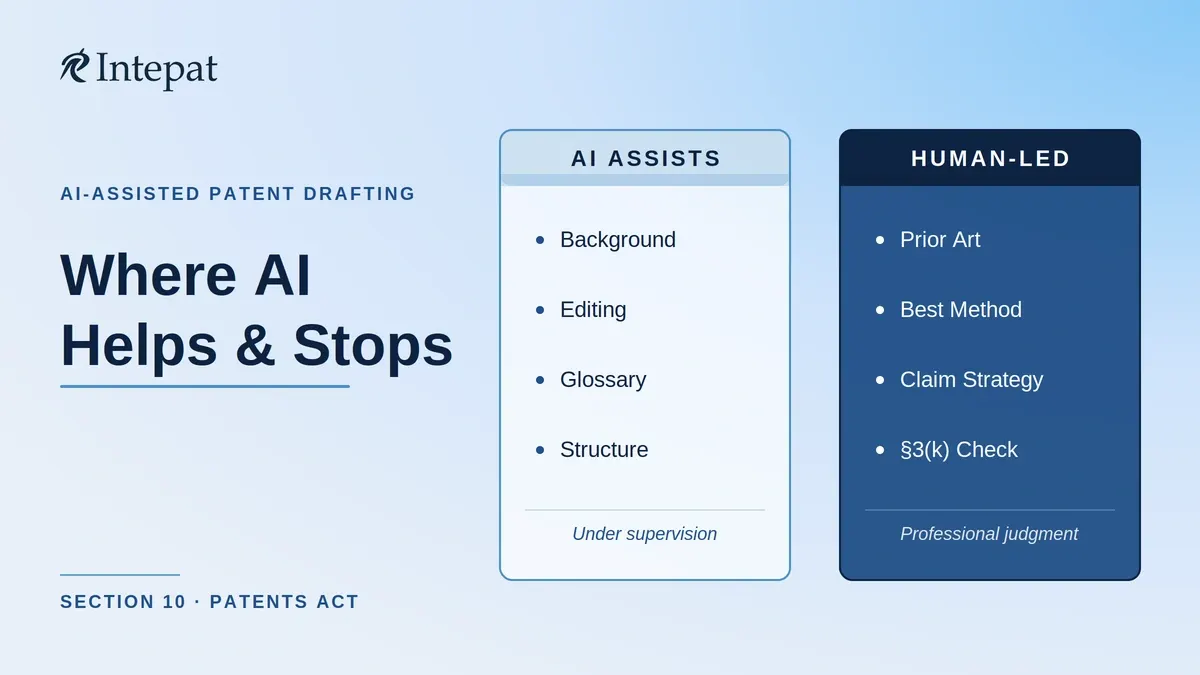
Where AI Genuinely Helps in Patent Drafting
The risks above are not arguments against using AI tools at all. They are arguments against treating an AI output as a filing-ready document. Several roles fit a general-purpose AI tool well, provided the input does not include unfiled inventive content and the output is reviewed by someone who understands Indian patent practice.
Background and field of invention. Once the inventive concept is documented internally, an AI can help draft a clean background section that situates the invention against publicly known prior art. The applicant must verify each technical claim against actual published sources.
Editing for clarity. AI tools can improve the readability of human-drafted text, fix passive constructions, and tighten sentences. The substantive content must already be correct before the AI sees it.
Glossary and consistent terminology. AI tools can flag inconsistent use of technical terms across long specifications. The terms must still be supported by the description per the Manual of Patent Office Practice and Procedure.
Structural review. AI tools can check that a specification contains all the standard headings and that each section is present. Whether each section is statutorily sufficient remains a human judgment.
Human-led with AI as support: independent claim drafting, prior art search and analysis, the best method determination, novelty and inventive step argument, Section 3 subject matter analysis (especially Section 3(k), which excludes “a mathematical or business method or a computer programme per se or algorithms” from patentability, for software or AI inventions), and the final review against Section 10 requirements. These tasks depend on professional judgment grounded in current Indian Patent Office practice. AI can accelerate the surrounding work, but the primary responsibility for each of these sits with a human who understands the law.
The pattern that works: draft the technical content yourself or with a registered patent agent, then use AI as an editing assistant. The pattern that fails: prompt an AI to draft the specification, then file what comes back.
A Pre-Filing Checklist for Any AI-Assisted Patent Draft
Before filing anything that an AI helped produce, a founder should verify each of the following against the actual specification. Any failure here is a reason to slow down rather than file.
- A patentability search has been conducted independently of the AI, against current Indian Patent Office and global patent databases.
- The description discloses the specific best method of performing the invention known to the applicant, not a generic restatement.
- Every claim term appears in the description or is fairly inferable from it. No term is used only inside the claims.
- The claims are framed against actual prior art, with a clear distinguishing feature. No claim relies on vague qualifiers like “improved” or “optimised” to do the distinguishing work.
- For software or AI inventions, the specification discloses algorithmic implementation in enough detail to reproduce the invention; the claims demonstrate a technical effect rather than an abstract algorithmic step.
- No part of the unfiled inventive concept has been sent to a consumer-tier AI tool with public or shared output settings, or pasted into a chat thread whose data retention or training-use terms have not been verified.
- The inventor named on the application is a natural person who exercised inventive judgment over the conception of the invention.
- The specification has been reviewed by a registered patent agent or qualified IP professional with current Indian Patent Office prosecution experience.
A founder who can check every item with confidence is in a different position from one relying on the AI’s competence as a proxy. The first founder is using AI as a tool. The second is hoping the AI knew the law.
Frequently Asked Questions
You can use AI tools to draft text, but Indian patent law does not test text. It tests whether the specification meets Section 10 requirements, whether the claims are novel and inventive, and whether the best method is disclosed. A general-purpose AI cannot verify any of those. Use it for editing assistance only.
No. The CRI Guidelines 2025 permit AI-assisted inventions where the standard patentability criteria are met and the claims show technical effect. What matters is whether the inventive concept came from a human, not whether the drafting text was AI-generated. Inventorship declarations must reflect the true human inventor under Sections 6 and 7.
It depends on the configuration. A private prompt to a consumer tool retained for training may not be a public disclosure on its own, but a shared chat link or a chat thread on a discoverable platform can be. India follows absolute novelty under Sections 2(l) and 13. File first if the priority date matters.
No. Section 59 of the Patents Act 1970 bars any amendment that would claim or describe matter not in substance disclosed in the specification before the amendment. The technical disclosure is locked at filing. Narrowing and clarification within the disclosed substance are permitted; adding new matter is not.
Only narrow exceptions under Sections 29 to 32. These cover unauthorised publication, communication to Government, exhibition with Central Government notification, papers read before a learned society, and public working in India for reasonable trial. None covers a voluntary disclosure through an AI tool or social platform.
No. The Indian Patent Office refused the DABUS application on 15 April 2026, holding that an AI system cannot be a true and first inventor under the Patents Act 1970. The inventor must be a natural person. A juristic person may apply as assignee, but the inventor named must be human.
Omnibus claims, which the Indian Patent Office does not allow under Section 10(4)(c), per the Manual of Patent Office Practice and Procedure. Also: claims using vague qualifiers (“improved,” “optimised”), claims that read on prior art without a distinguishing feature, and claims for software inventions that fail Section 3(k) for lacking a technical effect.
No. Section 10(4)(b) requires the best method to be disclosed at filing. Section 59 prevents amendments adding new matter after filing. Section 64(1)(h) is a revocation ground where the specification does not disclose the best method known to the applicant. Disclose it before filing or it falls permanently outside the patent.
This article addresses the Indian patent law position as at June 2026, including the CRI Guidelines 2025 (effective 29 July 2025) and the Indian Patent Office’s DABUS order dated 15 April 2026. AI tools and their data-handling terms change frequently. This article does not constitute legal advice. Consult a registered patent agent or qualified IP professional before filing a patent application or relying on AI-assisted output.