




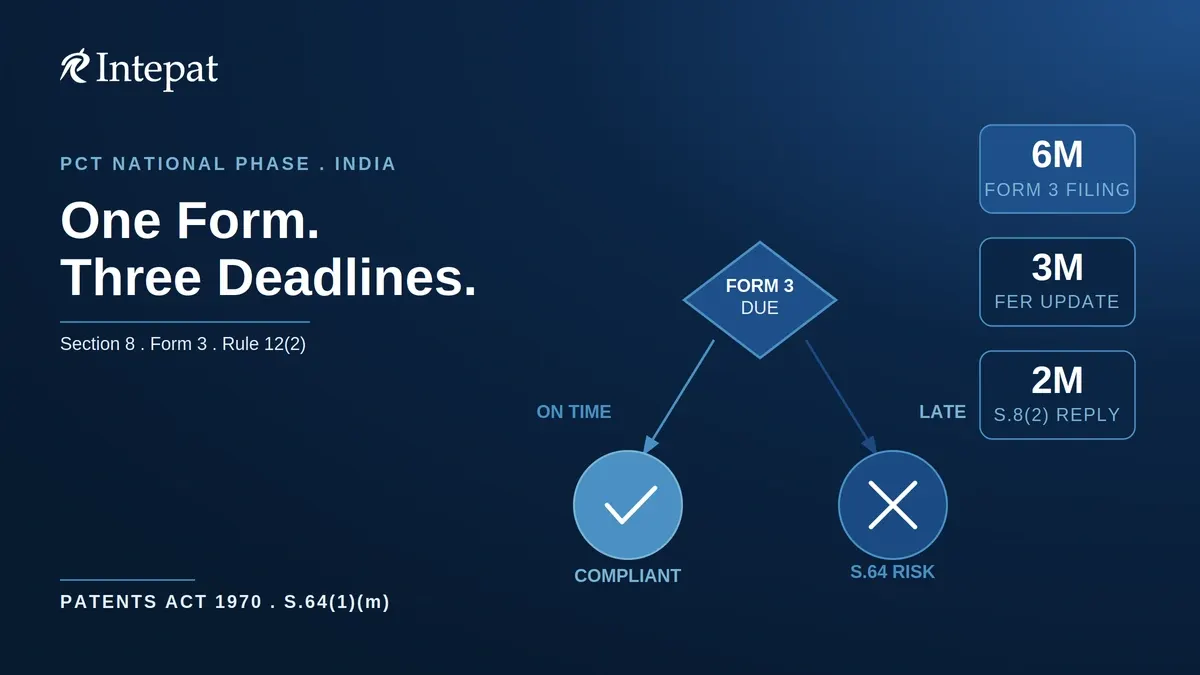
Every PCT application entering the Indian national phase carries a continuing disclosure obligation under Section 8 of the Patents Act 1970. The applicant must file Form 3 within six months of national phase entry, update it when the first examination report issues, and respond to any Controller direction within two months. Non-compliance is a ground for revocation under Section 64(1)(m).
| Quick answer |
| File Form 3 (no fee) within six months of the date you actually file your national phase application in India.Update the Controller within three months of the date the first statement of objections is issued.If you miss the Form 3 deadline, file a Form 4 condonation petition before the three-month extension window closes. |
In plain terms: Form 3 is India’s way of asking where else you have filed the same invention and what is happening in those patent offices. For a PCT national phase filing, it is not optional paperwork. It is a statutory disclosure obligation that must be tracked separately from the patent specification, the translation, the filing fee, and the FER response.
What Section 8 requires from a PCT applicant in India
Section 8 of the Patents Act 1970 imposes two distinct obligations on any applicant who is prosecuting, or who knows of someone prosecuting, an application for the same or substantially the same invention in any country outside India.
The first obligation, under Section 8(1)(a), is to file a statement setting out the name of the country, the application number, the filing date, and such other particulars as may be prescribed. The second obligation, under Section 8(1)(b), is to give an undertaking to keep the Controller informed of every subsequent corresponding foreign application until the date of grant in India.
For a PCT national phase application, both obligations apply from the date the corresponding national phase application is actually filed in India. The Section 8 obligation sits alongside the national phase entry requirements under Rule 20 of the Patents Rules 2003; paying the national fee and filing any required translation are separate steps, not substitutes for Form 3.
Section 8(2) also gives the Controller an independent power, exercisable at any time between filing and grant, to direct the applicant to furnish details of how corresponding foreign applications are being processed, including objections raised, amendments made, and claims allowed.
The Form 3 deadline for PCT national phase: how the six-month clock runs
Rule 12 of the Patents Rules 2003 sets the Form 3 deadline at six months from the date of filing the application. For a PCT national phase application, the six-month period is reckoned from the actual date on which the corresponding application is filed in India, not from the PCT international filing date and not from the priority date.
This distinction matters in practice. A PCT application designating India has a 31-month national phase entry window running from the priority date under Rule 20(4)(i). An applicant who enters the Indian national phase early gets six months from that early entry date; an applicant who waits until month 30 gets six months from that later date. In both cases the clock starts at the actual Indian filing.
Form 3 carries no fee when filed within the prescribed period. The First Schedule to the Patents Rules 2003 sets the fee for filing a statement and undertaking under Section 8 as nil for all applicant categories, whether filed electronically or physically (verified as of July 2026). The form requires the applicant to list every application for the same or substantially the same invention filed outside India as at the date of filing, with application numbers, filing dates, and current status.
Foreign counsel filing across multiple offices should note that the Section 8 obligation in India is broader than the duty to disclose prior art that applies in some other jurisdictions. It extends to all corresponding foreign applications, not only those that have generated search reports or office actions. An applicant who has entered the national phase in the US, EP, and Japan, as well as India, must list all three in Form 3 and keep the Indian Controller updated on each of them.
The continuing duty: when you must update Form 3 after the FER
The Section 8(1)(b) undertaking does not expire on filing Form 3. It requires the applicant to keep the Controller informed of every subsequent corresponding foreign application until the date of grant in India.
Rule 12(2) (as amended by the Patents (Amendment) Rules, 2024) sets a specific trigger for this update obligation: the applicant must keep the Controller informed of details in respect of other applications filed in any country within three months from the date of issuance of the first statement of objections under Rule 24B(3) or Rule 24C(8). When the first examination report is issued on the Indian national phase application, the applicant has three months from that date to update the particulars of corresponding foreign applications filed up to that point, covering application numbers, countries, filing dates, and current status.
This Rule 12(2) update covers application-level particulars. It is distinct from a direction the Controller may separately issue under Section 8(2), which can require the applicant to furnish prosecution details such as search and examination reports, objections raised, amendments made, and claims allowed or refused in corresponding foreign applications. A Section 8(2) direction, if issued, must be responded to within two months from the date of the Controller’s communication.
This three-month update window is shorter than the six-month window to put the application in order under Rule 24B. Applicants managing parallel prosecution in multiple jurisdictions should diarise the Form 3 update obligation as a separate action item alongside the FER response, not as a step within it.
Where the Indian Patent Office can access documents through the WIPO Centralized Access to Search and Examination (WIPO CASE) system, it may not require the applicant to physically resubmit documents that are available there, provided the applicant has filed a statement confirming availability. Per section 09.03.06 of the Manual of Patent Office Practice and Procedure, examiners are guided to check WIPO CASE before requiring further information under Section 8(2). This reduces the document burden in practice, but does not waive the Form 3 filing obligation or its deadline.
What happens if you miss the Form 3 deadline
The condonation and extension provision in Rule 12 of the Patents Rules 2003 permits the Controller to condone the delay or extend the time for filing Form 3 by up to three months, on a petition made in Form 4. The fee for this Form 4 request is prescribed in the First Schedule to the Patents Rules 2003: Rs 2,000 per month for natural persons, startups, small entities, and educational institutions filing electronically; Rs 10,000 per month for other applicants filing electronically; Rs 2,200 per month for natural persons, startups, small entities, and educational institutions filing physically; and Rs 11,000 per month for other applicants filing physically (verified as of July 2026).
The three-month condonation window is the only relief mechanism the Rules provide for a missed Form 3 deadline. Rule 137(2) of the Patents Rules 2003 expressly excludes the general extension mechanism under Rule 138 from applying to this condonation. There is no provision for a further extension after the three-month window closes. An applicant who misses the six-month period without filing a Form 4 petition within three months has left the delay unresolved.
The consequence of non-compliance is serious. Section 64(1)(m) of the Patents Act 1970 provides that a patent may be revoked on a petition of any person interested or of the Central Government, or on a counter-claim in a suit for infringement, where the applicant has failed to disclose to the Controller the information required by Section 8 or has furnished information which in any material particular was false to his knowledge.
Indian courts have interpreted this ground with some nuance. The revocation remedy under Section 64(1)(m) is discretionary: the word “may” in Section 64 means a court is not obliged to revoke solely and automatically on proof of non-compliance. Courts have considered whether the non-disclosure was deliberate or wilful and whether the undisclosed information was material to the grant.
These court decisions are defences against revocation after the event, not a substitute for timely filing. A granted patent carrying an unresolved Section 8 defect remains exposed to challenge at any point before expiry. Foreign applicants should not rely on the discretionary element of the revocation provision as a reason to treat the Section 8 timeline loosely.
Filing Form 3: what the form covers and how to submit it
Form 3 is a two-part document. The first part is the statement required under Section 8(1)(a): a list of every corresponding foreign application, with application number, country, filing date, and current status. The second part is the undertaking required under Section 8(1)(b): a commitment to keep the Controller informed of future corresponding applications until the date of grant in India.
For PCT national phase applications, the form is filed through the Indian Patent Office e-filing portal under the national phase application number. The form can be submitted along with the Form 1 national phase application at entry, or as a standalone filing within the six-month window. Where the PCT international application is the earliest application and there are no other corresponding national filings as at entry, the form is completed with the international application details alone; the undertaking then covers any subsequent national or regional entries.
Subsequent updates required under Rule 12(2) are filed as a fresh Form 3 submission under the same application number. No additional fee applies to timely subsequent filings. Applicants relying on WIPO CASE or WIPO DAS availability should include a statement in their Form 3 identifying the documents accessible through those systems and the relevant access codes.
For the full national phase entry procedure in India, including the 31-month deadline and the fee structure at entry, those articles cover the entry requirements alongside which the Form 3 obligation runs. The PCT overview covers the international phase in full.
What to include in Form 3: a PCT filing reference
Before filing or updating Form 3 for a PCT national phase application in India, confirm the following details are available:
- PCT international application number and international filing date.
- Priority application details (country, application number, filing date).
- All national or regional phase entries already filed, with application number, country or office, filing date, and current status.
- Publication date and disposal date for any corresponding application where available.
- The date the first examination report was issued in India, if updating under Rule 12(2).
- Whether the Controller has issued a separate direction under Section 8(2) requiring prosecution details.
- Whether the six-month Form 3 deadline has passed and a Form 4 condonation petition is needed.
Frequently Asked Questions
Yes, in practice. For a PCT national phase filing in India, Form 3 should disclose the PCT international application details and any corresponding foreign, national, or regional applications known at the time of filing. Where no separate national or regional entries exist yet, the undertaking should still be filed and updated when corresponding applications are later made.
Under Rule 12(1A) of the Patents Rules 2003, the deadline is six months from the actual date the corresponding national phase application is filed in India. The period runs from the Indian filing date, not from the PCT international filing date or the priority date.
No fee is prescribed for a timely Form 3. The First Schedule to the Patents Rules 2003 records the fee as nil for all applicant categories. A fee applies only on a Form 4 condonation petition: Rs 2,000 per month for natural persons, startups, small entities, and educational institutions (e-filing) or Rs 10,000 per month for other applicants (e-filing).
Rule 12(2) of the Patents Rules 2003 requires the applicant to keep the Controller informed within three months from the date of issuance of the first statement of objections under Rule 24B(3) or Rule 24C(8). The trigger is the issuance of the first examination report on the Indian application; the three-month window runs from that date.
No. WIPO CASE allows the Indian Patent Office to access search and examination documents from corresponding foreign applications and may reduce what the office requires under Section 8(2). It does not waive or extend the Form 3 deadline under Rule 12 or the obligation to file the initial statement and undertaking under Section 8(1).
Under Section 64(1)(m) of the Patents Act 1970, failure to disclose the information required by Section 8 is a revocation ground. The remedy is discretionary; Indian courts have held that willfulness and materiality are relevant. A granted patent with an unresolved Section 8 defect is exposed to challenge by any interested person or by the Central Government.
Rule 12 of the Patents Rules 2003 permits the Controller to condone the delay or extend the time for filing Form 3 by up to three months, on a petition in Form 4. No further extension is available once this window closes. An applicant who has missed the deadline should file the Form 4 petition promptly within that three-month period.
This article explains the law on Section 8 disclosure and Form 3 for PCT national phase applications in India as at July 2026 and is for general information only. It is not legal advice. Government fees, forms, and procedures change; confirm current figures with the Indian Patent Office before you file. For advice on your specific application, consult a registered patent agent. Deadlines in this area are strict, and missing one can result in the loss of rights. The figures and timelines here are indicative and change; do not rely on them for a specific filing without confirming the current position.
Note for CMS: the Rule 12 sub-rule number for the condonation provision requires gazette verification before publication. The First Schedule cross-references subrule (4); Rule 137(2) cross-references sub-rule (5). Cite by description pending confirmation against the Official Gazette.