



India’s DPIIT Committee published its first AI-and-copyright Working Paper in December 2025. The majority view recommends a mandatory blanket licence for AI training, with statutory royalties routed through a new collective called CRCAT. Nasscom dissented from inside the Committee, recommending TDM with opt-out. None of this is law yet. Section 52 of the Copyright Act 1957 still governs.
| Quick answer | |
| What’s proposed | Mandatory blanket licence on lawfully accessed works + statutory remuneration via a new collective body, CRCAT |
| Status | Working Paper Part 1, December 2025. Proposal only. Not law. |
| What governs AI training in India today | Copyright Act 1957; Section 52 fair dealing; ANI v. OpenAI (judgment reserved 27 March 2026) |
| Lawful access | Required under the proposal. Circumvention of paywalls or technological protection measures excluded. |
| Cost upfront for startups | None proposed. Royalties triggered only when the AI product earns revenue. |
| Dissent inside Committee | Yes. Nasscom recommends TDM with two-tier opt-out (Annexure E). |
| Coming next | Working Paper Part 2 will cover AI outputs, authorship, and moral rights. |
The legal gap: why Section 52 may not comfortably cover commercial AI training
The Copyright Act 1957 was framed long before machine learning. Section 14 grants the copyright owner an exclusive right to reproduce a work in any material form, including by storing it in any medium by electronic means. Training AI systems on copyright-protected works may engage that storage right, depending on the technical pipeline. Whether the act is excused under Section 52 turns on whether AI training falls within the listed categories: private or personal use including research, criticism, review, reporting current events, or transient incidental electronic storage during transmission.
On the Committee’s analysis of Section 52 fair dealing, set out in Section 2.3 of the Working Paper, commercial AI training is unlikely to fall within those enumerated exceptions. India has no general text-and-data-mining exception equivalent to United Kingdom CDPA Section 29A, Japan’s Article 30(4), or the European Union’s Articles 3 and 4 of Directive 2019/790.
The gap is being tested in court. In ANI Media Pvt Ltd v. Open AI Inc & Anr, CS(COMM) 1028/2024, the Delhi High Court is examining whether storage of copyrighted news data for AI training amounts to infringement, whether use of that data to generate user responses is infringing, whether the use qualifies as fair use under Section 52, and whether Indian courts have jurisdiction over a foreign defendant. Judgment was reserved on 27 March 2026 and is awaited. The pronouncement, depending on its scope, may produce India’s first substantive judicial guidance on AI training and copyright.
How the Committee got to a Hybrid Model
DPIIT constituted the Committee on 28 April 2025 with a mandate to identify the legal issues raised by AI systems, examine the existing copyright framework, and recommend changes. The first Working Paper, published in December 2025, deals with copyright-protected works as training input. A second Working Paper is expected to address AI outputs.
Six regulatory pathways were examined and found insufficient when applied in their traditional form. Voluntary direct licensing was unworkable at the scale of modern AI training, where billions of data points must be sourced. A blanket TDM exception, backed by parts of the tech industry in consultation, was rejected as a zero-price licence that would leave Indian creators uncompensated. A TDM exception with opt-out, of the kind used in the European Union under Article 4 of the DSM Directive, was found insufficient because India’s largely informal creative sector lacks the technical and bargaining capacity to opt out at scale. Traditional collective licensing through copyright societies was rejected because Indian copyright societies have incomplete membership: large parts of the regional and folk sector are not represented at all. Extended collective licensing depended on well-organised central groups absent in many Indian categories. Traditional statutory licensing, as the Section 31D broadcasting precedent illustrates, has historically taken years to set rates.
Stakeholders consulted included copyright societies (IPRS, PPL, IRRO, ISAMRA), music industry bodies (IMI, RMPL), news broadcasters, and tech companies. The tech industry majority backed a blanket TDM exception. The content industry was unanimous in its preference for voluntary licensing. From this divergence, the Committee built the Hybrid Model.
Inside the Hybrid Model: mandatory licence, CRCAT, royalty flow
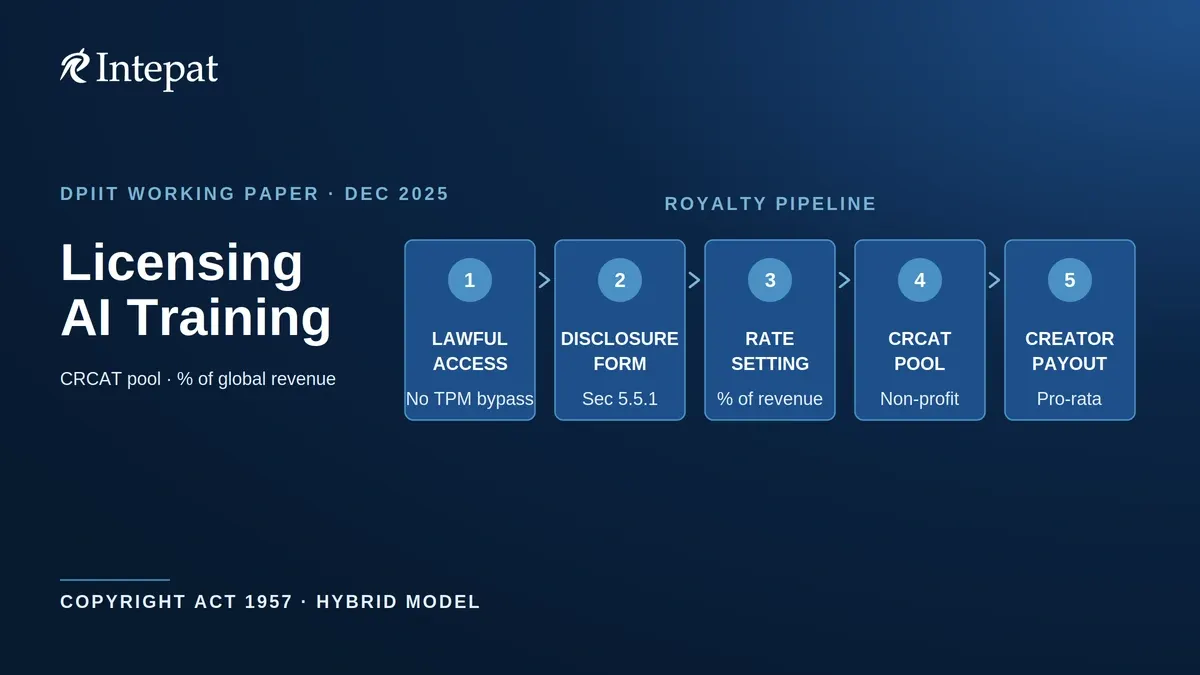
The Hybrid Model has six moving parts. The first is a mandatory blanket licence to be introduced into the Copyright Act 1957 itself. If enacted in the form proposed, the model would significantly limit a rightsholder’s ability to refuse training use of lawfully accessed works. The second is a single non-profit collecting body, the Copyright Royalties Collective for AI Training (CRCAT), designated by the Central Government. CRCAT membership would be restricted to one organisation per class of work, drawn either from copyright societies registered under Section 33 of the Copyright Act 1957 or from non-profit collective management organisations meeting eligibility thresholds set under the Copyright Rules.
The third is a strict lawful-access prerequisite. AI developers cannot rely on the licence to bypass technological protection measures, paywalls, or login-gated content. The blanket licence covers only what was lawfully obtained.
The fourth is a government-appointed Rate-Setting Committee that would fix royalty rates as a flat percentage of the AI system’s total global revenue, review them every three years, and operate under judicial review. For startups, the timing matters. No royalty would be payable during the training and pre-launch period; payments would be triggered only when the AI product begins generating revenue. This pay-as-you-earn structure draws from the broader logic of statutory royalty rights already familiar in Indian copyright.
The fifth is the AI Training Data Disclosure Form. Under Section 5.5.1 of the Working Paper, each AI developer would file a “sufficiently detailed summary” with CRCAT covering data categories under Section 14 (text, images, music, sound recordings), data sources, and the nature of the content. The Working Paper is explicit that the form is not designed to expose trade secrets; it is modelled on the EU AI Act’s Recital 107 standard.
The sixth is distribution. CRCAT would divide collected royalties among its members based on disclosure data, and members would in turn distribute to registered creators using either a pro-rata method or a value-based method weighted by traffic, awards, and licensing history. Creators do not need to be members of a copyright society to claim, but must register their works in a central database. For sectors without organised representation, royalties would be held in a Welfare Fund. If a sector forms a CMO within three years, the fund would flow to it; if not, the money would be deployed for community-level use.
The dissent inside the Committee: Nasscom’s TDM with opt-out
Not every Committee member endorsed the Hybrid Model. Nasscom, represented on the Committee by Sudipto Banerjee, lodged a formal written dissent on 17 August 2025. Nasscom’s recommendation, recorded verbatim in Section 5.1 of the Working Paper and elaborated in Annexure E, is materially different in architecture.
Nasscom proposes a Text and Data Mining exception covering both commercial and non-commercial purposes, conditioned on lawful access and a “good faith knowledge safeguard,” applicable solely to the training and input-processing stage of machine learning. Rightsholders would retain control through a two-tier opt-out: for content publicly accessible online, opt-out would operate through machine-readable signals at the point of availability; for content not publicly accessible, opt-out would operate through contract or licence terms.
The architectural difference is fundamental. The majority view starts from compulsory remuneration with no ability to refuse. Nasscom’s view starts from default permission with a structured ability to refuse. The Working Paper records the rest of the Committee endorsing the Hybrid Model and rejecting TDM-with-opt-out for reasons set out in Section 4.2.
In a separate public submission in February 2026, Nasscom developed its critique further: DPIIT had not yet conducted a baseline assessment of India’s existing licensing market; rates set through stakeholder consultation without market signals risk systemic mispricing; and the ownership-tracing infrastructure assumed by the Hybrid Model may not yet be mature at the scale AI training requires. Nasscom recommended a UK-style process, with technical working groups producing evidence-led reports before legislation.
MEITY’s submission aligns with the majority concern
The Ministry of Electronics and Information Technology has signalled support for the Hybrid Model. MEITY’s submission to the DPIIT Committee, attached as Annexure D to the Working Paper, frames copyright as protecting “the sanctity of labour” and rewarding human creative thought. It rejects the proposition that the public-good potential of AI can be a qualifying criterion for unconditional immunity from legal challenge.
MEITY recommends designing the framework to “preclude disputes and litigation” through clear rules at copyright society and CMO level, with grievance redressal at both tiers. This places MEITY on the majority side of the Committee’s debate.
Where India’s proposal sits globally
For Indian AI startups operating cross-border, the Hybrid Model sits uneasily alongside every major comparable regime.
The European Union, under Articles 3 and 4 of Directive 2019/790, permits TDM by default and requires rightsholders to opt out actively. Japan, under Article 30(4) of its Copyright Act since the 2018 amendment, permits commercial and non-commercial AI training without an opt-out, subject only to lawful access. The United Kingdom limits its TDM exception under CDPA Section 29A to non-commercial research. Singapore’s Section 244 of the Copyright Act 2021 covers computational data analysis for both commercial and non-commercial use, again subject to lawful access.
The United States offers no TDM statute. Each AI training case turns on the four-factor fair-use analysis under Section 107 of the US Copyright Act, as the New York Times case against OpenAI continues to test. Recent district court decisions illustrate how unsettled the position remains. In Bartz v. Anthropic and Kadrey v. Meta Platforms, the Northern District of California granted summary judgment of fair use to the AI developer in 2025, emphasising transformative training. In Thomson Reuters v. ROSS Intelligence, the District of Delaware reached the opposite conclusion in February 2025, finding infringement where Westlaw headnotes were used to build a competing product.
India’s proposal departs from each of these. Among the major comparator regimes, India’s is distinctive in placing statutory remuneration at the centre of the AI-training framework. The closest existing Indian analogue is Section 31D of the Copyright Act 1957, which provides a statutory licence for broadcasting. The Hybrid Model extends that statutory-licensing logic to a domain orders of magnitude larger.
The international compatibility question: Berne 9(2) and TRIPS 13
Whether the Hybrid Model is compatible with India’s international copyright obligations is a question the Working Paper does not engage with substantively. It deserves close attention.
Article 9(2) of the Berne Convention, to which India is a signatory, permits member states to legislate exceptions to the reproduction right only where three cumulative conditions are met: the exception applies in “certain special cases”; it does “not conflict with a normal exploitation of the work”; and it does “not unreasonably prejudice the legitimate interests of the author.” Article 13 of the TRIPS Agreement extends this three-step test to all exclusive rights and is binding on India as a WTO member.
The Hybrid Model is not, in form, a Berne Article 9(2) exception. It does not eliminate the rightsholder’s claim to remuneration; it converts the right of authorisation into a right of compensation. That structure has Berne precedent. Article 11bis(2) of Berne permits member states to legislate conditions on broadcasting rights, including compulsory licensing, provided the author’s right to equitable remuneration is secured.
The closer question is whether “all lawfully accessed copyright-protected works” satisfies the “certain special cases” limb of the three-step test. A general-purpose AI training carve-out, applied to every category of work and every kind of use within the training pipeline, may invite scrutiny on this limb. The Working Paper’s framing of AI training as a single delineated activity, distinct from downstream output use, will be tested in this respect. Treaty compatibility is not a fatal challenge to the model, but it is a risk Indian draftsmen must address explicitly when the wider AI-IP framework is converted into a Bill.
Pending Indian litigation: ANI v. OpenAI and what’s at stake
The most significant Indian test of AI training and copyright is already in court. The ANI v. OpenAI India case, formally ANI Media Pvt Ltd v. Open AI Inc & Anr before the Delhi High Court, alleges infringement by OpenAI through the use of news content in ChatGPT training and outputs. Justice Amit Bansal identified four questions by order dated 19 November 2024: storage infringement, use-for-output infringement, Section 52 fair-use applicability, and territorial jurisdiction.
OpenAI’s counsel informed the Court that the defendant had blocklisted www.aninews.in in October 2024. The Court appointed Adarsh Ramanujan, Advocate (also a DPIIT Committee member), and Professor Arul George Scaria of NLSIU as amici curiae. Six intervenors joined: the Digital News Publishers Association, Indian Music Industry, and Federation of Indian Publishers backed ANI; the Broadband India Forum, Flux Labs AI Private Limited, and IGAP Project LLP backed OpenAI. Related interventions in adjacent matters have also emerged.
The bench heard 32 hearings between November 2024 and 27 March 2026, when Justice Amit Bansal reserved judgment on ANI’s interim application. The Working Paper acknowledges this litigation but proceeds on the basis that “awaiting finality on such pending litigations may not be optimal.” Whether the Hybrid Model becomes law before ANI is pronounced is itself a policy question.
What AI builders in India should do now
Until the Hybrid Model is enacted by Parliament and given operational shape through amended Copyright Rules and a constituted CRCAT, no AI builder in India is required to do anything specific under it. The right move is to plan for it.
For startups training models on Indian content today, the operative framework remains the Copyright Act 1957, Section 52 fair dealing, and the eventual ratio in ANI v. OpenAI. Defensive practice is to record lawful-access provenance for every dataset used in training, avoid circumventing paywalls or technological protection measures, and maintain documentation of dataset categories, sources, and content nature in a form convertible to the proposed AI Training Data Disclosure Form.
For builders deploying internationally, the Indian proposal does not relieve compliance with EU Directive 2019/790 opt-out signals, Japan’s Article 30(4) lawful-access requirement, or US fair-use risk. How a model trained outside India but deployed to Indian users would be treated is left open by the Working Paper and remains an unresolved question. Adjacent obligations under the Digital Personal Data Protection Act 2023 layer on top: copyright compliance is not privacy compliance, and a dataset lawful under one regime can be unlawful under the other.
For in-house counsel, the public consultation on Part 1 closed on 6 February 2026, after DPIIT extended the original 7 January deadline by 30 days. The next watchpoints are Working Paper Part 2 on AI outputs, any draft Bill, and the Delhi High Court’s pronouncement in ANI v. OpenAI.
What to watch through 2026
Three timelines will determine whether this proposal becomes law. The first is the Delhi High Court’s pronouncement in ANI v. OpenAI, where judgment has been reserved since 27 March 2026; the eventual ruling on Section 52 may relieve some of the urgency the Hybrid Model is designed to address. The second is the publication of Working Paper Part 2 on AI outputs, which is expected to land before any Bill is drafted. The third is what DPIIT does with the consultation responses received by 6 February 2026. Nasscom’s dissent, the content industry’s preference for voluntary licensing, and MEITY’s endorsement will all weigh in the parliamentary process. The wider AI copyright law debate in India is far from settled, and the final Bill will not be the Working Paper’s first draft.
Frequently Asked Questions
No. The Hybrid Model is a recommendation in DPIIT’s Working Paper Part 1, published in December 2025. Implementation requires amendments to the Copyright Act 1957, new Rules under the Copyright Rules 2013, and the formal designation of CRCAT. None of these steps has been taken at the time of writing.
Indian law has no general TDM exception. Training that involves storage and reproduction of copyrighted works engages Section 14 of the Copyright Act 1957. Whether Section 52 fair dealing protects it is unsettled and is now reserved for judgment by the Delhi High Court in ANI v. OpenAI. Conservative practice is to obtain licensed datasets where possible.
Under the proposal, no. The Rate-Setting Committee is to fix royalties as a percentage of the AI system’s total global revenue, payable only after the system begins earning. Pre-revenue startups in training and development would owe nothing during that period under the Hybrid Model as currently drafted in the Working Paper.
The Working Paper does not expressly address cross-border training and deployment. The royalty rate is described as a percentage of the AI System’s total global revenue, but how that applies when training occurs outside India and deployment touches Indian users is left unresolved. Builders should treat this as an open question for the consultation period.
Section 5.2 of the Working Paper proposes that the lawful-access requirement attach prospectively only. Past use of copyrighted works for training would continue to be governed by the existing Copyright Act 1957 framework as interpreted by Indian courts in cases such as ANI v. OpenAI. Pre-enactment liability is not extinguished by the proposal.
No. Under the proposed Hybrid Model, lawful access is the entry condition for the blanket licence, not a permission to use copyrighted works without payment. If the framework is enacted, royalty obligations would arise once the AI system is commercialised. Pre-revenue training and development would be cost-free under the proposal; revenue-generating deployment would not.
Under current Indian law, there is no specific TDM opt-out regime equivalent to the European Union model under Article 4 of the DSM Directive. Under Nasscom’s dissenting proposal, machine-readable opt-outs would matter for publicly accessible online content. Under the majority Hybrid Model, opt-out is not the central mechanism. Builders deploying across the EU and India should track both.
EU Directive 2019/790 permits commercial AI training under Article 4 by default, with rightsholders required to opt out through machine-readable signals. India’s Hybrid Model removes the opt-out and replaces refusal with a statutory right to remuneration. The architectures are different, and an Indian-deployed AI system must comply with both regimes if it operates across both markets.
AI Data Risk?
If your AI product uses third-party datasets, web-scraped content, licensed corpora, or user-generated content, the Indian copyright position deserves a closer look before deployment. Intepat IP advises AI developers, content rightsholders, and in-house counsel on training-data provenance, licensing posture, and India-facing copyright risk under the Copyright Act 1957 and the evolving DPIIT framework. To discuss your position, contact our copyright services team.
Disclaimer. This article reflects the position as at 13 May 2026. The DPIIT Hybrid Model discussed here is a recommendation in Part 1 of a Working Paper published for stakeholder consultation in December 2025; the consultation closed on 6 February 2026, and the Model is not enacted law. The Copyright Act 1957, including Section 52 fair dealing, and pending litigation before the Delhi High Court in ANI v. OpenAI (judgment reserved on 27 March 2026), remain the operative framework governing AI training and copyright in India. Nothing in this article constitutes legal advice. Builders, content creators, and counsel should consult qualified counsel before relying on any feature of the proposed framework.