




On 15 April 2026, the Indian Patent Office refused Application No. 202017019068 (Thaler / DABUS), holding that an artificial intelligence system cannot be recognised as the “true and first inventor” under the Patents Act, 1970. The refusal rested on two independent grounds: non-compliance with Sections 6, 7 and 10 on inventorship, and lack of inventive step under Section 2(1)(ja).
The article is scoped to Indian law, with comparative references included where reflected in the Controller’s reasoning. The orders discussed reflect current examination practice at the Controller level and are persuasive in understanding how similar issues may be approached. However, they have not been tested on appeal and should not be treated as settled law across jurisdictions. The analysis therefore tracks the Controller’s reasoning rather than presenting a conclusive pan-Indian legal position.
Practitioner takeaways
- The two orders: the refusal under Section 15 and the rejection of the pre-grant opposition under Section 25(1) and Rule 55.
- Refusal rests on two independent grounds: inventorship non-compliance with Sections 2(1)(y), 6, 7 and 10, and lack of inventive step under Section 2(1)(ja).
- The companion opposition order holds that inventorship objections fall outside Section 25(1)(f), which tests patentability of the claim, not entitlement to apply.
- A PCT Rule 4.17(ii) declaration does not cure the Indian statutory defect; because Section 138(4) gives the PCT application the effect of a Section 7 application, the Indian inventorship requirements still apply.
- AI-assisted inventions remain patentable where a human inventor is identified and disclosure meets Section 10 and CRI Guidelines 2025 standards.
The DABUS orders: what the Controller actually held
Both were issued by Assistant Controller Neeraj Kumar Meena on an application filed on 5 May 2020 by Stephen L. Thaler naming DABUS (Device for the Autonomous Bootstrapping of Unified Sentience) as inventor. The First Examination Report issued on 26 October 2021, and the Section 14 hearing was held on 12 March 2026.
The Section 15 refusal sustained the inventorship objection under Sections 2(1)(y), 6, 7 and 10 and the inventive-step objection under Section 2(1)(ja). The Section 25(1) and Rule 55 order disposed of the pre-grant opposition separately. Position verified against the orders.
The inventive-step analysis in the Section 15 order runs on conventional problem-solution lines. The person skilled in the art is a mechanical or packaging engineer, or a container-design technologist. D1 (a cylindrical container with part-cylindrical abutment surfaces) is the closest prior art; the distinguishing features of Claim 1 reduce to a “fractal” surface geometry and a flexible wall enabling elastic coupling. The objective technical problem is framed as how to provide an alternative surface-profile configuration for releasable engagement between adjacent containers, and the combination of D1 with D2 (annular flanges, collars and threaded engagement structures) and D3 (projections on an inner resin layer) is held to be routine workshop modification. The fractal descriptor is treated as a geometry variation unsupported by comparative data, and wall flexibility as inherent to polymeric or thin metallic container materials. Claims 2–9 fall with Claim 1. The order reinforces that characterising a known structural variation using a mathematical descriptor such as “fractal” does not establish inventive step without a demonstrable technical effect. Even if the inventorship defect were cured by naming a human inventor, the application would still fail on this independent ground.
Why AI fails the Sections 6, 7 and 10 test
Section 6(1) restricts the right to apply to three categories: the true and first inventor, the assignee of such inventor, or the legal representative of a deceased inventor. Each presupposes a natural person capable of holding rights, assigning them, and being represented after death. An AI system cannot satisfy any of these attributes because it possesses no legal personality in either the natural or the juristic sense.
Section 7 carries the architecture into filing requirements. Section 7(2) requires proof of right from the inventor where the application is made by an assignee, Section 7(3) requires naming the true and first inventor with a supporting declaration, and Section 10(6) prescribes a declaration of inventorship. Each requires particulars only a legal person can furnish, including nationality, address, and a valid signature. A machine cannot execute a declaration, and the defect is not a formality that can be cured during prosecution. The applicant’s express disclaimer that no human inventor existed foreclosed compliance with Sections 6 and 7, turning a drafting issue into a structural defect.
Section 2(1)(y) is a negative definition providing only that the “true and first inventor” does not include the first importer or a person to whom the invention is first communicated from outside India. Read in isolation, it does not exclude a non-human inventor; read harmoniously with Sections 6, 7 and 10, the surrounding provisions require capacity to assign rights and execute declarations, which presupposes a human actor.
The applicant argued that Section 2(1)(s), which extends “person” to include Government, demonstrates that inventorship is not confined to natural persons. The Controller rejected this. Where Parliament intended to extend “person” expressly, it did so; Section 3(42) of the General Clauses Act, 1897 extends “person” only to entities with statutory or common-law legal recognition, which AI systems do not possess under any Indian statute.
The applicant argued that Section 2(1)(s), which extends “person” to include Government, demonstrates that inventorship is not confined to natural persons. The Controller rejected this. Where Parliament intended to extend “person” expressly, it did so; Section 3(42) of the General Clauses Act, 1897 extends “person” only to entities with statutory or common-law legal recognition, which AI systems do not possess under any Indian statute.
Section 25(1)(f) does not extend to inventorship objections
The pre-grant opposition was filed on two grounds: Section 25(1)(f), citing Sections 3(b) and 3(c), and Section 25(1)(h), for non-compliance with Section 8. The principal contention was that DABUS could not be recognised as an inventor under Sections 2(1)(y), 6 and 7.
Paragraph 8 of the opposition order carries the operative reasoning. Section 25(1)(f) permits opposition on the ground that the subject matter of a claim is not an invention within the meaning of the Act or is otherwise not patentable. Inventorship, however, is addressed under Sections 2(1)(y), 6 and 7, which govern the concept of the true and first inventor, entitlement to apply, and related procedural compliance. The Act does not provide a distinct ground under Section 25(1) to challenge inventorship as a standalone issue. An objection directed solely to the identity or status of the inventor therefore does not properly fall within Section 25(1)(f), unless framed to implicate patentability or statutory non-compliance.
The Section 25(1)(h) ground was rejected as the Controller found that the applicant had furnished the corresponding foreign application details in compliance with Section 8. The challenges under Sections 3(b) and 3(c) were also rejected: a fractal-walled food container bears no nexus to public order, morality, or environmental harm, and the claimed structural wall configuration constitutes a technical feature rather than a mere discovery of a scientific principle or abstract theory.
PCT Rule 4.17(ii) does not cure the Indian statutory defect
Many AI-related applications reach India through the PCT route. The applicant relied on the PCT Rule 4.17(ii) declaration, arguing that it should satisfy Indian inventorship requirements on national phase entry. The Controller rejected this position. Section 138(4) provides that a PCT application designating India has the effect of an application under Section 7, meaning that Section 7 continues to apply rather than being displaced. Where the named inventor is not a legally recognisable person under Indian law, a procedural declaration cannot cure the underlying defect. The order also relied on the IPAB decision in OA/39/2011/PT/CH dated 28 October 2013, which held that formal proof of right is mandatory for PCT national phase applications in India even where priority is established.
The applicant also advanced an ownership-of-AI theory, arguing that Thaler’s ownership of the source code and the computer, together with responsibility for the operation and maintenance of DABUS, conferred entitlement. This was rejected. Section 7(2) requires proof of a right derived from the inventor, and ownership of a machine does not establish a chain of title unless the right originates from a legally recognisable inventor. The Full Federal Court of Australia in Commissioner of Patents v Thaler adopted similar reasoning, interpreting entitlement provisions analogous to Section 7 as requiring derivation from a natural-person inventor. A national phase entry supported by a Rule 4.17(ii) declaration naming an AI system as inventor cannot be cured by subsequent amendment, as the defect exists at the time of filing.
AI-generated versus AI-assisted inventions under the CRI Guidelines 2025
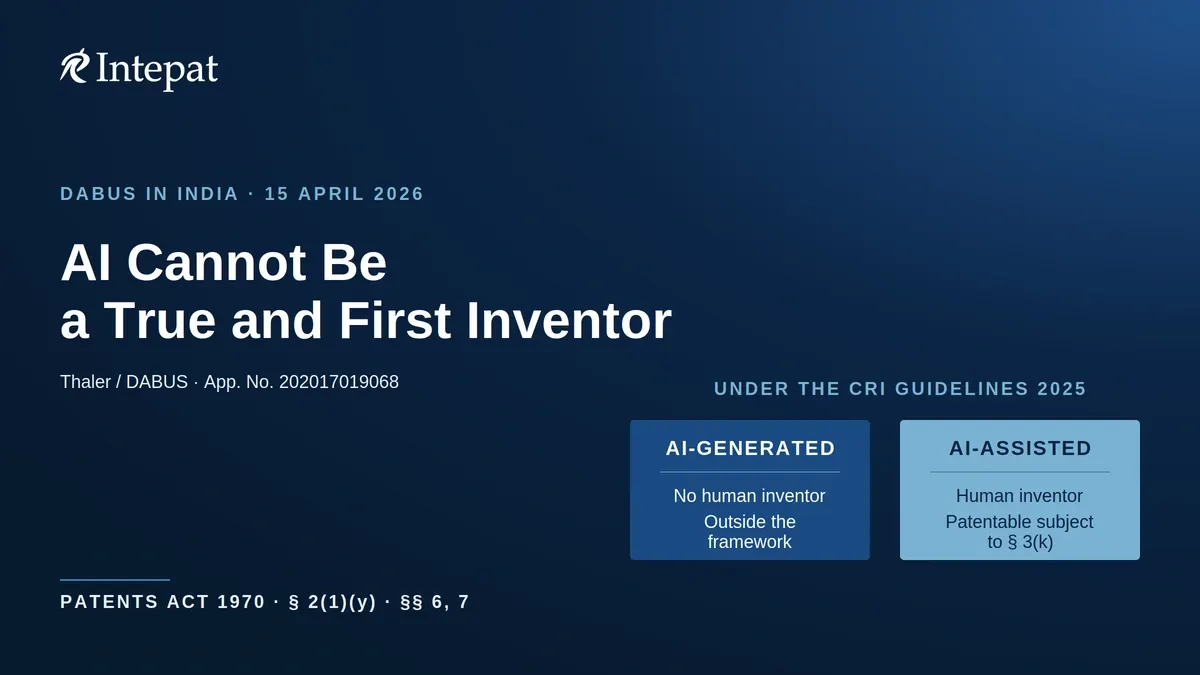
The refusal does not render AI-involved inventions unpatentable in India. The Guidelines for Examination of Computer Related Inventions, 2025, notified on 29 July 2025, distinguish between AI-generated and AI-assisted inventions. This distinction does not arise from the orders themselves but reflects the current examination framework applied by the Controller.
An AI-generated invention is one produced autonomously by an AI system without human inventive contribution and falls outside the present statutory framework. By contrast, an AI-assisted invention, where AI operates as a tool within a human-directed inventive process, is not excluded per se and is assessed against the standard patentability criteria, including novelty, inventive step, industrial applicability, and the Section 3 exclusions, most commonly Section 3(k).
The technical-effect requirement under Section 3(k) remains the principal threshold for AI and software-related inventions. The Delhi High Court in Ferid Allani v. Union of India clarified that computer-related inventions are not excluded where they demonstrate a technical effect, and the CRI Guidelines 2025 consolidate this approach in examination practice.
The operative distinction lies in inventive contribution. Where a human has directed the inventive process, selected system architecture, curated or structured training data, or made the technical choices leading to the claimed effect, the invention is treated as AI-assisted and prosecutable. Where human involvement is limited to providing the system and obtaining the output, the invention falls within the AI-generated category.
Drafting and prosecution implications for AI-involved inventions
First, the human inventor must be identified with precision. Inventorship follows contribution, not facilitation. In AI-assisted work, the inventive contribution may lie in system architecture, parameter selection, data curation, or problem formulation. Form 1, Form 5 and the assignment chain must align, as any inconsistency creates an entitlement risk that cannot be cured on the merits.
Second, enablement under Section 10 assumes heightened importance. The CRI Guidelines 2025 raise the disclosure threshold for AI and machine-learning inventions. A specification that merely aggregates known techniques without disclosing implementation details sufficient to enable reproduction will not satisfy Section 10(4). Disclosure expectations now extend to aspects such as model architecture, training data characteristics, parameterisation, and convergence behaviour where relevant to the claimed invention.
Third, the PCT route requires careful handling at the examination stage. National phase entry should be assessed against the Indian entitlement framework at the outset. Where the international filing proceeds on inventorship assumptions that are not recognised under Indian law, the national phase must be structured to ensure full compliance with Section 7.
The Indian patent framework continues to protect innovation involving AI, but only within a human inventorship model. The orders apply the existing statutory structure to a boundary case, and on the Controller’s analysis, that framework remains intact.
Disclaimer: This article is provided for general informational purposes and does not constitute legal advice. The orders discussed are recent and may be subject to review. For advice on specific applications, PCT national phase entries, or ongoing prosecution matters, consult a registered patent agent or attorney. Reading this article does not create an attorney-client or agent-client relationship.