




The Bolar exemption in India is Section 107A of the Patents Act, 1970. It permits making, constructing, using, selling or importing a patented invention without infringement liability, solely for uses reasonably related to developing and submitting information required under Indian or foreign regulatory law.
The provision does not expressly mention export, but the Delhi High Court has held that a qualifying export sale can fall within its protection. In Novartis AG v. Venkata Narayana Active Ingredients Pvt. Ltd. (Madras High Court, 3 June 2026, neutral citation 2026:MHC:1874), a Chennai API manufacturer’s Section 107A defence failed because it could not document that its exports of a patented diabetes drug ingredient were genuinely tied to a regulatory approval process, not ordinary commercial supply.
Quick answer
- Section 107A protects regulatory-use acts, not commercial sales; the Madras High Court in Novartis held that the party invoking it must prove the exemption applies.
- Marking an invoice “for R&D use only” is not, by itself, sufficient evidence.
- Where the buyer is not itself the manufacturer, the Madras High Court expects evidence of the buyer’s request for supply, evidence regulatory approval was sought, and evidence the regulator asked for the underlying data.
There is no statutory quantity cap, but quantity, purchase-order language and buyer conduct are all evidence the court will weigh.
What Is the Bolar Exemption in India Under Section 107A?
Section 48 of the Patents Act, 1970 gives a patentee, for a product patent, the exclusive right to prevent third parties from making, using, offering for sale, selling or importing the patented product in India without consent, for the life of the patent. Section 107A carves a narrow exception into that exclusivity. It provides that certain acts “shall not be considered as an infringement of patent rights,” specifically, making, constructing, using, selling or importing a patented invention “solely for uses reasonably related to the development and submission of information required under any law for the time being in force, in India, or in a country other than India, that regulates the manufacture, construction, use, sale or import of any product.”
The provision traces to the US case that gave the exemption its name, Roche Products v. Bolar Pharmaceutical (1984). As quoted by the Madras High Court in Novartis, India’s Joint Parliamentary Committee explained the provision was meant “to ensure prompt availability of products, particularly generic drugs, immediately after the expiry of the term of the patent.”
Section 107A is not a general research exemption. India already has a separate carve-out in Section 47(3), covering use “for the purpose merely of experiment or research including the imparting of instructions to pupils.” Section 107A serves a narrower purpose: letting a generic manufacturer or ingredient supplier generate the stability, bioequivalence and clinical data a regulator needs, so a generic version can be filed for close to the moment the patent lapses. It authorises regulatory preparation before expiry, not commercial exploitation dressed up as research.
Does Section 107A Permit Exports From India?
Section 107A does not use the word “export.” The acts it lists are making, constructing, using, selling and importing. The leading authority on whether a cross-border sale of a patented ingredient can nonetheless qualify is the Delhi High Court’s Division Bench in Bayer Corporation v. Union of India (2019:DHC:2199-DB), which held that “sale” in Section 107A is not confined to a sale within India and that an export sale can fall within the exemption, provided the underlying purpose is regulatory rather than commercial.
Bayer did not stop there. It set out ten non-exhaustive considerations relevant to whether a particular export genuinely serves a regulatory purpose, later quoted in full and expressly endorsed by the Madras High Court in Novartis. Seven go to the transaction itself: the patent granted; the nature of the product or elements exported; particulars of the importing party; the quantity exported; end-use particulars establishing the export is solely for research and regulatory information; the relevant foreign regulations, including the scope of inquiry and quantities required, to be supplied by the exporter to the buyer; and an authentic English translation where the foreign regulations are not in English. Three go to procedure and remedy if the exemption is later found not to apply: an appropriate interim undertaking to compensate the patentee if the suit is decreed; verification, where necessary, through the Indian mission abroad; and, where the exported article turns out not to be patented at all, suitable restitutionary relief to the defendant. Bayer was explicit that this list is indicative, not exhaustive, and that it created no unrestricted right to export a patented product during the patent term. An exporter still has to show, on the facts, that the “solely” and “reasonably related” conditions in the statute are met.
What Happened in Novartis v. Venkata Narayana?
Novartis AG, together with its Indian subsidiary and trademark user, Novartis Healthcare Pvt. Limited, which markets Galvus and the combination product Galvus Met/Eucreas in India, held Indian Patent 212815 for vildagliptin, a Type 2 diabetes molecule. The patent’s twenty-year term, the Madras High Court held, ran from the international PCT filing date of 9 December 1999, so it expired on 9 December 2019, not a year earlier as the defendant argued.
Venkata Narayana Active Ingredients, a Chennai-based API manufacturer, exported vildagliptin API to several Egyptian buyers between 2016 and 2018, including consignments of 200 kilograms to one buyer and 800 kilograms to another. The defendant had, in 2015, given the Madras High Court an undertaking in an earlier suit over the same patent, promising not to manufacture, sell, export or otherwise deal in vildagliptin. The court found, from the defendant’s own ARE-1 export documentation, that exports of vildagliptin to Egypt had begun by December 2014, before that 2015 undertaking was given, and that this earlier export history was not disclosed to the court when the undertaking was recorded. Novartis’s 2018 suit followed its discovery of the continuing exports, supported by an IQVIA market-intelligence report that the Egyptian buyers were already commercially marketing finished vildagliptin formulations. The court treated that as evidence of the buyers’ general commercial activity, but expressly declined to conclude from it alone that the specific API the defendant exported was what got resold.
The court decreed the suit substantially in terms of the plaintiffs’ prayers: a permanent injunction against further manufacture, sale or export of vildagliptin, and delivery up of infringing stock. On damages, it declined to fix a lump-sum figure: Novartis had put a supply value of Rs. 34.95 crore to the court only in written arguments, not in its proof affidavit or other evidence, so the court could not treat that figure as proved. Instead it ordered rendition of accounts followed by a decree of profits, with costs to be fixed by the Taxing Officer. A separate prayer for a mandatory injunction was rendered otiose because the patent had already expired by the time of judgment.
Why Did the Section 107A Defence Fail?
The defendant’s case rested largely on invoices and purchase orders. Some of the invoices carried a printed note that the material was for research and development purposes, but the corresponding purchase orders, the documents recording what the buyer actually asked for, carried no such notation. The Madras High Court held that an R&D notation appearing only on the seller’s own invoice, with nothing in the buyer’s purchase order or other corroborating material connecting the supplies, quantities and buyers to an identified regulatory process, was insufficient to establish the exemption. The court read Section 107A as imposing two conditions the defendant had to prove: that the regulatory purpose was the sole purpose of the export, and that the export was reasonably related to that regulatory purpose.
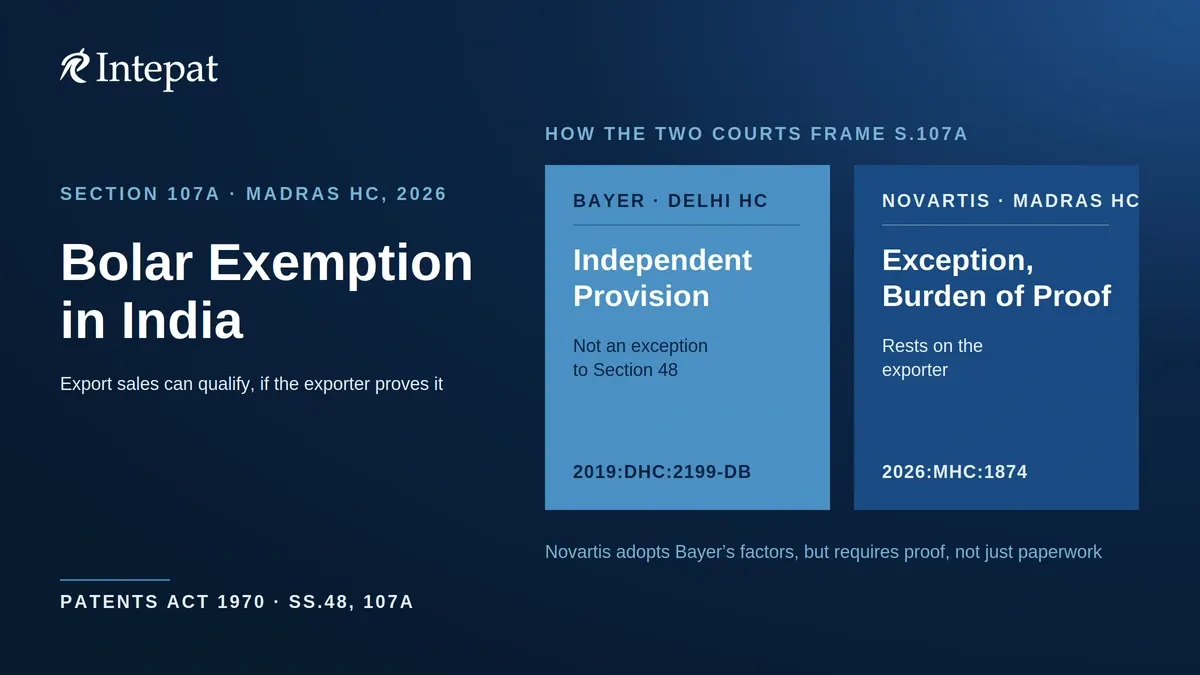
Because Section 107A operates, in the Madras High Court’s view, as an exception to the patentee’s Section 48 rights, the court held the burden of proving both conditions rests on the party invoking it, here the exporter. That characterisation is where Novartis parts from Bayer’s Division Bench, which had described Section 107A as an independent provision rather than a conventional exception; the doctrinal difference, and what it does and does not change in practice, is discussed further below.
On the facts, the court found the defendant’s documentation wanting on several fronts. None of the Egyptian purchase orders indicated that the quantities involved were needed for a regulatory purpose. Certificates later obtained from two buyers, describing the purchases as being for bio-equivalence or process-validation studies, did not disclose the signatories’ designation or authority, and neither was corroborated by any document from an Egyptian regulatory authority; the court described them as not inspiring confidence for these reasons. The defendant’s own quality assurance witness admitted in cross-examination that customers sometimes said they wanted the product “for trial purpose,” but that the company did not verify this.
The Madras High Court referred to a 2024 decision of the Italian Court of Cassation in a dispute involving Boehringer Ingelheim, as quoted and discussed within the Novartis judgment. That decision, on the Madras High Court’s account, required the regulatory-purpose relationship between an API supplier and the party seeking approval to be identifiable from the inception of the transaction, arising from a specific request or commissioning arrangement, which the defendant’s purchase orders lacked. Applying comparable reasoning, the Madras court concluded the exports were not proved to be solely for, or reasonably related to, a genuine regulatory approval process in Egypt. The court did not hold that exporting a patented API is inherently infringing or that Section 107A cannot cover exports; the finding was confined to this defendant’s exports.
What Evidence Should an API Manufacturer Retain?
The Madras High Court was explicit that the evidence needed will depend on the facts of each case and that its own list is not exhaustive. It nonetheless stated that, at a minimum, four categories of documents should be provided by a party relying on Section 107A: evidence that regulatory approval was sought for the patented product, in India or abroad; evidence that the regulator requested product-related data, such as pre-clinical or clinical trial data; where the party seeking approval is not itself the manufacturer, evidence of that party’s request for supply; and evidence that the supply was reasonably related to the request for regulatory approval. The court separately endorsed Bayer’s broader factors set out above as also relevant.
Section 107A’s own text covers uses reasonably related to both the “development” and “submission” of regulatory information. Novartis did not decide, one way or the other, whether or on what evidence a supply made before any formal regulatory application or regulator request would qualify; the judgment’s minimum-evidence categories are framed around proof that approval was sought and that the regulator requested data, and the article does not draw a further inference from the statutory wording beyond what the judgment itself decided.
Will the Government Prescribe Section 107A Documentation Rules?
The Madras High Court did not leave this uncertainty entirely to future litigation. It recommended that the Central Government, using its general rule-making power under Section 159 of the Patents Act, frame rules after consulting stakeholders to specify the documentary requirements for relying on Section 107A, so the provision is not abused to circumvent Section 48. Readers should check the current position against the latest Patents Rules and DPIIT notifications before relying on this article for the up-to-date rules status. Until any rules are notified, businesses must build compliance records from the statutory language, the Bayer factors, and Novartis’s four minimum categories, rather than a settled checklist.
Does the Judgment Narrow the Bayer Decision?
Novartis and Bayer differ doctrinally on one point: the character of Section 107A. Bayer held it is an independent provision, not an exception to Section 48. Novartis stated it was unable to subscribe to that view, treated Section 107A as an exception, and placed the burden of proof on the party invoking it. Novartis did not disturb Bayer’s conclusion that a qualifying export sale may fall within Section 107A; it expressly approved Bayer’s non-exhaustive factors and applied a closely related evidentiary approach to a specific set of facts, finding the proof wanting.
Bayer’s factors read as considerations a court weighs together, with no single factor decisive on its own. Novartis, building on Bayer’s own factors, additionally specified four minimum categories of evidence and drew on foreign case law not previously featured in Indian Section 107A jurisprudence, on a record that included a customs document showing exports predating a prior undertaking not to export, exports the defendant had not disclosed to the court when giving that undertaking. Whether Novartis’s four categories amount to a settled evidentiary floor for future cases, or reflect this defendant’s particularly weak paper trail, is not addressed by the judgment itself and is not yet finally clear. The judgment is a Single Judge decision, and its appellate status should be checked before being treated as a final word.
Intepat’s Section 107A Risk-Management Checklist
The table below translates Novartis’s four minimum categories and Bayer’s broader factors into practical documentation, alongside additional contractual and internal controls Intepat recommends as risk management. Those additional controls (internal legal sign-off, periodic end-use confirmations, audit rights, anti-diversion clauses) are not statutory requirements prescribed by either judgment; they reduce risk without guaranteeing a court will accept the defence.
| Reader | Documentation to build and retain |
| API manufacturers and contract manufacturers | Written request from the buyer specifying a regulatory purpose, ideally before manufacture begins; batch and shipment records tying supply quantities to the buyer’s stated development programme; internal legal sign-off before dispatch of any patented-ingredient shipment |
| Formulation companies developing generics | The buyer’s or own regulatory development plan, including the target regulator and jurisdiction; product-specific regulatory data requirements (stability studies, bioequivalence, and similar); periodic confirmation of continued regulatory-only use |
| Exporters supplying foreign generic companies | Purchase-order language that states the regulatory purpose and, where feasible, references the specific regulatory filing or programme; a written regulatory-use warranty from the buyer; contractual restrictions on diversion or resale for commercial purposes; audit or information rights to verify end use |
| Patentees investigating suspected misuse | Customs and shipment records (ARE-1 or equivalent export documentation); market-intelligence evidence of finished-product sales by the buyer; any prior undertakings given by the supplier in earlier proceedings over the same patent |
An invoice or purchase order that merely states “for R&D use only,” without a corroborating request from the buyer, evidence of an actual regulatory process, and a sensible relationship between quantity and stated purpose, is unlikely on its own to establish the Section 107A defence, as the Novartis judgment illustrates.
A documented freedom-to-operate search against the specific patents covering an active ingredient, run before manufacture or export begins, is the starting point for identifying whether Section 107A needs to be relied upon at all.
What the Decision Means for Patentees and Generic Manufacturers
For patent infringement enforcement generally, Novartis gives patentees a template: purchase orders, invoices, buyer certificates, customs records and cross-examination together showed the gap between what the defendant asserted and what it could prove, and a patentee investigating suspected misuse can test a defendant’s documents against the same categories. Section 107A sits alongside other statutory limits on Section 48 exclusivity, including the government-use and experimental-use conditions in Section 47 and the compulsory licensing regime.
For generic manufacturers, API suppliers and exporters, Section 107A remains available, but Novartis shows it must be proved with the four categories of contemporaneous documentation described above, not asserted after the fact from an invoice notation alone. Building that record before a shipment leaves India is more defensible than reconstructing it after a patentee challenges the transaction.
Frequently Asked Questions
No. Section 107A refers to “any law… that regulates the manufacture, construction, use, sale or import of any product,” and is not confined by its text to drugs. Bayer and Novartis, the two decisions this article examines, both arose in the pharmaceutical context.
It can, in principle, following the Delhi High Court’s Bayer ruling that export sales are capable of falling within Section 107A. Whether a specific export qualifies depends on proof that the transaction was solely for, and reasonably related to, a genuine regulatory approval process abroad, as the Novartis judgment shows.
Not by itself. The Madras High Court in Novartis held that such notations, without corroborating evidence such as a buyer request tied to an actual regulatory process, do not establish the exemption.
The party invoking Section 107A, ordinarily the defendant in an infringement suit. The Madras High Court in Novartis treated Section 107A as an exception to the patentee’s Section 48 rights, placing the burden on the party relying on it to prove both that the use was solely for a regulatory purpose and that it was reasonably related to that purpose.
No fixed statutory ceiling exists. Bayer itself held that “neither the quantity used nor the place of research or information…is per se conclusive” against the exemption; quantity is instead one of the non-exhaustive factors a court weighs against the buyer’s stated regulatory needs. A quantity disproportionate to any credible regulatory programme can still undermine the defence on the facts, but there is no numeric cap in the statute itself.
Section 107A covers uses reasonably related to the development, as well as the submission, of regulatory information, which contemplates preparatory activity. Novartis identified evidence that approval was sought and that the regulator requested product-related data among its minimum evidentiary categories, but did not separately decide whether, or on what evidence, a supply made before any formal application or regulator request would qualify. The position remains fact-sensitive.
Contemporaneous documentation connecting each shipment to a specific regulatory purpose: the buyer’s written request, batch and shipment records, purchase-order language referencing the regulatory programme, and, where obtainable, corroboration from the buyer’s regulatory correspondence. See the compliance checklist above for a fuller breakdown by business role.
Disclaimer: This article discusses Section 107A of the Patents Act, 1970 and the Madras High Court’s judgment in Novartis AG v. Venkata Narayana Active Ingredients Pvt. Ltd. (2026:MHC:1874) as at August 2026, based on the statutory text, the judgment, and the Delhi High Court’s Division Bench ruling in Bayer Corporation v. Union of India (2019:DHC:2199-DB). It is for general information only and is not legal advice. Whether a specific export, sale or supply of a patented product qualifies for the Section 107A exemption is intensely fact-sensitive and depends on the documentary record available in each case. The appellate status of the Novartis judgment should be independently verified before it is relied upon, and readers facing an actual dispute or compliance decision should obtain advice from Indian patent counsel experienced in patent infringement and pharmaceutical regulatory-use matters.