




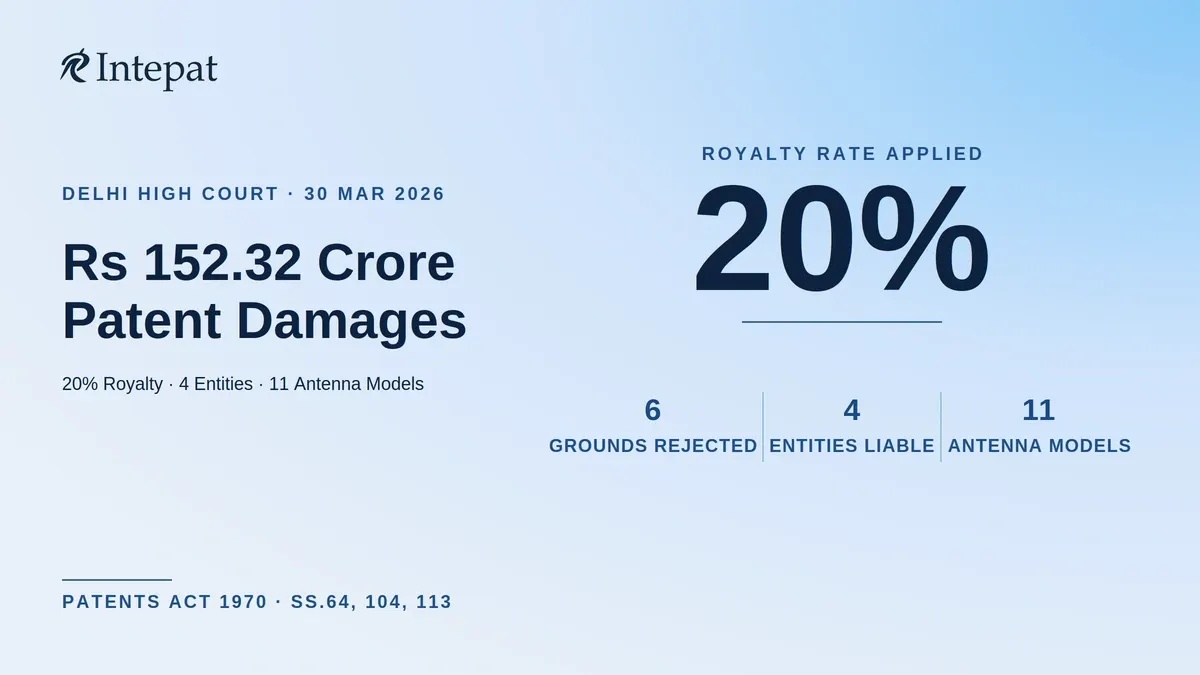
On 30 March 2026, the Delhi High Court set out a detailed method for calculating patent damages in India, holding Rosenberger Hochfrequenztechnik GmbH and three related entities liable for infringing an antenna patent owned by Communication Components Antenna Inc, and ordering damages of Rs 152.32 crore at a 20 percent royalty rate (CS(COMM) 653/2019, Justice Prathiba M. Singh).
The judgment comes from the Delhi High Court’s specialised patent bench, which decides infringement suits and revocation counter-claims under the Patents Act, 1970. The dispute concerned Indian Patent No. 240893, covering split-sector antenna technology used in cellular telecommunications networks, filed through the Patent Cooperation Treaty route and granted in 2010. The verdict uses a real comparable licence rather than an estimate, and it sits alongside two evidentiary and procedural innovations the Court adopted along the way.
| Quick answer: |
| The Delhi High Court upheld Patent No. 240893 against every revocation ground raised, found four Rosenberger group entities liable for infringing eleven antenna models, granted a permanent injunction, and ordered Rs 152.32 crore in damages using a 20 percent royalty rate applied to disclosed sales. The Court also introduced the “Dartboard Model” to discourage unlinked prior art challenges and accepted MATLAB-based beam pattern simulation as proof of infringement where the accused product itself was withheld. |
What did the Delhi High Court decide in CCA v Rosenberger?
The Delhi High Court upheld Indian Patent No. 240893 against every revocation ground Rosenberger raised, found four Rosenberger group entities liable for infringement, granted a permanent injunction covering eleven antenna models, and ordered Rs 152.32 crore in damages together with a certificate confirming the patent’s validity.
Communication Components Antenna Inc, a Canadian company, is the successor in interest to TenXc Wireless Inc, which entered the Indian national phase on 5 August 2008 (Application No. 1683/MUMNP/2008) of a PCT application filed 19 March 2007 (PCT/CA2007/000434), itself claiming priority from a Canadian application dated 17 March 2006. The patent was granted on 9 June 2010 and, after TenXc’s assets were sold in 2011, was assigned to CCA in 2012. CCA sued Rosenberger Hochfrequenztechnik GmbH and three related manufacturing and distribution entities for patent infringement in December 2019, and the defendants counter-claimed for revocation under Section 104 of the Patents Act, 1970, raising grounds under Section 64(1)(e), (f), (h), (i), (j) and (k): lack of novelty, lack of inventive step, insufficiency of disclosure, claims not fairly based on the specification, false suggestion, and non-patentability.
The Court rejected every one of those grounds and, having held the suit patent valid, directed the Registry to issue a certificate of validity under Section 113 of the Act. That certificate does not bar a later challenge to the patent’s validity; rather, if CCA successfully defends this claim again in a future infringement or revocation proceeding, Section 113(2) ordinarily entitles it to full costs on that claim, subject to statutory exceptions and the court’s discretion. For a sense of how far revocation grounds can run even after this stage, a separate Delhi High Court ruling has also clarified when a revocation petition survives after a patent has expired. Of the eleven accused antenna models, the Court found all eleven infringing, holding that the Defendants could have but did not produce their own beam pattern data at any stage of the proceedings.
How did the court calculate patent damages in India here?
The Court measured damages using the reasonable royalty a willing licensor and willing licensee would have agreed, set that rate at 20 percent of each antenna’s price based on a genuine comparable licence on record, and applied it to the Defendants’ own disclosed sales figures in both US Dollars and Indian Rupees.
The Court had before it, placed on record in a sealed cover, a patent licence agreement between CCA and a third party, CommScope Technologies LLC, and found that a fair royalty for an infringer who did not negotiate a licence at all should sit at the higher end of the range that licence disclosed, rather than at the rate a cooperative licensee might have obtained. On that basis it fixed the royalty at 20 percent of the price per antenna, applied to disclosed sales of USD 60,945,991.60 and Rs 1,84,73,47,179.22, producing royalty components of USD 12,189,198.32 and Rs 36,94,69,435.84 respectively.
For the currency conversion, the Court extended a rule the Supreme Court had applied in a different context, DLF Ltd v Koncar Generators and Motors Ltd, 2024 SCC OnLine SC 1907, which held that a foreign-currency arbitral award converts to rupees at the exchange rate on the date of the award, because that is when the obligation to pay crystallises. The Delhi High Court reasoned that the same rationale applies with equal force to a civil money decree: converting the USD component at the rate prevailing on 30 March 2026 produced Rs 115,37,67,348.06, which combined with the rupee-denominated royalty gives the Rs 152,32,36,783.90 total. The Defendants must pay this by 30 June 2026, after which 7 percent simple interest applies, and any further sales not yet reflected in the existing affidavits attract the same 20 percent rate once disclosed.
What is the Dartboard Model and why did the court create it?
Faced with prior art drawn from unrelated technical fields and linked only by a shared keyword, the Court coined the “Dartboard Model”: each unconnected document is a dart thrown at the patent hoping one lands, and courts should treat the tactic as wasteful rather than reward it with revocation.
The Court found that Rosenberger’s invalidity case cited documents connected to the claimed invention only by isolated words such as “asymmetry,” lifted from technologies as different as three-dimensional lens design and cellular network underlay and overlay planning, without showing why a skilled person would have combined them. It set out the analytical steps an obviousness case actually needs: what a specific prior art document discloses, what a skilled person already knew, and how that person would have been led from the prior art to the claimed invention, with any multi-document combination requiring an articulated link such as a common field or a shared problem being solved.
The Court also flagged a risk it expects to recur: in an era of increasing use of AI tools and large language models, it will become easier to generate long lists of superficially relevant prior art without doing the linking work an obviousness case demands, and it cautioned that courts must hold that threshold rather than let volume substitute for connection. For a rights holder or challenger running a patent invalidity search, the practical takeaway is that a search report needs an articulated combination theory for every document it relies on, not a volume of hits.
How did MATLAB simulation help prove infringement without the accused product?
CCA’s expert recreated Rosenberger’s antenna beam patterns in MATLAB using the power and phase values disclosed in the patent’s own specification, then compared the simulated output against beam patterns in Rosenberger’s own admitted product brochures, a route the Court accepted because Rosenberger could have but did not produce its own beam pattern data.
The Court’s own “Overall Infringement” finding records that neither side had physically inspected the other’s antenna, that the Defendants’ product brochures were broadly admitted by their own witness, and that the plaintiff’s MATLAB-generated beam patterns could not seriously be disputed once the Defendants admitted both the element-spacing calculation and the underlying cosine-function formula. The Court treated the comparison between MATLAB simulation and the Defendants’ own brochures as sufficient because the Defendants, who could easily have produced their own beam patterns, did not, and some of their brochures were even taken offline as the suit progressed, conduct the Court described as suspect. In cross-examination, Rosenberger’s own technical witness admitted he had not personally run a comparable simulation to test the claimed beam pattern, undercutting the written evidence that the patent’s disclosure was insufficient to produce the claimed result.
The lesson for a plaintiff assessing whether it can prove infringement without physical access to a defendant’s product is that a simulation built directly from the patent’s own numbers, tested against whatever the defendant has itself admitted or published, can discharge the initial evidentiary burden, particularly where the defendant is in a position to produce contrary data and does not. Read alongside the Delhi High Court’s SEP evidentiary standard in Bansal v Philips, the two rulings together show the same court holding both plaintiffs and defendants to a technical proof standard rather than an assertion-based one.
What made this patent trial move faster than usual?
The Court used Rule 16 of the Delhi High Court Rules Governing Patent Suits, 2022 to fast-track adjudication once the patent had under five years left to run, then compressed evidence recording to about three months using one technical witness per side, video testimony for overseas witnesses, and live transcription during cross-examination.
The suit was filed in December 2019, and the patent’s term runs until 19 March 2027. With the remaining term short enough to trigger Rule 16’s summary adjudication route, the Court and counsel agreed to a confidentiality club to protect sales data, a single technical and a single non-technical witness for each side, virtual examination-in-chief for overseas witnesses conducted before the Joint Registrar, and cross-examination in open court with live transcription, each witness capped at ninety minutes. Framing of issues to conclusion of evidence took roughly three months, between July and September 2023.
That efficiency has a limit worth flagging for anyone estimating a timeline: evidence closed in September 2023, but final arguments did not conclude and the judgment was not reserved until 31 May 2025, a gap of roughly twenty months, and a further ten months passed before it was pronounced on 30 March 2026. A founder weighing India as an enforcement venue should read the procedural cooperation here as shortening the trial phase specifically, evidence went from framing of issues to conclusion in about three months, not as a general promise of a fast result from filing to judgment.
What should founders take from this before enforcing a patent in India?
For a rights holder deciding whether to litigate a patent in India, this case shows that the Delhi High Court will discount scattergun invalidity attacks, accept simulation-based proof where an infringer withholds its own product data, and quantify damages using a real comparable licence rather than an infringer’s preferred numbers.
Three practical points follow. First, a comparable licence agreement, even a confidential one, is worth keeping on file and ready to place before a court under a confidentiality club, since it was the anchor for the royalty rate here rather than a court-estimated figure. Second, an invalidity defence built from unconnected prior art documents risks being called out by name as a “Dartboard” challenge; this Court said that approach ought to draw heavy costs, which changes the calculus for a defendant weighing a broad-but-shallow prior art search against a narrower, better-linked one. Third, willingness to cooperate on trial mechanics, a single technical witness, a confidentiality club, and virtual or fast-tracked evidence, measurably shortened the evidence phase here, which matters most for a patent nearing the end of its term.
This article explains the law on patent enforcement and damages in India as at August 2026 and is for general information only. It is not legal advice, and government fees, forms, and procedures change, so confirm current figures with the Indian Patent Office before you file. For advice on your specific invention, consult a registered patent agent. This analysis is based on the full text of the decision cited, describes the Single Judge decree as decided, and does not track any subsequent appeal or execution proceedings that may follow it; it is a summary for general information, not a substitute for reading the order in your own matter.
Sources
- Communication Components Antenna Inc. v. Rosenberger Hochfrequenztechnik GmbH & Co. KG and Ors., CS(COMM) 653/2019 and CC(COMM) 22/2022, High Court of Delhi at New Delhi, judgment dated 30 March 2026 (Prathiba M. Singh, J.), paragraphs 9, 81 to 89, 208 to 213, 285 to 287, 336 to 347, 354 to 358.
- The Patents Act, 1970, ss. 64, 104, 113 (as consolidated to 1 August 2024).
- DLF Ltd v Koncar Generators and Motors Ltd, 2024 SCC OnLine SC 1907, cited in the judgment at paragraph 340 for the currency-conversion crystallisation rationale.