




Moral rights are an author’s personal rights over their own work: the right to be credited as its creator, and the right to object to distortion or mutilation that harms their reputation. Under Section 57 of the Copyright Act, 1957, these rights stay with the author even after the copyright is sold.
Moral rights apply in India under Section 57 of the Copyright Act, 1957, which reflects Article 6bis of the Berne Convention. The article below covers the Indian position.
Quick answer Moral rights give a creator two things: the right to be named as the author of a work (the right of paternity), and the right to object to any distortion or mutilation of that work that would harm their honour or reputation (the right of integrity). They are separate from copyright. You keep them even after you sell or assign the copyright; a contract may permit ordinary editing, but it cannot give the assignee a free hand to distort or misattribute the work.
| Situation | Moral-rights issue? | Why |
| Your name is removed from your photograph | Likely yes | Right of paternity engaged |
| A painting you sold is edited into an offensive advertisement | Likely yes | Integrity, reputational prejudice |
| A publisher makes minor formatting edits to your book | Usually no | No reputational prejudice |
| A film adaptation alters the theme and characters of your novel | Possibly yes | Distortion or mutilation under Section 57 (cf. Mannu Bhandari) |
| The owner of a building demolishes a structure you designed | Not a s.57 claim | Property right prevails (Raj Rewal) |
What are moral rights under Section 57?
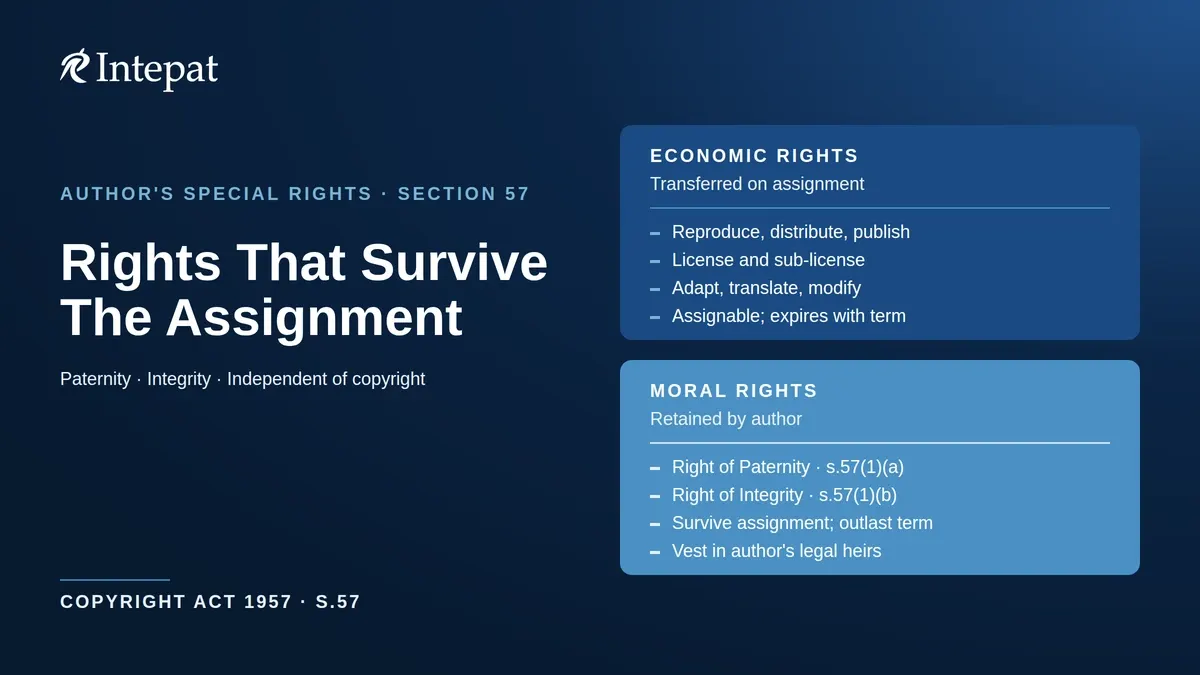
Original work carries two kinds of right. One is economic: the right to copy, sell, license, and earn from the work; these are the rights people usually mean by “copyright,” and they can be assigned. The other is personal: it protects the author’s connection to the work, not the ability to profit from it. These are the moral rights.
In India, moral rights are set out in Section 57 of the Copyright Act, 1957, under the heading “author’s special rights.” The idea is that a creative work carries something of its author, and that the author should keep a say over how the work is treated even after they no longer own it.
This is why moral rights matter where economic rights do not. A photographer who sells an image still has a reason to object if it is later edited into something that misrepresents their work. A composer who assigns a song still has an interest in being credited for it. To see how these rights sit alongside the economic side of copyright law in India, look at each in turn.
Who counts as the author?
Section 57 protects the “author” of the work, and the Copyright Act defines “author” differently across work types. For a literary or dramatic work it is the writer; for a musical work, the composer; for a photograph, the person who takes it; for a cinematograph film or sound recording, the producer; for a computer-generated work, the person who causes it to be created. A single project, a film with a screenplay, lyrics, music and a sound recording, may therefore have several authors, each with separate moral rights in their own layer. Performers do not sit in this definition; their rights are handled separately under Section 38B, discussed below.
The two rights: attribution and integrity
Section 57(1) gives an author two distinct rights. The first, in clause (a), is the right to claim authorship of the work. This is often called the right of attribution or the right of paternity. It is the right to be identified as the creator and to have the work credited to you. If someone publishes your work under another name, or strips your name from it, that engages this right.
The second, in clause (b), is the right of integrity. It lets the author restrain, or claim damages for, any distortion, mutilation, modification, or other act done to the work, where that act would be prejudicial to the author’s honour or reputation. The reputational harm is the key. Not every change to a work crosses the line; the change has to be one that damages how the author is regarded.
These rights were originally associated with literary works, but they apply across the categories of work that copyright protects, including artistic, dramatic, musical, and cinematograph works. A sculptor, a songwriter, and a screenwriter can each draw on them. The right of integrity has been read broadly by Indian courts: it can cover not only direct damage to a work but also treatment that effectively destroys or dismembers it, as the Sehgal case below shows.
Why selling your copyright does not end your moral rights
The most practically useful feature of Section 57 is in its opening words. The rights apply “independently of the author’s copyright and even after the assignment either wholly or partially of the said copyright.” In plain terms, you can sell every economic right you have in a work and still hold your moral rights in it.
This has a direct consequence for contracts. If you assign your copyright to a publisher, a label, or a client, the assignment transfers the economic rights, but it does not hand over your right to be credited or your right to object to reputation-damaging treatment. In Mannu Bhandari v. Kala Vikas Pictures (AIR 1987 Del 13), the Delhi High Court read Section 57 as overriding the terms of an assignment: a contract is read subject to the section, not the other way around. The court accepted that some changes are inevitable in adaptation, for example when a novel becomes a film, but it drew the line at distortion that modifies the theme and characters. An assignee gains the economic rights but cannot rely on the contract to distort, mutilate, or misattribute the work in ways that prejudice the author’s reputation.
For creators, this is the answer to a common worry: that signing a standard “all rights” assignment leaves you with nothing. The economic rights, yes; the moral rights, no. The distinction also explains why moral rights are not something you register. Unlike the optional step of copyright registration, which records ownership, moral rights arise automatically with the work and attach to the author rather than to whoever owns the copyright at a given moment.
What the 2012 amendment changed
The version of Section 57 that many older articles describe is out of date. As originally framed, the right of integrity could only be exercised against acts done “before the expiration of the term of copyright.” That time limit no longer exists.
The Copyright (Amendment) Act, 2012 removed those words from Section 57(1)(b). The effect is that the right of integrity is no longer tied to the lifespan of the copyright. The same amendment also adjusted Section 57(2), which provides that the rights may be exercised by the author’s legal representatives, by removing an earlier carve-out that had excluded the right to claim authorship from what heirs could pursue.
Read together, the position after 2012 is broader than before. The right to object to reputation-damaging treatment of a work can outlast the economic copyright, and an author’s legal representatives can act on the author’s moral rights. For the family of a deceased artist, this matters: the connection between an author and their work is no longer set to expire on the same clock as the right to earn from it.
Amar Nath Sehgal v. Union of India: moral rights tested in court
The Indian case most often cited on moral rights began with a commission. In the late 1950s the Government of India commissioned the sculptor Amar Nath Sehgal to create a large bronze mural for Vigyan Bhavan, a prominent convention venue in Delhi. The mural was installed and became a recognised piece of public art. Years later it was taken down, and parts of it were lost or damaged while in storage, without notice to or permission from the artist.
Sehgal sued the Government under Section 57. The Government argued it had bought the work and could deal with it as it wished. In the 2005 judgment, reported as 2005 (30) PTC 253 (Del), Justice Pradeep Nandrajog rejected that argument: moral rights are independent of physical ownership and survive the assignment of copyright. Removing the mural and allowing its destruction amounted to mutilation prejudicial to the artist’s reputation.
The outcome is often misreported. Sehgal had claimed damages of around Rs 50 lakh; the court awarded Rs 5 lakh, ordered the remains of the mural returned, and declared the rights in it vested in him. The significance is not the figure but the principle: an author does not lose the right to protect their work from reputational harm simply because someone else now owns it.
Where moral rights stop: the limits
Moral rights are strong, but they are not unlimited. Section 57 itself builds in qualifications, and Indian courts have drawn further limits where moral rights collide with property rights.
First, the right of integrity is not breached by every change. The act complained of must be prejudicial to the author’s honour or reputation. A routine edit, a format change, or a use the author simply dislikes will not automatically qualify; the reputational element has to be made out.
Second, an Explanation to the section states that failure to display a work, or to display it to the author’s satisfaction, is not an infringement of these rights. An author cannot use Section 57 to compel someone to exhibit their work, or to exhibit it in a particular way.
Third, there is a specific exception for software: the section’s proviso removes the right to restrain or claim damages in respect of an adaptation of a computer programme to which the relevant fair-dealing provision of Section 52 applies.
Fourth, moral rights do not give an architect a right to stop demolition. In Raj Rewal v. Union of India (Delhi High Court, 2019), the architect of the Hall of Nations at Pragati Maidan invoked Section 57. Justice Endlaw held that Section 57 does not enable an author to restrain the landowner from demolishing a building; the property owner’s right to demolish or redevelop prevails. Distortion of an existing building can still engage Section 57; its demolition does not.
A separate but related set of rights exists for performers. Section 38B gives a performer, including singers, actors, dubbing artists, and voice performers, the right to be identified as the performer and to object to distortion or modification of their performance that is prejudicial to their reputation, with an allowance for ordinary technical editing. These performer’s moral rights sit alongside the author’s rights in Section 57 rather than replacing them.
What moral rights mean for you as a creator
Your moral rights are automatic; you do not register them and you cannot lose them by selling your copyright. When you sign an assignment or an employment or commissioning agreement, read it knowing that the economic rights pass but your right to attribution and your right to object to reputation-damaging treatment do not. If you are commissioning or licensing someone else’s work, the same point cuts the other way: owning the copyright does not give you a free hand to alter or misattribute the work.
If you need to enforce a moral-rights claim, the strength of it turns on the facts. Keep evidence of the original work, the assignment or licence, the altered or misattributed version, and material showing how the change affects your professional reputation. A claim under Section 57 hinges on proving reputational prejudice. For a deeper treatment of how these rights interact with the economic side of copyright and where the two come into tension, see our discussion of the intersection of copyright and moral rights. Composers, lyricists, and producers face moral-rights questions of their own; our guide to copyright in your musical work looks at how the rights apply to songs and recordings.
Frequently asked questions
Moral rights are an author’s personal rights in their work under Section 57 of the Copyright Act, 1957. They are the right to claim authorship (paternity) and the right to object to distortion or mutilation that harms the author’s honour or reputation (integrity).
No. Section 57 of the Copyright Act, 1957 states that moral rights apply independently of copyright and survive even after the copyright is assigned. You can sell the economic rights in a work and still keep your moral rights in it.
Not anymore. The Copyright (Amendment) Act, 2012 removed the words that had limited the right of integrity to acts done before the expiry of the copyright term. The right of integrity can now outlast the economic copyright in the work, and the author’s legal representatives may exercise these rights.
Section 57 does not permit transfer of moral rights. In Mannu Bhandari v. Kala Vikas Pictures (AIR 1987 Del 13), the Delhi High Court read the section as overriding assignment terms. A contract may permit ordinary editing, but it cannot let an assignee distort, mutilate, or misattribute the work in ways that prejudice the author’s reputation.
Yes. Section 57(2) of the Copyright Act, 1957 provides that the rights conferred by Section 57(1) may be exercised by the legal representatives of the author. The Copyright (Amendment) Act, 2012 removed an earlier carve-out that had excluded the right to claim authorship from what heirs could pursue.
No. In Raj Rewal v. Union of India (Delhi High Court, 2019), the court held that Section 57 does not enable an author to restrain the landowner from demolishing a building. The landowner’s property right prevails. Distortion that affects an existing building may still engage Section 57, but its demolition does not.
The Delhi High Court held in 2005 that moral rights are independent of ownership and survive assignment. The destruction of the artist’s mural was prejudicial to his reputation. The court awarded Rs 5 lakh, ordered the mural’s return, and vested its rights in him.
Yes. Section 38B of the Copyright Act, 1957 gives performers the right to be identified as the performer and to object to distortion or modification of their performance that is prejudicial to their reputation, subject to an allowance for ordinary technical editing.
Disclaimer: This article explains moral rights under Indian copyright law for general informational purposes and reflects the legal position as at May 2026. It is not legal advice. Moral-rights claims turn heavily on their specific facts, particularly on whether reputational harm can be shown. For advice on your own situation, consult a qualified IP practitioner.