




Inventions often begin as ideas—but not every idea is worth developing or patenting. Before investing time, money, and R&D resources, it is crucial to understand whether an invention is new, meaningfully different, and legally protectable. This is where patent searches play a decisive role.
Two terms frequently used in this context—prior art search and patentability search—are often misunderstood or used interchangeably. While both involve searching existing knowledge and patents, they serve very different purposes and are conducted at different stages of the innovation journey.
Choosing the wrong type of search—or skipping one altogether—can result in wasted development costs, weak patent applications, or avoidable rejections. This article clearly explains the difference between a prior art search and a patentability search, when each should be conducted, and how they help inventors and businesses make informed decisions.
If you are evaluating whether your invention is worth developing or filing for patent protection, understanding this distinction is the first critical step.
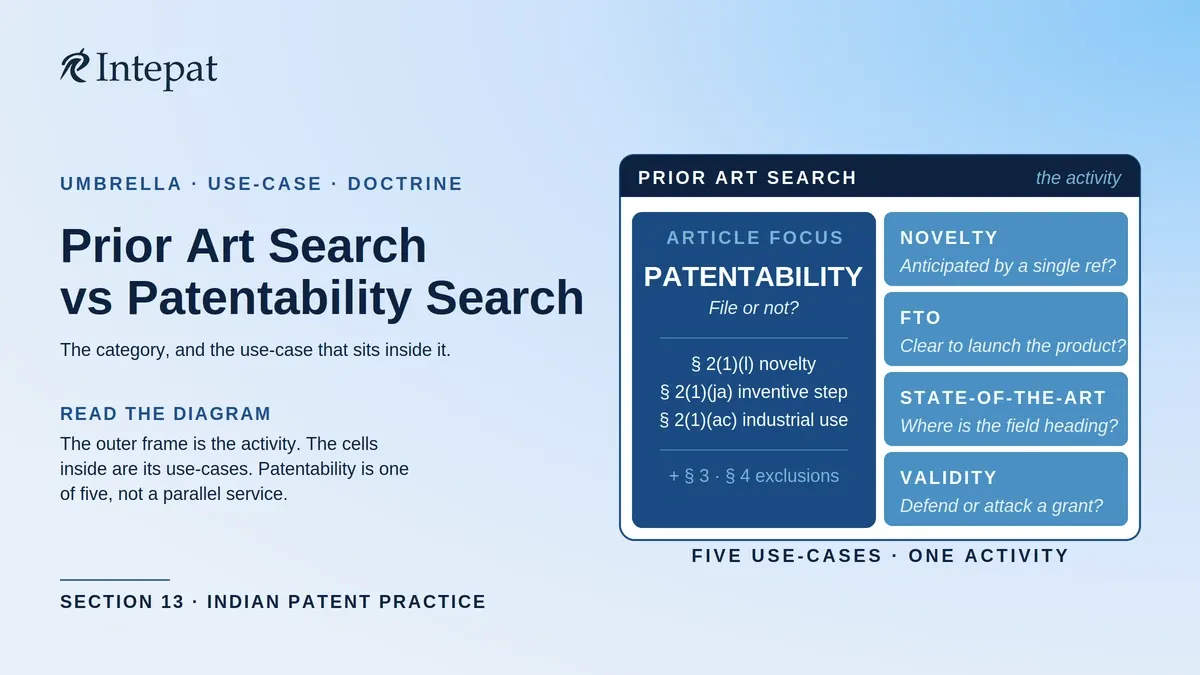
Quick Answer: Prior Art Search vs Patentability Search
If you are short on time, here is the simplest way to understand the difference:
- A prior art search helps you understand what already exists in a technical field and whether pursuing a new invention idea makes practical sense.
- A patentability search evaluates whether a defined invention is likely to meet legal patent requirements such as novelty and inventive step.
In short, a prior art search supports innovation decisions, while a patentability search supports filing decisions.
Not sure which search fits your current stage? A brief expert review can help you choose the right approach before you move forward.
For example, if an inventor is considering developing a new type of thermal container, conducting a prior art search early can reveal existing designs, materials, and mechanisms already disclosed in patents or publications. This insight can prevent duplication of effort and guide the invention toward a more differentiated direction.
What Is a Prior Art Search?
A prior art search is conducted to identify existing knowledge that relates to a proposed invention. Prior art includes any publicly available information—such as patents, patent applications, technical papers, research articles, product disclosures, or online publications—that existed before the date of the invention.
The objective of a prior art search is not to decide patentability under the law, but to help innovators understand what already exists in a particular technical domain and whether further development of an idea is worthwhile.
Purpose of a Prior Art Search
A prior art search helps answer foundational questions such as:
- Has a similar solution already been disclosed?
- Is the idea truly new, or only a minor variation of existing technology?
- Are there gaps or limitations in existing solutions that can be improved?
For example, if an inventor is considering developing a new type of thermal container, conducting a prior art search early can reveal existing designs, materials, and mechanisms already disclosed in patents or publications. This insight can prevent duplication of effort and guide the invention toward a more differentiated direction.
When Should a Prior Art Search Be Conducted?
A prior art search is ideally conducted before committing to full-scale research and development, and during the development phase as well. Because patent databases are continuously updated, periodic searches help ensure that an invention remains distinct from newly published disclosures.
Inventors who want to independently explore whether similar inventions already exist often begin by learning how to find if an idea is already patented, before moving to more structured professional searches.
What Sources Are Covered in a Prior Art Search?
An effective prior art search goes far beyond general internet searches. It typically includes:
- Patent databases maintained by national and international patent offices
- Published patent applications
- Non-patent literature such as journals, conference papers, and technical standards
Patent documents are particularly valuable because they contain detailed descriptions, drawings, and claims that explain how an invention works and what problem it solves. Official guidance on identifying and using prior art sources is available through the USPTO’s prior art search resources, while academic frameworks for conducting structured searches are explained in a university guide to prior art searching.
For inventors seeking a more methodical approach, following a structured patent search strategy can significantly improve the relevance and completeness of search results.
What Output Should You Expect?
A prior art search generally results in:
- A set of relevant prior art references
- A clearer understanding of existing solutions and design approaches
- Early insight into whether the invention space is crowded or underexplored
However, a prior art search does not determine whether an invention is legally patentable. That assessment requires a separate patentability analysis, which evaluates the invention against statutory requirements.
Best Suited For
A prior art search is particularly useful for:
- Early-stage inventors and researchers
- Startups validating feasibility before investing in R&D
- Companies exploring white-space opportunities in a technology domain
What Is a Patentability Search?
A patentability search is conducted to assess whether a defined invention is likely to qualify for patent protection under applicable patent laws. Unlike a prior art search—which focuses on understanding what already exists—a patentability search evaluates the invention against legal patentability requirements.
In most jurisdictions, an invention must satisfy three core criteria to be patentable:
- Novelty
- Inventive step (non-obviousness)
- Industrial applicability (utility)
A patentability search is therefore performed at a stage where the invention has taken a reasonably concrete form and the inventor is considering filing a patent application.
Purpose of a Patentability Search
The primary purpose of a patentability search is to answer a critical filing question:
Is this invention likely to be granted a patent?
To do so, the search goes beyond identifying similar disclosures. It evaluates whether the key features of the invention, when compared against existing prior art, would be considered obvious to a person skilled in the relevant technical field.
This assessment is particularly important because many patent applications are refused not due to lack of novelty alone, but due to failure to meet the inventive step requirement.
How a Patentability Search Is Conducted
A patentability search typically involves:
- Identifying the core technical features of the invention
- Mapping those features against relevant prior art references
- Analysing whether the invention represents a technical advancement or merely a predictable combination of known elements
Unlike a broad prior art search, even a single overlapping feature in earlier disclosures is carefully analysed. Multiple prior art references may also be considered together to determine whether the invention would have been obvious.
International guidance on conducting structured patent searches and understanding how prior art is evaluated is explained in the WIPO basics of patent searching, which outlines how patent examiners approach search and comparison.
Role of Inventive Step in Patentability
One of the most decisive aspects of a patentability search is the assessment of inventive step. Even if no single prior art reference discloses the invention in its entirety, an application may still be refused if the invention is considered an obvious modification of existing knowledge.
Understanding how non-obviousness is assessed is therefore crucial before filing, especially in technology areas where incremental improvements are common.
What Output Should You Expect?
A patentability search typically provides:
- Identification of the closest prior art
- An assessment of novelty and inventive step risks
- Insight into whether claim amendments or technical refinements may improve patent prospects
While a patentability search does not guarantee grant, it offers a realistic view of filing strength, helping inventors decide whether to proceed, refine, or reconsider their application strategy.
Prior Art Search vs Patentability Search: Key Differences
While both searches involve reviewing existing disclosures, they serve distinct purposes and are conducted at different stages of the innovation and filing process. The table below highlights the core differences to help you decide which search you need.
| Aspect | Prior Art Search | Patentability Search |
|---|---|---|
| Primary purpose | To understand what already exists in a technical field and whether developing an invention idea makes sense | To assess whether a defined invention is likely to be granted a patent under the law |
| Stage of use | Early stage—before or during research and development | Later stage—when the invention is clearly defined and filing is being considered |
| Focus of analysis | Identifying similar or related disclosures | Evaluating novelty and inventive step against prior art |
| Legal evaluation | Limited or none | Central and decisive |
| Scope of comparison | Broad exploration of existing technologies | Feature-by-feature and claim-oriented comparison |
| Outcome | Strategic insight into feasibility and white-space | Risk assessment of patent grant likelihood |
| Can it confirm patentability? | No | Provides a reasoned indication, but not a guarantee |
Key Takeaway
A prior art search helps you decide whether to proceed with an idea.
A patentability search helps you decide whether to file a patent application.
Skipping the right search at the right time often leads to avoidable costs, weak filings, or rejections that could have been anticipated earlier.
Choose the Right Search Before You File
If you are unsure whether your invention needs a prior art search, a patentability search, or a combination of both, a short expert-led assessment can save significant time and expense later in the process.
Which One Should You Do First?
The choice between a prior art search and a patentability search depends largely on where you are in the invention lifecycle. The following scenarios can help clarify the right approach.
If Your Invention Is Still an Idea
When you are exploring an idea or identifying a problem worth solving, a prior art search should come first. At this stage, the goal is to understand existing solutions, avoid duplicating known technology, and identify gaps that justify further development.
If Your Invention Is Technically Defined
Once the invention has taken a concrete form—such as a working concept, prototype, or clearly defined technical solution—a patentability search becomes more relevant. This helps assess whether the invention is likely to satisfy novelty and inventive step requirements before filing.
If You Are Planning to File Soon
If patent filing is being considered in the near term, especially for a provisional or complete specification, a patentability search is critical. It allows you to evaluate filing risks early and refine the invention or claims if needed.
If You Are Making Investment or R&D Decisions
For startups and R&D-driven companies, a prior art search often comes first to justify development budgets, followed by a patentability search before committing to filing and prosecution costs.
Practical Tip
In many real-world cases, inventors benefit from using both searches sequentially—starting with a prior art search for direction and concluding with a patentability search for filing confidence.
Common Mistakes Inventors Make with Patent Searches
Even when inventors understand the importance of patent searches, mistakes in approach or timing often reduce their value. Some of the most common pitfalls include:
Relying Only on Internet or Keyword Searches
General web searches or marketplace checks are not substitutes for patent searches. Many relevant disclosures exist only in patent databases and are classified using technical codes rather than obvious keywords.
Assuming “No Exact Match” Means Patentable
Finding no identical invention does not automatically mean an invention is patentable. Patent examiners often combine multiple prior art references to assess obviousness, especially during inventive step analysis.
Treating Prior Art Search as a Patentability Opinion
A prior art search is exploratory in nature. Treating it as confirmation that an invention will be granted a patent can lead to weak applications and avoidable rejections.
Ignoring New Publications During Development
Patent applications are published continuously. An invention that appeared novel at the idea stage may become vulnerable if new disclosures emerge during development.
Skipping Search Documentation
Failing to record search strategies, keywords, and classifications makes it difficult to reassess risks later or explain how an invention evolved in view of prior art.
Avoiding these mistakes significantly improves the quality of decision-making before investing in patent filing and prosecution.
Frequently Asked Questions (FAQs)
Is a prior art search mandatory before filing a patent?
No. A prior art search is not legally mandatory, but it is strongly recommended. Conducting one early helps inventors avoid investing time and money in developing ideas that already exist or are too close to known solutions.
Can I file a patent application without a patentability search?
Yes, it is possible to file without a patentability search. However, doing so increases the risk of objections or rejection during examination. A patentability search helps identify novelty and inventive step risks before filing.
Is a patentability search the same as a freedom to operate (FTO) search?
No. A patentability search assesses whether your invention can be patented, while an FTO search evaluates whether commercial use of the invention may infringe existing patents. Each serves a different legal purpose and is conducted at different stages.
How long does a patentability search usually take?
The time required varies depending on the technology area and scope of analysis. In most cases, a focused patentability search can be completed within a few days to a couple of weeks, depending on complexity.