



Patent Search USA
One cannot patent something unless it is entirely new, novel, non-obvious, and has industrial application. A patent or patentability search is performed to check the novelty of the idea.
During every stage of innovation, awareness of current and previous research are vital for developing a clear path to progress. Review of patent and technical literature, which is published with a global perspective, influences technical, legal, and business decisions. Therefore, it is essential at the initial stages of the invention lifecycle. Missing influential prior art can lead to repeating others’ research, unsuccessful projects, obliviousness to solutions to common challenges encountered, and losing ownership of licenses or products from the research already patented.
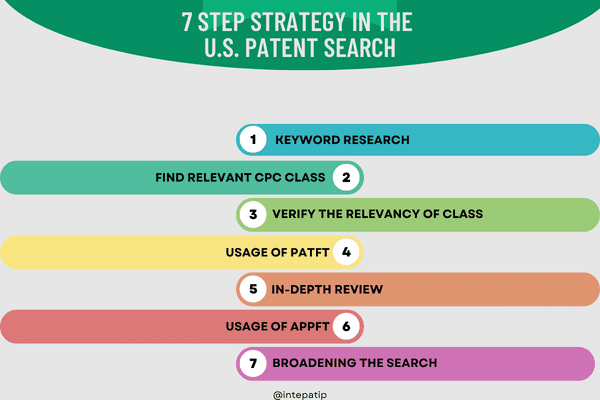
The seven-step strategy is usually suggested to perform primary searches of US patents and published applications using USPTO and EPO (European Patent Office) free online resources.
The Seven Steps in a Preliminary Search of U.S. patent and Published Patent Applications are:
1. Keyword Research:
The process starts by brainstorming the search terms. A brief but precise description of the innovation is written. While doing so, a list of keywords and technical phrases is prepared, which might help describe it. This can be done by keeping the following points in mind:
i) The objective of the invention
ii) Whether the invention is a product or a process
iii) The composition of the invention
iv) The use of the invention
v) Nature of the invention. A dictionary can also be used to search the relevant terms.
2. Search initial CPC class/subclass:
The terms searched above are used to find relevant Cooperative Patent Classification using the USPTO website (uspto.gov). The site search box on the home page, “CPC scheme [plus keyword describing innovation].” The most relevant classification to the invention is then determined from the resulting classification’s class scheme. Another keyword or alternative term is used if the search yields zero results.
3. Verify the relevancy of CPC class/subclasses:
The CPC classification definition is reviewed to confirm the relevance of the CPC classification found in the above step.
4. Usage of PatFT:
US U.S.tent documents are retrieved with the selected CPC classification. It is done in the PatFT (Patents Full Text and Image) database. The front page information of the abstract and the representative drawings are reviewed, and the most relevant patent applications are selected.
5. In-Depth Review:
The selected relevant patent publications are then taken for in-depth review. This is done to check the similarity with the invention. Close attention is paid to the drawing pages, the specifications, and the legal claims page. Total patents can be viewed by clicking the “full pages” button on the left.
6. Usage of AppFT:
This search enables to review of pending patent applications for closely related prior art. This is the final step to ensure that there are no applications PTO is currently studying that might match. For this purpose, US U.S.blished patent applications with the selected CPC classification in step 3 are searched in the AppFT (Applications Full Text and Image) database. Results are narrowed down for an in-depth review, as mentioned in step 5. If nothing matches the invention, one can apply for a U.S. patent.
7. Broadening the Search:
If the PTO searches don’t yield valuable results, widening of the search is done until desired results are obtained. This is a time-consuming process, and the options available are:
a) Keyword search in PatFT and AppFT databases.
b) Search can be performed in U.S. patent Classification (USPC). USPC was used on U.S. Utility patents on 1/1/2015, but the classification system remains searchable for all pre-2015 U.S. Utility patents.
c) The search can also be extended to foreign patents and published applications using the CPC classification identified in step 3. The search can be re-run on Espacenet, which is the European Patent Office’s worldwide patent publication database of over 90 million patent publications.
d) Books, journals, websites, technical catalogs, and conference proceedings can be searched for publicly disclosed inventions.
e) Or Hire a registered Patent Agent or Patent Attorney after conducting a preliminary patent search, and he would review and perform a follow-up search.
A thorough patent search will make your patents apt and more robust. At Intepat, we can execute a patent search for you to find the novelty of your invention. With the help of Intepat patent search, you get a detailed investigation that identifies relevant patents and patent applications compiled systematically in one place. Get started with the Intepat patent search process today.