




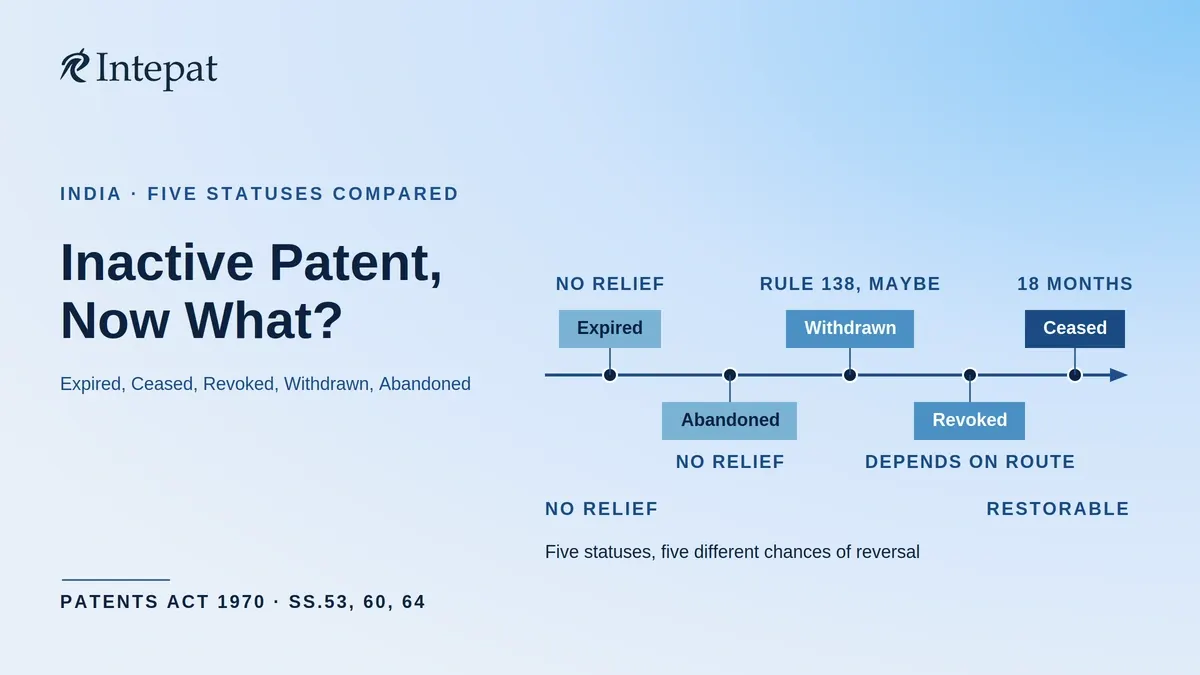
A granted Indian patent may expire, cease to have effect, or be revoked. A pending application may instead be withdrawn or deemed abandoned before it becomes a patent. Each outcome rests on a different provision of the Patents Act, 1970, and they are not interchangeable for deciding whether you can safely rely on the disclosure.
Quick answer
- Expired: that patent’s own claims can no longer be enforced, but this does not establish freedom to operate; a different, still-live Indian patent may cover the same product.
- Ceased for non-renewal: restorable within 18 months under Section 60. No suit lies for acts between cessation and publication of the restoration; further protection depends on Section 62.
- Revoked: reversal depends on the route. Sections 25(4), 63, 66 and 85 orders are appealable under Section 117A; Section 65 is not; a Section 64 revocation is itself a High Court decision.
- Deemed withdrawn or deemed abandoned (missed FER) run on Rules-based deadlines, so a Rule 138 extension or condonation may still be available if sought in time. Section 9(1) abandonment has no such relief; that 12-month period is Act-fixed.
- Confirm every status, and its date, via the correct IP India tool before relying on it commercially.
What Makes a Patent Inactive Under Indian Law
An Indian patent or application loses its enforceable standing in one of five common ways: the 20-year term under Section 53(1) runs out; the patent ceases under Section 53(2) for unpaid renewal fees; the patent is revoked through one of several routes; an application is withdrawn under Section 11B(4) or by the applicant’s own request; or an application is deemed abandoned under Section 9(1) or Section 21(1). This is not exhaustive: refusal under Section 15, and abandonment under Section 40 for contravening a Section 35 secrecy direction or the Section 39 foreign-filing restriction, are narrower examples.
These categories look alike from the outside: the patent no longer blocks anyone. But they are not interchangeable. Only cessation for non-renewal has a dedicated restoration chapter; revocation can sometimes be challenged, but the route depends on which provision produced it; withdrawal and abandonment sit outside Chapter XI entirely, and relief depends on whether the deadline was Act-fixed or left to the Rules, as below.
How to Confirm a Patent’s Current Status
Never assume status from age, a discontinued product, or a competitor’s say-so. IP India runs this check across three tools: the Patent E-Register for a granted patent’s legal status by patent number, Application Status for a pending application by application number, and Patent Search for a bibliographic search by applicant, inventor, title or field. Using the wrong tool causes incomplete answers. A related IP India utility lists patents ceased under Section 53(2) in real time, noting the list may not yet reflect a Section 60 restoration.
Two figures matter more than the label: the date status changed, and the filing date used for the 20-year term. A “ceased” entry without its cessation date does not tell you whether the 18-month Section 60 window is still open. See our guide to checking Indian patent application status, and Indian Patent Status Meaning and Prosecution Guide for what each label means.
Expired: Full 20-Year Term Run Out, No Restoration Route
A patent expires on completing the term fixed by Section 53(1): 20 years from the filing date, or, for a PCT national phase application, from the international filing date. Once the term runs out, exclusive rights end permanently, with no renewal, extension, or restoration mechanism.
Section 53(4) states only that the subject matter of that patent is no longer entitled to protection, narrower than it sounds: it clears that patent’s claims, not everything around the product. The same product can still fall within a separate, still-live patent covering an independent improvement, a sub-combination, a process, or claims granted on a divisional application. A patent of addition is different: under Section 55 it remains in force only for the term of, or until the earlier cessation of, its main patent, and does not survive independently except where the main patent is revoked and the court or Controller orders its conversion. Expiry is a starting point for a freedom-to-operate check, not a substitute; also check corresponding foreign filings and rights such as a design or trademark.
Ceased for Non-Renewal: The 18-Month Restoration Window
A granted patent ceases under Section 53(2) if a renewal fee is unpaid within the prescribed period. Renewal falls due from the expiry of the second year and each year after, extendable up to six months on Form 4; if still unpaid, the patent ceases from expiry of the renewal period. Where grant occurred more than two years after filing, Section 142(4) governs fees accrued meanwhile: payable within three months of the patent’s recording in the register, extendable to nine months. Since delayed grant is common in India, work out the cessation date from the register and fee history, not the filing date.
This is the only inactive status the Act allows back: Chapter XI gives the patentee 18 months from cessation to apply for restoration under Section 60, on Form 15. The Controller must be satisfied the failure was unintentional and the application not unduly delayed; the application is published, with a window for interested persons to oppose on either ground. Restoration does not recreate uninterrupted enforcement: Section 62 protects a person who began using, or took definite contractual steps to use, the invention between cessation and publication of the restoration application, barring suit for that window and allowing the Controller to impose further terms for continued use. Keep dated development and contractual records if you build on a technology while its patent shows as ceased.
Our restoration of lapsed patents guide covers the full procedure; for the renewal deadlines that lead to cessation, see patent renewal in India.
Revoked: Six Different Routes, Not One
Revocation has no single procedure or outcome. The Act sets out several routes, run by different forums, with different appeal positions; “no appeal is pending” only answers the question once you know which route produced the revocation, and not every route carries a right of appeal at all.
A patent can be revoked by the High Court, on petition by any person interested or the Central Government, or on counter-claim in an infringement suit, under Section 64. The Controller can revoke following post-grant opposition under Section 25(4); the patentee can offer to surrender under Section 63, accepted after publication and any opposition; the Controller can revoke under Section 85, two years after the first compulsory licence, for non-working, unmet public requirements, or unaffordable pricing; the Central Government can direct revocation in atomic-energy cases under Section 65, and can, after a hearing, declare revocation under Section 66 where the patent or its exercise is mischievous to the State or prejudicial to the public. The IPAB was abolished by the Tribunals Reforms Act, 2021, so Section 64 jurisdiction now sits with the High Courts.
The available challenge depends on the route. Section 117A gives a right of appeal to the High Court from orders under Sections 25(4), 63, 66 and 85, ordinarily within three months; Section 65 is not among the sections listed. A Section 64 revocation is itself a High Court decision, so its challenge follows ordinary appellate procedure, not Section 117A. None of these routes carries a Section 60-style restoration window: the order, and any appeal or stay, must be checked route by route rather than assumed from the word “revoked.” Our patent revocation in India guide covers the Section 64 grounds and forum in detail.
Withdrawn and Abandoned Applications: What Can and Cannot Still Be Cured
Withdrawal and abandonment are often used interchangeably, but the Act treats them separately, and further relief depends on whether the missed deadline was fixed by the Act or left to the Rules.
An application is deemed withdrawn under Section 11B(4) if no request for examination is filed in time: 31 months from priority or filing (whichever earlier) for applications filed on or after 15 March 2024, or the pre-amendment 48 months for earlier ones, saved by the same 2024 amendment. Since this period is Rules-fixed (Rule 24B), Rule 138 lets the Controller extend or condone the delay by up to six months, on Form 4 within six months of the deadline: discretionary, not a Chapter XI restoration right, reaching only Rules-fixed periods. An applicant can also withdraw expressly before grant, under Section 11B(4) proviso (i), using Form 29 under Rule 26; a partial refund is available if withdrawal follows a request for examination but precedes the first statement of objections.
Abandonment follows the same divide. Under Section 21(1), an application is deemed abandoned if the first statement of objections is not met within six months, extendable three months under Rule 24B(6); since this period too is Rules-based, Rule 138 may allow a further six-month extension. Under Section 9(1), the 12-month period to file a complete specification is Act-fixed, not Rules-based, so Rule 138 does not apply: once 12 months lapse, there is no extension or cure. Our guide on whether an abandoned patent application can be revived reflects this for the Section 9(1) case.
Until grant, none of these applications carries an enforceable claim, and no infringement suit can be instituted. But if an application is already published, a Rule 138 window remains open, and grant later follows, Section 11A(7) can make post-publication acts legally relevant, since the applicant then has the like privileges as if granted on the publication date; do not treat such an application as permanently closed. Once every extension or condonation period has expired without grant, the published specification, where publication occurred, is technical literature without an enforceable claim.
Comparison at a Glance
| Status | Statutory basis | What triggers it | Further relief |
| Expired | Section 53(1) | 20-year term completed | None; check other live Indian patents (a patent of addition does not usually outlive its main patent) |
| Ceased for non-renewal | Section 53(2) | Renewal fee unpaid past the extended period | Restoration under Section 60, within 18 months of cessation |
| Revoked | S.64 (High Court); SS.25(4), 63, 66, 85 (appealable under S.117A); S.65 (not listed) | Petition, opposition, surrender, post-compulsory-licence application (non-working, unmet demand, or unaffordable pricing), or Government direction | Route-dependent: S.117A appeal where listed, or further challenge to the High Court’s own S.64 decision |
| Deemed withdrawn (no RFE) | S.11B(4), Rule 24B(1) | RFE not filed in time | Rule 138 extension/condonation, up to 6 months, if sought within 6 months of deadline |
| Express withdrawal | S.11B(4), proviso (i) | Applicant’s own Form 29 request | None; a deliberate act |
| Deemed abandoned, FER | S.21(1), Rule 24B(5)/(6) | FER requirements not met in time | Rule 24B(6) 3-month extension, then possibly Rule 138 |
| Deemed abandoned, no spec | Section 9(1) | Complete specification not filed within 12 months | None; period fixed by the Act, Rule 138 does not reach it |
Before Relying on the Disclosure: What Still Needs Checking
An inactive patent’s specification is still a useful technical reference, but the status label only answers one of two questions: can this patent presently be enforced, and can the product be made or sold without infringing a different right. This article addresses only the first.
Check whether the same product is covered by a different, still-live Indian patent: an independent improvement, process, or granted divisional patent may remain enforceable after a related patent becomes inactive; a pending divisional application is different, carrying no claim until granted. Confirm the relevant date: cessation date, revocation order date and appeal position, or filing date for a completed term. Check foreign filings independently, and whether other rights, such as a design or trademark, might still apply.
Organisations planning to build on an inactive Indian patent’s disclosure may benefit from a structured patent status and freedom-to-operate review before development begins.
Frequently Asked Questions
Use the tool that matches your question: the Patent E-Register for a granted patent by patent number, or Application Status for a pending application by application number. A status label alone, without its date, does not tell you whether a restoration or appeal window remains open.
Not automatically. Once the 20-year Section 53(1) term is complete, that patent’s own claims can no longer be enforced, with no restoration mechanism. But Section 53(4) only removes protection for that specific patent’s subject matter; the same product can still fall within a different, still-live patent, so expiry alone does not establish freedom to operate.
A ceased patent lost effect under Section 53(2) for non-payment and can be restored under Section 60 within 18 months, subject to Section 62 protection for intervening users. A revoked patent was cancelled under one of several provisions: Sections 25(4), 63, 66 and 85 orders are appealable under Section 117A, a Section 65 order is not, and a Section 64 revocation is itself a High Court decision.
It depends which deadline was missed. Deemed withdrawal under Section 11B(4) and deemed abandonment under Section 21(1) both run on Rules-based periods, so a Rule 138 extension or condonation may still be available if sought in time. Section 9(1) abandonment runs on a period fixed by the Act, so no such relief exists. None of this is Chapter XI restoration, which applies only to a patent ceased for non-payment of renewal fees.
Not automatically, but it is not automatically dead elsewhere either. Corresponding patent applications or granted patents in other countries are governed entirely by that jurisdiction’s own law, on its own timeline, and must be checked independently before any cross-border commercial use.
This article explains the law on inactive patent statuses in India as at July 2026 and is for general information only, not legal advice. Fees, forms, rules and procedures change; confirm current figures and status with the Indian Patent Office before relying on this commercially. Deadlines under Sections 9(1), 21(1), 11B(4) and 60 are strict and can cost you rights if missed, and any extension route such as Rule 138 must itself be invoked within its own time limits. For advice on your situation, consult a registered patent agent.