




Initially Published June 2016; Updated April 2026
Quick Answer: Industrial design registration in India grants the registered proprietor copyright (the exclusive right to apply a design to any article in its registered class) under the Designs Act, 2000. Protection runs for ten years from the date of registration and may be extended for a further five years on payment of the prescribed renewal fee.
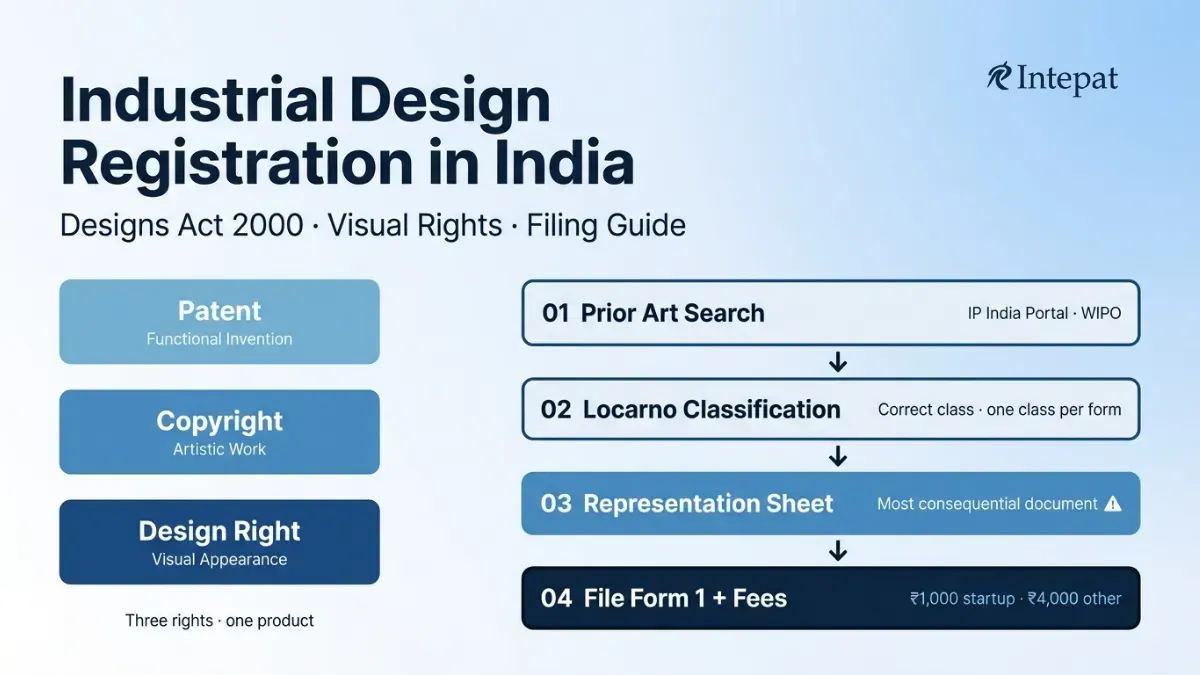
What industrial design registration protects in India
Industrial design registration in India protects the visual features of a product, not its function. Section 2(d) of the Designs Act, 2000 defines a design as only the features of shape, configuration, pattern, ornament, or composition of lines or colours applied to any article, by any industrial process, which in the finished article appeal to and are judged solely by the eye. If a feature exists because of how the article works rather than how it looks, the Designs Act does not cover it.
This distinction separates design protection from two adjacent rights. A patent protects an invention, including its functional principle. Copyright under the Copyright Act, 1957 protects an original artistic work as a standalone creation. A registered design protects the particular visual expression applied to a manufactured article. The three can coexist: a lamp may carry a patent on its mechanism, copyright in a sculptural element, and a registered design in the shape of its shade.
The article to which the design is applied must be manufactured or capable of being manufactured. Section 2(a) defines an article as any article of manufacture, artificial or partly natural, including any part capable of being made and sold separately. This means components sold on their own (a car bumper, a chair leg) are eligible, provided the component meets the other requirements for registration.
What registration confers is described in the Act as copyright: the exclusive right to apply a design to any article in any class in which the design is registered. The term is the Act’s own usage, distinct from copyright under the Copyright Act. Every claim about the right that registration creates must trace back to that statutory formulation.
Who can apply and what qualifies for registration
Any person claiming to be the proprietor of a new or original design may apply under Section 5(1). The proprietor is typically the author of the design, but where a designer creates the work for consideration on behalf of another person, the commissioning party is the proprietor. A company, LLP, individual, or foreign entity may apply. Foreign applicants must provide an address for service in India as a condition of proceeding.
A design that falls within any of the four bars in Section 4 cannot be registered, regardless of how distinctive it appears:
- it is not new or original;
- it has been disclosed to the public anywhere in India or in any other country by publication in tangible form, by use, or in any other way prior to the filing date or, where applicable, the priority date;
- it is not significantly distinguishable from known designs or combinations of known designs; or
- it comprises or contains scandalous or obscene matter.
Novelty under the Designs Act, 2000 is assessed globally, not merely in India. A design published or used anywhere in the world before the filing date is prior art. This is a material departure from the 1911 Act, under which novelty was determined by reference to India alone.
The requirement that the design must be “original” does not require absolute novelty of the design element in isolation. Section 2(g) defines original as originating from the author and includes cases that are old in themselves yet new in their application. A traditional motif applied to a class of article in which it has never appeared may qualify, depending on the facts.
| What cannot be registered under the Designs Act |
| • Anything that is in substance a mechanical device; if the feature is purely functional, it falls outside Section 2(d) |
| • Trade marks as defined under the Trade Marks Act, 1999 |
| • Property marks under Section 479 of the Indian Penal Code |
| • Any artistic work as defined in Section 2(c) of the Copyright Act, 1957 |
| • Scandalous or obscene matter (Section 4(d)) |
| • Designs not significantly distinguishable from existing known designs or combinations of them (Section 4(c)) |
Applicants who need to determine precisely whether their design clears the global novelty threshold can read Intepat’s detailed analysis of novelty and originality standards under the Designs Act.
How to file an industrial design application in India
Design applications are filed with the Office of the Controller General of Patents, Designs and Trade Marks (CGPDTM). Physical filing is accepted at any of the four Patent Offices in Delhi, Mumbai, Chennai, or Kolkata. All substantive examination and prosecution, however, is conducted only at the Designs Wing in Kolkata. E-filing through the IP India portal is available and carries a lower fee than physical submission.
Step 1: conduct a prior art search
Before preparing the application, search the Indian Register of Designs through the IP India portal and the WIPO Global Design Database. The purpose is to identify whether a substantially similar design already exists in the registered class. An application filed against a pre-existing design will be objected to on novelty grounds; addressing that objection costs time and fees that a search would have avoided.
Step 2: determine the correct Locarno class
Under Rule 10 of the Designs Rules, 2001 as substituted by the 2021 Amendment Rules, articles must be classified in accordance with the current edition of the International Classification for Industrial Designs published by WIPO, known as the Locarno Classification. Applicants should check the live WIPO Locarno publication at the time of filing because the current edition may have changed. Form 1 requires the class number to be stated correctly. Where an article spans more than one class, a separate application is needed for each class.
Misidentifying the Locarno class is the one of the most common sources of formality objections during examination. CGPDTM’s own Manual of Designs Practice and Procedure records that 90 per cent of applications are objected to on formality grounds, and class errors are the most common among them. When the correct class for an article is genuinely ambiguous, the Controller may decide the question under Section 5(3).
Step 3: prepare Form 1 and the representation sheet
The application is filed on Form 1, which requires: the full name, address, and nationality of each applicant; the name of the article; the Locarno class number; an address for service in India including an email address and mobile number registered in India (mandatory after the 2021 Amendment Rules); and the prescribed fee. The applicant’s category (natural person, startup, small entity, or other entity) must be declared, as it determines the fee tier.
The representation sheet is the most consequential document in the application. Examination of representations accounts for a large proportion of formality objections. The representation must show the design clearly, durably, and accurately in all necessary views. Photographs, drawings, or tracings are all acceptable. The rules require consistent proportions and features across all views; if any view shows a different shape or proportion from another, the examiner will object. Background objects not forming part of the design must be excluded. Where a trademark, word, letter, or numeral appears in the representation, a disclaimer must be included in the representation sheet.
Step 4: file the application
File Form 1 with the prescribed fee through the IP India portal for e-filing, or at any Patent Office counter for physical filing. Physical filing carries a 10 per cent surcharge on all prescribed fees. Startups and small entities claiming the concessional fee tier must file Form 24 along with the application. If the application is filed through a registered patent agent or legal practitioner, a power of attorney or general power of attorney should be filed with the application. CGPDTM practice materials indicate that where it is not filed with the application, it should be submitted within one month from the filing date. Foreign applicants must provide a compliant address for service in India, including an email address and mobile number registered in India, at the time of filing. In practice, foreign applicants usually appoint a registered Indian patent agent or legal practitioner to provide this address. Unless a compliant address for service in India is given, the request may not be considered.
Government fees for design registration in India
The fee structure is set out in the First Schedule of the Designs Rules, 2001, as revised by the Designs (Amendment) Rules, 2021. The 2021 revision introduced a two-tier structure: natural persons, startups recognised under the Startup India initiative, and small entities recognised under the MSME Act pay the same fee, which is 75 per cent lower than the fee payable by other entities. The table below sets out the principal fees for e-filing; physical filing attracts a 10 per cent surcharge on each figure.
| Action / Form | Individual / Startup / Small Entity (e-filing) | Other Entities (e-filing) |
| Application for registration — Form 1 | ₹1,000 per class | ₹4,000 per class |
| Extension of time — Form 18 | ₹500 | ₹2,000 |
| Renewal of copyright — Form 3 | ₹2,000 | ₹8,000 |
| Certified copy of registered design | ₹500 | ₹2,000 |
| Inspection of registered design | ₹500 | ₹2,000 |
Source: First Schedule, Designs Rules, 2001 as amended by the Designs (Amendment) Rules, 2021, Gazette of India, 25 January 2021. Inspection (s.17(1)): ₹500/₹2,000; certified copy (s.17(2)): ₹500/₹2,000. For the complete schedule including restoration, cancellation, and inspection fees, see Intepat’s dedicated guide to industrial design e-filing fees in India.
Startups claiming the reduced fee on the basis of Startup India recognition must file Form 24 declaring their status. A false declaration attracts the consequence that the filing is treated as having been made without the required fee, rendering the application of no effect under Section 24(2) of the Designs Act. If a concessional-fee application is later transferred to an entity that does not qualify for the concession, the difference in fees must be paid by the new applicant at the time of transfer.
What happens after filing: examination and registration
A design application does not require a separate request for examination. Once filed, it is taken up automatically by an Examiner at the Designs Wing in Kolkata in the order in which applications are received. This distinguishes the design process from patent prosecution, which requires a formal request for examination.
The Examiner checks compliance with the Designs Act and Rules and assesses whether the design is new, original, and not contrary to public order or morality. If no objections arise, the design proceeds directly to registration.
Where the Examiner identifies defects, a First Examination Report is issued and communicated to the applicant or agent at the address for service. The applicant must remedy the defects and place the application in order for acceptance within six months from the date of the application. If the six-month period is about to expire and compliance is not yet possible, an extension of up to three further months may be sought by filing Form 18 with the prescribed fee before the original period expires. An application that is not in order at the end of the extended period is deemed abandoned under Section 5(5).
If the Examiner is not satisfied after the first response, a further examination report or a hearing notice may be issued. A decision by the Controller to refuse registration may be appealed to the High Court under Section 36 of the Designs Act. Refusal appeals in India lie before the High Court of Calcutta.
Once accepted, the design is registered and an e-Certificate of Registration is issued. The registration is backdated to the date of the original application under Section 5(6). The registered design is then published in the Patent Office Journal, after which it is open to public inspection.
Rights and duration: what registration gives you
Section 11(1) of the Designs Act, 2000 provides that when a design is registered, the registered proprietor shall have copyright in the design during ten years from the date of registration. This copyright is the exclusive right to apply the design to any article in any class in which it is registered. No further steps are required to activate this right once registration is complete.
Before the expiry of the original ten-year period, the proprietor may apply for renewal under Section 11(2) by filing Form 3 and paying the prescribed renewal fee. On payment, the Controller extends copyright for a second and final period of five years, bringing the maximum possible term to fifteen years. There is no further renewal beyond fifteen years.
Where a proprietor fails to renew within the original ten-year term, the registration lapses. A lapsed design may be restored within one year of lapsing under Section 12 by filing a restoration application with a statement explaining why the renewal fee was not paid in time, together with the prescribed fee. Restoration is not automatic; the Controller must be satisfied that the failure was unintentional and that there has been no undue delay in making the restoration application.
Section 15 of the Act imposes a marking obligation. Before the registered articles are put on sale, the proprietor must file exact representations or specimens with the Controller, and mark each article with the word Registered or the abbreviation Regd. accompanied by the registration number. A proprietor who fails to mark cannot recover damages or a penalty for infringement unless they show that all proper steps were taken to ensure marking, or that the infringer knew of the registration before committing the infringing act.
A proprietor whose registered design is used without consent may bring an action under Section 22. The remedies available and the ground rules for passing off in design matters are examined in Intepat’s article on design infringement and passing off in India, and the liability framework for defendants is set out in our separate article on liability for design infringement in India.
Three filing decisions that delay or invalidate most applications
The CGPDTM’s Designs Practice Manual records that, at the time of publication of that Manual, a large majority of applications were objected to on formality grounds rather than on substantive grounds. Three filing decisions account for the great majority of avoidable delays.
1. Selecting the wrong Locarno class
The Locarno Classification is the source of class numbers under the Designs Rules, not an applicant’s intuitive description of their product. An article that is sold as a ‘smart home device’ may fall under class 14 (equipment for recording, communication, or information retrieval for leisure, sport, and teaching), class 13 (equipment for production, distribution, or transformation of electricity), or another class entirely depending on the article’s primary form and function. Applicants who rely on general product descriptions rather than the WIPO Locarno schedule itself routinely file in the wrong class.
A class error typically results in a formality objection. Depending on the nature of the error, the Controller may allow amendment to the application or, in some cases, require a fresh application in the correct class. A class error cannot be resolved by explanation alone and typically requires amendment to the application. Identifying the correct class before preparing Form 1, using the WIPO Locarno search tool and the current WIPO Locarno Classification publication, avoids this delay entirely.
2. Representation sheet failures
The representation sheet is examined for three things: clarity, consistency, and completeness. The most common failures are inconsistent views (where the design appears to have a different configuration in one view than in another) and incomplete view sets, where the application does not show all surfaces of a three-dimensional article. A two-dimensional design requires at least the front view. A three-dimensional article typically requires six orthographic views (front, back, left, right, top, and bottom).
Photographs and drawings are both accepted, but both must show the design against a clean background. Objects that are not part of the design (a hand holding the product, a room behind furniture, a model wearing a garment) are grounds for objection. Where the design contains words, letters, or trade marks, a disclaimer must accompany the representation, stating that protection is not claimed for the verbal or mark element.
3. Foreign applicants omitting a complete Indian address for service
Rule 4 of the Designs Rules, 2001, as substituted by the 2021 Amendment Rules, requires that an address for service must include an email address and mobile number registered in India of the agent or applicant. This is not a directory-style address requirement; it is a functioning electronic contact point in India. The requirement applies at the time of filing and continues throughout prosecution. Where a foreign applicant names an Indian agent in Form 1 but does not provide that agent’s India-registered email and mobile number, unless a compliant address for service in India is given, the request may not be considered.
Important: foreign applicants — address for service Under Rule 4 of the Designs Rules, 2001 as amended in 2021, the address for service must include an email address and a mobile number registered in India. Naming an Indian agent in Form 1 without providing those contact details is not sufficient. Unless a compliant address for service in India is given, Form 1 states that the request may not be considered. Foreign applicants should confirm these details with their Indian agent before filing.
The boundary between what can and cannot be protected as a registered design, including the treatment of functional elements and mixed-purpose articles, is examined in Intepat’s article on registrable and non-registrable industrial designs.
Industrial design registration in India for foreign applicants
Foreign nationals and foreign entities may apply for design registration in India directly, without any requirement for Indian incorporation. The Designs Act, 2000 applies uniformly to Indian and foreign proprietors, subject to two requirements that apply exclusively to foreign applicants: an address for service in India, and, for convention applications, a certified copy of the priority application.
Convention priority
India is a member of the Paris Convention for the Protection of Industrial Property. An applicant who has filed a design application in a convention country may claim priority in India under Section 44 of the Designs Act, provided the Indian application is filed within six months of the original convention filing. This six-month period is not extendable.
The priority document (a certified copy of the convention application) must be submitted at the time of filing or within three months of the Indian filing date. If it is not filed within the original deadline, an extension of three months may be sought using Form 18 with the prescribed fee, but this must be done before the initial three-month period expires. Failure to file the priority document within the permitted time means that priority cannot be claimed.
Startup status for foreign entities
The 2021 Amendment Rules introduced Rule 2(eb), which defines a startup for fee purposes as any entity in India recognised as a startup by the competent authority under the Startup India initiative, and also any foreign entity that fulfils the criteria for turnover and period of incorporation as per the Startup India initiative and submits a declaration to that effect. Foreign entities that qualify may claim the 75 per cent reduced fee applicable to natural persons and small entities by filing Form 24 with the supporting declaration. The Reserve Bank of India’s reference rates apply when calculating turnover in foreign currency. The complete analysis of the 2021 Amendment Rules is in Intepat’s dedicated article on the Design Amendment Rules 2021.
Foreign applicants who require protection across multiple jurisdictions simultaneously may consider whether the Hague System for the international registration of industrial designs, administered by WIPO, is available for their home country. India has not yet acceded to the Hague Agreement, so applications for Indian registration must be filed directly with CGPDTM.
Businesses that require coordinated filings across India and multiple other markets can explore Intepat’s global IP filing services.
Disclaimer
This article reflects the Designs Act, 2000 and the Designs Rules, 2001 as amended to the date of publication. It is prepared for general informational purposes for India and does not constitute legal advice. Readers should seek specific legal advice based on their factual situation.
Frequently asked questions
The Designs Wing processes examination automatically once a design application is filed. CGPDTM’s official materials have referred to targets of one to three months for properly filed applications (the Designs Practice Manual Preface refers to three months; Chapter 3 refers to one month from April 2011). Actual timelines depend heavily on formality compliance. Applications that attract a First Examination Report extend the timeline by the time taken to prepare and file a compliant response; the applicant has six months from the application date to place the application in order for acceptance, with a possible three-month extension on payment of the prescribed fee.
Yes. E-filing is available through the IP India portal at ipindia.gov.in. E-filing carries a lower government fee than physical filing. Physical filing at a Patent Office counter attracts a 10 per cent surcharge on all prescribed fees. Prosecution, examination, and correspondence are handled by the Designs Wing in Kolkata regardless of where the application is filed.
A startup recognised under the Startup India initiative pays Rs 1,000 per class for the initial design application when filing electronically, which is the same rate as an individual applicant. This represents a 75 per cent reduction from the Rs 4,000 fee payable by other entities. The startup status must be declared on Form 24 filed with the application. A false declaration renders the filing of no effect under Section 24(2) of the Designs Act.
A registered design is initially protected for ten years from the date of registration under Section 11(1) of the Designs Act, 2000. The proprietor may apply for a single renewal under Section 11(2) before the ten-year period expires, extending protection for a further five years. The maximum total term is fifteen years. There is no provision for a second renewal beyond fifteen years.
Section 5(3) of the Designs Act states that a design may be registered in not more than one class per application. Where an applicant wishes to protect a design in more than one Locarno class, a separate Form 1 application with the prescribed fee must be filed for each class. The Controller resolves any doubt about which class an article falls under, and that decision is final under Section 6(2).
A design registration under the Designs Act, 2000 protects the visual or aesthetic features of an article that appeal to the eye: shape, configuration, pattern, ornament, or colour composition. A patent under the Patents Act, 1970 protects a new invention, including the functional principle or method by which an article operates. A design that is in substance a mechanical device or that exists purely because of how an article works falls outside the scope of design protection and would need to be considered for patent protection instead. The two rights can coexist in the same product where the visual and functional elements are separable.
India has not acceded to the Hague Agreement Concerning the International Registration of Industrial Designs. Applicants who want protection in India must file directly with CGPDTM. Applicants who have already filed in a Paris Convention country may claim priority in India within six months of their original filing date. India signed the Final Act of the Riyadh Design Law Treaty on 26 November 2024. The treaty itself was adopted on 22 November 2024 and will enter into force only after 15 ratifications or accessions are achieved. When ratified and implemented domestically, it is expected to streamline and harmonise design registration procedures with international standards.
The Designs Act, 2000 does not prescribe use of the ® symbol for registered designs. Section 15 requires the proprietor to mark articles with the word Registered or the abbreviation Regd. together with the registration number before placing them on sale. Use of the ® symbol is associated with registered trade marks under the Trade Marks Act, 1999 and should not be used as a substitute for the required design marking.