




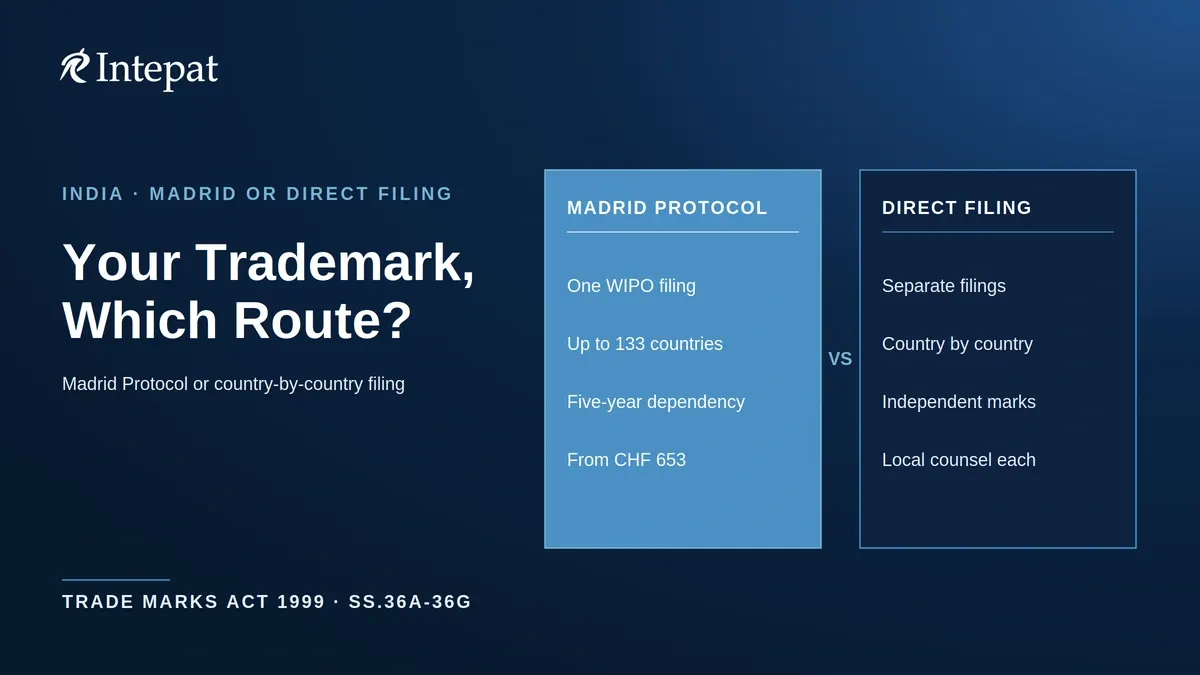
An Indian startup or business owner pursuing international trademark registration from India has two routes: the Madrid Protocol, a single WIPO application covering up to 133 countries, or direct national filing in each jurisdiction. The choice turns on how many markets you are entering, your cost tolerance, and whether the home mark on which a Madrid filing depends is secure.
| Key facts for Indian applicants |
| • A live Indian basis mark is required: either a pending application under Section 18 of the Trade Marks Act 1999 or a registered mark under Section 23; the applicant must also have a connection to India by citizenship, domicile, or real and effective industrial or commercial establishment. • WIPO’s basic fee is CHF 653 (Swiss francs) for a standard mark or CHF 903 for a colour mark (10-year period); the Indian Trade Marks Registry adds a handling fee of Rs 5,000 (e-filing only). Fees verified as of July 2026. • The five-year dependency rule means your international marks can be cancelled across all designated countries if the Indian basis mark is withdrawn, cancelled, expired, or refused within five years of the international registration date. |
This article covers international trademark registration from India, comparing the Madrid Protocol and direct national filing as the two principal outbound routes available to Indian trademark owners. It does not address inbound designation of India by foreign applicants.
How Madrid Protocol Trademark Registration Works from India
India is a Contracting Party to the Madrid Protocol (formally, the Protocol Relating to the Madrid Agreement Concerning the International Registration of Marks), the international trademark filing system administered by WIPO, the World Intellectual Property Organization. The statutory framework in India is Chapter IVA, comprising Sections 36A to 36G, of the Trade Marks Act 1999.
Eligibility and the basis mark. To file an international application through India, an applicant must hold either a pending application under Section 18 of the Trade Marks Act 1999 (in the Act, the “basic application”) or a registered mark under Section 23 (the “basic registration”), and must be a citizen of, be domiciled in, or have a real and effective industrial or commercial establishment in India (meaning a genuine business presence, not merely a registered address). The international application must represent the mark identically to the basis mark and must cover the same goods and services, or a narrower subset.
Filing the MM2(E). The application is filed in English on WIPO form MM2(E) through the Trade Marks International Application System (electronic filing only). The Indian Trade Marks Registry acts as the Office of Origin: it certifies the application, collects the Rs 5,000 handling fee (e-filing only), and forwards the certified form to the WIPO International Bureau within two months of receipt.
Examination in designated countries. WIPO examines the application for formal compliance and, if satisfied, records the international registration and notifies each Contracting Party (member country) the applicant has designated. Each designated office then examines the mark under its own domestic law. Under the Madrid Protocol, a designated office typically has up to 18 months from WIPO’s notification to issue a provisional refusal (an initial objection or refusal of protection in that jurisdiction), though the applicable period may differ by jurisdiction. Where no provisional refusal is issued within the applicable period, protection in that jurisdiction is ordinarily extended.
Duration. The international registration lasts 10 years, is renewable for further 10-year periods, and carries a six-month grace period for renewal with a surcharge.
For a guide to avoiding procedural mistakes in the Madrid filing process, see common errors to avoid while filing under the Madrid system.
What Direct National Filing Involves
Direct national filing means submitting a separate trademark application to the national trademark office of each target country. Each application is in that office’s required language and format, covers the goods and services specified for that jurisdiction, and is examined under that jurisdiction’s own law.
The key difference from the Madrid Protocol, for an Indian applicant, is independence. Once a directly filed mark registers in a foreign jurisdiction, that registration stands on its own. It carries no legal link to the Indian trademark and is not affected by anything that happens to the Indian mark: opposition, cancellation, or lapse.
In practice, direct national filing involves engaging local trademark attorneys in each jurisdiction and managing separate timelines, prosecution correspondence, and renewal deadlines for each registration.
Cost Comparison: Madrid Protocol Fees vs Direct Filing
Madrid Protocol costs
The WIPO fee schedule for the Madrid Protocol is structured as follows. Fees are denominated in Swiss francs (CHF). The schedule below is verified against the official WIPO Madrid System fee schedule; last published update February 2023, confirmed on wipo.int in July 2026.
- Basic fee: CHF 653 for a standard (black and white) mark, or CHF 903 for a colour mark, covering the 10-year registration period
- Supplementary fee: CHF 100 per class, for every class beyond three; no supplementary fee is payable where all designated Contracting Parties charge individual fees rather than the standard complementary fee
- Complementary fee: CHF 100 per Contracting Party designated, where that Party applies the standard complementary fee rather than an individual fee
- Individual fees: where a Contracting Party has notified WIPO that it requires its own individual fee (as the European Union, USA, China, and Japan have done, among others), that individual fee replaces the CHF 100 complementary fee and is set by each Party separately
- A 90% reduction in the basic fee is available to applicants from least-developed countries
The Indian Trade Marks Registry separately charges a handling fee of Rs 5,000 per international application, payable by e-filing only (verified as of July 2026).
Direct national filing costs
Direct national filing costs vary by jurisdiction, applicant category, number of classes, and local professional fees. No single authoritative cross-jurisdiction fee schedule exists. For a meaningful cost comparison, applicants should request a jurisdiction-by-jurisdiction cost estimate from counsel before committing to a route.
When the comparison shifts
For applicants entering five or more markets simultaneously (a practical threshold; the Protocol itself imposes no minimum), the consolidated WIPO process avoids the transaction costs of multiple separate engagements. For one or two markets, direct filing may be comparable in total cost once professional fees for both routes are included. The comparison shifts further where key target markets, such as the EU, USA, and Japan, charge individual fees under Madrid, since those individual fees can equal or exceed the CHF 100 complementary fee and reduce the Protocol’s cost advantage.
Timeline: How Long Each Route Takes
Madrid Protocol
The process from Indian filing to decisions in designated countries has three stages.
First, the Registrar must certify and forward the certified MM2(E) application to WIPO within two months of receipt. If the application is non-compliant on any point, the Registrar requires corrections before forwarding.
Second, WIPO examines the application for formal compliance and, if satisfied, records the international registration and notifies designated offices.
Third, each designated office has up to 18 months (or such shorter period as may apply in that jurisdiction) from WIPO’s notification to issue a provisional refusal. Where no provisional refusal is issued within the applicable period, protection in that jurisdiction is ordinarily extended.
The total period from Indian filing to resolution in designated countries is therefore shaped by the examination timeline in each designated jurisdiction. Startups planning trademark clearance in parallel with commercial launches should file early.
Direct national filing
Each jurisdiction operates on its own examination timeline. Some offices complete examination and advertisement within months of filing; others take longer depending on office workload and the number of classes filed. Direct national filings are not subject to an internationally imposed provisional-refusal notification deadline.
The Five-Year Dependency Risk and What It Means for Your Brand
A notable structural risk for Indian applicants filing internationally under the Madrid Protocol is the five-year dependency provision in Section 36D(5) of the Trade Marks Act 1999.
Section 36D(5) provides: where, at any time before the expiry of a period of five years from the date of international registration, the Indian basis mark (the basic application under Section 18 or the basic registration under Section 23 on which the international application rested) has been withdrawn, cancelled, has expired, or has been finally refused in respect of all or some of the goods or services listed in the international registration, the protection resulting from the international registration ceases to have effect for those goods or services.
This is sometimes called “central attack.” A competitor who successfully challenges the Indian basis mark within five years removes not only the Indian registration but also the protection in all designated countries for the goods or services affected, under that provision.
The Madrid Protocol does provide a remedy, called transformation (Article 9quinquies), which allows an applicant to convert a centrally attacked international registration into individual national applications in each designated country, provided the national application is filed within three months of the date the international registration was cancelled. This deadline is tight and requires immediate engagement of local counsel in each jurisdiction.
The risk is highest where the Indian basis is a pending application that has not yet cleared examination and survived the opposition period. A third party can, in a single proceeding in India, disable the applicant’s international portfolio for the affected goods or services within the five-year window.
After five years from the date of international registration, each designated country’s protection ordinarily becomes independent of the Indian basis. However, a statutory proviso applies: where both an appeal against the registration decision AND an opposition or withdrawal action were initiated in India before the five-year window closed, any final decision resulting in withdrawal, cancellation, or refusal is deemed to have taken place within the five-year period even if it is issued after that date.
| Central attack risk: key facts |
| The five-year provision (Section 36D(5)) is the most operationally significant risk in a Madrid Protocol portfolio. If the Indian basis mark is withdrawn, cancelled, expired, or refused within five years, protection ceases in all designated countries for the affected goods or services. The window ordinarily closes after five years from the international registration date; a statutory proviso extends it where both an appeal and an opposition or withdrawal action were initiated in India before the five-year mark. A transformation mechanism exists under Article 9quinquies of the Madrid Protocol, but requires filing national applications within three months of cancellation and local counsel in each jurisdiction. |
Managing the risk
Where the Indian basis mark is under serious objection or opposition, filing the highest-priority markets directly through those countries’ national offices avoids the central attack risk entirely: a directly filed national registration carries no link to the Indian mark and is not affected by the Indian mark’s fate. For guidance on provisional refusals issued by India as a designated country (an inbound matter), see responding to a provisional refusal in India under the Madrid Protocol.
Which Route Fits Your Situation
The right filing route turns on three factors: the number of markets you are entering, the stability of the Indian basis mark, and the specific countries on your list. The table below maps these factors to a recommendation.
| Factor | Madrid Protocol is likely the better fit | Direct national filing is likely the better fit |
| Number of markets | Generally five or more countries simultaneously (practical guidance; the Protocol imposes no minimum) | One or two countries |
| Indian basis mark | Registered and unchallenged | Pending and under examination or opposition |
| Target markets | Mix of countries where the CHF 100 complementary fee applies | Primarily major individual-fee markets (EU, USA, Japan, China) |
| Ongoing management | Centralised renewals and recordals via WIPO preferred | Complex prosecution required in each jurisdiction |
| Timeline preference | 18-month provisional-refusal notification period per jurisdiction is acceptable | Faster national examination preferred |
A hybrid approach is also available: an applicant may file via the Madrid Protocol for a broad group of markets while filing directly in one or two priority jurisdictions where national examination is faster or direct filing is cost-comparable. The Intepat Madrid Protocol service page covers the scope of support available for both approaches.
For Indian startups who have not yet completed domestic registration, the complete guide to trademark registration in India covers the Indian filing process in detail.
If European markets are a priority, trademark registration in Europe through EUIPO covers the EU trademark as an alternative to or alongside Madrid designation of the EU.
Common Questions About International Trademark Registration from India
The Madrid Protocol is an international trademark filing system administered by WIPO (the World Intellectual Property Organization) that allows an Indian trademark owner to file a single application in English, designating up to 133 countries, on the basis of an existing Indian application or registration. The statutory framework in India is Chapter IVA (Sections 36A to 36G) of the Trade Marks Act 1999.
The WIPO basic fee is CHF 653 (Swiss francs) for a standard mark or CHF 903 for a colour mark (10-year period). A supplementary fee of CHF 100 applies per class beyond three, though no supplementary fee is payable where all designated countries charge individual fees. Each designated country attracts either CHF 100 or its own individual fee. The Indian Registry separately charges Rs 5,000 (e-filing only). Fees verified as of July 2026.
Under Section 36D(5) of the Trade Marks Act 1999, if the Indian basis mark is withdrawn, cancelled, expired, or finally refused within five years of the international registration date, protection ceases in all designated countries for the goods or services affected. After five years, protection ordinarily becomes independent of the Indian basis; however, a statutory proviso extends the dependency window where both an appeal and an opposition or withdrawal action were initiated in India before the five years expired.
Yes, ordinarily within the first five years from the date of international registration. A successful challenge to the Indian basis mark during that period triggers cancellation of the international registration for the affected goods or services across all designated countries. A statutory proviso also deems a final decision to fall within the five-year window if both an appeal and an opposition or withdrawal action were initiated in India before the five years expired. This risk is sometimes called central attack. Applicants with pending or contested Indian basis marks often file priority markets directly for this reason.
Rule 66(2) of the Trade Marks Rules 2017 requires the Registrar to forward the certified MM2(E) application to WIPO within two months of receipt. If the application is non-compliant, the Registrar may require corrections before forwarding.
It depends on the number of target markets, the state of the Indian basis mark, and the specific countries involved. The Protocol tends to be more efficient for startups entering five or more markets simultaneously (a practical rule of thumb; the Protocol imposes no minimum) with a stable and unchallenged Indian registration. For one or two markets, or where the Indian mark is pending or contested, direct national filing or a hybrid approach may offer better risk management.
This article provides general information about the Madrid Protocol trademark registration process for Indian trademark owners and does not constitute legal advice. Trademark law, Registry procedures, official fees, and WIPO schedules are subject to change. Verify all fees, deadlines, and procedural requirements against current official sources before acting. For advice specific to your circumstances, consult a qualified trademark attorney.