




WIPO’s Madrid fee calculator estimates what an international trademark filing will cost by adding together WIPO’s basic fee, a supplementary or complementary fee, and each designated country’s individual fee, then totalling the result in Swiss francs before an applicant files or renews through the Madrid System.
For an application filed from India, the calculator treats the Trade Marks Registry as the Office of origin. India is bound by the Madrid Protocol only, not the 1891 Agreement; it acceded on 8 July 2013, which fixes which fee rules apply whenever India is designated.
| Quick answer: |
| WIPO’s Madrid fee calculator totals the basic fee (CHF 653 for a black-and-white mark, CHF 903 in colour), a CHF 100 supplementary fee per class beyond three (waived if every designated country charges its own individual fee instead), and either a CHF 100 complementary fee or a country-specific individual fee for each designated country. Enter the office of origin, class count, and target countries to generate the estimate. |
What the Madrid fee calculator actually calculates
The Madrid fee calculator, hosted under WIPO’s eMadrid platform, builds an estimate from the fee categories in the Schedule of Fees: a basic fee on every application, a supplementary or complementary fee tied to classes and countries, and an individual fee where a country has fixed one. It does not process payment.
Payment happens separately, through eMadrid, once the application is filed, and the calculator’s Schedule-of-Fees basis sits under the Regulations under the Madrid Protocol. An applicant who estimates from memory instead of running the calculator risks the two errors that show up as a WIPO irregularity notice: an out-of-date individual fee, and a miscounted class. A checklist of common filing mistakes under the Madrid System covers the non-fee side of that problem.
Because individual fees change by country-specific notice without any change to the Regulations themselves, a figure the calculator returns today can be superseded by the time of filing. Re-running the calculator close to the actual filing or renewal date, rather than relying on an earlier check, avoids budgeting on a stale number.
The three fee components
Every Madrid System transaction combines some mix of three fee types set out in the Schedule of Fees: a basic fee paid once to WIPO regardless of destination, and then either a complementary fee or an individual fee charged separately for each designated country, never both for the same country.
- Basic fee: CHF 653 where no part of the mark’s reproduction is in colour, or CHF 903 where any part is in colour. Applicants whose Office of origin is on the United Nations’ Least Developed Country list pay 10% of these amounts instead: CHF 65 or CHF 90.
- Supplementary or complementary fee: CHF 100 for each class beyond three, unless every designated country charges an individual fee instead of a complementary fee, in which case no supplementary fee applies. CHF 100 for each designated country that has not fixed its own individual fee.
- Individual fee: set independently by each country that has chosen to receive one instead of a share of the standard fees. Because this figure changes by notice, a number carried over from an earlier filing is not reliable without a fresh check.
Renewal, due every ten years from the date of international registration, follows the same three-part structure, plus a surcharge of 50% of the basic renewal fee if payment falls within the six-month grace period after expiry.
India’s individual fee under the Protocol
Because India has chosen to charge its own fee rather than the standard complementary fee, every application, subsequent designation, or renewal designating India attracts that fee instead. It is currently CHF 83 per class, effective for filings received on or after 28 June 2026, per WIPO’s official fee table (verified as of August 2026).
An applicant relying on the 2023 published figure, CHF 110 per class, will understate the India component of an estimate; that rate has since been superseded by the current CHF 83 per class, which is why the live calculator, not a saved figure, is the reliable source at the point of filing.
This fee applies only where India is a designated country, not to an Indian-origin applicant filing outward. An Indian company designating the United Kingdom or Japan pays those countries’ own individual fees, never India’s; the India figure above matters to a company outside India that is designating India in its own application.
What the calculator does not include
The calculator estimates only the fees payable to WIPO, in Swiss francs. It excludes the separate domestic fee the Trade Marks Registry charges for certifying and transmitting an application from India, which is the figure most often confused with WIPO’s basic fee, since both are paid around the same point in filing.
Under the Trade Marks Rules, 2017, an applicant whose Office of origin is India pays a handling fee for the Registry’s certification and transmittal of the international application, Form MM2(E), to the International Bureau, fixed at INR 5,000 for electronic filing (no physical-filing rate is available). This fee is paid in Indian rupees, electronically, with the international application itself, not with the underlying domestic trademark application, and it is separate from, and additional to, every Swiss-franc figure the calculator produces.
Using the calculator, step by step
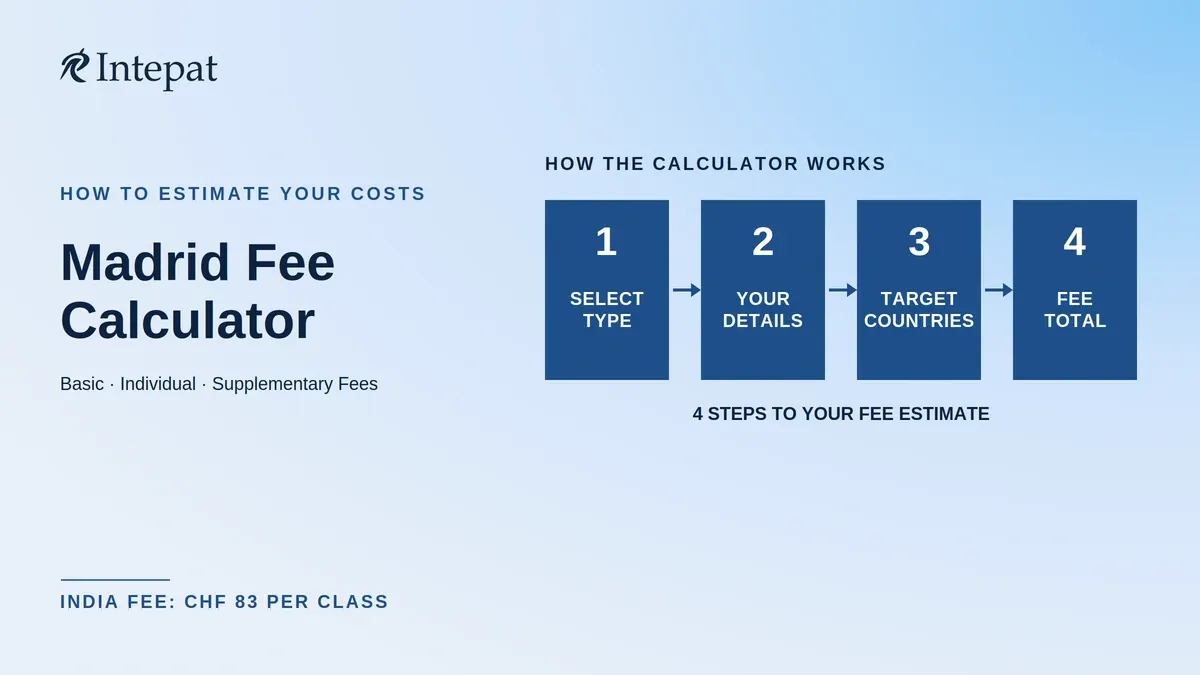
The calculator works through four inputs before generating an estimate: transaction type, Office of origin and mark details, designated countries, and the itemised breakdown. An incorrect class count can materially change the total.
- Select the transaction type: new international application, subsequent designation, or renewal, chosen from a dropdown; each draws on a different item of the Schedule of Fees.
- Enter the Office of origin and mark details: for an Indian applicant, select India as the Office of origin, enter the number of classes to be covered internationally (which must fall within, though can be narrower than, the goods and services in the underlying Indian application or registration), and indicate whether any part of the mark’s reproduction is in colour, since that changes the basic fee.
- Choose the designated countries: add or remove target countries individually; the calculator applies each country’s current individual fee automatically where one exists, and the standard complementary fee where it does not.
- Read the breakdown: the output itemises the basic fee, any supplementary fee, and each country’s fee separately, in Swiss francs, before totalling them, which lets an applicant catch a miscounted class or a wrongly added country before filing.
Worked example
An Indian company files a new international application for a mark that is not in colour, covering four classes of goods, and designates the United Kingdom and Japan, both of which currently charge their own individual fee rather than the standard complementary fee.
- Basic fee: CHF 653 (no colour)
- Supplementary fee: none. The CHF 100 per-class supplementary fee for classes beyond three does not apply here, because both designated countries charge individual fees rather than the complementary fee
- United Kingdom and Japan: each country’s own individual fee, read directly from the calculator at the time of filing
The basic fee alone totals CHF 653 before either country’s individual fee is added; no supplementary fee is due for the fourth class in this specific combination. A different combination, such as designating a country that charges the standard complementary fee alongside the UK, would bring the supplementary fee back into the total. Country-specific individual fees for the UK and Japan are not stated as figures here, since verifying them was outside this article’s India-focused source verification; the calculator itself is the reliable source for those figures at the time of filing.
Frequently Asked Questions
Yes. It is a free, browser-based tool on WIPO’s Madrid System site, requires no WIPO user account, and returns an estimate immediately after the required fields are entered, without submitting anything to WIPO or committing to a filing.
No. The calculator only estimates Madrid System fees; it does not process payment. Payment is made separately through WIPO’s own payment channels once the application or renewal is actually filed, and the amount due is fixed in Swiss francs at that later step.
India’s individual fee is fixed by WIPO notice, not by the Schedule of Fees itself, and has been revised since 2023, most recently to CHF 83 per class. Re-running the calculator close to filing is the safest way to avoid a stale figure.
India is a Contracting Party under the Protocol only; it acceded in 2013 and never joined the 1891 Agreement. This fixes which fee applies whenever India is designated: India’s own individual fee under the Protocol, currently CHF 83 per class, rather than a different rate tied to the Agreement.
This article explains how to use WIPO’s Madrid fee calculator and is not legal advice. Fee amounts, particularly individual fees, change by WIPO notice and should be confirmed on the calculator at the time of filing; an applicant should consult a trademark attorney before filing or renewing an international application.
Sources
- WIPO Publication No. 207E/25, Schedule of Fees (in force 1 February 2023), items 2, 5, 6. World Intellectual Property Organization.
- WIPO, Individual Fees Under the Madrid Protocol (current rates, last updated 1 August 2026).
- WIPO Madrid System, Declarations and Notifications by Madrid System Members.
- WIPO Madrid System Fee Calculator.
- Trade Marks Rules 2017, Rule 67 and First Schedule Entry 23.