




Missed the 12-Month PCT Deadline?
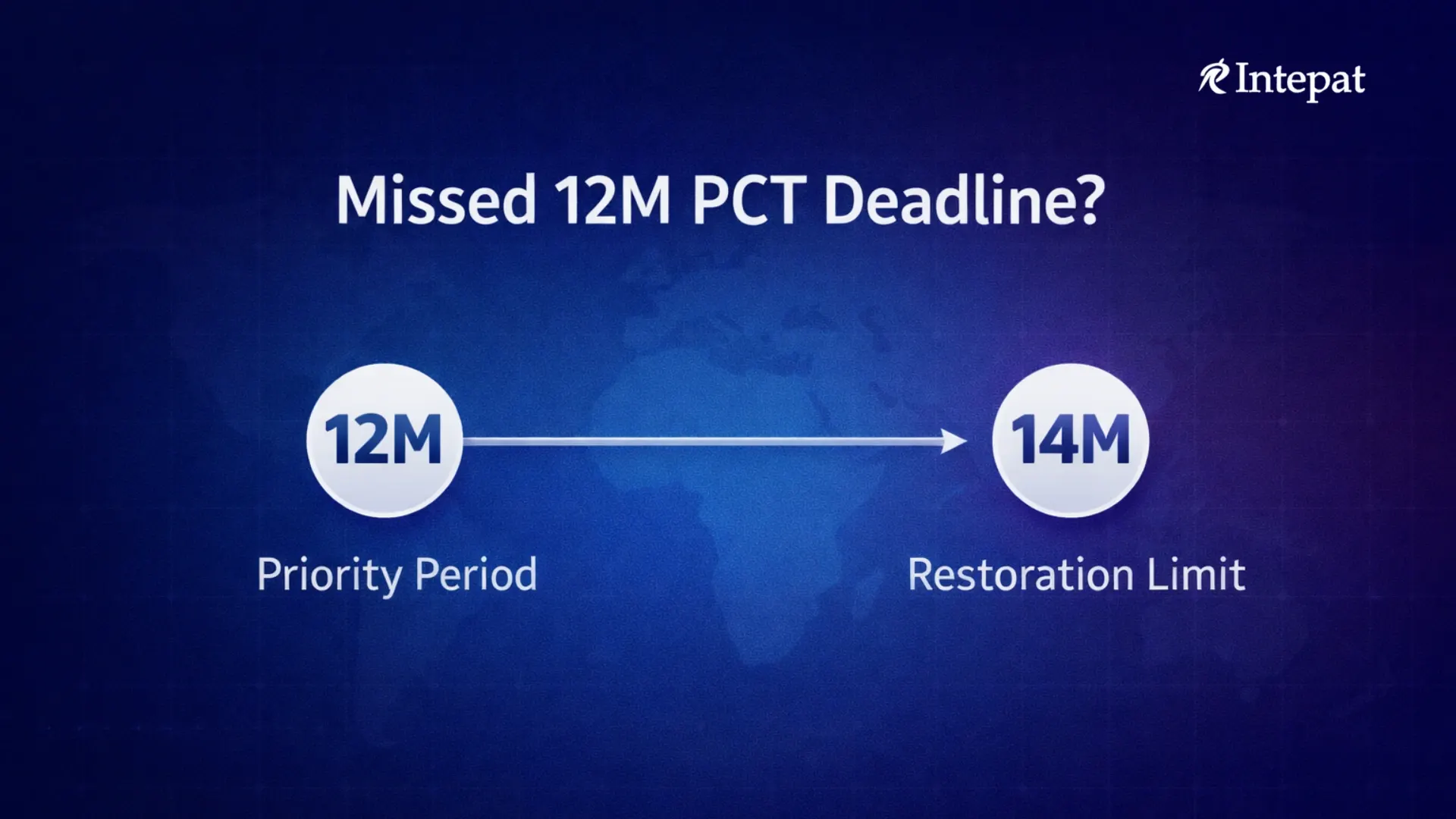
The 12-month period is the priority period under Article 4 of the Paris Convention. A PCT application must normally be filed within 12 months from the earliest priority date to preserve that priority.
If a PCT application is filed after expiry of the 12-month period, the application itself is not invalid. However, the priority claim becomes vulnerable.
In practice, when filing through ePCT, the system automatically flags that the priority date exceeds 12 months. The applicant is prompted to request restoration of priority, provided the filing still occurs within 14 months from the earliest priority date. The system does not block the filing. It alerts the applicant that restoration must be requested and justified.
The legally accurate position is therefore nuanced. Filing after 12 months does not automatically destroy the PCT application. It places the priority claim at risk. Restoration may be available if the filing occurs within 14 months and the delay satisfies the applicable legal standard of the Receiving Office.
If the PCT application is filed after 14 months from the earliest priority date, restoration under the PCT framework is not available. The application can proceed without priority, but prior art exposure increases significantly.
The following sections explain the 12-month rule, the 14-month restoration window, the applicable legal standards, and the India-specific considerations that require careful handling.
The 12-Month Priority Rule Under the Paris Convention
Legal Basis: Article 4 of the Paris Convention
The 12-month priority period originates from Article 4 of the Paris Convention for the Protection of Industrial Property. For patent applications, an applicant who files a first application in one member country is granted 12 months to file subsequent applications in other member countries while retaining the original filing date as the priority date.
The priority date becomes the legally protected reference point across jurisdictions.
Why the Priority Date Matters
In practical terms, the earliest priority date becomes the benchmark for assessing novelty and inventive step. Any disclosure made after that priority date but before the later filing will not count as prior art against the invention, provided the priority claim is valid.
If priority is lost, the effective filing date shifts forward to the PCT filing date. That shift can expose the application to additional prior art.
How This Applies to PCT Filings
For PCT filings, the same 12-month rule applies. The PCT system does not create a new priority period. It operates within the Paris Convention framework. If you want a structured comparison of how both systems interact, you can read our detailed analysis on Paris Convention vs Patent Cooperation Treaty.
If an applicant files a provisional or complete specification in India, the United States, Europe, Japan, or any other Paris Convention country, the 12-month clock starts running from that first filing.
If the PCT application is filed within those 12 months, the priority claim is secure, subject to formal compliance. In case, the PCT application is filed after expiry of 12 months, the priority claim becomes vulnerable unless restoration is successfully requested under the PCT Rules.
The PCT filing date and the priority date are legally separate concepts. Missing the 12-month deadline does not invalidate the PCT application itself. It affects the strength and validity of the priority claim.
What Happens If the PCT Is Filed After 12 Months?
If a PCT application is filed after expiry of the 12-month priority period, the international application itself remains valid. The issue concerns the priority claim, not the existence of the PCT filing.
In practice, when filing through ePCT, the system immediately alerts the applicant if the earliest priority date exceeds 12 months. The filing is not blocked. Instead, the system prompts the applicant to request restoration of priority, provided the filing still falls within the permissible restoration window.
If no restoration request is made, or if the request is refused, the priority claim fails. The effective date for assessing novelty and inventive step then shifts from the original priority date to the international filing date. Any disclosure between those two dates may become citable prior art. From a patentability perspective, that shift can be decisive.
Restoration is not automatic. A formal request must be filed before the Receiving Office, accompanied by a statement explaining the reasons for the delay and payment of the prescribed fee, where applicable. WIPO provides an official explanation of how restoration operates under the PCT system in its guidance on restoration of priority.
It is equally important to avoid confusing this situation with late national phase entry at 30 or 31 months. That issue arises much later in the lifecycle of a PCT application. If you need clarity on that structural difference, see our article on PCT National Phase and PCT International Phase.
The 14-Month Window and the Legal Basis Under Rule 26bis.3
The PCT framework provides a limited corrective mechanism if the 12-month priority period has expired.
Under PCT Rule 26bis.3, restoration of priority may be requested if the international application is filed within two months from the expiry of the 12-month priority period. In practical terms, this creates a maximum outer limit of 14 months from the earliest priority date.
The two-month period is calculated from the date on which the 12-month priority period expired. If the international filing date falls within this additional window, the applicant can request restoration. If the filing occurs after 14 months, restoration is not available under the PCT system.
Rule 26bis as a whole governs correction or addition of priority claims. Within that framework, Rule 26bis.3 specifically deals with restoration of the right of priority. The official rule text can be accessed under PCT Rule 26bis.3.
A restoration request must be filed within the prescribed time limit and must include a statement explaining the reasons for the delay in filing the international application within the 12-month priority period. Where required by the chosen Receiving Office, the prescribed restoration fee must also be paid within the applicable deadline.
Restoration is examined during the international phase by the Receiving Office with which the PCT application is filed. The assessment is not informal or automatic. The Receiving Office must determine whether the facts presented satisfy the applicable legal standard under Rule 26bis.3. The decision is therefore grounded in defined statutory criteria rather than discretionary leniency.
Importantly, even if restoration is granted at the Receiving Office stage, certain designated Offices in the national phase may review the effect of that restoration under their national law.
Legal Standards for Restoration: “Unintentional” vs “Due Care”
Restoration of priority is not granted merely because a request is filed within 14 months. The Receiving Office must be satisfied that the delay meets one of the recognised legal standards under the PCT framework.
Two standards exist internationally:
1. Unintentional delay
Under this standard, the applicant must state that the failure to file within the 12-month priority period was unintentional. The focus is generally on the applicant’s intent rather than on detailed evidence of precautionary measures.
2. Due care required by the circumstances
This is the stricter standard. The applicant must demonstrate that all reasonable precautions were taken and that the delay occurred despite exercising due care. Documentary evidence may be required to support internal systems, docketing procedures, or exceptional circumstances.
Not every Receiving Office applies both standards. Some apply only the stricter due care test. Some apply the unintentional standard. Some apply both. The choice of Receiving Office can therefore materially affect the probability of restoration being accepted.
Another important nuance is that restoration granted by the Receiving Office does not automatically bind every designated Office in the national phase. Certain jurisdictions may review whether the applicable standard was correctly applied under their national law.
A further nuance is often overlooked. Restoration granted during the international phase does not automatically bind every designated Office during national phase examination. Certain jurisdictions retain the right to review the effect of restoration under their national law. This is why understanding the structural difference between the international phase and national phase is essential. For clarity on that distinction, see our guide on PCT National Phase and PCT International Phase.
Receiving Office Practice: Why the Choice of Filing Office Matters
Restoration of priority is decided by the Receiving Office where the PCT application is filed. It is not determined by the applicant’s country of residence alone.
Where more than one Receiving Office is available to an applicant, the choice of office can materially influence the restoration outcome.
Under the PCT framework:
• Some Receiving Offices apply only the stricter due care required by the circumstances standard
• Some apply the unintentional delay standard
• Some apply both standards
• Procedural requirements such as declarations, supporting evidence, and fees may differ
This distinction is not theoretical. Under the due care standard, the applicant may need to demonstrate the existence of reliable docketing systems, monitoring procedures, or exceptional circumstances that led to the delay. Under the unintentional standard, the focus is generally on whether the delay was deliberate.
The restoration decision is taken during the international phase. However, restoration granted by a Receiving Office does not always bind every designated Office in the national phase. Certain jurisdictions retain the right to review whether the restoration decision satisfies their national legal requirements.
This is why restoration strategy must be evaluated before filing, not after. The international phase and national phase operate within the same PCT framework but involve different legal assessments. If you need clarity on how these phases interact, see our explanation of PCT National Phase and PCT International Phase.
India-Specific Strategy: Restoration vs Post-Dating
For Indian applicants, two distinct mechanisms may arise when the 12-month priority period has expired:
1. Restoration Under the PCT Framework (Within 14 Months)
If the PCT application is filed within 14 months from the earliest priority date, restoration of priority may be requested under Rule 26bis.3. The request must satisfy the applicable legal standard of the chosen Receiving Office.
This mechanism operates entirely within the PCT system.
If restoration is granted, the original priority date is preserved.
2. Post-Dating Under Indian Law (Up to 6 Months)
Indian law permits post-dating of a patent application by up to 6 months. Post-dating changes the effective filing date of the Indian application. Since the Paris Convention priority period is calculated from the effective filing date, post-dating can, in limited circumstances, shift the starting point of the 12-month priority clock.
In practical terms, if no disclosure has occurred before the proposed post-dated filing date, and if post-dating is legally available within the statutory six-month limit, a PCT application may still be filed based on the revised effective filing date. This effectively means that, in certain fact-specific scenarios, the international filing may occur within what becomes a new 12-month priority period, provided the overall timeline does not extend beyond 18 months from the original filing date.
However, this strategy is highly sensitive to disclosure history and filing chronology. Post-dating cannot cure prior public disclosure, and it must comply strictly with statutory requirements. The procedural mechanics and limitations are explained in detail in our guide on post-dating patent applications in India.
When Restoration Is Not Available: The 14-Month Cut-Off
The PCT framework sets a strict outer boundary. If the international application is filed after 14 months from the earliest priority date, restoration of priority under Rule 26bis.3 is not legally available. The Receiving Office has no discretion beyond this time limit.
The PCT application can still be filed. However, it will proceed without the benefit of the original priority date. The effective date for assessing novelty and inventive step will shift to the international filing date.
This shift is not merely procedural. It can materially affect patentability. Any disclosure made between the original priority date and the PCT filing date may become prior art. In practical terms, that often includes conference disclosures, investor presentations, website publications, technical demonstrations, or academic submissions.
Once the 14-month period has expired, corrective mechanisms under the PCT system are exhausted. Restoration cannot be revived. At that stage, the applicant must reassess patentability in light of intervening disclosures and evaluate whether filing without priority remains commercially viable.
If no disclosure occurred and post-dating was lawfully exercised earlier under Indian law, strategic restructuring may still be possible. However, once public disclosure has intervened, the legal position becomes significantly narrower.
From a practitioner’s perspective, this is where proactive docket management makes the difference between preservation and irreversible loss of priority rights.
Practical Decision Path: What Should You Do If the 12-Month Deadline Is Missed?
If you discover that the 12-month Paris Convention period has expired, the first step is to determine the exact number of days elapsed from the earliest priority date.
If the PCT filing can still be made within 14 months, restoration under Rule 26bis.3 should be evaluated immediately. The choice of Receiving Office, applicable legal standard, and supporting documentation must be assessed before filing. Delay at this stage reduces strategic flexibility.
If the filing date has crossed 14 months but remains within 18 months from the original Indian filing, and no disclosure has occurred, post-dating under Indian law may require urgent examination. This option is fact-sensitive and must be analysed before any further disclosure takes place.
If the filing date has crossed both 14 months and the permissible post-dating window, restoration is no longer available. The application may still be filed without priority, but patentability must be reassessed against intervening disclosures.
At this stage, three questions must be answered immediately:
What disclosures have occurred?
In which jurisdictions is protection commercially critical?
Does filing without priority remain strategically viable?
The difference between recoverable delay and irreversible priority loss often comes down to timing and documentation.
Conclusion: Priority Deadlines Require Immediate Assessment
The 12-month Paris Convention deadline is a strict legal benchmark. Missing it does not automatically invalidate a PCT application, but it places the priority claim at risk.
If the filing occurs within 14 months, restoration may be available under Rule 26bis.3, subject to the applicable legal standard and Receiving Office practice. Beyond 14 months, restoration under the PCT system is no longer possible.
For Indian applicants, post-dating may in limited circumstances alter the effective filing date, but only where statutory conditions are satisfied and no intervening disclosure has occurred.
Each of these mechanisms operates under distinct legal frameworks. The correct strategy depends on filing chronology, disclosure history, jurisdictional objectives, and timing.
When a priority deadline is missed, the analysis must be immediate and precise. Delay at this stage can permanently affect patent rights across multiple jurisdictions.
Missed the 12-Month Deadline?
Priority restoration and post-dating require careful legal evaluation before taking any further step.
Frequently Asked Questions
1. Can I file a PCT application after 12 months from the priority date?
Yes, a PCT application can still be filed after 12 months. However, the priority claim becomes defective unless restoration is requested and granted. If the filing occurs within 14 months from the earliest priority date, restoration of priority may be available under PCT Rule 26bis.3.
2. What is the 14-month rule under the PCT?
The 14-month rule refers to the outer limit for requesting restoration of priority. A PCT application must be filed within two months from the expiry of the 12-month priority period. In practical terms, this creates a maximum 14-month window from the earliest priority date.
3. What is restoration of priority under the PCT?
Restoration of priority is a legal mechanism under Rule 26bis.3 that allows an applicant to request preservation of the original priority date if the PCT application was filed after 12 months but within 14 months. The applicant must satisfy either the unintentional delay standard or the due care standard, depending on the Receiving Office.
4. What is the difference between unintentional delay and due care?
Unintentional delay generally requires a declaration that the failure to meet the deadline was not deliberate. The due care standard is stricter and requires proof that all reasonable precautions were taken to meet the deadline and that the delay occurred despite those efforts.
5. Does restoration granted by the Receiving Office bind national offices?
Not always. Although restoration is decided during the international phase by the Receiving Office, certain designated Offices may review the effect of restoration under their national law during the national phase.
6. Can India restore priority under the PCT?
Restoration is governed by the PCT framework and examined by the Receiving Office where the international application is filed. If the application is filed with the Indian Patent Office as Receiving Office, restoration may be considered under the applicable PCT standards. The decision depends on compliance with Rule 26bis.3 and procedural requirements.
7. What happens if I file a PCT application after 14 months?
If the PCT application is filed after 14 months from the earliest priority date, restoration of priority is not available under the PCT system. The application may still be filed, but it will proceed without the benefit of the original priority date. Any disclosure made between the priority date and the filing date may become prior art.