




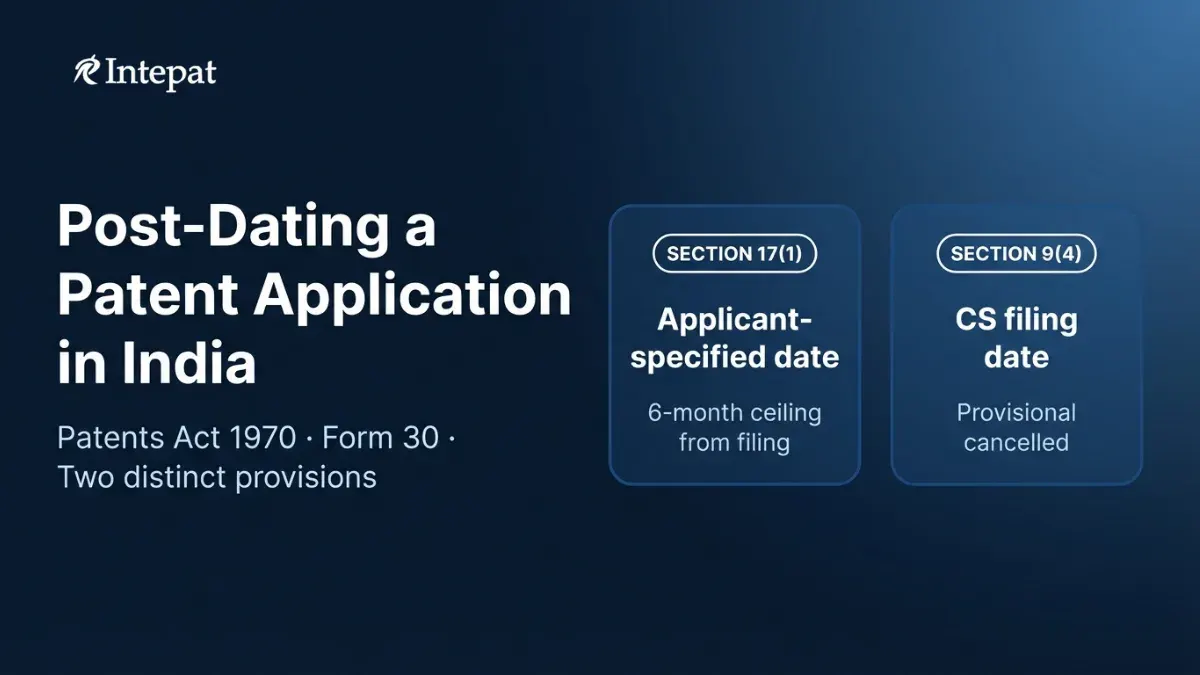
Post-dating shifts the official filing date of a patent application to a later date. The Patents Act, 1970 provides two distinct provisions for this: Section 17(1) and Section 9(4). They operate differently, apply to different fact patterns, and produce different structural outcomes. Both are filed through Form 30. Both carry the same downstream effect on priority computations under Section 11(7). Understanding precisely what each provision does, and what each cannot do, is essential before any post-dating request is made.
Section 17(1): General Post-Dating
Section 17(1) of the Patents Act, 1970 provides:
“Subject to the provisions of section 9, at any time after the filing of an application and before the grant of the patent under this Act, the Controller may, at the request of the applicant made in the prescribed manner, direct that the application shall be post-dated to such date as may be specified in the request, and proceed with the application accordingly: Provided that no application shall be post-dated under this sub-section to a date later than six months from the date on which it was actually made or would, but for the provisions of this sub-section, be deemed to have been made.”
What Section 17(1) Does
Section 17(1) gives the Controller power to direct that an application be post-dated to a date specified by the applicant. The applicant chooses the new date. The ceiling is 6 months from the original filing date, expressly stated in the proviso. The original document, whether a provisional or complete specification, is not cancelled. The application date simply shifts forward to the chosen date.
Section 17(1) is expressly subject to the provisions of Section 9 throughout. This subordination is in the opening words of the provision itself. It means Section 17(1) cannot be used to achieve anything that Section 9 prohibits.
When Section 17(1) Applies
Section 17(1) is the general post-dating provision that applies to any application, whether filed with a provisional specification or directly with a complete specification. It is the only post-dating mechanism available where no provisional was filed. The applicant files Form 30 with the prescribed fee and specifies the new date, which must fall within 6 months of the original filing date.
What “Subject to Section 9” Means in Practice
The subordination of Section 17(1) to Section 9 has one confirmed, critical consequence: Section 17(1) cannot be used to extend the 12-month deadline for filing a complete specification after a provisional specification under Section 9(1). The Delhi High Court confirmed this in Standipack Pvt. Ltd. v. Oswal Trading Co. Ltd. (AIR 2000 Delhi 23), the only judicial authority on this point. The Controller applied it directly in Application No. 1064/DEL/2010, where a post-dating request was made with the intention of extending the CS deadline. The application was deemed abandoned under Section 9(1).
The Patents (Amendment) Act 2005 reinforced this position by deliberately removing the provision that had previously allowed a complete specification to be filed between 12 and 15 months from the provisional filing date on payment of a fee. That removal signals that the 12-month deadline under Section 9(1) is strict and non-extendable by any procedural mechanism.
The Prior Art Consequence of Post-Dating Under Section 17(1)
Section 17(1) moves the filing date forward. Prior art is assessed against the new date. Any disclosure occurring between the original filing date and the post-dated date, by the applicant or any third party, becomes citable prior art from the new date. Three categories of intervening disclosure carry specific risk: the applicant’s own publications, presentations, product launches, or investor materials; independent filings by third parties working in the same field; and third-party publications, academic papers, or patent applications published during the gap.
Absolute Bars Under Section 17(1)
A convention application cannot be post-dated under Section 17(1) to a date later than the date on which it could have been made under the Act. Section 136(3) of the Patents Act, 1970 is explicit on this point. A post-dating request specifying a date more than 6 months after the original filing date will not be accepted. A request made after the patent has been granted will not be accepted. Both conditions, the 6-month ceiling and the pre-grant timing, are absolute.
Section 9(4): Cancellation of the Provisional and Re-Dating to the Complete Specification Date
Section 9(4) of the Patents Act, 1970 provides:
“Where a complete specification has been filed in pursuance of an application for a patent accompanied by a provisional specification… the Controller may, if the applicant so requests at any time before grant of patent, cancel the provisional specification and post-date the application to the date of filing of the complete specification.”
What Section 9(4) Does
Section 9(4) does two things as a single act: it cancels the provisional specification and re-dates the application to the CS filing date. Unlike Section 17(1), the applicant does not specify a date. The date is fixed by statute as the date on which the complete specification was filed. The provisional specification ceases to exist on the record.
The CS filing date becomes the new application date and the reference point for all downstream legal computations. Section 11(7) of the Patents Act, 1970 provides that references to the date of filing in priority calculations are references to the date as so post-dated. The patent term of 20 years runs from the CS filing date. Prior art is assessed against the CS filing date.
When Section 9(4) Applies
Section 9(4) applies only where two conditions are both satisfied: a provisional patent application in India has been filed, and a complete specification has subsequently been filed within the 12-month window under Section 9(1). The request to cancel and re-date must be made before the grant of the patent.
Section 9(4) cannot apply where no provisional specification was filed. Where the application was filed directly with a complete specification, only Section 17(1) is available.
The Prior Art Consequence of Cancellation
Cancelling the provisional specification under Section 9(4) removes the protection that provisional filing date provided. The gap between the original provisional filing date and the CS filing date becomes entirely unprotected. Any disclosure during that gap, whether by the applicant, by a competitor, or by any third party anywhere in the world, becomes citable prior art from the new CS filing date.
Three categories of intervening disclosure carry specific risk: the applicant’s own publications, presentations, product launches, or investor materials; independent filings by third parties working in the same field; and third-party publications, academic papers, or patent applications published during the gap.
Why an Applicant Invokes Section 9(4)
The typical reason is that the provisional specification was inadequately drafted: it did not provide sufficient disclosure to anchor meaningful claims. Rather than proceeding with a CS whose claims are constrained by a weak provisional, the applicant cancels the provisional entirely and makes the CS the effective start of the application. A second reason is that a later patent term start date is commercially preferable where the invention has a long commercialisation timeline and a term running from the CS date is strategically more valuable than one running from the provisional date.
| The critical condition for Section 9(4) |
| Section 9(4) should only be invoked where the applicant has verified with certainty that no disclosure of the invention, by the applicant or any third party, has occurred between the provisional filing date and the CS filing date. A prior art search covering the full interval, across patent and non-patent literature, is a prerequisite. Cancelling the provisional without this verification exposes the application to an invalidity risk that cannot be corrected after the fact. |
The Hard Limit: Section 9(1) Cannot Be Overridden
Neither Section 9(4) nor Section 17(1) extends the 12-month deadline for filing a complete specification after a provisional specification. Section 9(1) is absolute. The Standipack court confirmed this. Application No. 1064/DEL/2010 applied it with a concrete fact pattern. The 2005 Amendment, which deliberately removed the old 15-month extension provision, confirmed the legislative intent. Post-dating under either provision cannot achieve what Parliament specifically chose to remove.
Timing of the Post-Dating Request Relative to the First Examination Report
The Patent Manual (chapter 9.05) published by the Office of the Controller General of Patents, Designs and Trade Marks (CGPDTM) draws a procedural distinction. A post-dating request filed before the First Examination Report is issued is generally allowed, with examination proceeding from the post-dated date. A request filed after the First Examination Report may still be allowed, but the application must undergo a fresh examination cycle from the post-dated date, restarting prosecution. The request for examination deadline of 31 months from the filing or priority date is not extended by post-dating.
Fees
Both Section 9(4) and Section 17(1) post-dating requests are filed through Form 30. The fee is set in Entry 6 of the First Schedule to the Patents Rules, 2003 as amended by the Patents Amendment Rules 2024.
| Applicant category | E-filing | Physical filing |
| Natural person, startup, small entity, or educational institution | ₹800 | ₹880 |
| Others (alone or jointly with natural person, startup, small entity, or educational institution) | ₹4,000 | ₹4,400 |
Source: First Schedule, Entry 6, Patents Rules, 2003, as amended by the Patents Amendment Rules 2024.
| Jurisdictional comparison: |
| The treatment of post-dating in the United States, Europe, and other jurisdictions differs materially from the Indian position. For a comparison of how post-dating is treated in the US and European jurisdictions, see the companion article at that link. |
Key Questions
No. Section 17(1) is expressly subject to Section 9. The 12-month deadline under Section 9(1) runs from the original provisional filing date and cannot be extended by any post-dating request. Standipack (AIR 2000 Delhi 23) is the controlling judicial authority. Application No. 1064/DEL/2010 confirmed the position at Controller level. The 2005 Amendment removed the last procedural mechanism that had allowed an extension of this deadline, making the legislative intent unambiguous.
Under Section 9(4), the application is re-dated to the CS filing date, a date fixed by statute and not chosen by the applicant. The provisional is cancelled. Under Section 17(1), the application is post-dated to a date specified by the applicant, within a ceiling of 6 months from the original filing date. The original document is not cancelled. In both cases the new date becomes the reference point for priority calculations under Section 11(7), and anything disclosed between the original date and the new date becomes citable prior art.
Yes. The patent term runs for 20 years from the date of filing. Section 11(7) provides that this date is the post-dated date, whether under Section 9(4) or Section 17(1). Under Section 9(4), the term runs from the CS filing date, which may be up to just under 12 months after the provisional date. Under Section 17(1), the term runs from the post-dated date, up to 6 months after the original filing date. For most types of patent applications in India, the trade-off between the shifted date and the shortened term requires specific analysis on the facts of each application.
Sources
The following primary sources were relied upon in the preparation of this article. All official Indian government sources are published by the Office of the Controller General of Patents, Designs and Trade Marks (CGPDTM) or the Ministry of Commerce and Industry.
Primary Legislation
Patents Act, 1970 (as amended to March 2015), Ministry of Commerce and Industry, Government of India:
Patents Rules, 2003 (as amended), CGPDTM:
Official Manual
Manual of Patent Office Practice and Procedure (Version 3.0), Office of the Controller General of Patents, Designs and Trade Marks (CGPDTM), Government of India:
Case Law
Standipack Pvt. Ltd. v. Oswal Trading Co. Ltd., Delhi High Court, 26 May 1999, AIR 2000 Delhi 23, (1999) IVAD Delhi 613, 80 (1999) DLT 56. Available at Indian Kanoon:
Controller Decision
Application No. 1064/DEL/2010, Controller of Patents, Indian Patent Office. Controller decision on abandonment under Section 9(1) following post-dating request. Not publicly available online; cited by reference throughout this article.
This article reflects Indian patent law as it stood in March 2026 and is intended as general information only. It does not constitute legal advice.