




An invention may be new, but it is patentable only if it is also non-obvious. In India, the United States, and Europe, non-obviousness or inventive step requires that the invention must not be something a person skilled in the art would have arrived at using existing knowledge before the filing date.
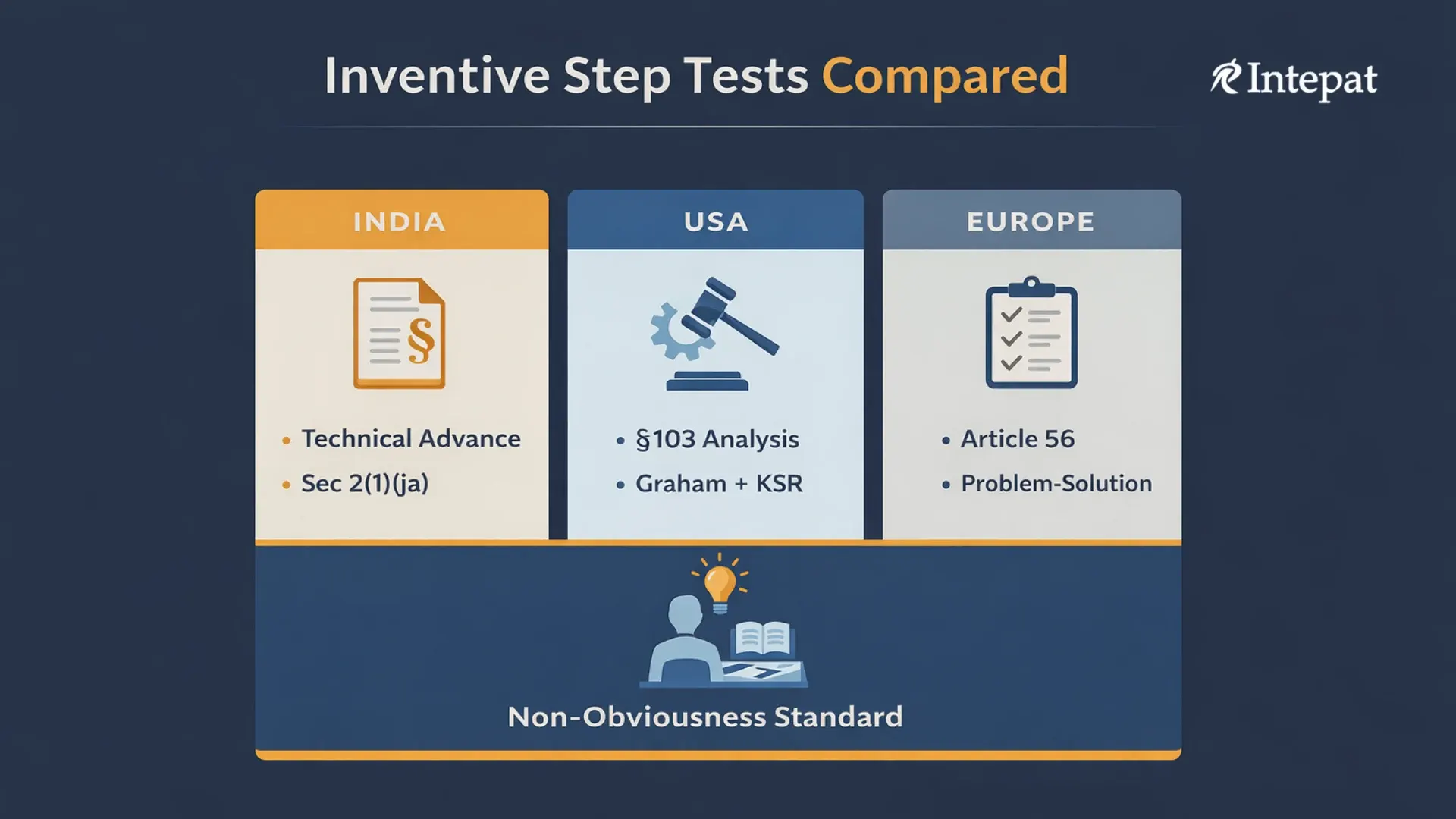
In India, this requirement is defined under Section 2(1)(ja) of the Patents Act, 1970 and requires a demonstrable technical advance or economic significance. In the United States, 35 U.S.C. §103 asks whether the invention would have been obvious in light of prior art. In Europe, Article 56 of the EPC applies a structured problem-solution approach to determine whether the claimed solution would have been obvious to a skilled person.
Although the underlying principle is similar across all three jurisdictions, the analytical framework and the way examiners assess prior art differ significantly, and those differences frequently determine whether a patent application proceeds to grant or faces rejection on inventive step grounds.
Why Inventive Step Is the Real Examination Barrier
Most patent applications do not fail because of novelty. They fail because of inventive step. An invention can be technically new, yet still be rejected if the examiner concludes that a person skilled in the art could have combined existing teachings to arrive at the same solution before the filing date.
In India, objections under Section 2(1)(ja) frequently form the core of First Examination Reports. A detailed understanding of how inventive step is interpreted by the Indian Patent Office is essential, and this has been discussed separately in our analysis on inventive step in Indian patents.
A structured patentability search before filing helps identify the closest prior art and evaluate whether the improvement represents a genuine technical advance or merely an incremental modification. During the patent prosecution process in the United States and Europe, rejections under 35 U.S.C. §103 and Article 56 EPC similarly dominate substantive examination.
With this context, examining how India, the United States, and Europe analyse non-obviousness becomes essential, because although all three apply the skilled person standard, the analytical structure and evidentiary expectations differ significantly in practice.
Inventive Step in India
In India, inventive step is defined under Section 2(1)(ja) of the Patents Act, 1970. An invention must demonstrate a technical advance or economic significance over existing knowledge and must not be obvious to a person skilled in the art at the priority date.
The statutory language is broader than many other jurisdictions because it expressly refers to economic significance. However, in examination practice, the Indian Patent Office focuses primarily on technical advancement rather than commercial value alone.
Indian examiners assess whether the claimed features represent more than a routine modification of known technology. Combining prior art references is permitted if such combination would have been obvious to a skilled person. Incremental design changes, material substitutions, or parameter adjustments without demonstrable technical effect often lead to objections under Section 2(1)(ja).
Unlike Europe, India does not apply a rigid problem-solution framework. Unlike the United States, secondary considerations such as commercial success rarely play a decisive role. Instead, the analysis typically centres on whether the claimed technical difference produces a measurable and identifiable technical improvement over the closest prior art.
For a detailed discussion focused exclusively on Indian inventive step jurisprudence and prosecution strategy, refer to our separate analysis on inventive step in Indian patents.
Non-Obviousness in the United States
In the United States, non-obviousness is governed by 35 U.S.C. §103. A patent cannot be granted if the differences between the claimed invention and the prior art are such that the invention as a whole would have been obvious before the effective filing date to a person having ordinary skill in the art.
The analytical framework is shaped primarily by the Supreme Court decisions in Graham v. John Deere and KSR v. Teleflex. Under Graham, the examiner considers the scope and content of the prior art, the differences between the prior art and the claims, and the level of ordinary skill in the relevant field. Objective factors such as commercial success, long-felt need, and failure of others may also be considered.
KSR introduced a more flexible approach and rejected rigid formulas. If a claimed combination merely unites known elements according to their established functions and produces predictable results, it may be considered obvious. The concept of “obvious to try” becomes relevant when there are a finite number of predictable solutions.
The USPTO has issued guidance explaining how examiners apply §103 in light of KSR, including structured reasoning for combining prior art references. An official USPTO explanation of this approach is available in its published training material on obviousness analysis.
In practice, U.S. examination frequently relies on combining multiple prior art references. The key question is whether there was a reason for a skilled person to combine those teachings at the time of filing. If the combination would have been straightforward and yielded expected results, the claim is likely to face rejection under §103.
Compared to India, the United States gives greater weight to objective evidence, especially when applicants can demonstrate unexpected technical results. Compared to Europe, the analysis is less formally structured but often broader in scope.
Inventive Step in Europe
In Europe, inventive step is governed by Article 56 of the European Patent Convention. An invention is considered to involve an inventive step if, having regard to the state of the art, it is not obvious to a person skilled in the art.
Unlike the United States, where the analysis is more flexible, the European Patent Office applies a structured method known as the problem-solution approach. This approach is designed to ensure objectivity and to minimise hindsight during examination.
The analysis typically follows three stages. First, the examiner identifies the closest prior art, meaning the most relevant existing disclosure in the same or a closely related technical field. Second, the objective technical problem is defined by determining the difference between the claimed invention and the closest prior art. Third, the examiner assesses whether the claimed solution to that problem would have been obvious to the skilled person at the filing date.
The EPO Guidelines for Examination provide detailed explanations of this methodology and its application in practice. The official guidance can be accessed through the European Patent Office’s published examination guidelines, which explain how the problem-solution approach is applied during substantive examination.
In practice, the European analysis places strong emphasis on a demonstrable technical effect. If a claimed modification produces only an expected or predictable result, it is likely to be considered obvious. Commercial success or market adoption rarely plays a decisive role unless it can be directly linked to a technical feature claimed in the patent.
Compared to India, Europe does not recognise economic significance as an independent statutory basis for inventive step. Compared to the United States, the European framework is more formally structured and less reliant on flexible reasoning such as “obvious to try.” The structured nature of the problem-solution approach often makes European examination highly technical and documentation-driven.
Understanding this methodology is essential when drafting European-directed claims, particularly in engineering and technology-driven sectors where incremental innovation must be framed around a clear and identifiable technical effect.
How the Three Systems Differ in Practice
Although India, the United States, and Europe all apply the skilled person standard, the way inventive step is analysed differs in structure, emphasis, and evidentiary expectations.
The first key difference lies in analytical structure. Europe applies a highly structured problem-solution approach, requiring identification of the closest prior art and formulation of an objective technical problem. The United States applies a broader framework shaped by judicial precedent, allowing flexible reasoning under §103. India adopts a statutory definition supported by case law, but without a rigid multi-step structure comparable to Europe.
The second difference concerns the role of technical effect. In Europe, a demonstrable technical effect is central to the inventive step assessment. If the claimed modification does not produce a measurable technical improvement over the closest prior art, rejection under Article 56 is likely. In India, technical advance is equally important in practice, even though the statute also refers to economic significance. In the United States, predictable use of known elements performing their established functions may be treated as obvious, particularly after KSR.
The third difference relates to secondary considerations. In the United States, evidence such as commercial success, long-felt need, and industry recognition can influence the outcome of an obviousness analysis. In Europe, such considerations rarely override a lack of technical contribution. In India, while economic significance is mentioned in the statute, it is seldom decisive unless directly linked to a technical feature.
Finally, all three jurisdictions permit combining multiple prior art references. However, the reasoning requirement varies. The European approach demands a clear technical motivation within the structured framework. The United States allows broader reasoning, including common sense and market forces. Indian examination practice typically focuses on whether the combined teachings would naturally lead a skilled person to the claimed invention.
For applicants seeking protection across India, the United States, and Europe, claim drafting must anticipate these structural differences. A claim that survives examination in one jurisdiction may require stronger articulation of technical effect or clearer problem framing in another. Careful drafting at the filing stage, with jurisdiction-aware claim strategy, significantly reduces the risk of inventive step objections during prosecution. Where applications are intended for multi-country filing, early coordination of drafting strategy can help align the invention with the inventive step standards applied in each system.
Why Patent Applications Fail on Inventive Step
Across India, the United States, and Europe, inventive step remains one of the most frequent grounds for rejection during substantive examination. In many cases, the invention is technically new, but the claimed difference over prior art is considered predictable or routine.
A recurring issue is the absence of a demonstrable technical effect. Examiners typically look for a measurable technical contribution over the closest prior art. When an application merely substitutes known components, adjusts known parameters, or rearranges existing elements without improving performance, efficiency, or functionality, it becomes vulnerable to rejection.
The most common rejection patterns can be summarised as follows:
| Situation | Why It Fails | Where It Commonly Arises |
|---|---|---|
| Known elements combined | Produces predictable results | United States |
| Minor parameter adjustment | No identifiable technical effect | Europe |
| Equivalent material substitution | No technical advance shown | India |
| Broad functional drafting | Easily mapped to multiple prior art documents | All three |
Consider a practical illustration. Assume prior art discloses a temperature monitoring device using a wired sensor. The new invention replaces the wired connection with a standard wireless module to enable remote monitoring. If wireless modules were already widely used in comparable devices and the integration produces expected results, the modification is likely to be considered obvious.
In the United States, such a claim may be rejected under §103 as a predictable combination of known elements. In Europe, the examiner may define the technical problem as enabling remote communication and conclude that using a known wireless module would have been obvious. In India, unless the change demonstrates a clear technical advance, the claim may face objection under Section 2(1)(ja).
By contrast, if the same invention introduces a new communication protocol that measurably reduces signal latency or power consumption and that improvement was not suggested in the prior art, the inventive step argument becomes significantly stronger.
The consistent theme across jurisdictions is not commercial novelty, but technical differentiation. Without a clearly articulated technical contribution, even commercially attractive innovations may struggle to satisfy inventive step requirements.
Inventive Step Determines Whether Innovation Survives Examination
Across India, the United States, and Europe, inventive step is often the decisive requirement in patent prosecution. While the statutory language differs, the core inquiry remains consistent: would a person skilled in the art, using the knowledge available at the filing date, have arrived at the claimed invention without inventive ingenuity?
India emphasises technical advance under Section 2(1)(ja). The United States applies a flexible analysis under 35 U.S.C. §103 shaped by judicial precedent. Europe follows a structured problem-solution approach under Article 56 EPC. In each system, predictable modifications, routine substitutions, or combinations producing expected results are unlikely to withstand examination.
For applicants seeking protection in multiple jurisdictions, inventive step cannot be treated as a secondary drafting issue. The specification must clearly define the technical problem, distinguish the closest prior art, and demonstrate a measurable technical effect. Claims built only around functional outcomes or commercial advantages are significantly more vulnerable to rejection.
Inventive step analysis begins long before the examination report is issued. It begins at the drafting stage.
Evaluate Inventive Step Before You File
Assess whether your invention meets inventive step standards in India, the United States, and Europe before entering prosecution.
Frequently Asked Questions on Inventive Step
Yes. Novelty requires that the invention is not disclosed in a single prior document. Inventive step requires a broader assessment of whether the claimed differences would have been obvious when multiple prior teachings are considered together.
Yes. Novelty is assessed against individual prior art references. Inventive step involves analysing whether a skilled person could combine known teachings or modify existing technology to arrive at the claimed invention at the filing date.
No. Although Section 2(1)(ja) refers to economic significance, Indian examination practice focuses primarily on technical advance. Commercial value alone rarely satisfies inventive step unless tied to a technical improvement.
Under 35 U.S.C. §103, if there are a limited number of predictable solutions to a known problem and a skilled person would reasonably attempt them, the invention may be considered obvious even if it was not expressly disclosed in prior art.
The European Patent Office applies the problem-solution approach. The examiner identifies the closest prior art, defines the objective technical problem, and then evaluates whether the claimed solution would have been obvious to the skilled person.
Not automatically. A combination can still be patentable if it produces a new technical effect or an unexpected result that was not suggested by prior art. However, if each element performs its established function and yields predictable results, rejection is likely in all three jurisdictions.