




Under the Patents Act, 1970, an invention is patentable only if it is new, involves an inventive step, and is capable of industrial application. Section 2(1)(ja) defines “inventive step” as a feature of an invention that involves technical advance as compared to existing knowledge or has economic significance, or both, and that makes the invention not obvious to a person skilled in the art.
In practical examination before the Indian Patent Office, inventive step is often the central ground of objection. Even where novelty is established, the Controller evaluates whether the claimed subject matter represents a real technical advancement over prior art or whether a person skilled in the art would have arrived at the invention without the exercise of inventive ingenuity. The analysis is conducted from the perspective of the skilled person as of the priority date, considering common general knowledge and available prior publications.
Indian courts have consistently held that patentability must be determined on a true and fair construction of the specification and claims. The emphasis is on the substance of the invention rather than the title or drafting form. As observed in Raj Parkash v. Mangat Ram Choudhary, the essential inquiry is whether the inventor has brought forward something new in substance, including a new combination of known integers producing a new or important result.
Given the increasing scrutiny at both examination and enforcement stages, a clear understanding of how inventive step is assessed in India is critical. The standard is statutory, judicially interpreted, and fact-sensitive, requiring structured articulation of distinguishing features, technical contribution, and non-obviousness from the standpoint of the skilled person.
What Is the Statutory Basis for Inventive Step in India?
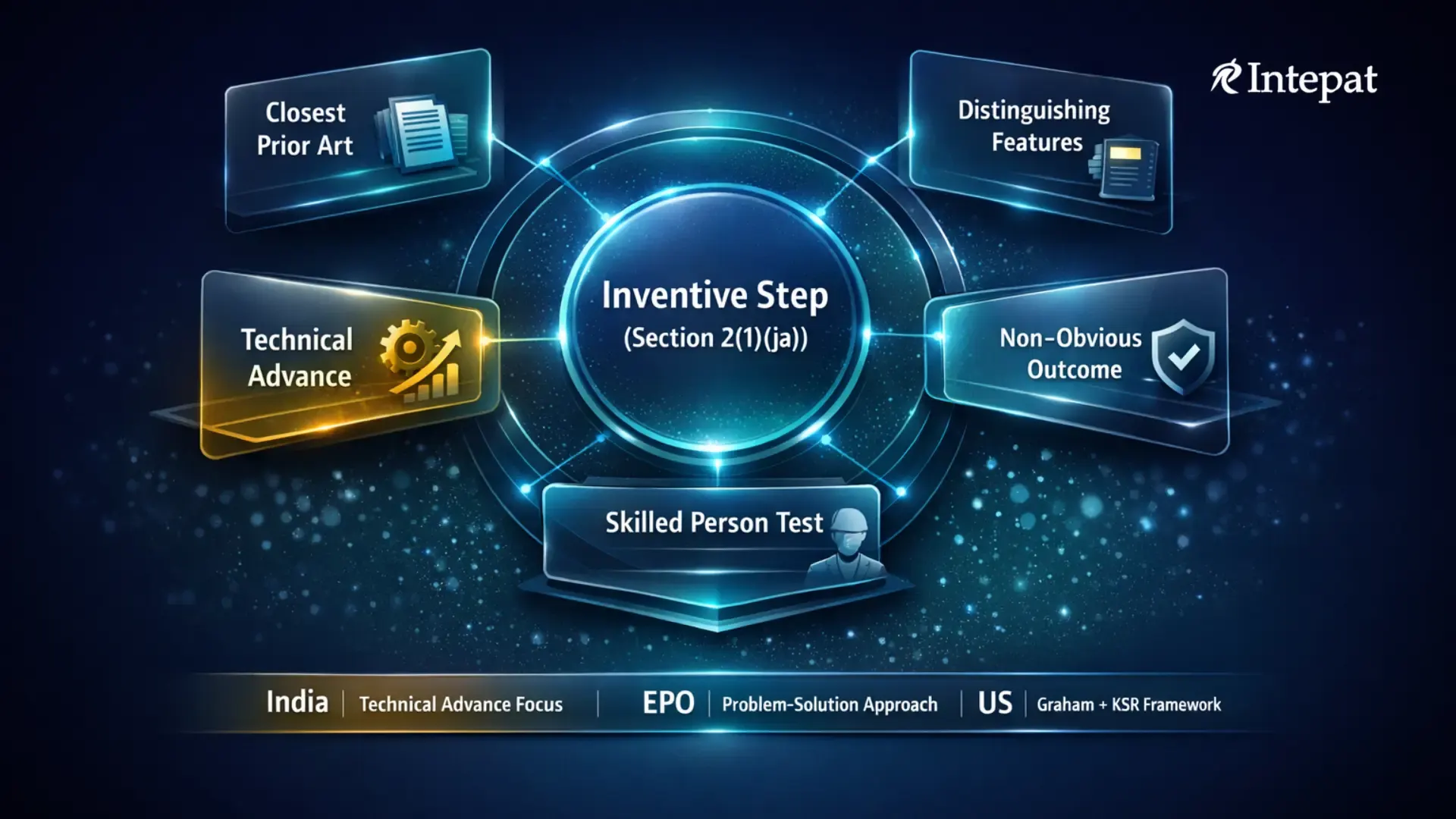
The requirement of inventive step originates from the combined reading of Sections 2(1)(j) and 2(1)(ja) of the Patents Act, 1970. Section 2(1)(j) defines an “invention” as a new product or process involving an inventive step and capable of industrial application. Section 2(1)(ja) defines “inventive step” as a feature of an invention that involves technical advance as compared to existing knowledge or has economic significance, or both, and that makes the invention not obvious to a person skilled in the art.
The statutory structure is cumulative. An applicant must establish:
- Novelty
- Inventive step
- Industrial applicability
Failure to satisfy any one requirement is sufficient for refusal under Section 15 during examination or for revocation under Section 64 after grant.
Inventive step operates independently from novelty. An invention can be novel yet obvious. In practice, the Indian Patent Office first identifies prior art for novelty assessment and then proceeds to evaluate whether the differences between the claimed invention and the prior art involve a technical advance or economic significance that renders the invention non-obvious.
For a detailed analysis of how novelty is assessed during examination, refer to our discussion on novelty under Indian patent law. The broader framework governing these three statutory requirements is explained in our guide on patentability criteria in India.
The statutory requirement must also be read alongside Sections 3 and 4, which enumerate non-patentable subject matter. In examination practice, objections under Section 2(1)(ja) are frequently raised together with exclusions such as Section 3(k), particularly in computer-related inventions. However, the inventive step inquiry remains distinct. Even where subject matter eligibility is satisfied, the invention must independently demonstrate non-obvious technical advancement over existing knowledge.
The statutory language places emphasis on two alternative pathways: technical advance or economic significance. In practical examination, technical advance carries primary weight. Economic significance may support inventive step but rarely substitutes for demonstrable technical contribution unless supported by objective evidence.
Accordingly, the statutory foundation of inventive step requires structured demonstration of distinguishing technical features, measurable advancement over prior art, and non-obviousness from the standpoint of the person skilled in the art as of the priority date.
How Do Indian Courts Interpret Inventive Step?
Judicial interpretation has significantly shaped the understanding of inventive step in India. While the statutory definition under Section 2(1)(ja) provides the framework, courts have clarified how the requirement must be applied in practice.
In Raj Parkash v. Mangat Ram Choudhary, the Delhi High Court observed that an invention may consist of a new combination of known integers producing a new or important result. The Court emphasized that the inquiry must focus on the substance of the invention and that claims and specifications must be read fairly and as a whole. The title of the invention cannot control the scope of the claim, and the real test lies in identifying the “pith and marrow” of the inventive concept.
The Supreme Court in Biswanath Prasad Radhey Shyam v. Hindustan Metal Industries clarified that the true test of inventive step is whether the alleged invention would have been obvious to a person skilled in the art in light of what was publicly known at the priority date. The Court cautioned against hindsight reconstruction and stressed that obviousness must be assessed objectively.
In F. Hoffmann-La Roche Ltd. v. Cipla Ltd., the Delhi High Court examined the standard of the person skilled in the art and reaffirmed that inventive step requires something more than mere workshop improvement. The Court also noted that secondary considerations such as commercial success may be relevant but cannot substitute for technical advancement.
Similarly, in Novartis AG v. Union of India, although primarily concerned with Section 3(d), the Supreme Court discussed the requirement of demonstrating enhanced efficacy, reinforcing the broader principle that patentability demands a real and demonstrable technical contribution over prior knowledge.
Across these decisions, certain principles consistently emerge:
- Inventive step must be assessed on the substance of the invention.
- Hindsight analysis is impermissible.
- The standard is that of a person skilled in the art at the priority date.
- Mere aggregation or routine modification of known elements does not qualify.
- A new combination can be patentable if it produces a new technical result.
Indian jurisprudence therefore aligns the inventive step inquiry with a structured, objective evaluation rooted in technical contribution rather than superficial claim drafting. The judicial emphasis on technical substance over form continues to influence examination practice before the Indian Patent Office.
How Does the Indian Patent Office Assess Obviousness?
During examination, the Indian Patent Office adopts a structured approach to determine whether the claimed invention satisfies Section 2(1)(ja). While the Act does not prescribe a rigid formula comparable to the European problem-solution approach, examination practice follows a logical sequence grounded in prior art comparison and technical contribution analysis.
The assessment typically proceeds through the following stages:
| Stage | Examination Focus |
|---|---|
| 1 | Identification of the closest prior art |
| 2 | Determination of distinguishing features |
| 3 | Evaluation of technical effect or technical advance |
| 4 | Analysis of obviousness to a person skilled in the art |
| 5 | Consideration of common general knowledge at the priority date |
First, the Examiner identifies the most relevant prior art reference, often referred to as the closest prior art. This reference forms the baseline for comparison.
Second, the distinguishing features of the claimed invention over the cited prior art are identified. At this stage, the analysis is factual and comparative.
Third, the Examiner evaluates whether those distinguishing features produce a demonstrable technical effect or technical advance. Mere difference is insufficient. The difference must translate into a meaningful contribution over existing knowledge. The articulation of such technical effect is directly influenced by how the specification is prepared at the drafting stage. A structured approach to patent drafting in India significantly reduces avoidable inventive step objections.
Fourth, the crucial question is addressed: would a person skilled in the art, possessing common general knowledge at the priority date, have been motivated to modify the prior art to arrive at the claimed invention? If the modification is considered routine, predictable, or based on known alternatives, the objection of lack of inventive step is raised.
Fifth, the Examiner may rely on common general knowledge, industry standards, or additional prior art references to support a conclusion of obviousness. However, the analysis must avoid hindsight reconstruction.
Inventive step objections frequently arise in conjunction with subject matter eligibility objections, particularly in computer-related inventions under Section 3(k).
Effective prosecution therefore requires a structured response addressing each stage of the examination logic: identifying technical distinctions, articulating technical effect, and demonstrating why the skilled person would not have arrived at the invention without inventive ingenuity. A deeper overview of how such objections are addressed during examination is available in our guide to the Indian patent prosecution process.
Technical Advance vs Economic Significance: What Qualifies?
Section 2(1)(ja) provides two alternative statutory pathways: the invention must involve a technical advance as compared to existing knowledge, or have economic significance, or both, and must be non-obvious to a person skilled in the art. Although the language appears disjunctive, examination practice in India places primary emphasis on demonstrable technical advance.
Technical advance generally refers to a measurable improvement in performance, efficiency, structure, functionality, or operational capability over prior art. The improvement must arise from the distinguishing technical features of the claim. Mere identification of a business advantage, cost reduction, or market impact is insufficient unless it flows directly from a technical contribution.
Economic significance, in theory, can support inventive step even where technical modification appears modest. However, in practice, the Indian Patent Office rarely treats economic benefit as a standalone ground unless supported by objective evidence demonstrating that the claimed feature delivers a substantial and non-obvious industrial advantage. Assertions of commercial success, without technical underpinning, are typically treated as secondary considerations.
The distinction may be summarised as follows:
| Criterion | Practical Weight in Examination |
|---|---|
| Technical advance | Primary determinant |
| Economic significance | Supportive, rarely independent |
| Both combined | Strongest position |
For example, a new configuration that increases energy efficiency by a quantifiable margin, reduces processing latency, enhances structural stability, or improves therapeutic efficacy can constitute technical advance. In contrast, a method that merely reorganises known steps to achieve faster market adoption without altering technical architecture may not satisfy the requirement.
Courts have also reinforced that the contribution must lie in the technical domain. Even where economic impact is argued, the focus remains on whether the invention reflects a real technical contribution over prior knowledge.
From a drafting and prosecution perspective, applicants should therefore:
- Clearly identify the technical problem addressed.
- Demonstrate how the distinguishing features solve that problem.
- Quantify improvement wherever possible.
- Avoid framing the invention purely in commercial or outcome-based terms.
A well-articulated technical effect not only strengthens inventive step but also supports defence in opposition and revocation proceedings, where the burden shifts to demonstrating that the claimed advancement was not obvious at the priority date.
The next critical question, therefore, is the identity and capability of the “person skilled in the art” against whom obviousness is assessed.
Who Is a “Person Skilled in the Art”?
The standard of obviousness under Section 2(1)(ja) is assessed from the standpoint of a “person skilled in the art” at the priority date. This construct is a legal fiction, but it plays a central role in determining whether the claimed invention would have been obvious.
Indian courts have consistently described the skilled person as an ordinary practitioner in the relevant technical field, possessing common general knowledge but lacking inventive capability. The skilled person is not an innovator or a creative genius. At the same time, the skilled person is presumed to be aware of publicly available prior art and routine technical developments in the field.
The Supreme Court in Biswanath Prasad Radhey Shyam v. Hindustan Metal Industries clarified that the obviousness inquiry must be objective and must not rely on hindsight reconstruction. The analysis must consider what the skilled person would have known and done at the priority date, not what becomes apparent after the invention is disclosed.
In technologically complex fields such as pharmaceuticals, biotechnology, telecommunications, or artificial intelligence, the skilled person may be conceptualised as a team rather than a single individual. Examination practice recognises that certain inventions require interdisciplinary knowledge. However, even in such cases, the team is presumed to operate within the bounds of ordinary skill, not inventive ingenuity.
This standard becomes particularly significant in post-grant challenges, where the burden of demonstrating obviousness is examined closely during patent opposition and revocation proceedings in India. The identification of the correct skilled person and common general knowledge often determines the outcome of such disputes.
Several principles govern the application of this standard:
- The assessment is conducted as of the priority date.
- Common general knowledge forms part of the baseline.
- Multiple prior art references may be considered, but combinations must be justified.
- Hindsight reasoning is impermissible.
- Routine workshop modifications are insufficient to establish inventive step.
In prosecution, the articulation of why the skilled person would not have combined prior art references in the manner claimed becomes central to overcoming inventive step objections. The response must demonstrate either the absence of motivation to combine, the presence of technical prejudice, or the existence of unexpected technical effect arising from the claimed configuration.
Can Commercial Success Prove Inventive Step?
Commercial success is often cited by patentees as evidence of inventive step. However, under Indian patent law, commercial performance alone does not establish non-obviousness. The statutory requirement under Section 2(1)(ja) remains anchored in technical advance or economic significance that renders the invention non-obvious to a person skilled in the art.
Indian courts have treated commercial success as a secondary consideration. It may support inventive step if a clear nexus is demonstrated between the commercial performance and the technical features of the claimed invention. The key inquiry is whether the market success flows directly from the technical contribution, rather than from advertising, brand strength, pricing strategy, regulatory exclusivity, or market timing.
For example, if a pharmaceutical formulation demonstrates superior therapeutic efficacy due to a specific structural modification, and that improvement drives market adoption, commercial success may reinforce the argument that the technical advance was not obvious. In contrast, if the commercial success arises from distribution strategy or brand positioning, it carries little evidentiary weight in the inventive step analysis.
Courts and examiners typically consider commercial success only after a prima facie technical contribution has been identified. It cannot substitute for the requirement of demonstrating distinguishing technical features and non-obvious advancement over prior art.
In opposition and revocation proceedings, evidence such as sales data, industry recognition, licensing activity, or long-felt but unsolved need may be introduced. However, such evidence must be linked to the technical merits of the claimed invention. Without establishing that link, commercial indicators remain insufficient to overcome an obviousness challenge.
Accordingly, while commercial success can strengthen a defensible patent, it cannot compensate for weak technical positioning. The foundation of inventive step remains technical contribution, assessed objectively from the perspective of the skilled person at the priority date.
The next practical consideration concerns common drafting and prosecution mistakes that frequently lead to inventive step objections during examination.
Common Mistakes That Lead to Inventive Step Objections
Inventive step objections frequently arise not because the invention lacks merit, but because the technical contribution is inadequately articulated in the specification or claims. Examination under Section 2(1)(ja) is structured and comparative. Weak drafting often results in avoidable objections.
One common mistake is result-oriented claim language. Claims that merely state a desired outcome, such as “improving efficiency” or “enhancing performance,” without defining the technical features that achieve that result, are vulnerable. The Indian Patent Office examines structural or process-based limitations, not objectives or advantages in isolation.
Another recurring issue is failure to clearly identify the technical problem. If the specification does not articulate the specific technical limitation in the prior art and how the invention overcomes it, the Examiner may characterise the modification as routine. A properly framed problem-solution articulation strengthens the inventive step analysis.
Mere aggregation of known elements is also insufficient. Where the invention combines known components, the combination must produce a synergistic or technically interdependent effect. If each element performs its conventional function without interaction producing a new technical result, an objection of obviousness is likely.
Functional claiming without technical architecture presents additional risk. Particularly in computer-related inventions, claims drafted at a high functional level without specifying technical implementation are often treated as obvious variations of known systems. This frequently overlaps with subject matter eligibility objections. A structured understanding of how such objections are examined is essential in the broader context of computer-related inventions under Section 3(k).
Another mistake arises when the alleged advantage is framed purely in commercial terms. Cost reduction, faster market entry, or improved customer adoption must be traced back to specific technical features to be persuasive in an inventive step analysis.
Finally, hindsight arguments during prosecution weaken credibility. Responses must avoid reconstructing the invention using the benefit of disclosure. Instead, the response should demonstrate why the skilled person would not have been motivated to combine prior art references in the claimed manner at the priority date.
A strategically drafted specification anticipates these examination stages. Clear articulation of distinguishing features, measurable technical effect, and structural limitations significantly improves defensibility both during prosecution and in post-grant proceedings.
The next section examines how inventive step is challenged in opposition and revocation proceedings in India.
How Is Inventive Step Challenged in Opposition and Revocation?
Inventive step is one of the most common grounds raised in both pre-grant opposition under Section 25(1) and post-grant opposition under Section 25(2), as well as in revocation proceedings under Section 64 of the Patents Act, 1970. After grant, the scrutiny does not diminish. Instead, the analysis becomes more detailed and evidence-driven.
In opposition proceedings, the opponent typically identifies prior art references and argues that the distinguishing features of the granted claim would have been obvious to a person skilled in the art at the priority date. The challenge may involve a single prior art document or a combination of references, supported by technical reasoning and common general knowledge.
During revocation proceedings before the High Court, the inventive step inquiry becomes even more rigorous. Courts assess:
- The closest prior art
- The differences between prior art and the claimed invention
- Whether those differences amount to technical advance
- Whether the skilled person would have been motivated to combine references
- Whether any technical prejudice existed in the field
- Whether secondary considerations have evidentiary relevance
Unlike examination, opposition and revocation involve evidentiary submissions, expert affidavits, and cross-examination in certain cases. The identification of the correct “person skilled in the art” often becomes contested. Competing expert testimonies may present differing interpretations of what constituted common general knowledge at the relevant date.
A patent that survives examination but lacks a clearly articulated technical contribution may face significant vulnerability during post-grant challenges. For this reason, inventive step must be defensible not only at the time of filing but also under adversarial scrutiny.
The practical implication is clear. Drafting strategy should anticipate how the invention would withstand a Section 25 or Section 64 challenge. Clear technical differentiation, measurable advancement, and structured problem-solution articulation reduce long-term risk.
To place this in broader perspective, it is useful to briefly compare how inventive step is approached in India relative to other major jurisdictions.
How Does India Compare With EPO and US Standards?
Although the Indian statute defines inventive step under Section 2(1)(ja), the analytical framework shares conceptual similarities with other major jurisdictions. However, the articulation and emphasis differ.
A simplified comparison is set out below:
| Jurisdiction | Core Framework for Obviousness |
|---|---|
| India | Technical advance or economic significance + non-obviousness to skilled person |
| EPO | Problem-Solution Approach |
| United States | Graham factors as refined by KSR v. Teleflex |
In India, the focus remains on whether the distinguishing features demonstrate technical advance or economic significance that renders the invention non-obvious. The statutory wording expressly incorporates “technical advance,” which gives structured importance to demonstrable technical contribution.
The European Patent Office follows the Problem-Solution Approach. The closest prior art is identified, the objective technical problem is formulated, and the analysis examines whether the claimed solution would have been obvious. The emphasis is strongly technical and structured.
In the United States, obviousness is assessed using the Graham factors, which consider prior art scope, differences between prior art and the claim, the level of ordinary skill in the art, and secondary considerations. The decision in KSR v. Teleflex broadened the approach by discouraging rigid application of the “teaching-suggestion-motivation” test and permitting more flexible reasoning.
In practical terms, Indian examination increasingly reflects structured comparative reasoning similar to the European approach, particularly in identifying distinguishing features and assessing technical effect. However, the statutory inclusion of “economic significance” remains a distinctive element of Indian law, even though it is rarely treated as sufficient in isolation.
For applicants filing across jurisdictions, alignment of the problem-solution articulation in the specification can significantly improve consistency in examination outcomes. A technically grounded disclosure that clearly identifies the problem addressed and the technical contribution made strengthens patentability arguments in India, Europe, and the United States alike.
A more detailed comparative analysis of how non-obviousness is assessed across India, Europe, and the United States is available in our dedicated discussion on non-obviousness standards across jurisdictions.
Key Takeaways on Inventive Step in India
Inventive step remains the decisive threshold in Indian patent examination and enforcement. Novelty alone is insufficient. The invention must demonstrate a real technical advance or economic significance that renders it non-obvious to a person skilled in the art as of the priority date.
Indian examination practice, supported by judicial interpretation, requires structured comparative analysis. The closest prior art must be identified, distinguishing technical features must be articulated, and measurable technical contribution must be demonstrated. Commercial success or drafting form cannot substitute for technical substance.
Inventive step is also one of the most frequently invoked grounds in opposition and revocation proceedings. A patent that survives examination without clearly defined technical advancement may remain vulnerable under post-grant scrutiny. The strength of inventive step is therefore determined not only at filing but by how effectively the technical contribution is embedded into the specification and claims.
Need a Strong Inventive Step Strategy?
Get a structured technical assessment to strengthen your patent claims before filing or during prosecution.
Disclaimer The information provided in this article is for general educational purposes only and does not constitute legal advice. Assessment of inventive step depends on specific facts, prior art landscape, and claim structure. Professional advice should be obtained based on the individual circumstances of each invention.