




Initially Published in 2019; Updated in Sept 2026
The Indian Patents Act, 1970 (39 of 1970) is the principal legislation governing patent protection in India. Its substantive provisions came into force on 20 April 1972, replacing the patents part of the Indian Patents and Designs Act, 1911, and its drafting followed the Ayyangar Committee’s recommendation that Indian patent law serve national development rather than protect foreign monopolies. The Act reached its current substantive form through the Patents (Amendment) Act, 2005, which omitted Section 5 (the bar on product patents for medicines, food and chemicals) with effect from 1 January 2005 and substituted Section 3(d), the efficacy filter that became globally significant in pharmaceutical patent litigation. The Patents (Amendment) Rules, 2024 (G.S.R. 211(E), notified 15 March 2024) introduced the most consequential procedural changes since the Patents Rules, 2003 were made: the request-for-examination period fell from 48 to 31 months, a Form 31 route was created for the grace period under Section 31, and the statement of working moved to a three-financial-year cycle. The Act is administered by the Controller General of Patents, Designs and Trade Marks (CGPDTM) through the patent office and its branch offices (Section 74), located at Kolkata, Mumbai, Chennai and Delhi. The appropriate office for an application is fixed by Rule 4 of the Patents Rules, 2003: the office within whose territorial limits the applicant (or the first-named joint applicant) resides, is domiciled or has a place of business, or from which the invention actually originated; an applicant with no domicile or place of business in India files at the office serving the address for service given in India.
What Qualifies as a Patentable Invention
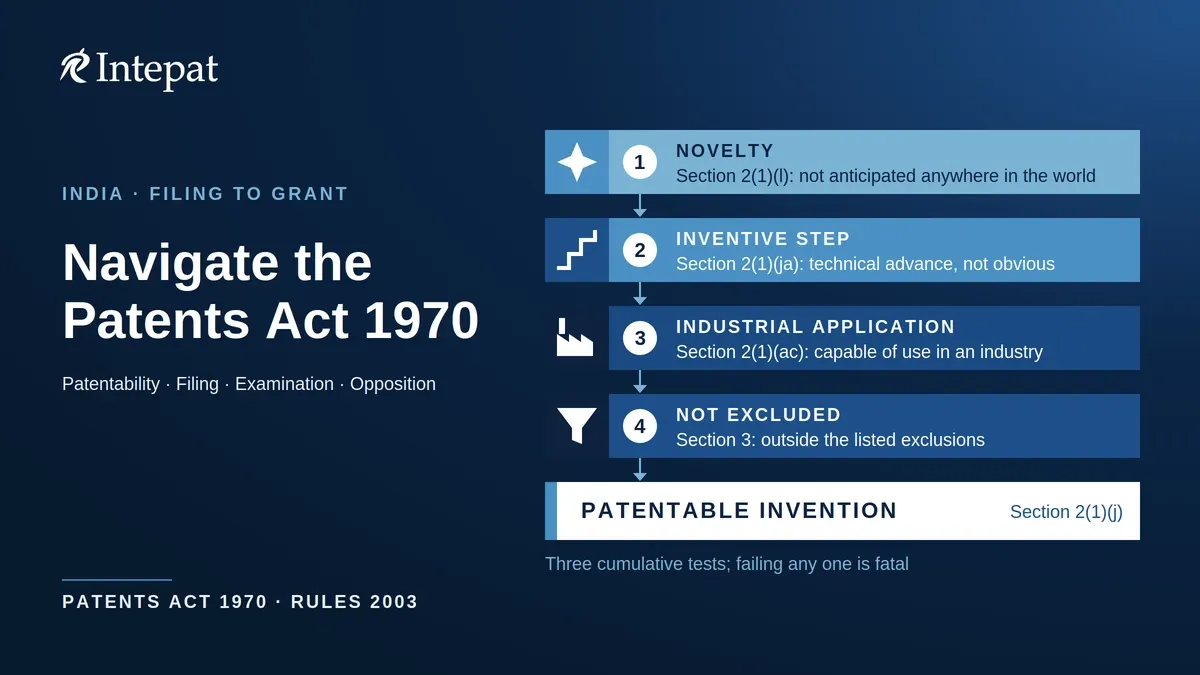
Section 2(1)(j) defines an invention as a new product or process involving an inventive step and capable of industrial application. Three cumulative requirements govern every patentability analysis, and failing any one of them is fatal.
Novelty. Section 2(1)(l) defines a new invention as one that has not been anticipated by publication in any document or used in India or elsewhere in the world before the date of filing of the patent application with complete specification, so that the subject matter has not fallen into the public domain and does not form part of the state of the art. The standard for publication is global: publication anywhere in the world counts, whereas prior public knowledge or use is a ground of opposition or revocation only where it occurred in India (Sections 25(1)(d), 25(2)(d) and 64(1)(e)); the separate ground of anticipation by traditional knowledge (Section 25(1)(k)) reaches knowledge available within a local or indigenous community in India or elsewhere. In prosecution, opposition and revocation the comparison is made claim by claim against the priority date of each claim (Sections 13, 25 and 64), and Sections 29 to 34 list the disclosures that are not treated as anticipation, including a paper read before a learned society or a display at a notified exhibition where the application follows within twelve months (Section 31).
Inventive step. Section 2(1)(ja) defines an inventive step as a feature of an invention that involves technical advance as compared to the existing knowledge, or has economic significance, or both, and that makes the invention not obvious to a person skilled in the art. Novelty is therefore not enough: the claimed feature must show a technical advance or economic significance, and the invention as a whole must be non-obvious to the skilled person. The Office’s examination guidance (the Guidelines for Examination of Computer Related Inventions, 2025, drawing on the Supreme Court’s decision in Biswanath Prasad Radhey Shyam v Hindustan Metal Industries) sets out a five-step approach: identify the person skilled in the art; identify that person’s common general knowledge at the priority date; identify or construe the inventive concept of the claim; identify the differences between the state of the art and the inventive concept; and ask, without knowledge of the alleged invention, whether those differences would have been obvious to the skilled person or required inventive ingenuity. The Manual of Patent Office Practice and Procedure adds that the invention must be considered as a whole and that mosaicing of prior art is permissible for obviousness where the art itself leads the skilled person to combine the documents.
Industrial applicability. Section 2(1)(ac) requires that the invention be capable of being made or used in an industry. In practice the specification should make the industrial use evident or state it; an objection on this ground is uncommon but is fatal where a claimed product or process has no stated or evident use.
What Section 3 excludes. Section 3 lists subject matter that is not an invention within the meaning of the Act, regardless of novelty or inventive step. The exclusions a practitioner encounters most frequently in prosecution are the following.
Section 3(d) has three limbs: the mere discovery of a new form of a known substance that does not result in the enhancement of the known efficacy of that substance; the mere discovery of any new property or new use for a known substance; and the mere use of a known process, machine or apparatus, unless the known process results in a new product or employs at least one new reactant. The Explanation treats salts, esters, ethers, polymorphs, metabolites, pure form, particle size, isomers, mixtures of isomers, complexes, combinations and other derivatives of a known substance as the same substance unless they differ significantly in properties with regard to efficacy. In Novartis AG v Union of India (Civil Appeal Nos. 2706-2716 of 2013, decided 1 April 2013), the Supreme Court held that in the case of a medicine that claims to cure a disease the test of efficacy “can only be therapeutic efficacy” (paragraph 180); that physico-chemical properties such as more beneficial flow properties, better thermodynamic stability and lower hygroscopicity “cannot even be taken into account” for the Section 3(d) test because they have nothing to do with therapeutic efficacy (paragraph 187); and that increased bioavailability alone may not lead to enhanced therapeutic efficacy, which must be specifically claimed and established by research data (paragraph 189). The Court added that Section 3(d) does not bar patent protection for all incremental inventions in chemical and pharmaceutical substances (paragraph 191). Section 3(d) is examined at the substantive stage and is most effectively addressed in the specification at the drafting stage, with the supporting efficacy data maintained through prosecution.
Section 3(j) excludes plants and animals in whole or any part thereof other than micro-organisms, but including seeds, varieties and species, and essentially biological processes for the production or propagation of plants and animals. In Monsanto Technology LLC v Nuziveedu Seeds Ltd (Civil Appeal Nos. 4616-4617 of 2018 with connected appeals, decided 8 January 2019), a Division Bench of the Delhi High Court had held, at the interim stage, that Monsanto’s Bt cotton claims fell within Section 3(j). The Supreme Court set that judgment aside, restored the Single Judge’s order of 28 March 2017 and remanded the suit to the Single Judge for disposal in accordance with law, holding that summary adjudication of a technically complex suit requiring expert evidence, at the injunction stage, was “neither desirable or permissible in the law” (paragraph 22). The Supreme Court did not decide the scope of Section 3(j); the decision stands for the narrower proposition that, in a technically complex infringement suit requiring expert evidence, a Section 3(j) validity challenge is decided at trial and not summarily at the injunction stage.
Section 3(k) excludes a mathematical or business method, a computer programme per se, or algorithms. The Office reads the clause as four limbs. The qualifier “per se” is what the Office applies: under the Guidelines for Examination of Computer Related Inventions, 2025 (which replaced the 2017 Guidelines that the Manual had referred to, and apply with immediate effect), a claimed invention is examined for a technical effect or technical contribution beyond the computer programme itself, following the Delhi High Court in Ferid Allani v Union of India (12 December 2019). In the firm’s experience application of the exclusion has varied across examination groups; a demonstrable technical effect grounded in the disclosure, rather than a recital of one in the claims, is what overcomes a Section 3(k) objection.
Section 3(i) excludes any process for the medicinal, surgical, curative, prophylactic, diagnostic, therapeutic or other treatment of human beings, or any process for a similar treatment of animals to render them free of disease or to increase their economic value or that of their products. Section 3(h) excludes a method of agriculture or horticulture. Per the Manual, a surgical, therapeutic or diagnostic instrument or apparatus may still be patented; the exclusion is confined to the process of treatment.
The remaining exclusions are Section 3(a) (an invention that is frivolous or claims anything obviously contrary to well established natural laws), 3(b) (an invention whose primary or intended use or commercial exploitation would be contrary to public order or morality or would cause serious prejudice to human, animal or plant life or health or to the environment), 3(c) (the mere discovery of a scientific principle, the formulation of an abstract theory, or the discovery of any living thing or non-living substance occurring in nature), 3(e) (a substance obtained by mere admixture resulting only in the aggregation of the properties of its components, or a process for producing it), 3(f) (the mere arrangement, re-arrangement or duplication of known devices each functioning independently in a known way), 3(l) (literary, dramatic, musical or artistic works and other aesthetic creations), 3(m) (a mere scheme or rule or method of performing a mental act or playing a game), 3(n) (a presentation of information), 3(o) (topography of integrated circuits) and 3(p) (an invention which in effect is traditional knowledge or an aggregation or duplication of known properties of traditionally known components). Section 4 separately bars a patent for an invention relating to atomic energy falling within Section 20(1) of the Atomic Energy Act, 1962.
The Patent Specification: Provisional and Complete
The specification is the foundational legal instrument of a patent, and the scope of all enforceable rights depends on the claims read against the disclosure. An applicant, other than a convention, PCT national phase or divisional applicant, may file a provisional specification to secure a filing date and follow it with a complete specification, or file a complete specification at the outset (Sections 7(4) and 9(1), both of which exclude convention and PCT applications from the provisional route; a divisional must be accompanied by a complete specification under Section 16(2)). Every specification, provisional or complete, is filed in Form 2 (Rule 13(1)) alongside the application in Form 1.
A provisional specification is used when the invention can be described but has not been fully developed. Section 10(1) requires every specification to describe the invention and to begin with a title sufficiently indicating its subject matter; the Manual advises against including claims in a provisional, since its purpose is to describe the invention and fix a date. The critical constraint is Section 9(1): where an application is accompanied by a provisional specification, a complete specification must be filed within twelve months from the date of filing the application, failing which the application is deemed abandoned. The Act provides no extension of that period. A claim in the later complete specification takes the provisional’s date only if it is fairly based on the matter disclosed in the provisional (Section 11(2)).
A complete specification carries four obligations under Section 10(4). It must fully and particularly describe the invention and its operation or use and the method by which it is to be performed; it must disclose the best method of performing the invention known to the applicant and for which the applicant is entitled to claim protection; it must end with a claim or claims defining the scope of the invention for which protection is claimed; and it must be accompanied by an abstract, which under Rule 13(7)(c) may not contain more than one hundred and fifty words. Failure to disclose the best method is a ground of revocation under Section 64(1)(h), which also states the sufficiency standard: the description must by itself be sufficient to enable a person in India possessing average skill in, and average knowledge of, the art to work the invention. Broad claims unsupported by working examples regularly attract objections on this ground, and Section 10(5) additionally requires the claims to relate to a single invention or a group linked so as to form a single inventive concept, to be clear and succinct, and to be fairly based on the matter disclosed.
Where the invention uses a biological material that cannot be described so as to satisfy the description and best-method requirements, and the material is not available to the public, Section 10(4)(d)(ii) requires the applicant to complete the application by depositing the material with an international depositary authority under the Budapest Treaty not later than the date of filing the application in India, with a reference to the deposit in the specification within three months of filing, or on or before the date of any request for early publication under Rule 24A if that is earlier (Rule 13(8)), the depositary’s particulars and the deposit number included, and the source and geographical origin of the material disclosed in the specification. Non-disclosure or wrong mention of the source or geographical origin is a ground of pre-grant opposition under Section 25(1)(j), post-grant opposition under Section 25(2)(j) and revocation under Section 64(1)(p).
Filing: Forms, Applicant Categories, and the Section 8 Obligation
An application for a patent is made in Form 1 with the specification in Form 2, a statement and undertaking regarding foreign applications in Form 3 under Section 8, and, where the applicant is represented by a registered patent agent, an authorisation in Form 26 filed within three months (Rule 135(1)). A declaration as to inventorship in Form 5 is required in every case other than an ordinary application accompanied at the outset by a complete specification; it is filed with the complete specification or, where the Controller allows an extension on a request in Form 4 with the prescribed fee, within one month thereafter (Rule 13(6); Table I, entry 4(i)). Patent agents must file electronically (Rule 6(1A)), and any applicant filing in physical form pays a ten per cent additional fee (Rule 7(1), first proviso).
Fees under the First Schedule turn on the applicant’s category. Natural persons, startups, small entities and educational institutions (the last three defined in Rule 2) pay the concessional scale; every other applicant, alone or jointly with a concessional applicant, pays the standard scale, which for most entries, including the application fee, is five times the concessional figure, and higher for the expedited examination and conversion fees (Table I, entries 29 and 30). Under Table I as substituted by the 2024 Rules (entry 1), the fee on an application under Sections 7, 54 or 135 or Rule 20(1) is Rs 1,600 for the concessional categories and Rs 8,000 for others on e-filing (Rs 1,750 and Rs 8,800 on physical filing), with additional fees for each sheet of specification beyond 30 and each claim beyond 10. A small entity, startup or educational institution must accompany every fee-bearing document with Form 28 (Rule 7(1), second proviso), and where an application is transferred to an applicant outside the concessional categories the difference in fees is payable with the request for transfer (Rule 7(3)). An application for a patent of addition under Section 54 attracts a 50 per cent reduction in the application fee (Table I, entry 1, note). Figures verified as of September 2026 against G.S.R. 211(E).
Section 8 imposes a continuing obligation to disclose corresponding applications for the same or substantially the same invention filed outside India. The statement and undertaking in Form 3 is due within six months from the date of filing the application in India (Rule 12(1A)). Under the undertaking, the applicant must keep the Controller informed in writing of the details of every later foreign application; since the 2024 Rules, Rule 12(2) fixes that period at three months from the date of issuance of the first statement of objections under Rule 24B(3) or Rule 24C(8), replacing the earlier duty to update within six months of each foreign filing. Separately, the Controller may, for reasons recorded in writing, direct the applicant under Section 8(2) to furnish a fresh Form 3 within two months of the communication (Rule 12(4)), and may use accessible databases to consider foreign prosecution (Rule 12(3)). Delay in filing Form 3 may be condoned, or the time extended, for up to three months on a request in Form 4 (Rule 12(5)). Failure to disclose the information required by Section 8, or furnishing information false in a material particular to the applicant’s knowledge, is a ground of pre-grant opposition under Section 25(1)(h), post-grant opposition under Section 25(2)(h) and revocation under Section 64(1)(m), and in the firm’s experience is among the grounds most frequently pleaded.
A person resident in India may not make, or cause to be made, an application for a patent outside India without a written permit from the Controller (Form 25, Rule 71, disposed of within twenty-one days of the request, or of the Central Government’s consent where the invention relates to defence or atomic energy) unless an application for the same invention has been made in India not less than six weeks earlier and either no secrecy direction under Section 35(1) has been given or all such directions have been revoked (Section 39(1)). Section 39 does not apply where the first application was filed outside India by a person resident outside India (Section 39(3)). Under Section 40, an application made in contravention of Section 39 causes the Indian application to be deemed abandoned and any patent granted to be liable to revocation under Section 64(1)(n); Section 118 additionally makes the contravention punishable with imprisonment for up to two years, or fine, or both.
Examination, First Examination Report, and the Path to Grant
An application is not examined as of right. Under Section 11B(1), examination begins only when the applicant or any other interested person makes a request in Form 18 within the prescribed period, which under Rule 24B(1)(i) is thirty-one months from the date of priority or the date of filing, whichever is earlier. Applications filed before 15 March 2024 keep the earlier forty-eight month period (Rule 24B(1)(vi)). This is the single most consequential deadline in Indian prosecution: if no request is made in time, the application is treated as withdrawn by the applicant (Section 11B(4)). The Act contains no provision for reviving such an application. As recorded in the Manual of Patent Office Practice and Procedure, the Delhi High Court in Nippon Steel Corporation v Union of India (W.P.(C) 801 of 2011, decided 8 February 2011) held that once an application is deemed withdrawn under Section 11B(4) the Controller cannot entertain a request to amend any part of it, and in Sphaera Pharma Pte Ltd v Union of India (decided 16 February 2018) held that a request for extension under Rule 138 had to be made before the prescribed period expired. Both decisions pre-date the 2024 substitution of Rule 138. Rule 138 was substituted by the 2024 Rules: it now provides that, notwithstanding anything in the Rules, the time specified for doing any act or taking any proceeding may be extended, or delay condoned, by the Controller for up to six months on a request in Form 4 made before that six months expires, and the substituted rule lists no excluded provisions, whereas Rule 137(2)(iv) expressly excludes the Rule 24B(1) period from the Controller’s power to correct irregularities. Any relief under the substituted Rule 138 is discretionary and depends on a timely Form 4; it is distinct from statutory revival, which the Act does not provide, and whether the rule reaches the Rule 24B(1) period at all is a question that neither decision, both decided under the earlier text, answers.
Applicants within the ten grounds of Rule 24C(1) may request expedited examination in Form 18A, filed electronically within the same period as an ordinary request under Rule 24B: where India was the International Searching Authority or International Preliminary Examining Authority for the corresponding international application; startups; small entities; natural-person applicants of whom at least one is female; government departments; institutions established by a Central, Provincial or State Act and owned or controlled by government; government companies; institutions wholly or substantially financed by government; applications in a sector notified by the Central Government; and applicants eligible under an arrangement between the Indian Patent Office and a foreign patent office. An applicant within one of those grounds who has already filed an ordinary request may convert it to an expedited request by paying the conversion fee and submitting the documents Rule 24C(1) requires for the ground relied on (Rule 24C(2); Table I, entry 30). On the ordinary track the examiner reports ordinarily within one month, and not later than three months, from the Controller’s reference (Rule 24B(2)(ii)), and the first statement of objections issues within one month of the Controller’s disposal of the report (Rule 24B(3)); on the expedited track the examiner’s report is due ordinarily within one month and not later than two months, and the first statement of objections within fifteen days (Rule 24C(6) and (8)).
The examiner’s findings are communicated as the First Examination Report, covering patentability under Sections 3 and 4, novelty, inventive step, industrial applicability, sufficiency of disclosure, clarity and support of the claims, and compliance with Section 8. The applicant must put the application in order for grant within six months from the date on which the first statement of objections is issued (Section 21(1), Rule 24B(5)), extendable by three months on a request in Form 4 with the prescribed fee made before the six months expire (Rule 24B(6)); the corresponding provisions for the expedited track are Rule 24C(10) and (11). An application not put in order in time is deemed abandoned (Section 21(1)). On the expedited track the Controller must dispose of the application within three months of the last reply or of the last date for putting the application in order, whichever is earlier, save where a pre-grant opposition is pending (Rule 24C(12)).
Where the examiner’s report is adverse, Section 14 requires the Controller to communicate the gist of the objections and, if the applicant so requires within the prescribed period, to give the applicant an opportunity of being heard before disposing of the application; the request for a hearing must reach the Controller at least ten days before the expiry of the period (Section 80, proviso; Rule 28(2)). Written submissions follow within fifteen days of the hearing (Rule 28(7)). Where the application does not comply with the Act or the Rules, the Controller may refuse it or require amendment and refuse it on failure to amend (Section 15); where it is found in order, the patent is granted under Section 43 and the grant is published. A refusal under Section 15 is appealable to the High Court under Section 117A(2) within three months of the order, or within such further time as the High Court allows under its rules (Section 117A(4)).
Amendment of an application, specification or related document is made on application to the Controller under Section 57 (Form 13, Rule 81), before or after grant; in revocation proceedings the High Court may allow amendment under Section 58. Every amendment is subject to Section 59(1): it must be by way of disclaimer, correction or explanation and for the purpose of incorporating actual fact, and no amendment of a complete specification may be allowed whose effect would be to claim or describe matter not in substance disclosed or shown in the specification before the amendment, or to produce any amended claim that does not fall wholly within the scope of a claim before the amendment. A post-grant application to amend may be published and opposed by any person interested (Section 57(3) and (4); Rule 81(3)). Every patent is dated as of the date of filing of the application (Section 45(1)), and the term is twenty years from that date, or from the international filing date for an application under the Patent Cooperation Treaty (Section 53(1) and its Explanation). The Act contains no provision for extending the term of a patent in any field.
Pre-Grant and Post-Grant Opposition
The Act provides two distinct windows for third parties to challenge an application or a granted patent before the Patent Office. They differ in timing, standing and procedure but share the same substantive grounds.
Pre-grant opposition under Section 25(1) is open to any person, by representation in Form 7A (Rule 55(1)), at any time after publication of the application under Section 11A and before grant; since the 2024 Rules the representation carries a fee (Table I, entry 9(ii)). The eleven grounds are wrongful obtaining; prior publication; prior claiming; prior public knowledge or use in India; obviousness; that the subject of a claim is not an invention or is not patentable; insufficiency of description; non-disclosure or false disclosure under Section 8; a convention application made outside twelve months of the first application; non-disclosure or wrong mention of the source or geographical origin of biological material; and anticipation by traditional knowledge (Section 25(1)(a) to (k)). No patent may be granted within six months of publication (Rule 55(1A)), and the Controller considers a representation only once a request for examination has been filed (Rule 55(2)). Under Rule 55(3) as substituted in 2024, where no prima facie case is made out the Controller notifies the opponent and, unless the opponent asks to be heard, passes a reasoned order within one month of the notification (or within one month of the hearing where one is requested); where a prima facie case is made out the Controller passes an order within one month of receiving the representation and notifies the applicant. The applicant may then file a statement and evidence within two months of the notice, reduced from three months in 2024 (Rule 55(4)). The Controller decides the application and the representation together by a speaking order, ordinarily within one month of completing the proceedings (Rule 55(5)). An application in which a representation has been filed and notice issued is examined under the expedited procedure of Rule 24C (Rule 55(5B)).
Post-grant opposition under Section 25(2) is available to any person interested, by notice in Form 7 (Rule 55A), at any time after grant but before the expiry of one year from the date of publication of the grant, on the same eleven grounds. The Controller constitutes an Opposition Board of three members, excluding the examiner who dealt with the application (Rule 56(1) to (3)); the Board reports on each ground with its joint recommendation within two months from the date on which the documents were forwarded to it, reduced from three months by the 2024 Rules (Rule 56(4)). The patentee’s reply statement and evidence are due within two months of receiving the opponent’s written statement and evidence (Rule 58(1)); a patentee who does not wish to contest, or who fails to file the reply statement and evidence within that period, is deemed to have the patent revoked (Rule 58(2)). After hearing the parties and considering the Board’s recommendation, the Controller orders that the patent be maintained, amended or revoked (Section 25(4)), and that order is appealable to the High Court under Section 117A(2).
The two proceedings are independent: a person who filed a pre-grant representation may oppose after grant, provided that person is a “person interested” within Section 2(1)(t), which includes a person engaged in or promoting research in the same field. A patentee facing a post-grant opposition may apply to amend under Section 57, subject to Section 59 and to the bar in the proviso to Section 57(1) while an infringement suit or a revocation proceeding before the High Court is pending.
Renewal, Lapse, and Restoration
A patent is kept in force by payment of renewal fees. Under Rule 80(1) the fee is payable at the expiration of the second year from the date of the patent, which by Section 45(1) is the filing date, and of every succeeding year, and must be remitted before that year expires; the first fee is therefore paid before the end of the second year in respect of the third year (Table I, entry 18). The period may be extended by up to six months on a request in Form 4 with the prescribed fee (Rule 80(1A); Table I, entry 4(i)). A patent ceases to have effect if the fee is not paid within the prescribed period or the extended period (Section 53(2)). Renewal fees for two or more years may be paid in advance, and where fees for at least four years are paid in advance electronically a ten per cent reduction applies (Rule 80(3), substituted by the 2024 Rules).
Where a patent has ceased to have effect for non-payment, the patentee or legal representative may apply for restoration in Form 15 within eighteen months from the date on which the patent ceased to have effect (Section 60(1); Rule 84). The Controller must be prima facie satisfied of two things: that the failure to pay was unintentional and that there has been no undue delay in making the application (Section 61(1)); the application is then published and any person interested may oppose it on either ground within two months (Rule 85). On restoration the unpaid renewal fees and an additional fee are payable (Section 61(3); Rule 86). Under Section 62(1), the rights of the restored patentee are subject to such provisions as may be prescribed and to such other provisions as the Controller thinks fit to impose for the protection or compensation of persons who began to avail themselves of the invention, or took definite steps by contract or otherwise to do so, between the date the patent ceased and the date of publication of the restoration application; and no suit or other proceeding may be commenced or prosecuted for an infringement committed in that window (Section 62(2)).
Every patentee and every licensee, exclusive or otherwise, must furnish a statement of the extent to which the patented invention has been worked on a commercial scale in India (Section 146(2)), in Form 27 (Rule 131(1)). Rule 131(2) as substituted in 2024 requires the statement once in respect of every period of three financial years, starting from the financial year commencing immediately after the financial year in which the patent was granted, within six months from the expiry of each such period; the Controller may condone delay or extend the time by up to three months on a request in Form 4. Since 1 August 2024 the consequences under Section 122 are civil penalties adjudicated by an officer under Section 124A, with appeal under Section 124B: a refusal or failure to furnish the information carries a penalty of up to one lakh rupees and a further one thousand rupees for every day the default continues (Section 122(1)); furnishing information known or believed to be false carries a penalty equal to one half per cent of the total sales or turnover of the business or gross receipts of the profession as shown in the audited accounts, or five crore rupees, whichever is less (Section 122(2)).
Compulsory Licensing
Section 83 sets out the governing principles: patents are granted to encourage inventions and to secure that they are worked in India on a commercial scale and to the fullest extent reasonably practicable without undue delay, and not merely to enable patentees to enjoy a monopoly for the importation of the patented article. The compulsory licence provisions in Sections 84 to 94 give effect to those principles.
Under Section 84(1), at any time after the expiration of three years from the date of the grant, any person interested may apply to the Controller (Form 17, Rule 96) for a compulsory licence on any of three grounds: that the reasonable requirements of the public with respect to the patented invention have not been satisfied; that the patented invention is not available to the public at a reasonably affordable price; or that the patented invention is not worked in the territory of India. Section 84(7) lists the circumstances in which the reasonable requirements of the public are deemed not to be satisfied. Among the matters the Controller must take into account is whether the applicant made efforts to obtain a licence from the patentee on reasonable terms and failed within a reasonable period, which the Explanation to Section 84(6)(iv) construes as a period not ordinarily exceeding six months.
India’s first compulsory licence was granted to Natco Pharma Ltd on 9 March 2012 over Bayer’s patent for sorafenib tosylate (Nexavar), the Controller finding all three grounds of Section 84(1) established. The Intellectual Property Appellate Board upheld the licence, holding that working in India could in some cases be satisfied by importation and that manufacture in India was not necessary in every case, the question being one for decision on the facts of each case; the Bombay High Court agreed and dismissed Bayer’s challenge in Bayer Corporation v Union of India (Writ Petition No. 1323 of 2013, decided 15 July 2014), adding that the patentee must nevertheless satisfy the authorities as to working. The working requirement is therefore assessed on the facts; importation is not excluded as a mode of working, and the Form 27 note added in 2024 records that, subject to the conditions specified under the Act, a patented invention is not to be treated as not worked merely because the product is imported; Section 84(7)(e), under which importation by the patentee that prevents or hinders working in India is a deemed failure to satisfy the reasonable requirements of the public, is the principal such condition.
Section 92 provides for compulsory licences where the Central Government, by notification, declares that they should be granted in circumstances of national emergency, extreme urgency or public non-commercial use. In those circumstances the licence-negotiation factor in Section 84(6)(iv) does not apply (its proviso), and where the Controller is satisfied that such a circumstance exists the procedure under Section 87 is not to be applied (Section 92(3)). Section 92A makes a compulsory licence available for the manufacture and export of patented pharmaceutical products to a country with insufficient or no manufacturing capacity in the pharmaceutical sector for the product concerned, provided that country has granted a compulsory licence or has by notification or otherwise allowed importation of the products from India.
Key Statutory Deadlines at a Glance
| Stage | Period and provision | Consequence of default |
| Complete specification after a provisional | 12 months from the date of filing the application; Section 9(1) | Application deemed abandoned; no extension provided |
| Convention application | 12 months from the earliest basic application; Section 135(1) | No convention priority; ground of opposition under Section 25(1)(i) |
| PCT national phase entry | 31 months from the priority date; Rule 20(3) and (4)(i) | Application deemed withdrawn (Rule 22); excluded from Rule 137 (Rule 137(2)(ii)); any extension only under Rule 138 on Form 4 |
| Form 3, initial statement | 6 months from filing; Rule 12(1A) | Extension or condonation up to 3 months on Form 4 (Rule 12(5)) |
| Form 3, update | 3 months from the first statement of objections; Rule 12(2) | As above |
| Publication | 18 months from filing or priority, whichever is earlier; Section 11A, Rule 24 | Automatic, save where a secrecy direction is in force, the application was abandoned under Section 9(1), or it was withdrawn at least three months before the period expired (Section 11A(3)); early publication on Form 9 (Rule 24A) |
| Request for examination, filed on or after 15 March 2024 | 31 months from priority or filing, whichever is earlier; Rule 24B(1)(i) | Application treated as withdrawn (Section 11B(4)); no revival in the Act; excluded from Rule 137 (Rule 137(2)(iv)); any relief only at the Controller’s discretion under the substituted Rule 138 (extension or condonation of up to six months on Form 4, requested within that six months) |
| Request for examination, filed before 15 March 2024 | 48 months from priority or filing, whichever is earlier (the last such deadlines fall on or before 14 March 2028); Rule 24B(1)(vi) | As above |
| Putting the application in order after the first statement of objections | 6 months; Section 21(1), Rule 24B(5) (Rule 24C(10) expedited) | Extendable by 3 months on Form 4 before expiry (Rule 24B(6), 24C(11)); otherwise deemed abandoned |
| Applicant’s reply to a pre-grant representation | 2 months from the Controller’s notice; Rule 55(4) | Excluded from Rule 137; any extension only under Rule 138 on Form 4 |
| Post-grant opposition | 1 year from publication of the grant; Section 25(2) | Time-barred |
| Patentee’s reply in post-grant opposition | 2 months from receipt of the written statement; Rule 58(1) | Patent deemed revoked (Rule 58(2)) |
| Renewal fee | Before expiry of the second year from the date of the patent and each succeeding year; Rule 80(1) | Extension up to 6 months on Form 4 (Rule 80(1A)); then the patent ceases (Section 53(2)) |
| Restoration | 18 months from the date the patent ceased; Section 60(1) | No later application; unintentional failure and no undue delay required (Section 61(1)) |
| Statement of working, Form 27 | Within 6 months after each three-financial-year period; Rule 131(2) | Penalties under Section 122; condonation up to 3 months on Form 4 |
| Compulsory licence application | After 3 years from the date of grant; Section 84(1) | Application premature before that date |
| Appeal to the High Court | 3 months from the Controller’s order; Section 117A(4) | Barred unless the High Court allows further time |
This article reflects the Patents Act, 1970 as amended up to 1 August 2024 (including the Jan Vishwas (Amendment of Provisions) Act, 2023) and the Patents Rules, 2003 as amended up to the Patents (Amendment) Rules, 2025 (G.S.R. 865(E), 25 November 2025), the Patents (Amendment) Rules, 2024 (G.S.R. 211(E), 15 March 2024) being the last instrument to touch the provisions discussed. It covers Indian jurisdiction only and is not legal advice. Readers should consult a registered patent agent or patent attorney for advice specific to their invention and circumstances.