




In India, a trademark registration should be renewed every 10 years to stay valid. You renew by filing Form TM-R on the IP India e-filing portal, ideally before the expiry date. Miss it and a six-month grace window applies; after that the mark can be removed from the register and only restored at the Registrar’s discretion.
Renewal at a glance
• Term: 10 years, renewable any number of times. There is no upper limit.
• Form and where: Form TM-R, filed online at ipindiaonline.gov.in. You can file as early as one year before expiry.
• Fee (e-filing, per class): Rs 9,000 on time; Rs 13,500 if you renew late within the six-month grace period; Rs 18,000 to restore a removed mark.
• If you miss the date: six months to renew with a surcharge, then a further window up to one year from expiry to apply for restoration. After one year, the mark is gone and you must apply afresh.
This guide is written for founders and business owners who hold a registered mark and want to know what to do, by when, and what it costs. It covers India only, under the Trade Marks Act 1999 and the Trade Marks Rules 2017.
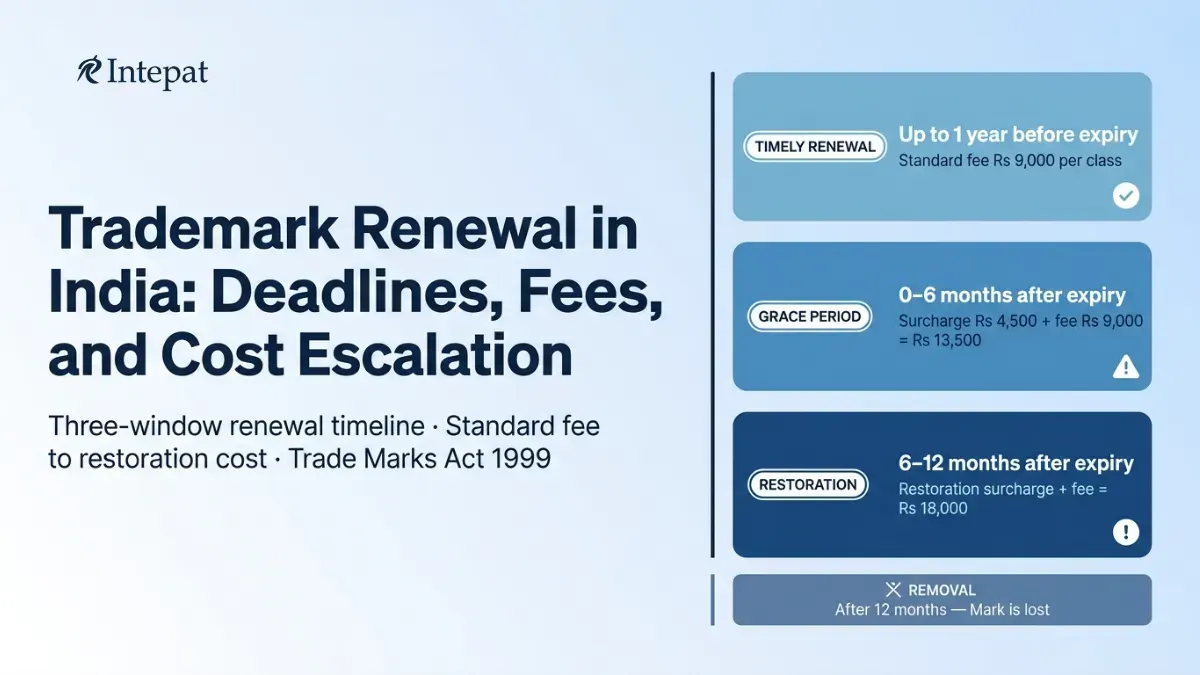
Trademark renewal period in India: how long does a trademark last?
A registered trademark in India is protected for ten years from its date of registration. Section 25(1) of the Trade Marks Act 1999 sets the ten-year term, and the same section lets you renew it from time to time. There is no cap on the number of renewals, so a mark can stay on the register indefinitely as long as you keep renewing it.
One point trips up a lot of owners. The fresh ten-year term always runs from the date your last registration expired, not from the day you actually paid. Renewing a few weeks early does not shorten your protection, and renewing late does not buy you extra time at the back end. The clock resets to the original expiry date either way.
The “date of registration” for counting the ten years is the date you originally applied, not the date the certificate issued. So if your application was filed in 2016 and the certificate came through in 2019, your renewal is still due ten years from the 2016 filing date. Timing can differ in unusual cases, for example where a mark registers very close to or after its renewal date, so always confirm the exact renewal date from your registration certificate or the trademark status page on the IP India portal.
A worked example. Say your trademark took effect from 15 July 2016. Your first renewal is due by 15 July 2026, and you can file it any time from 15 July 2025. If you miss 15 July 2026, you still have six months (to mid-January 2027) to renew with a surcharge. After that, restoration may be available up to 15 July 2027, one year from expiry. Past 15 July 2027, the routine renewal and restoration windows have closed.
Good to know: Filing early does not shorten your protection. The renewed ten years still runs from the previous expiry date, not from the date you paid.
The trademark renewal timeline: key dates
Renewal is not a single deadline. It is a series of windows, each with a different cost and a different level of risk. The table below sets out what you can do and when, measured from the expiry date of your current registration.
| Up to 1 year before expiry | File the renewal early (Form TM-R) | Standard renewal fee |
| Within 6 months before expiry | The Registry sends a reminder notice (Form RG-3) to your address on record | Standard renewal fee |
| On or before the expiry date | Renew normally | Standard renewal fee |
| Up to 6 months after expiry | Renew with a surcharge; the mark is not removed in this window | Renewal fee plus surcharge |
| After 6 months, up to 1 year after expiry | Apply to restore and renew (discretionary) | Renewal fee plus higher restoration surcharge |
| More than 1 year after expiry | No renewal or restoration; the mark is off the register | Must file a fresh application |
Two practical takeaways. First, Rule 57 of the Trade Marks Rules 2017 lets you file as early as one year before expiry, so there is no reason to leave it late. Second, do not rely on the RG-3 reminder as your business diary. The Rules require the Registry to send notice before removal, but it goes to the address for service on record, and if that address is out of date or the notice is missed, you can lose valuable time. Treat your own diary as the real deadline.
Trademark renewal fees in India
Renewal fees are charged per class. If your mark is registered in three classes, you pay the renewal fee three times. The figures below are the official government fees under the First Schedule to the Trade Marks Rules 2017 and do not include any professional or attorney charges. E-filing is cheaper than physical filing and is the normal route.
| Renewal on or before expiry | TM-R | Rs 9,000 | Rs 10,000 |
| Late renewal with surcharge (within 6 months after expiry) | TM-R | Rs 13,500 | Rs 15,000 |
| Restoration and renewal (6 months to 1 year after expiry) | TM-R | Rs 18,000 | Rs 20,000 |
Government fees verified as of June 2026 against the IP India forms and official fees schedule. Fees are set by the Rules and can change by amendment.
The pattern is simple: the longer you wait, the more it costs. The late-renewal figure adds a surcharge on top of the base fee, and restoration adds a larger one. Letting a multi-class mark slide into restoration can turn a routine renewal into a four or five figure bill per class, which is the main reason to file early.
How to renew a trademark online using Form TM-R
Renewal is filed through the same official platform used for registration: the IP India e-filing portal at ipindiaonline.gov.in. The application is made on Form TM-R, the single form that now covers renewal, late renewal with surcharge, and restoration. The older forms some guides still mention (TM-12, TM-13) were retired under the 2017 Rules and no longer apply.
The renewal can be filed by the registered proprietor or by an authorised agent or attorney acting on the proprietor’s behalf. Filing online requires a registered portal account and, for signing, a Class 3 digital signature. In practice the steps are: log in to the portal, locate the registered mark by its application or registration number, select the renewal option, complete Form TM-R, and pay the per-class fee online. The process mirrors the online filing you would have used for the original trademark application on Form TM-A.
After filing, track the request on the portal until the Registry processes it. Renewal can occasionally throw up queries that need a time-bound response, so it is worth checking the application status until you see the renewal recorded. Once renewed, the renewal is entered in the register and advertised in the Trade Marks Journal as a public record.
Information needed for trademark renewal
To file a renewal you usually need only a few things in hand:
- The trademark application or registration number.
- The proprietor’s name and current details.
- The class or classes the mark is registered in (this drives the fee).
- Authorisation for your agent or attorney (Form TM-M), if someone files on your behalf.
- The correct renewal fee for each class.
If the mark has changed hands since registration, it is cleaner to have the assignment recorded before or alongside the renewal, so the register shows the right owner.
Missing the deadline: grace period and restoration
Missing the expiry date is not immediately fatal, but every step after it costs more and carries more risk.
The six-month grace period. Under the proviso to Section 25(3), the Registrar will not remove your mark if you file Form TM-R with the renewal fee and surcharge within six months of the expiry date. In this window the mark stays on the register; you are simply renewing late with a penalty. This is the cheapest way to recover from a missed date.
Removal and restoration. If you do nothing in those six months, the Registrar may remove the mark from the register and advertise the removal in the Trade Marks Journal. Once removed, the only route back is restoration under Section 25(4). You can apply for restoration and renewal, again on Form TM-R, after six months and within one year of the expiry date. Restoration is not automatic. The Registrar restores the mark only if satisfied that it is just to do so, and Rule 60 requires the Registrar to have regard to the interests of any other person affected, for example someone who has since applied for a similar mark. The renewal and restoration are then advertised in the Journal.
After one year, the routes close. If no renewal or restoration is filed within one year of expiry, the ordinary renewal and restoration routes are closed, and in practice you will usually need to file a fresh application and start over, with no guarantee the mark is still available. (Removal depends on the Registry following the notice process, so in unusual cases there may be grounds to challenge a removal, but that is the exception, not the plan.) A limited cushion exists under Section 26: for one year after removal, your old mark may still be treated as being on the register when the Registry assesses a later conflicting application from someone else, unless the Section 26 exceptions apply. That can block an opportunist in the short term, but it is only a conflict-assessment cushion; it does not revive your registration.
Trademark renewal vs restoration
The two are easy to confuse, so here is the practical line between them.
| When it applies | On time, or within six months after expiry (with surcharge) | After the six-month grace window, up to one year from expiry |
| Mark’s status | Still on the register | Removed, or liable to removal |
| Registry’s stance | Routine; allowed as of course | Discretionary under Section 25(4); weighs other affected persons |
| Form and cost | TM-R, lower fee | TM-R, higher surcharge |
What you lose if the mark lapses
A registered trademark gives you rights that an unregistered one does not, and if the mark is removed and not restored, those statutory advantages go with it. (During the six-month grace period the mark is still on the register, so the loss bites only once removal stands and restoration has failed.) The most important advantage is the exclusive right to use the mark for your goods or services and to sue for infringement on the strength of the registration itself. Lose it and you are pushed back to a passing-off action, which is harder and more expensive to prove because you have to establish your reputation from scratch each time.
A live registration is also a commercial asset. It is what lets you assign the mark, that is sell it, or license it to others for a royalty. A lapsed mark has little of that value, and any licence or assignment built on it weakens with it. For most brands the renewal fee is small set against what the registration protects.
Staying ahead of your next renewal date
The single most useful habit is to docket your expiry date the moment your mark registers, and to set your own reminder for at least a few months ahead rather than waiting for the RG-3 notice. Confirm the exact date from your certificate or the IP India register, since the ten years run from the original filing date, not the certificate date.
If your mark covers more than one class, remember the fee multiplies per class, so budget accordingly. And if you already hold a portfolio of marks with different expiry dates, a single tracked schedule is worth setting up so nothing slips into the grace period or, worse, into removal. Filing early costs the same as filing on time and removes the risk entirely.
The renewals that go wrong tend to fail for the same handful of reasons:
- Relying only on the RG-3 notice instead of keeping your own diary.
- Using the certificate issue date instead of the original filing date to work out when renewal is due.
- Forgetting that the fee multiplies for each class the mark is registered in.
- Letting the address for service fall out of date, so reminders never arrive.
- Assuming restoration is automatic once the mark is removed. It is not.
Frequently asked questions
A trademark registration in India lasts ten years from the date of registration and can be renewed for further ten-year terms without limit, under Section 25 of the Trade Marks Act 1999. Each renewal extends protection by another ten years from the previous expiry date.
The official e-filing fee is Rs 9,000 per class for an on-time renewal under the Trade Marks Rules 2017. Renewing late within the six-month grace period costs Rs 13,500 per class, and restoring a removed mark costs Rs 18,000 per class. Physical filing costs slightly more.
You renew online by filing Form TM-R through the IP India e-filing portal at ipindiaonline.gov.in. Log in, locate your registered mark by its number, select renewal, complete Form TM-R, and pay the per-class fee. The proprietor or an authorised agent can file using a Class 3 digital signature.
If you miss the expiry date, you have six months to renew with a surcharge while the mark stays on the register. After that the Registrar may remove the mark, and you then have up to one year from expiry to apply for restoration, which is granted at the Registrar’s discretion.
Yes. Under Rule 57 of the Trade Marks Rules 2017, Form TM-R can be filed at any time up to one year before the expiry of the last registration. Filing early carries the same fee as filing on time and removes the risk of missing the date.
Yes. Trademark renewal fees in India are charged for each class the mark is registered in. A registration covering three classes requires the renewal fee to be paid three times, once per class, whether filing on time, late with surcharge, or for restoration.
Yes. Under Section 25(4) of the Trade Marks Act 1999, a removed mark can be restored and renewed on Form TM-R, filed after six months and within one year of the expiry date. Restoration is discretionary; the Registrar must consider the interests of any other affected person before allowing it.
This article explains the law on trademark renewal in India as at June 2026 and is for general information only. It is not legal advice. Government fees and Registry practice can change, and restoration in particular turns on the facts of each case and the Registrar’s discretion. For advice on a specific mark, consult a trademark attorney.