




You can check your trademark status in India on the IP India eRegister portal using your application number. The label tells you where the application stands, but the part that matters is the deadline behind it: Objected, Opposed, Refused, Removed, and Abandoned each call for different action, and reading the status correctly can prevent a loss of rights.
This guide covers domestic trademark applications filed in India before the Trade Marks Registry, under the Office of the Controller General of Patents, Designs and Trade Marks. It explains how to check status, what each label on the IP India portal means, the action and deadline attached to each, and how to estimate when the next change is due. For the filing route itself, see the trademark registration process. For the full lifecycle including rights conferred, costs, renewal, and what registration does not protect, see the complete guide to trademark registration in India.
Act first on these four statuses
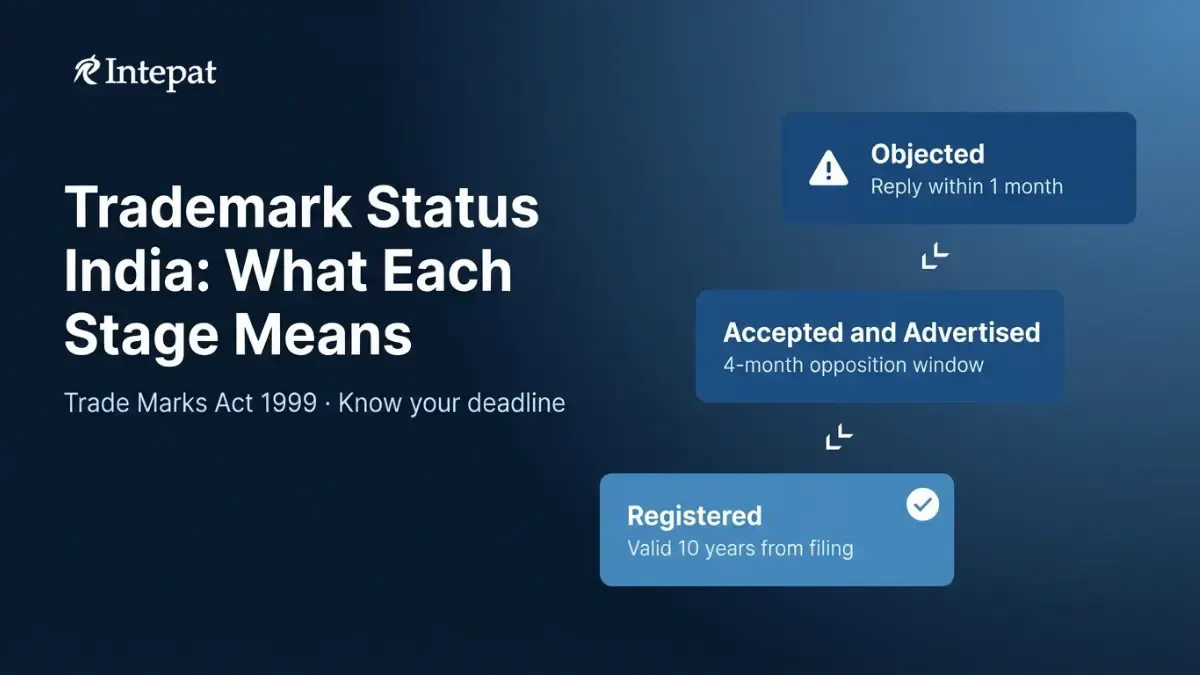
- Objected: reply within one month of receiving the examination report (Rule 33(4)). Silence can lead to abandonment.
- Opposed: file a counter-statement on Form TM-O within two months of receiving the copy of the notice of opposition (Section 21(2)). Miss it and the application is deemed abandoned.
- Accepted and Advertised: a four-month opposition window runs from the journal date (Section 21(1)). Monitor weekly.
- Removed: within six months of expiry, renew on Form TM-R with surcharge (Section 25(3)); from six months to one year, restoration may be sought (Section 25(4)); after one year, refile..
Jump to your status: New Application | Formalities Chk Fail | Marked for Exam | Exam Report Issued | Objected | Ready for Show Cause Hearing | Accepted and Advertised | Opposed | Registered | Removed | Refused | Abandoned
How to Check Trademark Status in India on the IP India Portal
The IP India trademark portal is the authoritative source for application status, and is more reliable than third-party trackers, which mirror the Registry record with a lag. It is publicly accessible. As of June 2026, record access uses one-time password (OTP) authentication. Because the OTP can be obtained with any email or mobile number, the record is open: anyone, including a competitor, can view the status of any application by its number, and obtaining an OTP only opens a session, it does not prove ownership.
- Visit the official eRegister portal at the E-Register and Application Status page.
- Enter any valid email address or mobile number to receive an OTP. The OTP is session-specific and need not match the contact on record with the Registry.
- Enter the OTP to open the session.
- Enter your trademark application number. The status displayed reflects the current stage of the application.
- If the status is Registered, a link to view the registration certificate appears on the record. The downloaded copy is marked NOT FOR LEGAL USE; a certified copy is obtained separately from the Registry.
The record shows more than the one-line status. It lists the journal number once the mark is advertised, a link to the examination report where one has issued, and the key dates, which together let you work out exactly where the application sits and which clock, if any, is running.
If you do not have the application number, you can retrieve it through the public search of the register by the wordmark.
| Tool | What it is for |
| eRegister (status check) | Current status and record by application number |
| Public Search | Find an application or registration by the wordmark |
| Trade Marks Journal | Confirm the advertisement date and run the opposition clock |
| E-Filing Portal | File the application, replies, oppositions, and renewals |
Email alerts from the Registry are useful but not sufficient on their own. Notices can be delayed or missed, so periodic checks on the portal remain the reliable safeguard against a deadline triggered by a status change. Where a trademark attorney is on record, they ordinarily monitor and advise; independent verification by the owner is still worth doing.
What Every IP India Trademark Status Means
The table below lists every status label a domestic applicant is likely to see, in lifecycle order, with the action and urgency for each. Read the label alongside the action: a hard deadline where inaction ends the application is the point at which professional help pays for itself.
| Status on portal | What it means | Action | Urgency |
| New Application | Filed; number and filing date recorded | Verify name, class, goods/services | Low |
| Send to Vienna Codification | Figurative elements being classified (device marks) | None; internal | Low |
| Formalities Chk Pass | Documents in order; cleared to the queue | None | Low |
| Formalities Chk Fail | A procedural deficiency was found | Remedy within one month (Rule 31) | High |
| Send Back to EDP | Returned to data processing for a record fix | Monitor for the next update | Low |
| Send to PRAS | A pre-registration amendment is being processed | Track if you filed one (Form TM-M) | Low to moderate |
| Marked for Exam | Queued for substantive examination | None; prepare evidence | Moderate |
| Exam Report Issued | Examiner has issued the report | Read it; act if objections are raised | Moderate |
| Objected | Objections raised under Section 9 or 11; not refused | Reply within one month (Rule 33(4)) | High |
| Ready for Show Cause Hearing | A hearing is scheduled | Prepare and attend | High |
| Accepted | Accepted; awaiting advertisement | None; await publication | Low |
| Advertised bef Acc | Published before formal acceptance | Monitor the four-month window | Moderate |
| Accepted and Advertised | Accepted and published in the Journal | Monitor weekly for opposition | Moderate |
| Opposed | A notice of opposition was filed | Counter-statement within two months (Section 21(2)) | High |
| Registered | Entered in the Register; certificate issued | Download certificate; set renewal reminder | Low |
| Rectification Filed | Registration challenged under Section 57 | Respond within the period directed | High |
| Removed | Struck off, usually for non-renewal | Renew or restore within the windows below | High |
| Cancelled | Cancelled by order or successful proceeding | Seek advice on appeal | High |
| Refused | Application refused after examination or hearing | Appeal or re-file (see below) | High |
| Abandoned | Lapsed on a missed deadline | Re-file; the priority date is lost | Terminal |
| Withdrawn | Voluntarily withdrawn before registration | None; re-file if needed | Low |
Four pairs of statuses are routinely confused, and the difference changes what you do. Objected is not Refused: an objection invites a reply, a refusal closes the application. Accepted is not Registered: acceptance precedes the opposition window, registration follows it. Removed is not Cancelled: removal is usually non-renewal and is reversible within set windows, while cancellation follows a proceeding or court order. Abandoned is not Withdrawn: abandonment is an involuntary lapse on a missed deadline, withdrawal is a deliberate choice.
The early labels, from New Application through Marked for Exam, are largely administrative and rarely call for action, with one exception noted below. The labels that carry deadlines or post-registration risk are explained in turn after them.
New Application
The application has been entered into the Registry database, an application number has been assigned, and the filing date is recorded. Use this status to confirm that the applicant name, class, and goods or services are correct. The filing date matters in itself: under Section 23(1), a mark when registered is registered as of the date of the application, so this date fixes priority against later applicants for the same or a similar mark.
Send to Vienna Codification
This label appears for device and composite marks. The figurative elements are processed through the Registry’s classification under the Vienna Agreement so that the examiner can search visually similar marks. Word marks do not pass through this stage. No applicant action is required.
Formalities Chk Pass
The application is procedurally complete and has cleared into the examination queue. No action is required.
Formalities Chk Fail
The Registry has found a procedural deficiency, for example a missing power of attorney, a classification mismatch, or an absent translation. The specific deficiency is recorded on the record. Remedy it within one month of the date of the notice; a notified deficiency that is not remedied within that month means the application is treated as abandoned. This is a procedural correction, not a rejection of the mark, and is usually cleared by filing the missing document or paying the fee difference.
Send Back to EDP
This is an internal routing status. The application has been returned to the data-processing section, commonly to correct a record or a scanned document. No applicant action is ordinarily required; monitor the portal for the next update.
Send to PRAS
PRAS is the section that handles amendments filed before registration. If you filed an amendment on Form TM-M under Section 22 of the Trade Marks Act 1999, it is being processed here. If you filed nothing, the routing usually reflects an internal correction rather than anything you need to answer.
Marked for Exam
The application is queued for substantive examination. The examiner assesses the mark on absolute grounds (Section 9) and relative grounds (Section 11) and searches earlier marks. No action is required while it waits. The examination queue is running on the order of 12 to 14 months at present, though this varies by class and Registry workload (indicative). The wait is also preparation time. If the mark contains descriptive elements or a common term, assembling evidence of use now, such as invoices, advertising, and dated examples of the mark in trade, shortens the turnaround if a later Section 9 objection calls for proof of acquired distinctiveness.
Exam Report Issued
The examiner has completed the review and issued the examination report. The report may accept the mark, accept it subject to conditions, or raise objections. If objections are raised, the status moves to Objected and the reply clock begins. Read the report in full before deciding how to respond.
Objected
Objected is the most misread status on the portal. It is not the same as Refused. It means the examiner has raised objections that you are required to answer, most often on absolute grounds under Section 9 (the mark is descriptive or lacks distinctiveness) or relative grounds under Section 11 (similarity to an earlier mark).
The reply is due within one month of the date you receive the examination report, and if no reply is filed the Registrar may treat the application as abandoned. Before that happens, the Registrar must give notice of the default and, if you ask, an opportunity to be heard. If the reply does not satisfy the examiner, a show cause hearing follows.
Do now: download the examination report, note its date of receipt, identify whether the objection is under Section 9 or Section 11, and file the reply within one month of that date.
The application remains alive at this stage, and many Section 9 and Section 11 objections are resolved at the written-reply stage. The two grounds call for different replies. A Section 9 objection is typically met by arguing that the mark is distinctive or, where it is descriptive, by showing acquired distinctiveness through use. A Section 11 objection, which cites an earlier mark, is usually met by distinguishing the marks or the goods and services, or by relying on consent or honest concurrent use where the facts support it. For how to structure the reply, see what an objection means and the reply to the examination report.
| At the objection stage |
| A reply should address each ground of objection with evidence and argument. |
| Get help replying |
Ready for Show Cause Hearing
Where the written reply has not satisfied the examiner, or a hearing is requested, a show cause hearing is scheduled. Hearings are commonly held by video conference in current practice. Attendance matters: where the applicant neither files a reply nor appears, the application can be treated as abandoned. For what to expect, see the show cause hearing guide.
Accepted
The Registrar has accepted the application, either absolutely or subject to conditions, and it now proceeds to advertisement. No action is required; await publication in the Trade Marks Journal.
Advertised bef Acc
This label, Advertised before Acceptance, means the mark was published before formal acceptance, which the Registrar may do in limited circumstances. The four-month opposition window applies in the same way. Monitor the portal weekly.
Accepted and Advertised
The mark has been accepted and published in the Trade Marks Journal. A four-month opposition window runs from the date of advertisement (Section 21). This period is fixed and cannot be shortened, including where examination was expedited. Note the journal date, monitor weekly, and if a third party files opposition the status moves to Opposed. The same journal is where you watch the other direction: if a later application that clashes with yours is advertised, that four-month window is your own opportunity to oppose it.
Opposed
A third party has filed a notice of opposition on Form TM-O. As the applicant, file a counter-statement on Form TM-O within two months of receiving the copy of the notice; if you do not, the application is deemed abandoned (Section 21). After the counter-statement, the matter moves through evidence stages and then to a hearing, which makes opposition the longest branch of prosecution, often running two to three years (indicative). Because the counter-statement fixes the applicant’s position, it is worth deciding early whether to defend in full, narrow the goods or services to reduce the conflict, or open discussions with the opponent. For the full sequence, see the opposition procedure.
Do now: confirm the date you received the copy of the notice, and file the counter-statement on Form TM-O within two months of that date.
| Opposition has a hard two-month deadline |
| The counter-statement period cannot be extended as of right. |
| Speak to a trademark attorney. |
Registered
The mark is entered in the Register and an electronic certificate is issued. Registration is valid for ten years from the date of the application, not the date of the certificate, and is renewable for successive ten-year periods. Download the certificate using OTP access, and from this point the registered-trademark symbol may be used. Set a renewal reminder well before Year 10. Registration is not the end of the work: continuous use protects the mark, because a registration left unused for long enough becomes open to removal for non-use, and any change of proprietor, name, or address is recorded with the Registry on Form TM-P so the Register and the service address stay current. For what the certificate records and authorises, see the registration certificate.
Rectification Filed
This status appears after registration. A petition has been filed under Section 57 of the Trade Marks Act 1999 to cancel, vary, or rectify the entry, or removal has been sought on the ground of non-use. Such applications lie before the Registrar or the High Court. The mark stays on the Register while the matter is pending, but an undefended rectification can end in removal. Respond within the period directed by the Registrar and take advice early. For the grounds and procedure, see rectification of a registered mark.
Removed
A registered mark is removed from the Register most often for non-renewal. Three windows follow the expiry date. Within six months of expiry, renew on Form TM-R with the prescribed surcharge (Section 25(3)). After six months and within one year of expiry, the Registrar may restore the mark on Form TM-R at the Registrar’s discretion (Section 25(4)). After one year, restoration is no longer available, and the route back is a fresh application. Refiling is worth doing promptly: the new application takes a new filing date, is examined afresh, and faces any conflicting marks filed by others in the meantime, though prior use of the mark can still support it. The Registry sends a removal-warning notice in Form RG-3 up to six months before expiry. Removal can also follow a successful rectification or non-use proceeding, in which case the grounds are set out in the order. One point is easy to miss: under Section 26, a mark removed for non-payment of the renewal fee is still treated as being on the Register for one year after removal when a third party applies for a similar mark, so removal does not immediately clear the field for others. For the windows and fees, see renewal and restoration.
Do now: check the expiry date, then renew on Form TM-R with surcharge if you are within six months, or seek restoration if you are within one year.
| Mark removed? |
| The renewal and restoration windows are short and unforgiving. |
| Check your options |
Cancelled
A registered mark has been cancelled pursuant to a successful proceeding or court order under Section 57. This is distinct from Removed, which is primarily non-renewal. The registration is void from the date specified in the order. Take advice on whether an appeal is available on the facts.
Refused
The Registrar has refused the application after examination, a show cause hearing, or both, and the record is closed. Two routes are available. The first is an appeal to the jurisdictional High Court within three months of the order being communicated; the appellate jurisdiction formerly exercised by the Intellectual Property Appellate Board under Section 91 was transferred to the High Courts by the Tribunals Reforms Act 2021. The second is a fresh application addressing the grounds of refusal, for example a mark refused under Section 9 supported by evidence of acquired distinctiveness, though a fresh application loses the original filing date. In practice the choice turns on the grounds: an appeal suits a legally contestable refusal where the original filing date is worth preserving, while a fresh application suits grounds that can be cured. For how to respond, see responding to a refusal.
Do now: read the grounds of refusal, and decide within the three-month window whether to appeal to the High Court or to re-file.
| A refusal is time-sensitive |
| An appeal and a re-file lead to different outcomes; the choice turns on the grounds. |
| Get urgent assistance |
Abandoned
An application reaches Abandoned when a mandatory deadline is missed: no reply to the examination report within the prescribed period, no counter-statement within two months during opposition, non-appearance at a hearing, or a deficiency left unremedied. The variant Deemed to be Abandoned appears specifically where the counter-statement is not filed in time under Section 21(2). There is no general statutory mechanism to restore an abandoned pending application; in practice a fresh application is filed and the priority date is lost. Where the lapse arose despite genuine diligence, a practitioner can assess whether any relief is open on the specific facts, though none is available as of right.
Withdrawn
The applicant has voluntarily withdrawn the application before registration. No action is required. A fresh application may be filed later, but it carries a new filing date.
How Long Each Trademark Status Takes in 2026
The timelines below are indicative, based on Registry processing patterns as at early 2026, and vary by class and filing volume. Treat them as planning benchmarks, not guarantees (verified as of June 2026).
| Stage transition | Indicative duration | Notes |
| Filing to formalities check | 2 to 4 weeks | Faster for e-filings |
| Formalities check to Marked for Exam | 2 to 6 weeks | Queue dependent |
| Marked for Exam to report | 12 to 14 months | Varies by class; expedited examination is faster |
| Objection to show cause hearing | 2 to 4 months after reply | Only where the reply is insufficient |
| Acceptance to journal publication | 3 to 6 weeks | Publication in the Trade Marks Journal |
| Publication to registration | 2 to 4 months after the window closes | Four-month opposition window is statutory |
| Uncontested application, total | 18 to 24 months | From filing date |
| Contested application, total | 3 to 5 years | If opposition runs to a final hearing |
Applicants who need to move faster can request expedited processing on Form TM-M after the application number is issued. Expedited examination is ordinarily completed within about three months, but the four-month opposition window remains statutory and cannot be shortened.
How to Predict Your Next Status Update Using the IP India Queue
The status check tells you where the application is now; a separate queue listing tells you roughly when the next movement is likely. The queue listing is open and needs no login.
It offers a General Queue List and an Expedite Queue List. Within each, three queues can be checked: the Examination Queue (your position for first examination), the Hearing Queue for show cause matters, and Consideration of Reply, listed as MIS-R, for a reply you have already filed. Checking your Examination Queue position every few weeks during Marked for Exam gives a realistic sense of when to expect a report. The position is approximate: it shifts as new applications enter and as expedited applications are taken ahead of the general queue. It is a planning tool, not a commitment.
Why Trademark Status Emails Reach Your Agent and Not You
The Registry sends notifications from a no-reply Registry address to the single service address recorded against each application. For an examination report, the Registry sends the report and then up to three reminders if no response is filed; for opposition, a separate reminder sequence runs for the counter-statement. All of these reach the address on record.
This is the point many brand owners miss. The Registry currently allows one service address per application and has no separate channel to the applicant. If you filed yourself using your own email, the notifications reach you. If you filed through an agent, the agent receives them, and whether your agent forwards Registry alerts and tracks the deadlines is therefore a material factor in whether your application survives prosecution. If you are unsure who is on record, the eRegister record shows the address of service; confirm it and confirm the forwarding arrangement. If the address on record is an agent who no longer acts for you, or an email you no longer control, the address of service can be updated with the Registry on Form TM-M for a pending application. For an application sitting at a live deadline, that single correction can decide whether the next notice is acted on in time.
When You Can Use the TM and Registered Symbols
The TM letters are conventionally used to signal a claim to a mark and may be adopted from the date of filing. The registered-trademark symbol is different: it may be used only once the portal status shows Registered. Using the registered symbol before registration represents an unregistered mark as registered, which is an offence under Section 107 of the Trade Marks Act 1999, punishable with imprisonment of up to three years, or fine, or both. The same provision applies after registration: use the registered symbol only for the goods, services, and classes the Indian registration actually covers, because representing a mark as registered for goods or services it does not in fact cover, or treating an Indian registration as if it ran in markets where the mark is not registered, also falls within Section 107. For the full distinction and common errors, see the difference between the TM and registered symbols.
Frequently Asked Questions About Trademark Status in India
Visit the IP India eRegister portal at tmrsearch.ipindia.gov.in/estatus, enter any valid email or mobile number to receive an OTP, open the session, and enter your application number. The portal shows the current status. If you do not have the number, find it through the IP India public search by mark or proprietor name.
Yes, if it shows Marked for Exam. The examination queue runs on the order of 12 to 14 months at present, varying by class. A status sitting between Marked for Exam and Objected is usually in the queue, not stalled. Check your position on the IP India queue listing to gauge timing.
No. Objected and Refused are different statuses. Objected means the examiner has raised concerns you must answer in a written reply, and the application remains alive. Many Section 9 and Section 11 objections are resolved at the reply stage. The reply is due within one month of receiving the examination report.
There is no general statutory mechanism to restore an abandoned pending application. The application is closed and the priority date cannot be recovered, so a fresh application is filed. A trademark attorney can advise on re-filing and on whether the grounds of the lapse can be addressed in the new application.
Check every two to three weeks while the status shows Marked for Exam. Once it shows Objected, check more frequently, because the one-month reply clock runs from the date of the examination report. During the four-month opposition window after Accepted and Advertised, weekly checks are appropriate, and if Opposed appears, act at once.
The Registry emails notifications to the single service address on record, not necessarily to the applicant. If you filed yourself, you receive them. If you filed through an agent, the agent receives them and you depend on the agent forwarding them. The Registry allows one service address per application and no separate channel to the applicant.
Both mean the mark is published in the Trade Marks Journal and the four-month opposition window is running. Accepted and Advertised means the Registrar accepted the mark before publication. Advertised bef Acc means publication came before formal acceptance, allowed in limited circumstances. The action is the same for both: monitor weekly.
A party or the Registry has moved to cancel, vary, or rectify your registration under Section 57 of the Trade Marks Act 1999, before the Registrar or the High Court. The mark stays on the Register while the matter is pending, but an undefended rectification can lead to removal. Respond within the period directed and take advice promptly.
Formalities Chk Fail means the Registry found a procedural deficiency in the application, such as a missing power of attorney, a classification mismatch, or an absent translation. It is a correction, not a rejection of the mark. Remedy the specific deficiency within one month of the date of the notice, or the application is treated as abandoned.
Removed means a registered mark has been struck off the Register, most often for non-renewal. Within six months of expiry you can renew with a surcharge; from six months to one year you can seek restoration; after one year the mark cannot be restored and a fresh application is needed. Removal can also follow a successful rectification or non-use proceeding.
A Status-Monitoring Routine That Prevents Abandonment
Tracking trademark status is how a filed and paid application survives prosecution. A change from Marked for Exam to Objected can happen overnight, and the one-month reply clock runs from the date you receive the examination report, so a status change is the signal to verify that date at once. A workable routine is to check every two to three weeks in the examination queue, more often once Objected shows, and weekly through the four-month opposition window, while confirming that whoever is on the service address is forwarding Registry notices. The aim is simple: no status should change without someone seeing it and knowing whether a deadline has started.
If your application is at a deadline-bearing stage, an Intepat trademark attorney can review the status and the next action before the clock runs out. Book a consultation.
This article is for general information on Indian trademark law and procedure and is not legal advice. Statuses, timelines, forms, and fees are set by the Trade Marks Registry and can change; the procedural figures here are indicative and verified as of June 2026. For advice on a specific application, consult a qualified trademark attorney.