




Trademark assignment in India is the transfer of trademark ownership from assignor to assignee under Chapter V of the Trade Marks Act 1999. Both registered and unregistered trademarks may be assigned with or without the goodwill of the business, subject to statutory restrictions. The assignee records title at the Trade Marks Registry by filing Form TM-P under Section 45.
| At a Glance |
| Assignment must be in writing (Section 2(b), Trade Marks Act 1999) |
| Registered and unregistered trademarks are both assignable (Sections 38 and 39) |
| Assignment without goodwill triggers an advertisement obligation with a six-month filing deadline (Section 42) |
| The assignee files Form TM-P under Section 45 to record title; e-filing fee is Rs 9,000 per trademark (First Schedule, Entry 6, Trade Marks Rules 2017) |
| Until Form TM-P is filed, the assignment is ineffective against a third party who acquires a conflicting interest without knowledge of it (Section 45(4)) |
What “Assignment” Means Under the Trade Marks Act 1999
Section 2(b) of the Trade Marks Act 1999 defines “assignment” as an assignment in writing by act of the parties concerned. The written form is not a procedural preference; it is the statutory definition. An oral purported transfer does not constitute an assignment within the meaning of the Act.
In commercial practice, trademark assignment is how a founder transfers a brand from personal ownership to the company, how a business sells its brand as part of a product line sale, or how group companies restructure trademark ownership following a merger or acquisition. It is the legal mechanism for any permanent change of trademark ownership.
“Transmission,” by contrast, is defined in Section 2(zc) as transfer by operation of law, devolution on the personal representative of a deceased person, or any other mode of transfer that is not assignment. A bequest under a will or succession on intestacy therefore constitutes transmission, not assignment.
The power to assign under Section 37 belongs to the person entered in the register as proprietor, subject to any rights on the register vested in another person.
When Is a Trademark Assignment Needed?
Trademark assignment arises in a range of business situations, including:
- a founder transferring a trademark application or registration to a newly incorporated company;
- a business selling a product line or brand to another party;
- a group-company restructuring where marks held by one entity are consolidated under a holding company or transferred to an operating subsidiary;
- a business acquisition or merger where the acquirer needs the seller’s trademarks formally transferred;
- an individual or partnership converting to a private limited company or LLP and needing to align trademark ownership with the new entity.
Where trademark ownership passes by succession or court order rather than by agreement between living parties, that is transmission under Section 2(zc), not assignment. The same Form TM-P registration procedure under Section 45 applies to transmissions, but the underlying instrument is different.
Which Trademarks Can Be Assigned?
Registered trademarks
Section 38 provides that a registered trademark is assignable and transmissible with or without the goodwill of the business concerned, in respect of all the goods or services for which it is registered or some only. A partial assignment transfers rights in the assigned subset; the assignor retains rights for the remainder.
Unregistered trademarks
Section 39 extends assignability to unregistered trademarks, which may be assigned or transmitted with or without the goodwill of the business concerned. The same Section 42 advertisement requirement applies when an unregistered trademark is assigned without goodwill.
Certification trademarks and associated trademarks
A certification trademark may not be assigned or transmitted without the written consent of the Registrar (Section 43). Associated trademarks may only be assigned as a whole and not separately, though they are treated as separate registrations for all other purposes of the Act (Section 44).
Registered user: no right of assignment
Section 54 expressly provides that nothing in the Act confers on a registered user of a trademark any assignable or transmissible right to the use of the mark. A licensee registered under Section 49 cannot assign the licensed rights to a third party.
Restrictions on Assignment: Sections 40 and 41
Two statutory restrictions can invalidate an otherwise permissible assignment.
Section 40: Multiple exclusive rights in the same goods or services
Under Section 40(1), a trademark shall not be assignable where, as a result of the assignment, exclusive rights in more than one person would subsist in relation to the same goods or services, the same description of goods or services, or associated goods or services, if the use of those marks would be likely to deceive or cause confusion.
The restriction does not apply where the exclusive rights resulting from the assignment are not exercisable by two or more persons in relation to goods sold within India otherwise than for export, goods exported to the same market outside India, or services available for acceptance in India (Section 40(1) proviso).
The registered proprietor of a trademark who proposes to assign it may apply to the Registrar under Section 40(2) for an advance certificate of validity. The certificate is conclusive (subject to appeal and except where obtained by fraud), provided the assignee files the Section 45 application within six months from the date the certificate is issued.
Section 41: Exclusive territorial rights in different parts of India
Section 41 prohibits an assignment creating exclusive territorial rights in different parts of India over identical or nearly resembling marks for the same or associated goods or services. The Registrar may grant approval if satisfied the use would not be contrary to the public interest. An approved assignment is not invalid, provided the Section 45 application is filed within six months from the approval date.
Assignment With Goodwill vs Without Goodwill
The Act draws a material distinction between these two categories.
Assignment with goodwill
Where a trademark is assigned with the goodwill of the business, no advertisement step is required by reason of the goodwill element alone. The trademark assignment deed is executed and Form TM-P is filed under Section 45.
Section 42’s Explanation clarifies two situations treated as goodwill assignments: an assignment of a trademark in respect of some goods or services, accompanied by the goodwill of the business in those goods or services; and an assignment of a trademark used on exported goods, accompanied by the goodwill of the export business.
Assignment without goodwill: the Section 42 advertisement requirement
Where a trademark (registered or unregistered) is assigned without the goodwill of the business, Section 42 imposes an advertisement condition. The assignment does not take effect unless:
- The assignee applies to the Registrar for advertisement directions within six months from the date of the assignment (extendable by up to three months in aggregate on application); and
- The assignment is advertised in the form, manner, and within the period directed by the Registrar.
The application for advertisement directions is made in Form TM-P under Rule 80, at Rs 2,700 e-filing (Rs 3,000 physical) per Entry 7 of the First Schedule (verified May 2026). An extension requires a further Form TM-P under Rule 80(3), at Rs 1,800 e-filing (Rs 2,000 physical) per Entry 8.
Where a Section 41 issue also exists, the Registrar may decline to consider the Rule 80 application unless the Section 41 approval has already been obtained and its reference is included in the application (Rule 80(2)).
Filing Form TM-P: Recording Your Title Under Section 45
Who files and what is submitted
Under Section 45(1), a person who becomes entitled by assignment or transmission to a registered trademark must apply to the Registrar to register the title. The deed transfers ownership between the parties; Form TM-P records that change on the official Register so the assignee appears as the subsequent proprietor. The Registrar registers the assignee as proprietor in respect of the goods or services covered and records the particulars on the Register.
The application is filed in Form TM-P under Rule 75. The applicant files a duly certified copy of the original trademark assignment deed and a statement of case in support (Rule 76(1)). For a breakdown of the applicable government fees, see the trademark registration fees guide.
Fees (verified MAY 2026)
| Application | Form | E-filing | Physical |
| Register subsequent proprietor (Section 45, per trademark) | TM-P | Rs 9,000 | Rs 10,000 |
| Advertisement directions / Section 40(2) certificate / Section 41 approval (per trademark) | TM-P | Rs 2,700 | Rs 3,000 |
| Extension of time for Section 42 advertisement (per trademark) | TM-P | Rs 1,800 | Rs 2,000 |
Source: First Schedule, Entries 6, 7, and 8, Trade Marks Rules 2017.
What the Registrar may require
Section 45(2) provides that the Registrar may call for evidence in proof of title only where there is a reasonable doubt about the veracity of any statement or document furnished. Under Rule 78, an instrument that is not properly stamped will be impounded under Chapter IV of the Indian Stamp Act 1899.
Processing timeline and disputed validity
Rule 76(2) provides that the Registrar shall ordinarily dispose of an application under Rule 75 within three months from the date of application. This is a standard processing target, not a guaranteed timeline. Where the validity of the assignment is in dispute between the parties, Section 45(3) allows the Registrar to defer registration until the rights have been determined by a competent court.
Documents Required for Trademark Assignment in India
The documents needed to record a trademark assignment with the Registry are:
- the original trademark assignment deed or a duly certified copy, purporting to transfer title in the mark (Rule 76(1));
- a statement of case in support of the application;
- where the assignment is without goodwill, a copy of the Registrar’s advertisement directions and proof that the advertisement has been completed (Rule 81);
- where a Section 41 territorial issue exists, a copy of the Registrar’s approval notification;
- where foreign currency is involved, documentation of any permission required under applicable foreign exchange law (Rule 79).
The assignment deed itself must be in writing (Section 2(b)) and should be executed on appropriately stamped paper. Stamp duty on a trademark assignment deed is determined under the applicable state stamp law or the Indian Stamp Act 1899, depending on the place of execution and the structure of the transaction. The Registrar is authorised under Rule 78 to impound any instrument that is not properly stamped. To know more about documents required is set out in our article Documents Required for Trademark Registration in India.
What a Trademark Assignment Deed Should Identify
A trademark assignment deed should clearly identify:
- the trademark being assigned, including its application or registration number, class, and the goods or services covered;
- the full legal names and addresses of the assignor and assignee;
- the scope of the assignment: whether it covers all goods and services or only some;
- whether the goodwill of the business is included in the transfer;
- the consideration paid or agreed, if any;
- the effective date of the assignment;
- a representation by the assignor that it holds valid title free of undisclosed encumbrances.
The deed must be in writing by act of the parties under Section 2(b). Where the assignment is without goodwill, the deed should record that fact clearly, as it triggers the Section 42 advertisement requirement.
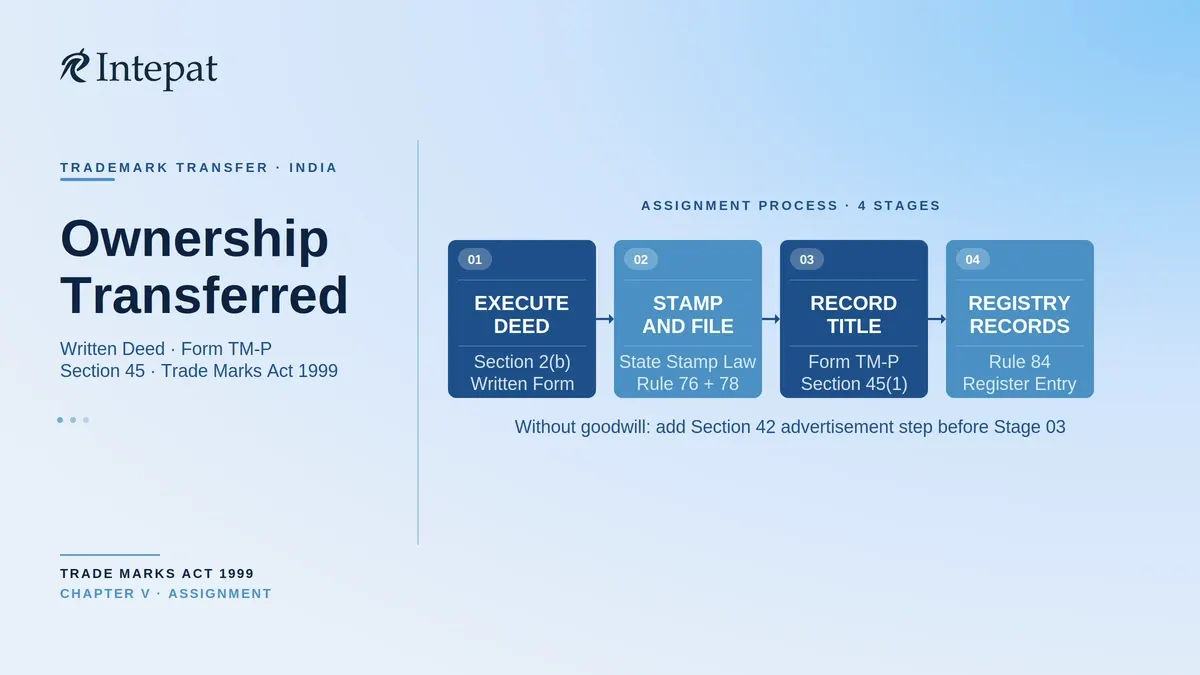
Trademark Assignment Process: Step by Step
The sequence for a standard assignment with goodwill is as follows.
1. Conduct a trademark search to confirm the current ownership, registration status, class, and any pending proceedings or encumbrances.
- Execute the trademark assignment deed in writing, correctly identifying the mark, the parties, the goods or services, and whether goodwill is included.
- Pay the applicable stamp duty and have the deed stamped under the relevant state stamp law.
- File Form TM-P with the Trade Marks Registry along with a certified copy of the deed and a statement of case (Rule 76(1)).
- Respond to any query raised by the Registrar under Section 45(2) until the assignee is entered in the register as subsequent proprietor.
Where the assignment is without goodwill, insert the following between steps 2 and 3 above:
- Apply to the Registrar in Form TM-P for advertisement directions under Section 42 within six months from the date of the deed.
- Complete the advertisement in the form, manner, and period directed by the Registrar.
- File Form TM-P for Section 45 registration only after the advertisement obligation is fulfilled.
Consequences of Not Filing Form TM-P
Section 45(4) provides that until the Form TM-P application has been filed, the assignment is ineffective against a person who subsequently acquires a conflicting interest in the registered trademark without knowledge of the assignment. An assignee who delays filing runs the risk that a later third-party interest without notice will be protected. Prompt filing after execution of the deed is the standard practice.
What the Register Records After a Successful Assignment
Rule 84 of the Trade Marks Rules 2017 prescribes the particulars entered in the Register after an assignment is allowed: the name and address of the assignee; the date of the assignment; where the assignment covers only a right in the trademark, a description of that right; the basis under which the assignment is made; and the date on which the entry is made.
Assignment vs Licensing: Key Distinction
Assignment permanently transfers ownership. A trademark licence is a permission to use the mark granted by the proprietor while the proprietor retains ownership. A registered user under Section 49 may use the mark subject to conditions, but Section 54 confirms the registered user holds no assignable right to that use. For a comparison of these two structures, see the guide to trademark licensing in India.
Assignments Involving Payment Outside India
Rule 79 of the Trade Marks Rules 2017 provides that where a law regulating the transmission of moneys outside India is in force, the Registrar shall not register title under an assignment involving such transmission except on production of the permission required by the applicable law. Whether a specific FEMA or Reserve Bank of India approval is needed depends on the structure of the transaction; practitioners should verify the applicable foreign exchange requirements before filing the Section 45 application.
Frequently Asked Questions
Under Section 2(b) of the Trade Marks Act 1999, “assignment” is defined as an assignment in writing by act of the parties concerned. An oral agreement does not constitute an assignment for the purposes of the Act and cannot be registered under Section 45.
Yes. Section 39 of the Trade Marks Act 1999 provides that an unregistered trademark may be assigned or transmitted with or without the goodwill of the business concerned. The Section 42 advertisement requirement applies to unregistered trademarks assigned without goodwill in the same way it applies to registered trademarks.
The fee to register a subsequent proprietor under Section 45, on a Form TM-P application, is Rs 9,000 per trademark for e-filing and Rs 10,000 for physical filing, per Entry 6 of the First Schedule to the Trade Marks Rules 2017. Separate fees apply for advertisement directions under Section 42 and for certificates or approvals under Sections 40(2) and 41.
The core documents are a duly certified copy of the trademark assignment deed and a statement of case (Rule 76(1)). Where the assignment is without goodwill, proof of completed advertisement under Section 42 is also required. The deed must be in writing (Section 2(b)) and appropriately stamped under the applicable stamp law.
Rule 76(2) provides that the Registrar shall ordinarily dispose of the Form TM-P application within three months from the date of filing. This is a standard processing target, not a guaranteed period. For without-goodwill assignments, the Section 42 advertisement process must be completed before or alongside the Form TM-P filing, extending the overall timeline.
Yes. Stamp duty is payable on a trademark assignment deed under the applicable state stamp law or the Indian Stamp Act 1899, determined by the place of execution and transaction structure. Under Rule 78 of the Trade Marks Rules 2017, the Registrar is authorised to impound any instrument produced in proof of title that is not properly stamped.
Assignment under Section 2(b) is a voluntary transfer of ownership in writing by act of the parties. Transmission under Section 2(zc) is a transfer by operation of law, devolution on a personal representative of a deceased person, or any other mode of transfer that is not assignment. A trademark that passes to an heir under succession is transmitted, not assigned.
Under Section 45(4) of the Trade Marks Act 1999, until the Form TM-P application has been filed, the assignment is ineffective against a person who acquires a conflicting interest in the registered trademark without knowledge of the assignment. Filing promptly after execution of the assignment deed protects the assignee’s position against later conflicting interests.
Yes. Section 38 expressly provides that a registered trademark is assignable in respect of either all the goods or services for which it is registered or some only of those goods or services. A partial assignment transfers rights in the assigned subset; the assignor retains rights for the remaining goods or services.
No. Section 54 of the Trade Marks Act 1999 provides that nothing in the Act confers on a registered user any assignable or transmissible right to the use of the trademark. Only the registered proprietor holds assignable ownership.
Registrar approval is required for assignments of certification trademarks (Section 43) and for assignments raising Section 41 territorial issues. The Section 40(2) certificate is optional but available when the registered proprietor wishes advance confirmation that the proposed assignment will not create confusingly overlapping exclusive rights. For ordinary commercial trademark assignments, the assignee files Form TM-P and the Registrar records title without prior approval.
This article covers trademark assignment under the Trade Marks Act 1999 and Trade Marks Rules 2017 as in force in India. It is for general informational purposes only and does not constitute legal advice. Specific transactions, particularly those involving goodwill disputes, foreign parties, territorial restrictions, or certification trademarks, require advice from a qualified trademark attorney. Fees and procedures should be verified against the current official schedules before filing.