







India has been a member of the Madrid Protocol since 8 July 2013, allowing Indian businesses to file a single international trademark application through the Indian Trade Marks Registry for protection in multiple member countries.
When India is designated under a Madrid application, the Indian Trade Marks Office has up to 18 months to issue a provisional refusal, and once protection is granted, the registration remains valid for 10 years, renewable centrally through WIPO.
However, during the first 5 years, the international registration remains dependent on the Indian basic mark, a risk commonly referred to as “central attack.”
This guide explains the complete process, timelines, dependency risks, refusal handling, and strategic considerations for both Indian applicants filing abroad and foreign applicants designating India.
Who Can File a Madrid Application from India?
An international application under the Madrid Protocol can originate from India only if the applicant satisfies two legal conditions. First, the applicant must have a qualifying connection with India. Second, the applicant must have a corresponding Indian basic mark. Both conditions must exist at the time of filing the international application.
Qualifying Connection with India
India can act as the Office of origin only if the applicant is eligible under the Madrid framework and Chapter IVA of the Trade Marks Act, 1999. An applicant qualifies if the applicant is:
- A national of India
- Domiciled in India
- The owner of a real and effective industrial or commercial establishment in India
If none of these conditions are satisfied, the applicant cannot file the international application through the Indian Trade Marks Registry.
For corporate groups operating across jurisdictions, the correct Office of origin must be determined carefully. The location of incorporation, operational control, and ownership of the Indian basic mark must align. Filing through an incorrect Office of origin may lead to refusal at the certification stage.
Requirement of a Basic Mark in India
Every international application originating from India must be based on an existing Indian trademark application or registration. This underlying filing is referred to as the basic mark.
The international application must strictly correspond with the Indian basic mark in three respects:
- The mark must be identical
- The applicant details must match the Indian record
- The goods and services must not exceed the scope of the Indian specification
If the international application expands beyond the scope of the Indian filing, the Indian Trade Marks Registry will refuse certification.
Applicants planning international protection should therefore ensure that the Indian filing has been structured correctly from the outset. The scope of goods, classification accuracy, and applicant details recorded during trademark registration in India directly determine the stability of the international registration.
Scope of Goods and Services
The goods and services designated in the international application must fall entirely within the specification of the Indian basic mark and must comply with the Nice Classification system.
A narrowly drafted Indian application limits international expansion. An overbroad or vulnerable Indian filing increases the risk of objection, opposition, or cancellation. Since the international registration remains dependent on the Indian basic mark for the first 5 years, any cancellation, limitation, or withdrawal of the Indian filing during that period will directly affect the international registration.
Eligibility and drafting at the Indian stage therefore determine the strength and sustainability of international protection.
Step-by-Step Process for Filing a Madrid Application from India
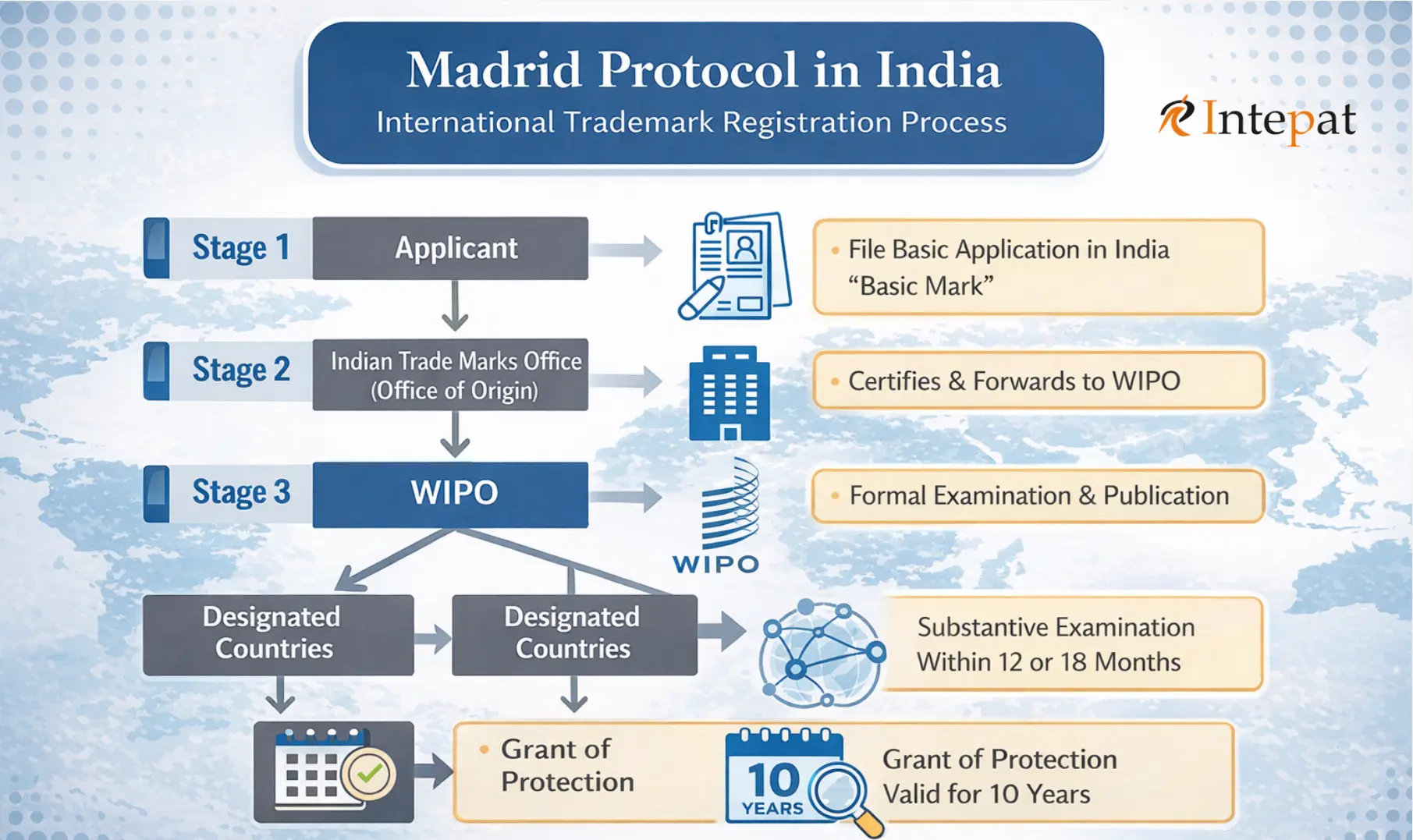
Filing an international trademark application under the Madrid Protocol from India involves coordination between the applicant, the Indian Trade Marks Registry, and the World Intellectual Property Organization. Although the system is centralized at the filing stage, examination ultimately occurs in each designated jurisdiction.
The process can be understood in six sequential stages.
Step 1: Basic Mark in India
The applicant must have either a pending Indian trademark application or a registered trademark in India. The international application must correspond exactly with the Indian basic mark in terms of the mark itself, applicant details, and goods and services. Any expansion beyond the Indian filing will prevent certification.
Step 2: Filing the International Application
The applicant submits Form MM2 electronically through the Indian Trade Marks Registry. The application identifies the designated Contracting Parties and includes the prescribed fees payable to WIPO.
At this stage, the Indian Registry does not examine the mark on substantive grounds. Its role is limited to verifying correspondence between the international request and the Indian basic mark.
Step 3: Certification by the Indian Trade Marks Registry
The Indian Registry verifies that the international application matches the Indian basic mark. If satisfied, the Registry certifies the application and forwards it to WIPO. If discrepancies exist, certification is withheld until corrections are made.
The date of international registration may correspond to the date on which the application was received by the Indian Registry, provided all formal requirements are met.
Step 4: Formal Examination by WIPO
Upon receipt, WIPO conducts a formal review of the application. This review is limited to compliance with Madrid Protocol requirements and does not involve substantive examination.
If WIPO identifies irregularities, the applicant is notified and typically given 3 months to remedy the defects. Failure to respond within the prescribed period results in abandonment.
If no irregularities exist, or once they are corrected, the mark is recorded in the International Register and published in the WIPO Gazette of International Marks.
Step 5: Examination in Designated Countries
After publication, WIPO notifies each designated country. Each jurisdiction then examines the application under its domestic trademark law.
A designated country may grant protection, issue a provisional refusal, or open the mark to opposition. The time limit for refusal varies by jurisdiction.
Where India is designated, the Indian Trade Marks Office has up to 18 months from notification to issue a provisional refusal.
Step 6: Grant of Protection or Refusal
If no refusal is issued within the prescribed period, protection is deemed granted in that jurisdiction. If a provisional refusal is issued, the applicant must respond before the trademark office of the designated country, usually through locally qualified representation.
Once protection is secured, the international registration remains valid for 10 years from the date of international registration and may be renewed centrally through WIPO.
Madrid Filing Timeline Overview
| Stage | Authority | Time Period |
|---|---|---|
| Certification | Indian Trade Marks Registry | Upon verification |
| Formal review | WIPO | Irregularity response usually within 3 months |
| Substantive examination where India is designated | Indian Trade Marks Office | Up to 18 months |
| Opposition in India | Trade Marks Journal | 4 months |
| Validity | WIPO | 10 years |
Although the Madrid system allows a single filing, rights are granted country by country. The first 18 months following designation are therefore critical, particularly where India is involved.
What Happens When India Is Designated Under a Madrid Application?
When India is designated in an international application, the application is examined by the Indian Trade Marks Office in the same manner as a national trademark application filed directly in India.
Designation of India does not automatically result in protection. Substantive examination under the Trade Marks Act, 1999 applies.
18-Month Examination Period
From the date on which WIPO notifies India of the designation, the Indian Trade Marks Office has up to 18 months to issue a provisional refusal.
If no provisional refusal is communicated within this period, protection is deemed granted in India.
The 18-month period is a maximum limit. Examination may occur earlier depending on Registry workload.
Provisional Refusal in India
If the Indian Trade Marks Office raises objections, a provisional refusal is issued through WIPO and communicated to the holder of the international registration.
Common grounds include:
- Absolute grounds of refusal
- Descriptiveness or lack of distinctiveness
- Conflict with earlier marks
- Incorrect classification or specification issues
Upon receipt of a provisional refusal, the holder must respond directly before the Indian Trade Marks Office.
The response must be filed within the time limit specified in the refusal communication. Under current practice, the response period is 1 month from the date of receipt of notification in India, subject to procedural rules in force at the time.
Failure to respond within the prescribed period may result in the designation being treated as abandoned in India.
Advertisement and Opposition in India
If objections are overcome or no objections are raised, the mark proceeds to advertisement in the Trade Marks Journal.
From the date of advertisement, any third party may file an opposition within 4 months.
Opposition proceedings for Madrid designations follow the same procedural framework applicable to national trademark applications in India.
Applicants unfamiliar with Indian opposition practice should review the procedure relating to trademark opposition in India, as opposition timelines are strictly enforced and require evidence-based response.
If no opposition is filed within the 4-month period, or if opposition is decided in favor of the holder, protection is granted in India.
Grant of Protection in India
Once protection is granted, the designation of India becomes effective as if the mark had been registered directly in India. The protection remains valid for 10 years from the date of international registration and can be renewed centrally through WIPO.
Although renewal is centralized, enforcement and dispute resolution remain governed by Indian law.
The 5-Year Dependency Rule and Central Attack Risk
An international registration obtained through the Madrid Protocol does not become immediately independent. For the first 5 years from the date of international registration, the registration remains dependent on the Indian basic mark.
This dependency period is commonly referred to as the 5-year dependency rule.
What Dependency Means in Practice
During the initial 5-year period, any adverse event affecting the Indian basic application or registration will automatically affect the international registration to the same extent. If the Indian filing is refused, withdrawn, cancelled, limited, or successfully opposed, the international registration will be restricted or cancelled in all designated countries for the corresponding goods or services.
This mechanism is often described as central attack because a single successful challenge in the Office of origin can impact multiple jurisdictions simultaneously.
Duration and Independence
The dependency applies strictly for the first 5 years. Once that period expires, the international registration becomes independent of the Indian basic mark. After independence is achieved, subsequent cancellation or limitation of the Indian registration does not affect the international registration.
The risk is therefore concentrated within the first 5 years.
Practical Risk Assessment
In the Indian context, dependency risk becomes significant where the basic application faces strong prior conflicting marks, vulnerability to opposition, or specification-related objections. An unstable Indian filing creates structural exposure across all designated jurisdictions.
Applicants intending to rely on the Madrid route should therefore assess the strength of the Indian filing before seeking international expansion.
Transformation as a Remedial Option
If an international registration is cancelled due to central attack within the first 5 years, the holder may convert the affected designations into separate national applications under the Madrid transformation mechanism. This preserves the original international filing date, provided the national applications are filed within the prescribed time frame.
However, transformation results in multiple national proceedings and increased cost. It is therefore a remedial mechanism rather than a preferred strategy.
Fees and Cost Structure Under the Madrid Protocol
The Madrid system centralizes filing and renewal, but fees are not uniform across countries. The total cost of an international application depends on three variables: the WIPO basic fee, individual or complementary fees payable to designated countries, and the number of classes covered.
WIPO Basic Fee
Every international application requires payment of a basic fee to WIPO. The amount varies depending on whether the mark is filed in black and white or in color. The fee is payable in Swiss francs and is revised periodically by WIPO.
Individual Fees for Designated Countries
Most Contracting Parties, including India, follow the individual fee system. Each designated country charges its own prescribed fee instead of a standard complementary fee.
Where India is designated, the individual fee is notified through WIPO and reflects the structure applicable under Indian law.
Applicants evaluating overall budget should also understand the statutory government fees applicable at the national level. A detailed breakdown of trademark cost in India helps assess how the Indian basic mark and international designations interact from a fee perspective.
Additional Class Fees
The Madrid system follows the Nice Classification. Fees increase when goods or services extend beyond one class.
Specification drafting directly affects international cost. Broad multi-class filings increase immediate fees, while narrow drafting may require subsequent designations or additional filings.
Renewal Fees
International registrations remain valid for 10 years from the date of international registration. Renewal is filed centrally through WIPO, although individual country renewal fees continue to apply.
Cost Planning Considerations
The Madrid system simplifies administration but does not automatically guarantee the lowest cost in every scenario. Total expenditure depends on the number of countries designated, the number of classes selected, and long-term renewal strategy.
Applicants should evaluate cost alongside dependency risk and enforcement strategy before choosing between Madrid filing and direct national applications.
Advantages and Limitations of the Madrid Protocol
The Madrid Protocol offers administrative efficiency, but it is not universally suitable for every filing strategy. Its advantages and limitations must be evaluated in light of the applicant’s expansion plan, risk profile, and long-term enforcement objectives.
Administrative Advantages
The primary advantage of the Madrid system is procedural centralization. A single international application can designate multiple member countries. Subsequent recordals such as change of name, change of address, assignment, or renewal can be effected through a single filing before WIPO rather than separate filings in each jurisdiction.
The system also permits subsequent designation. This allows the holder to extend protection to additional member countries after the initial registration, without filing a new international application.
Renewal is centralized. International registrations remain valid for 10 years and can be renewed directly through WIPO, reducing administrative fragmentation.
Procedural Predictability
The Madrid system introduces defined refusal timelines. Where India is designated, the 18-month maximum examination window provides clarity on when protection may be deemed granted in the absence of refusal.
The publication mechanism through the WIPO Gazette ensures structured notification to designated jurisdictions.
Strategic Limitations
Despite its administrative efficiency, the Madrid system carries structural limitations.
The most significant limitation is the 5-year dependency rule. During this period, instability in the Indian basic mark can affect all designated countries.
The system also does not eliminate the need for local representation in case of refusal or opposition. Substantive objections must be addressed before the national office of the designated country.
Fee efficiency is not guaranteed in every scenario. For applicants targeting only one or two jurisdictions, direct national filing may offer comparable cost with reduced dependency exposure.
Assignment restrictions may also arise where ownership is transferred to entities lacking connection with a Madrid member country.
When Madrid May Not Be Ideal
The Madrid route may not be optimal where:
- The Indian basic application is vulnerable to objection or opposition
- Only a single foreign jurisdiction is targeted
- Strategic flexibility in specification drafting is required across countries
- Enforcement sensitivity requires early local registration
The Madrid system simplifies administration, but it does not remove substantive examination at the national level. Each designation is ultimately subject to domestic trademark law.
Strategic Positioning of Madrid Filings Involving India
The Madrid Protocol provides a structured and centralized mechanism for securing trademark protection across multiple jurisdictions. When India is involved, either as the Office of origin or as a designated country, the process operates within clearly defined statutory timelines.
However, international registration through Madrid does not eliminate substantive examination, opposition risk, or dependency exposure. The first 5 years remain critical where the Indian basic mark forms the foundation of international protection. The 18-month refusal period applies when India is designated, and domestic opposition procedures continue to govern enforcement and disputes.
Administrative convenience should therefore be balanced against structural risk. The suitability of the Madrid route depends on the stability of the Indian filing, the number of target jurisdictions, and long-term enforcement objectives.
A well-structured Indian basic mark strengthens international protection. A weak or vulnerable Indian filing can create cascading exposure across designated countries.
International trademark expansion involving India should therefore be planned with procedural clarity, cost assessment, and dependency risk evaluation at the outset.
Expand Internationally with Structured Madrid Strategy
If you are:
- Filing a Madrid application from India
- Responding to a provisional refusal in India
- Evaluating dependency risk during the first 5 years
- Planning international expansion for your brand
A structured review of eligibility, specification scope, and jurisdiction selection is essential before filing.
International trademark protection is strongest when the Indian foundation is stable.
Frequently Asked Questions on the Madrid Protocol in India
How long does Madrid registration take in India?
Where India is designated, the Indian Trade Marks Office has up to 18 months from notification by WIPO to issue a provisional refusal. If no refusal is issued within that period, protection is deemed granted, subject to opposition.
What is the 5-year dependency rule under the Madrid Protocol?
For the first 5 years from the date of international registration, the international registration remains dependent on the Indian basic mark. If the Indian mark is cancelled, withdrawn, refused, or limited during this period, the same effect applies to the international registration.
Can India refuse a Madrid designation?
Yes. India can issue a provisional refusal based on absolute or relative grounds under the Trade Marks Act, 1999. The holder must respond before the Indian Trade Marks Office within the prescribed time limit.
What is the opposition period in India for a Madrid designation?
After advertisement in the Trade Marks Journal, any third party may file opposition within 4 months from the date of publication.
Is a Madrid registration valid worldwide automatically?
No. Protection is granted country by country. Each designated country examines the mark under its domestic law and may grant or refuse protection independently.
How long is an international registration valid?
An international registration is valid for 10 years from the date of international registration and can be renewed centrally through WIPO for further 10-year periods.
Can additional countries be added later?
Yes. The Madrid system permits subsequent designation, allowing the holder to extend protection to additional member countries after the initial registration.