




Trademark registration fees in India start at ₹4,500 per class for individuals, startups, and MSMEs filing online, and ₹9,000 per class for companies and LLPs. These are statutory government fees, prescribed under the First Schedule of the Trade Marks Rules, 2017, and they have not changed since the 2017 revision.
The fee is the starting point. What determines the total cost is everything that happens around it.
Consider a Bangalore SaaS startup that files a single trademark application in Class 9 for ₹4,500, assuming their cloud platform is fully covered. Six months later, an examination report flags a class mismatch because cloud services belong in Class 42, not Class 9. To fix this, the founders must pay additional procedural fees for a formal amendment (Form TM-M) to strike the services from Class 9, then file a completely new application in Class 42 to secure actual protection. This error doesn’t just double their statutory and professional costs; it resets their priority date by half a year, leaving their brand legally vulnerable during the delay. The ₹4,500 fee was never the problem; the incorrect class selection was.
This guide is built for Indian brand owners, startup founders, new companies, and in-house counsel who need more than a fee table. It covers every statutory charge across the trademark lifecycle in India, explains when costs arise and when they do not, models total ownership cost for different business profiles, and identifies the decisions that determine whether your filing cost stays at the minimum or multiplies.
For a procedural overview of the filing process, see how to file a trademark in India. For the complete end-to-end guide covering eligibility, timelines, rights, and class strategy, see trademark registration in India. This guide focuses specifically on cost structure and cost decisions
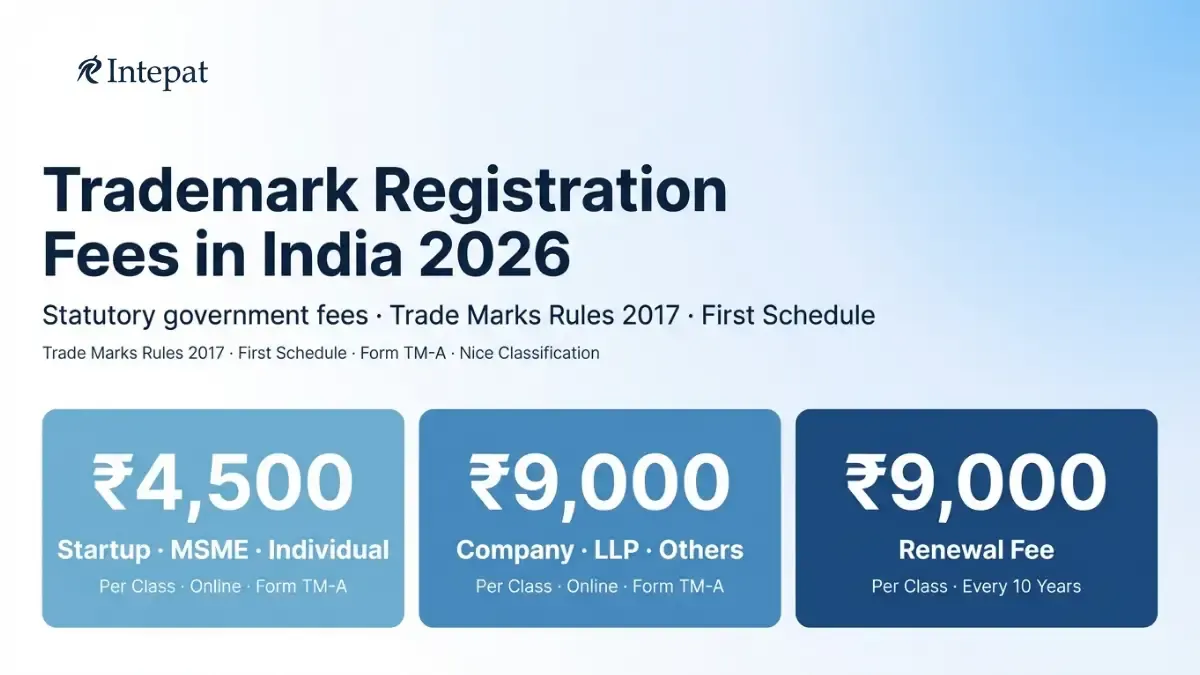
Trademark Fees India 2026: Key Facts
- Government filing fee starts at ₹4,500 per class for individuals, startups, and MSMEs filing online, and ₹9,000 per class for companies and LLPs.
- The fee is per class, not per application. Filing in three classes costs three times the per-class rate.
- Reply to examination reports and attending hearings attract no government fee.
- Renewal costs ₹9,000 per class every ten years. Missing the deadline adds a surcharge; removal from the register requires a restoration fee of ₹18,000 per class.
- An incorrectly filed application means forfeited statutory fees. There is no refund once the fee is paid to the Registry.
- Government fees and professional fees are entirely separate. Understanding both is essential to budgeting trademark ownership accurately.
Trademark Fees India: Quick Reference
Quick reference for the most common fee points before the full schedule.
| Applicant Type / Activity | E-Filing Fee |
| Individual / Startup / MSME — filing (per class) | ₹4,500 |
| Company / LLP / Others — filing (per class) | ₹9,000 |
| Renewal — every 10 years (per class) | ₹9,000 |
| Opposition / Counter-Statement (per class) | ₹2,700 |
| Renewal with surcharge — late filing (per class) | ₹13,500 |
| Restoration after removal (per class) | ₹18,000 |
What Are the Official Trademark Fees in India (2026)?
All statutory government trademark registration fees in India are prescribed under the First Schedule of the Trade Marks Rules, 2017 (IP India official schedule, last updated 16 March 2026), issued by the Office of the Controller General of Patents, Designs and Trade Marks (CGPDTM). For the primary legislation, see the Trade Marks Rules, 2017 on IndiaCode. The table below covers every official government charge across the trademark lifecycle. All fees are per class unless noted.
| Stage | Activity | E-Filing Fee | Physical Filing Fee | Notes |
| Pre-Filing | Trademark search | Nil | Nil | No statutory charge |
| Filing: TM-A | Application — Individual / Startup / MSME | ₹4,500 per class | ₹5,000 per class | Form TM-A |
| Filing: TM-A | Application — Company / LLP / Others | ₹9,000 per class | ₹10,000 per class | Form TM-A |
| Examination | Reply to Examination Report | Nil | Nil | No official charge |
| Examination | Amendment or clarification | Nil | Nil | If permitted |
| Hearing | Show-cause hearing | Nil | Nil | No official charge |
| Opposition | Filing Notice of Opposition | ₹2,700 per class | ₹3,000 per class | Form TM-O |
| Opposition | Filing Counter-Statement | ₹2,700 per class | ₹3,000 per class | Form TM-O |
| Opposition | Opposition hearing | Nil | Nil | No official charge |
| Registration | Certificate issuance | Included | Included | No separate fee |
| Renewal | Renewal– every 10 years | ₹9,000 per class | ₹10,000 per class | Form TM-R |
| Renewal | Renewal with surcharge (within grace period) | ₹13,500 per class | ₹15,000 per class | Late filing |
| Restoration | Restoration and renewal (after removal) | ₹18,000 per class | ₹20,000 per class | If removed |
| Procedural | Minor amendment / procedural request | ₹900 | ₹1,000 | If applicable |
| Expedited | Expedited examination — Individual / MSME | ₹20,000 per class | N/A | Fast-track route |
| Expedited | Expedited examination — Company / LLP | ₹40,000 per class | N/A | Fast-track route |
Important: Filing fees are non-refundable. Once paid to the Trademark Registry, no refund is issued regardless of whether the application is accepted, objected to, or refused.
Note on expedited examination: The ₹20,000 and ₹40,000 fees are for trademark expedited examination under Rule 34 of the Trade Marks Rules, 2017, an optional fast-track route that significantly reduces examination wait time compared to the standard queue. It is available to all applicant categories; the fee differs by category but eligibility is not restricted. It is not required for standard registration.
Which Applicants Pay ₹4,500 vs ₹9,000?
The applicant category is the single biggest determinant of your per-class filing fee, and it also determines the fee applicable if you choose the expedited examination route. Getting this classification right at the time of filing matters because the category is declared on Form TM-A and governs every subsequent fee calculation.
Individuals and Sole Proprietors
Natural persons filing in their individual capacity qualify for the reduced fee of ₹4,500 per class (online). This includes sole proprietors where the trademark is filed in the name of the individual, not under a business entity name. If you later incorporate and want to transfer the trademark to your company, that is a separate assignment process with its own procedural steps.
Startups
Startups recognised under the Startup India initiative qualify for the ₹4,500 rate. Recognition under the Department for Promotion of Industry and Internal Trade (DPIIT) is the qualifying criterion. A startup registration certificate is required documentation at the time of filing to claim this concession. For a full guide to trademark filing strategy for early-stage companies, see trademark registration for startups in India.
MSMEs
Enterprises registered under the MSME Development Act, 2006 qualify for the ₹4,500 rate. A Udyam Registration Certificate is the required documentation. If your enterprise qualifies as an MSME but files without providing the certificate, the Registry processes the application at the higher ₹9,000 rate. There is no retroactive adjustment. For a full breakdown of trademark filing requirements and cost considerations specific to MSMEs, see trademark registration for MSMEs in India.
Companies, LLPs, and Other Entities
Private limited companies, public limited companies, LLPs, partnership firms, trusts, and other legal entities that do not qualify under the startup or MSME categories pay ₹9,000 per class (online). This applies regardless of the company’s size or revenue. For a company with multiple brand names or product lines, each mark requires a separate application: the per-class fee applies to each mark filed, not just each class. A company filing three marks across two classes each faces a statutory outlay of ₹54,000 at the filing stage alone.
| Practical Note for Growing Businesses |
| If you are a startup or MSME today but expect to grow beyond those thresholds, filing now at the reduced rate locks in a valid registration regardless of your future category. The trademark right, once registered, is not affected by subsequent changes in your entity classification. |
How Many Classes Do You Need? Cost and Decision Logic
The single most common cost-multiplying mistake in Indian trademark filing is incorrect or over-broad class selection. The TM-A filing fee applies per class. Every additional class is an additional fee. But filing in too few classes leaves your brand exposed. The decision requires both legal and commercial judgment.
How Trademark Classes Affect Your Filing Fee in India
India follows the Nice Classification system, which divides goods and services into 45 classes. Classes 1 to 34 cover goods. Classes 35 to 45 cover services. Each trademark application must specify the class or classes in which protection is sought. You can use the Intepat Trademark Class Search tool to identify the correct classes for your goods and services before filing.
The fee is calculated per class selected, not per product or service listed within a class. Multiple products that fall within the same class attract a single fee. This is why accurate class identification before filing prevents unnecessary expenditure.
Trademark Filing Fee by Business Type in India
The following scenarios illustrate how class selection translates to trademark registration fees in India across different business types.
| Business Profile | Brand Activity | Classes Required | E-Filing Cost (MSME / Startup) | E-Filing Cost (Company) |
| D2C Food Brand | Packaged spices, sauces, ready-to-eat products | Class 29, 30 | ₹9,000 (2 x ₹4,500) | ₹18,000 (2 x ₹9,000) |
| SaaS Startup | Software platform (downloadable app + subscription service) | Class 9, 42 | ₹9,000 (2 x ₹4,500) | ₹18,000 (2 x ₹9,000) |
| Fashion Label | Apparel, accessories, retail store, online retail services | Class 25, 35 | ₹9,000 (2 x ₹4,500) | ₹18,000 (2 x ₹9,000) |
| FMCG Company | Personal care products, retail, advertising, e-commerce | Class 3, 35, 42 | See note * | ₹27,000 (3 x ₹9,000) |
| EdTech Platform | Online education services, downloadable content, software | Class 9, 41, 42 | ₹13,500 (3 x ₹4,500) | ₹27,000 (3 x ₹9,000) |
* This profile assumes a large-scale, established FMCG corporation that has exceeded the ₹250 crore turnover threshold for MSME classification and the ₹100 crore threshold for DPIIT Startup recognition. Therefore, the standard ₹9,000 per class company rate applies.
For a detailed discussion of the strategic trade-offs between single-class and multi-class filing structures, see our article on multi-class trademark filing in India. For a comprehensive guide to all 45 classes and how to identify the right ones for your goods and services, see trademark classes in India.
Which Trademark Registration Stages Attract a Government Fee?
Trademark registration in India passes through several stages. Understanding which stages attract statutory trademark registration fees and which do not helps applicants plan realistic cost expectations across the full registration timeline.
Pre-Filing (No Fee)
Conducting a trademark search, reviewing prior marks, identifying the correct class, and preparing the application all carry no statutory government fee. These activities are pre-filing exercises and do not involve any payment to the Registry.
Filing Stage (Fee Payable)
The statutory fee is payable at the time Form TM-A is submitted. This is the only mandatory fee in a straightforward registration. The fee is calculated based on applicant category, filing mode, and number of classes.
Examination Stage (No Fee)
After filing, the Registry examines the application. If objections are raised, the applicant files a written response. If the response does not fully resolve the objections, a show-cause hearing is scheduled. Neither the written response nor the hearing attracts any government fee. Any cost at this stage relates entirely to professional assistance, if engaged.
Opposition Stage (Fee if Applicable)
Once accepted, the mark is published in the Trademark Journal. Any third party has four months from the date of advertisement to file a Notice of Opposition. If an opposition is filed, you must file a Counter-Statement within two months. Both the Notice of Opposition and the Counter-Statement carry a fee of ₹2,700 per class (e-filing). For a full guide to the opposition timeline and evidentiary requirements, see our article on the trademark opposition process in India.
Registration and Certificate (No Additional Fee)
Once examination and opposition (if any) are cleared, the trademark is registered and a certificate is issued. There is no separate fee for certificate issuance. The registration charge is already included in the filing stage. For guidance on downloading your certificate, see how to get your trademark registration certificate.
Renewal, Surcharge, and Restoration Costs
A registered trademark in India is valid for ten years from the date of filing. Trademark protection does not renew automatically. To maintain exclusive rights beyond the initial term, a renewal application must be filed before the expiry date.
| Renewal Scenario | E-Filing Fee | Physical Fee |
| Renewal filed on time (per class) | ₹9,000 | ₹10,000 |
| Renewal with surcharge — within six months after expiry (per class) | ₹13,500 | ₹15,000 |
| Restoration and renewal — after removal from register (per class) | ₹18,000 | ₹20,000 |
The surcharge period runs for six months after the expiry date. Filing during this window keeps the mark alive but at a significantly higher cost. After the surcharge period closes, the mark is removed from the register. Restoration is then required, which carries the highest fee tier at ₹18,000 per class (e-filing).
For a multi-class registration, these costs multiply. A three-class registration renewed on time costs ₹27,000. The same registration restored after removal costs ₹54,000. The practical lesson is straightforward: docketing renewal deadlines accurately eliminates a significant avoidable cost.
For a full discussion of statutory deadlines, grace periods, and restoration procedures, see our guide on the trademark renewal process in India.
Total statutory Fee in India Over 10 Years
The table below models the projected statutory government cost over a ten-year period for three business profiles, assuming registration proceeds without opposition, restoration, or late renewal surcharge.
| Business Profile | Classes | Filing Fee | Renewal (Year 10) | Total 10-Year Statutory Cost |
| Individual / Startup / MSME — single class | 1 | ₹4,500 | ₹9,000 | ₹13,500 |
| Individual / Startup / MSME — two classes | 2 | ₹9,000 | ₹18,000 | ₹27,000 |
| Individual / Startup / MSME — three classes | 3 | ₹13,500 | ₹27,000 | ₹40,500 |
| Company / LLP — single class | 1 | ₹9,000 | ₹9,000 | ₹18,000 |
| Company / LLP — two classes | 2 | ₹18,000 | ₹18,000 | ₹36,000 |
| Company / LLP — three classes | 3 | ₹27,000 | ₹27,000 | ₹54,000 |
These figures represent the statutory government fees only. They do not include opposition costs, which arise only if a third party challenges the application, or professional fees, which are variable and separate.
The Real Cost of Getting It Wrong
The government fee table is the starting point. The true cost of a trademark filing depends on the quality of decisions made before and during the application. These are the most common failure modes that cause costs to exceed the minimum.
Wrong Class Selection
Filing in an incorrect class may require a fresh application if the goods or services cannot be maintained within the originally filed class. The application fails, the fee is forfeited, and a new application in the correct class requires a fresh fee. For a company filing in two classes at ₹9,000 each, a full refile costs ₹18,000 on top of the original ₹18,000 already paid. The total exposure is ₹36,000 for what should have been an ₹18,000 exercise.
Poorly Drafted Goods and Services Specification
The specification of goods and services defines the scope of trademark protection. A specification that is drafted too broadly can trigger examination objections due to classification errors, indefinite terms, or conflicts with earlier marks. A specification that is drafted too narrowly can leave commercial gaps that competitors may lawfully occupy. Where a specification issue cannot be resolved through clarification or limitation during examination, the applicant may need to file a fresh application with a corrected specification, forfeiting the original filing fee and restarting the timeline. A specification reviewed carefully before filing avoids these outcomes. One that fails at examination can cost months of delay and additional professional effort. One that cannot be corrected can result in the loss of the filing fee and the need to refile the application.
Filing Without a Clearance Search
A trademark search carries no statutory government charge. Skipping it is not a cost saving. An uncleared mark that conflicts with a prior registration will face opposition after publication, adding ₹2,700 per class for the Counter-Statement alone plus professional representation costs. The cost of an opposition almost always exceeds the cost of a thorough pre-filing clearance exercise. For a step-by-step walkthrough, see our guide on how to conduct a trademark public search in India.
Missing the Renewal Deadline
As outlined above, late renewal within the surcharge period costs 50% more per class. Restoration after removal costs 100% more. For a business with a two-class registration, the difference between timely renewal and restoration is ₹18,000. Across a portfolio of three or four marks, these figures become material.
Government Fees vs. Professional Charges IN india
When budgeting for trademark registration, two entirely separate cost categories apply: what you pay to the government, and what you pay for professional assistance. Understanding the distinction is essential. Conflating the two is the most common source of cost surprises for brand owners filing for the first time.
Government fees are fixed by statute and payable to the Trademark Registry. They do not vary by service provider. Whether you file through a large legal aggregator or engage a specialist trademark firm, the government fee is identical.
Professional fees are charged by trademark agents, attorneys, or filing services for the work they perform around the statutory process. This includes conducting a structured clearance search, drafting and refining the specification of goods and services, preparing and filing Form TM-A, managing examination responses, representing the applicant at hearings, managing opposition proceedings if they arise, and tracking renewal deadlines across a portfolio.
The market offers a wide range of professional service models, from automated online filing platforms that minimise human involvement to full-service legal engagement. The difference is not just price. An automated platform will submit your application as filed. A qualified trademark practitioner will assess whether the mark is inherently distinctive, whether the specification is commercially adequate, and whether any prior marks pose a realistic opposition risk before the application is submitted.
| Get a Cost Estimate Specific to Your Business |
| The government fee is the same for everyone in your category. What varies is everything around it: the number of classes your business actually needs, the breadth of your goods and services specification, and whether your mark requires a clearance search or opposition management. Request a quote from Intepat based on your entity type, intended classes, and specification scope: Trademark Registration Services. |
International Trademark FILING FEE FROM INDIA: Madrid Protocol
If your business operates across multiple jurisdictions, or plans to, the Madrid Protocol is the primary route for extending trademark protection internationally from an Indian base application.
Madrid fees have three components: a basic fee payable to WIPO, a complementary or individual fee for each country designated, and a supplementary fee for classes beyond three. The total cost depends entirely on which countries you designate, how many classes you cover, and whether those countries charge individual fees. For common commercial destinations such as the US, EU, UK, and Australia (all of which charge individual fees), the designation costs typically exceed the basic fee several times over. Two applicants filing the same mark can arrive at significantly different totals based solely on their country list.
The Indian domestic trademark application or registration serves as the basis for the international filing and must remain active at the Indian Trademark Office at the time of filing. For a step-by-step guide to calculating your Madrid filing cost based on your specific country list, see the Madrid Fee Calculator guide. For a comparison of the Madrid route versus direct national filing, see Madrid Protocol vs. direct national filing in India.
Summary: What to Take Away
The statutory fee schedule for trademark registration in India is transparent, accessible, and unchanged since 2017. Sections 1 through 5 cover every payable charge across the lifecycle. The tables in those sections are the definitive reference.
The statutory fee table defines the minimum cost of trademark registration. The actual cost depends on the decisions made before and during the filing process. Total trademark ownership cost depends on applicant category, number of classes, accuracy of class selection, quality of the goods and services specification, pre-filing clearance, and renewal management. Each of these variables either protects the statutory investment made at filing or exposes it to forfeiture, refile, or opposition costs that can multiply the original outlay several times over.
A structured approach to the filing decision, rather than a reactive response to cost at each stage, is the most reliable way to keep trademark costs within a planned budget while ensuring commercially adequate protection.
Disclaimer
The information in this guide reflects statutory government fees prescribed under the First Schedule of the Trade Marks Rules, 2017, as applicable in 2026. It is provided for general informational purposes and does not constitute legal advice. Fee structures may be amended by government notification. For advice specific to your filing situation, consult a registered trademark agent or trademark attorney.
Frequently Asked Questions
For individuals, startups, and MSMEs filing online: ₹4,500 per class. For companies, LLPs, and other entities: ₹9,000 per class. Physical filing is ₹500 higher in each category. All fees are prescribed under the First Schedule of the Trade Marks Rules, 2017 and are non-refundable. The full fee schedule, including opposition, renewal, and expedited examination charges, is in Section 1.
No. Filing a written response to an examination report and attending a show-cause hearing before the Trademark Registry carry no government fee. Any cost at the examination stage is attributable to professional assistance.
No. Trademark filing fees paid to the Registry under the Trade Marks Rules, 2017 are non-refundable in all circumstances. If the application is refused, withdrawn, or abandoned after payment, the statutory fee is not returned. This applies to filing fees, opposition fees, and renewal fees. The non-refundable nature of the fee makes accurate class selection and pre-filing preparation commercially significant: a forfeited fee on a failed application is a sunk cost that must be paid again on any new filing.
The filing fee is non-refundable. If the application cannot be maintained in the stated class, it fails and a new application in the correct class requires a fresh fee payment. Accurate class identification before filing is therefore both a legal and a cost-protection measure. For the full cost exposure calculation, including the rupee consequence of a refile, see Section 7.
This depends entirely on the scope of your goods and services. Filing in fewer classes than your business activities require leaves your brand exposed. Filing in more classes than necessary increases costs without adding commercially useful protection. A pre-filing review of your actual and intended business activities, matched against the Nice Classification, produces the right answer for your specific situation.
For an MSME or startup filing online in a single class, the total trademark registration cost in India over ten years is ₹4,500 at filing and ₹9,000 at renewal, totalling ₹13,500. For a company filing in three classes, the total trademark registration cost is ₹27,000 at filing and ₹27,000 at renewal, totalling ₹54,000. These figures assume no opposition proceedings, no surcharge for late renewal, and no restoration.
The renewal fee is ₹9,000 per class for e-filing. Renewal filed within the six-month surcharge period after expiry costs ₹13,500 per class. Restoration and renewal after removal from the register costs ₹18,000 per class.
No. Certificate issuance is included in the filing fee. No additional payment is required at the registration stage.
Filing a Notice of Opposition costs ₹2,700 per class (e-filing). Filing a Counter-Statement also costs ₹2,700 per class (e-filing). The opposition hearing itself carries no government fee.
No. Government fees are prescribed by statute and are fixed regardless of who files the application. Professional fees are charged separately by trademark agents, attorneys, or filing services for the work they perform in preparing, filing, and managing the application. The two categories are entirely distinct.
MSMEs must provide their Udyam Registration Certificate. Startups must provide their DPIIT recognition certificate under the Startup India initiative. These documents must be submitted at the time of filing to claim the ₹4,500 per class rate.
Yes. Self-filing through the IP India e-filing portal is permitted, and the government fee is identical whether you file independently or through a registered trademark agent. The difference lies in the quality of work done around the filing: a structured clearance search before filing, an accurately drafted specification of goods and services, and the ability to manage examination objections and hearings if they arise. Each of these directly affects whether the application succeeds and whether the statutory fee paid is protected or forfeited.