



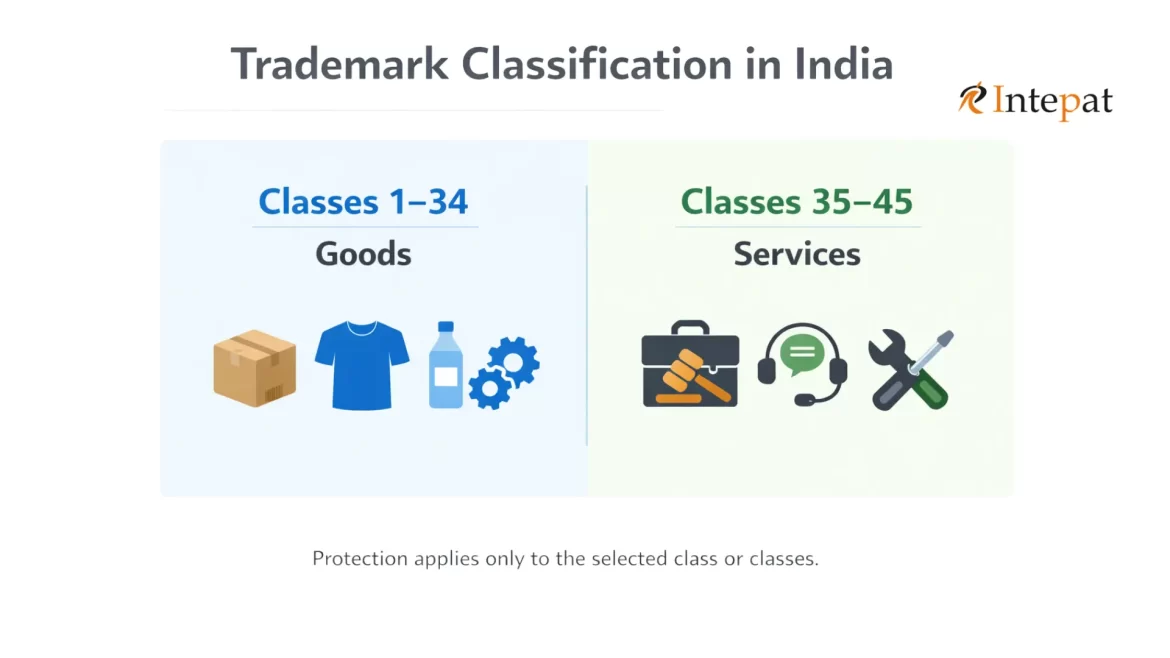
A trademark class list is the system used to classify goods and services for trademark registration. In India, trademark registration follows a standardized classification comprising 45 trademark classes, where Classes 1 to 34 apply to goods and Classes 35 to 45 apply to services. Every trademark application must be filed under one or more of these classes based on the actual goods or services offered under the trademark, and the complete trademark class list is set out below for reference.
Understanding the trademark class list is critical because trademark protection is limited strictly to the classes under which a mark is applied for and registered. Selecting an incorrect class—or failing to cover the relevant class—can lead to trademark objections, refusal of registration, or a registration that provides weak and unenforceable protection, even though the trademark appears on the Register.
In practice, many applicants mistakenly choose a trademark class based on the business name or company description. However, trademark classification depends entirely on what is sold or provided under the mark, not on how the business is structured or branded. This makes correct interpretation of the trademark class list one of the most important steps in the trademark registration process in India.
If you are unsure which trademark class applies to your goods or services, verifying the classification before filing can help avoid objections and future enforcement issues.
Verify Your Trademark Class Before Filing
Avoid objections, weak protection, and incorrect classification by confirming the appropriate class based on actual goods or services and Indian Trademark Registry practice.

What Is Trademark Classification? (Goods & Services Explained)
Trademark classification is a standardized system used to group goods and services into specific categories for the purpose of trademark registration. Instead of examining trademarks across every industry, the Trademark Registry evaluates a trademark only within the class or classes corresponding to the goods or services claimed by the applicant. This approach brings clarity, efficiency, and consistency to trademark registration and enforcement.
In India, trademark classification follows the Nice Classification system, an internationally accepted framework adopted by the Indian Trademark Registry. Under this system, the trademark class list comprises 45 classes, which together form the official basis for filing and examining trademark applications in India. A detailed discussion on the statutory framework and categorisation is also covered in our article on Trademark Classification of Goods and Services.
- Classes 1 to 34 cover goods (products)
- Classes 35 to 45 cover services
Each trademark class represents a broad category of goods or services. When filing a trademark application, the applicant must identify the class or classes that accurately reflect the goods or services offered under the trademark. A trademark registered in one class does not automatically extend protection to other classes, even if the trademark name is identical.
Trademark classification directly determines the scope of protection granted by registration. For example, a trademark registered for clothing under Class 25 does not protect software services under Class 42, unless a separate application is filed covering those services. This limitation on protection is discussed in greater detail in Limitation on the Specification of Trademark Goods and Services.
Applicants often confuse trademark classification with business objects, company incorporation documents, or future expansion plans. However, trademark classification is assessed strictly on the basis of what is actually sold or provided under the trademark at the time of filing, and not on how the business is structured or described. A step-by-step overview of how classification fits into the filing workflow is explained in 5 Step Trademark Registration Process in India.
Trademark classification defines where a trademark is examined, what it protects, and how far those rights extend. Understanding this foundation is essential before assessing the risks of choosing an incorrect class.
Why Correct Trademark Classification Matters
Correct trademark classification determines the legal strength, commercial value, and enforceability of a trademark. Trademark rights in India are not granted broadly over a brand name or business identity; they are granted only in relation to the specific goods or services covered under the selected class or classes. As a result, even a registered trademark can offer little practical protection if the classification is incorrect or incomplete.
One of the most common consequences of incorrect class selection is a trademark objection during examination. Applications filed under an inappropriate class, or with descriptions that do not align with the selected class, are frequently objected to under Sections 9 and 11 of the Trademark Act. Such objections delay registration, increase compliance costs, and often require amendment or refiling. Practical guidance on avoiding such issues is discussed in 10 Steps To Prevent Trademark Objections.
Incorrect classification can also weaken enforcement. A trademark owner may discover, often too late, that a registered trademark cannot be enforced against an infringer because the infringing activity falls outside the scope of the registered class. In such cases, the trademark registration exists on record but offers limited real-world protection.
From a business perspective, trademark classification also affects future expansion and licensing strategy. If a trademark is registered narrowly or under an unsuitable class, additional filings may be required later to cover new products or services. This results in avoidable costs and fragmented trademark protection, particularly for growing businesses and startups.
In essence, trademark classification defines where a trademark is examined, what it legally protects, and how effectively it can be enforced. Choosing the correct class at the outset is therefore not a technical formality, but a strategic decision that directly impacts the long-term value of the brand.
How to Choose the Right Trademark Class
Choosing the right trademark class requires analysing how the Trademark Registry interprets goods and services, rather than relying on business names, company objects, or internal descriptions. Trademark classification is determined strictly by what is actually offered under the trademark, not by how the business is branded or incorporated.
Step 1: Clearly Identify the Goods or Services
Begin by identifying the exact goods or services that are sold or proposed to be sold under the trademark. Descriptions should be specific, commercially accurate, and aligned with actual use. Broad or generic descriptions often lead to objections or incorrect classification.
For example, “computer software” as a product and “software development services” fall under different trademark classes, even though they appear related.
Step 2: Match the Description With the Trademark Class List
Once the goods or services are clearly identified, they must be matched against the trademark class list under the Nice Classification. While class headings provide a general indication, classification depends on how the goods or services are described, not merely on the heading itself.
Applicants should avoid selecting a class simply because it is commonly used or appears convenient. The correct class is the one under which the Trademark Registry will examine the application, not the one that best fits internal business terminology.
To understand how classification operates in practical registry examination, refer to Limitation on the Specification of Trademark Goods and Services.
Step 3: Verify the Class Using Official Classification Tools
To verify the appropriate class and standard descriptions of goods or services, applicants can use TMclass, an official classification tool maintained under the Nice Classification system:
TMclass allows users to search goods and services and identify the corresponding trademark class recognised by trademark offices worldwide, including India. The tool is helpful for reference, but its results should be interpreted cautiously, as the final determination of classification rests with the Indian Trademark Registry.
After identifying the likely class, it is advisable to conduct a class-specific trademark search to check for prior marks that may conflict. Issues arising from improper searches often surface later during examination or opposition.
Step 4: Consider Multi-Class Filing Where Applicable
If a trademark is used across different categories of goods or services, filing under a single class may leave parts of the business unprotected. In such cases, a multi-class trademark application can provide broader and more coherent protection.
However, multi-class filing also has cost and prosecution implications. These considerations are explained in Multi Class Trademark Application: Benefits and Drawbacks.
Step 5: Review the Filing Strategy Before Submission
Before submitting a trademark application in India, the selected trademark class and the description of goods or services must be reviewed specifically from the perspective of Indian Trademark Registry practice (CGPDTM).
While the Nice Classification provides the overarching framework, not all goods or services descriptions are accepted uniformly across jurisdictions. Therefore, applicants should ensure that the selected descriptions are recognised and accepted for India, as reflected when the India (CGPDTM) office is selected in official tools such as TMclass.
At this stage, the review should confirm that:
- The goods or services description aligns with CGPDTM-accepted terminology, not merely generic Nice class headings
- The description reflects actual or intended commercial use in India
- The selected class or classes provide complete coverage without over-breadth, which could attract objections
- Where TMclass results differ across jurisdictions, India-specific acceptance is prioritised
This India-focused review step helps minimise examination objections, avoids unnecessary amendments, and ensures that the trademark application proceeds smoothly under Indian Trademark Office practice.
Complete Trademark Class List in India (Classes 1–45)
The trademark class list in India consists of 45 trademark classes under the Nice Classification system. These classes define how goods and services are categorised for trademark filing, examination, and protection in India. Classes 1 to 34 cover goods, while Classes 35 to 45 cover services.
Before reviewing the list, it is important to note that class headings provide only a general indication of the goods or services covered. Final classification depends on the exact description of goods or services claimed in the trademark application and how the Indian Trademark Registry examines the application.
Use the list below as a reference guide to understand how goods and services are broadly classified. Where goods or services appear to span more than one class, a multi-class filing strategy may be required to ensure complete protection.
Goods (Products)
| Class 01 | Chemicals for use in industry, science, and photography, as well as in agriculture, horticulture, and forestry; Unprocessed artificial resins, and unprocessed plastics; Fire extinguishing and fire prevention compositions; Tempering and soldering preparations; Substances for tanning animal skins and hides; Adhesives for use in industry; Putties and other paste fillers; Compost, manures, fertilizers; Biological preparations for use in industry and science |
| Class 02 | Paints, varnishes, lacquers; Preservatives against rust and against deterioration of wood; Colorants, dyes; Inks for printing, marking and engraving; Raw natural resins; Metals in foil and powder form for use in painting, decorating, printing and art |
| Class 03 | Non-medicated cosmetics and toiletry preparations; Non-medicated dentifrices; Perfumery, essential oils; Bleaching preparations and other substances for laundry use; Cleaning, polishing, scouring, and abrasive preparations |
| Class 04 | Industrial oils and greases, wax; Lubricants; Dust absorbing, wetting, and binding compositions; Fuels and illuminants; Candles and wicks for lighting |
| Class 05 | Pharmaceuticals, medical and veterinary preparations; Sanitary preparations for medical purposes; Dietetic food and substances adapted for medical or veterinary use, food for babies; Dietary supplements for human beings and animals; Plasters, materials for dressings; Material for stopping teeth, dental wax; Disinfectants; Preparations for destroying vermin; Fungicides, herbicides |
| Class 06 | Common metals and their alloys, ores; Metal materials for building and construction; Transportable buildings of metal; Non-electric cables and wires of common metal; Small items of metal hardware; Metal containers for storage or transport; Safes |
| Class 07 | Machines, machine tools, power-operated tools; Motors and engines, except for land vehicles; Machine coupling and transmission components, except for land vehicles; Agricultural implements, other than hand-operated hand tools; Incubators for eggs; Automatic vending machines |
| Class 08 | Hand tools and implements, hand-operated; Cutlery; Side arms, except firearms; Razors |
| Class 09 | Scientific, research, navigation, surveying, photographic, cinematographic, audiovisual, optical, weighing, measuring, signalling, detecting, testing, inspecting, life-saving and teaching apparatus and instruments; Apparatus and instruments for conducting, switching, transforming, accumulating, regulating or controlling the distribution or use of electricity; Apparatus and instruments for recording, transmitting, reproducing or processing sound, images or data; Recorded and downloadable media, computer software, blank digital or analogue recording and storage media; Mechanisms for coin-operated apparatus; Cash registers, calculating devices; Computers and computer peripheral devices; Diving suits, divers’ masks, ear plugs for divers, nose clips for divers and swimmers, gloves for divers, breathing apparatus for underwater swimming; Fire-extinguishing apparatus |
| Class 10 | Surgical, medical, dental, and veterinary apparatus and instruments; Artificial limbs, eyes, and teeth; Orthopaedic articles; Suture materials; Therapeutic and assistive devices adapted for persons with disabilities; Massage apparatus; Apparatus, devices, and articles for nursing infants; Sexual activity apparatus, devices, and articles |
| Class 11 | Apparatus and installations for lighting, heating, cooling, steam generating, cooking, drying, ventilating, water supply and sanitary purposes |
| Class 12 | Vehicles; Apparatus for locomotion by land, air, or water |
| Class 13 | Firearms; Ammunition and projectiles; Explosives; Fireworks |
| Class 14 | Precious metals and their alloys; Jewellery, precious and semi-precious stones; Horological and chronometric instruments |
| Class 15 | Musical instruments; Music stands and stands for musical instruments; Conductors’ batons |
| Class 16 | Paper and cardboard; Printed matter; Bookbinding material; Photographs; Stationery and office requisites, except furniture; Adhesives for stationery or household purposes; Drawing materials and materials for artists; Paintbrushes; Instructional and teaching materials; Plastic sheets, films, and bags for wrapping and packaging; Printers’ type, printing blocks |
| Class 17 | Unprocessed and semi-processed rubber, gutta-percha, gum, asbestos, mica, and substitutes for all these materials; Plastics and resins in extruded form for use in manufacture; Packing, stopping, and insulating materials; Flexible pipes, tubes, and hoses, not of metal |
| Class 18 | Leather and imitations of leather; Animal skins and hides; Luggage and carrying bags; Umbrellas and parasols; Walking sticks; Whips, harness, and saddlery; Collars, leashes, and clothing for animals |
| Class 19 | Materials, not of metal, for building and construction; Rigid pipes, not of metal, for building; Asphalt, pitch, tar, and bitumen; Transportable buildings, not of metal; Monuments, not of metal. |
| Class 20 | Furniture, mirrors, picture frames; Containers, not of metal, for storage or transport; Unworked or semi-worked bone, horn, whalebone or mother-of-pearl; Shells; Meerschaum; Yellow amber |
| Class 21 | Household or kitchen utensils and containers; Cookware and tableware, except forks, knives, and spoons; Combs and sponges; Brushes, except paintbrushes; Brush-making materials; Articles for cleaning purposes; Unworked or semi-worked glass, except building glass; Glassware, porcelain, and earthenware |
| Class 22 | Ropes and string; Nets; Tents and tarpaulins; Awnings of textile or synthetic materials; Sails; Sacks for the transport and storage of materials in bulk; Padding, cushioning, and stuffing materials, except of paper, cardboard, rubber or plastics; Raw fibrous textile materials and substitutes therefor |
| Class 23 | Yarns and threads, for textile use |
| Class 24 | Textiles and substitutes for textiles; Household linen; Curtains of textile or plastic |
| Class 25 | Clothing, footwear, headwear |
| Class 26 | Lace, braid and embroidery, and haberdashery ribbons and bows; Buttons, hooks and eyes, pins and needles; Artificial flowers; Hair decorations; False hair |
| Class 27 | Carpets, rugs, mats and matting, linoleum and other materials for covering existing floors; Wall hangings, not of textile |
| Class 28 | Games, toys, and playthings; Video game apparatus; Gymnastic and sporting articles; Decorations for Christmas trees |
| Class 29 | Meat, fish, poultry, and game; Meat extracts; Preserved, frozen, dried, and cooked fruits and vegetables; Jellies, jams, compotes; Eggs; Milk, cheese, butter, yogurt, and other milk products; Oils and fats for food |
| Class 30 | Coffee, tea, cocoa and substitutes thereof; Rice, pasta, and noodles; Tapioca and sago; Flour and preparations made from cereals; Bread, pastries, and confectionery; Chocolate; Ice cream, sorbets, and other edible ices; Sugar, honey, treacle; Yeast, baking-powder; Salt, seasonings, spices, preserved herbs; Vinegar, sauces and other condiments; Ice [frozen water] |
| Class 31 | Raw and unprocessed agricultural, aquacultural, horticultural, and forestry products; Raw and unprocessed grains and seeds; Fresh fruits and vegetables, fresh herbs; Natural plants and flowers; Bulbs, seedlings, and seeds for planting; Live animals; Foodstuffs and beverages for animals; Malt |
| Class 32 | Beers; Non-alcoholic beverages; Mineral and aerated waters; Fruit beverages and fruit juices; Syrups and other preparations for making non-alcoholic beverages |
| Class 33 | Alcoholic beverages, except beers; Alcoholic preparations for making beverages |
| Class 34 | Tobacco and tobacco substitutes; Cigarettes and cigars; Electronic cigarettes and oral vaporizers for smokers; Smokers’ articles; Matches |
Services
| Class 35 | Advertising; Business management, organization, and administration; Office functions |
| Class 36 | Financial, monetary, and banking services; Insurance services; Real estate affairs |
| Class 37 | Construction services; Installation and repair services; Mining extraction, oil and gas drilling |
| Class 38 | Telecommunications services |
| Class 39 | Transport; Packaging and storage of goods; Travel arrangement |
| Class 40 | Treatment of materials; Recycling of waste and trash; Air purification and treatment of water; Printing services; Food and drink preservation |
| Class 41 | Education; Providing of training; Entertainment; Sporting and cultural activities |
| Class 42 | Scientific and technological services and research and design relating thereto; Industrial analysis, industrial research and industrial design services; Quality control and authentication services; Design and development of computer hardware and software |
| Class 43 | Services for providing food and drink; Temporary accommodation |
| Class 44 | Medical services; Veterinary services; Hygienic and beauty care for human beings or animals; Agriculture, aquaculture, horticulture and forestry services |
| Class 45 | Legal services; Security services for the physical protection of tangible property and individuals; Personal and social services rendered by others to meet the needs of individuals |
Building Enforceable Trademark Protection Through Correct Class Selection
The trademark class list forms the foundation of trademark registration and protection in India. Every trademark application is examined, registered, and enforced strictly within the scope of the goods or services covered by the selected class or classes. As a result, correct interpretation of trademark classification is not a procedural detail, but a critical step in securing meaningful and enforceable trademark rights.
Misclassification can lead to objections, delays, and protection gaps that surface only when enforcement becomes necessary. On the other hand, a well-considered class selection strategy ensures that the trademark accurately reflects commercial use, aligns with Trademark Registry practice, and supports future growth without unnecessary refiling.
Before filing a trademark application, it is therefore essential to carefully review the nature of the goods or services offered, assess whether one or multiple classes are required, and ensure that the chosen classification provides complete and practical protection. Investing attention at this stage can significantly reduce legal risk and long-term cost.
Frequently Asked Questions (FAQs)
A trademark class is a category under which goods or services are grouped for trademark registration. India follows the Nice Classification system, which divides goods and services into 45 trademark classes. Trademark rights are granted only in relation to the specific class or classes under which the trademark is registered.
There are 45 trademark classes in India.
- Classes 1 to 34 cover goods (products)
- Classes 35 to 45 cover services
Each class represents a distinct category, and protection is limited to the class or classes selected at the time of filing.
Yes. A single trademark can be registered under multiple classes if it is used for different goods or services falling in different categories. This is done through a multi-class trademark application. While multi-class filing offers broader protection, it also involves higher official fees and must be carefully evaluated based on actual use and business plans.
Choosing an incorrect trademark class can lead to examination objections, delays in registration, refusal, or weak enforcement later. In some cases, even a registered trademark may not be enforceable against infringers if their activity falls outside the registered class. Correct classification at the filing stage is therefore critical.
No. TMclass is a reference and classification assistance tool, not a binding authority. While it helps identify standard goods and services descriptions under the Nice Classification, the final determination is made by the Indian Trademark Registry (CGPDTM) during examination. India-specific acceptance should always be prioritised.
While basic classification can be understood using public tools, professional review is recommended where goods or services are complex, span multiple classes, or involve future expansion. Expert review helps avoid objections, ensures enforceability, and aligns the application with registry practice. You can explore this further under trademark registration services.
Trademark applications in India are filed online with the Indian Trademark Registry. However, before filing, it is important to identify the correct trademark class, prepare an accurate description of goods or services, and assess whether single-class or multi-class protection is required.
To simplify this process, you can submit your trademark details through our online trademark registration form, which captures all required information and enables a structured review before filing.
Trademark classification often depends on factual business use and filing strategy. For tailored guidance on selecting the correct class or classes for your trademark, you can get in touch with our team through the contact page.