




| Quick answer |
| A trademark objection in India means the Trade Marks Registry has raised concerns in the Examination Report under Section 9 or Section 11 of the Trade Marks Act, 1999. It is not a refusal. The application remains alive. Under Rule 33(4) of the Trade Marks Rules, 2017, you have one month from the date of receipt of the Examination Report to file a written reply (typically via MIS-R) or request a hearing. If no reply is filed within that period, the application may be treated as abandoned, and in practice the original filing date is usually lost. |
| Status on portal | Objected |
| Action required | File Reply to Examination Report (MIS-R) within one month of receipt |
| Risk if no reply | Application may be treated as abandoned, priority date permanently lost |
| Likely outcome | Acceptance and Journal publication, or show cause hearing if reply is insufficient |
Missing the deadline usually results in loss of the application and the benefit of the original filing date.
Every year, thousands of trademark applications filed with the Trade Marks Registry receive an Examination Report containing objections. For most applicants, seeing the word “Objected” on the IP India portal for the first time produces the same reaction: they assume the application has been rejected. It has not been. A trademark objection in India is a formal stage in the examination process, not a final decision. What happens next depends entirely on how quickly the applicant responds and whether the response addresses the correct grounds.
What “Objected” Status Means on the IP India Portal
When the status of a trademark application on the IP India portal changes to “Objected,” it means the Examiner has completed the review and identified concerns that prevent acceptance. These concerns are recorded in the Examination Report, which is published on the portal and also dispatched by post to the applicant or the applicant’s authorised agent.
The status reflects one thing: the Trade Marks Registry wants a response before the application can proceed. The application file is not closed. The mark has not been refused registration. Most objections are resolvable, depending on the nature of the mark and the evidence available. IIn practice, some objections appear in standardised form and may not always reflect a detailed mark-specific analysis.
The most common error at this stage is inaction. Applicants who wait for further notice risk losing their application entirely. Checking the portal regularly once the status shows “Marked for Exam” is one of the most practical safeguard any applicant can take. For a full account of how to read and monitor every trademark status code, see the Trademark Application Status guide.
How the Trade Marks Registry Raises an Objection
The examination process runs in two stages. A trademark Examiner reviews the application and prepares a draft Examination Report. An Examination Controller then approves it before it is issued. Once approved, the report is published on the IP India portal and dispatched to the applicant or their authorised agent.
The report sets out the specific statutory sections under which objections are raised, the Examiner’s remarks, and the one-month deadline to respond. It is available publicly under the application number on the IP India portal without a login.
| Practitioner insight: the portal, not the postman |
| The one-month deadline under Rule 33(4) runs from the date of service to the official address on record. For applications filed through an agent, that is the agent’s registered address, not the applicant’s. In practice, the portal publication date is often used as a working indicator of when the response period began, although the legally relevant trigger remains receipt at the address for service. However, the legally operative trigger remains the date of service to the address on record. Applicants who have filed through an agent can and should check the portal independently. A status change from Marked for Exam to Objected can occur overnight, and from that moment a one-month clock is running. As of 2026, the Trade Marks Registry sends up to three automated reminder emails to the service address on record before treating an application as abandoned. These reminders are a courtesy, not a right, and their arrival should not be read as an extension of the deadline. The operative deadline remains one month from receipt of the Examination Report under Rule 33(4). Applicants who file through an agent should not rely on reminder communications alone, because delay in receiving them can increase the risk of abandonment. |
Common Reasons for Trademark Objection in India
Examination Reports raise objections under two statutory categories. Identifying which one applies determines the entire response strategy.
Absolute grounds: Section 9 objections
Section 9 of the Trade Marks Act, 1999 covers grounds that relate to the nature of the mark itself, regardless of any existing marks. The principal sub-sections are:
- Section 9(1)(a): the mark lacks distinctive character and cannot distinguish the goods or services of one person from those of another.
- Section 9(1)(b): the mark consists exclusively of signs describing the kind, quality, quantity, intended purpose, values, geographical origin, or other characteristics of the goods or services.
- Section 9(1)(c): the mark consists exclusively of signs that have become customary in the current language or established trade practices.
- Section 9(2): the mark is deceptive, likely to cause confusion, contains matter likely to hurt religious sentiments, or consists of scandalous or obscene matter. Objections under Section 9(2) on these specific grounds may not be curable regardless of evidence.
For the full legal analysis of what each Section 9 ground means and how each can be addressed, see the Section 9 and Section 11 grounds for refusal in India.
Relative grounds: Section 11 objections
Section 11 of the Trade Marks Act, 1999 covers grounds arising from the existence of earlier marks or rights. The Examiner conducts a search of registered and pending marks, and if a conflicting mark is found for similar goods or services, a Section 11 objection is raised.
Under Section 11 of the Trade Marks Act, 1999, likelihood of confusion is assessed by reference to the overall impression of the marks, taking into account visual, phonetic, and conceptual similarity. In some Section 11 cases, the applicant may also explore obtaining a no-objection letter or consent from the proprietor of the cited mark. The Registry may take such consent into account, subject to the Registrar’s discretion, and it will not be determinative where the likelihood of confusion remains strong.
For the full legal framework and how each Section 11 ground is assessed in practice, see the Section 9 and Section 11 grounds for refusal in India.
The One-Month Deadline You Cannot Miss
Rule 33(4) of the Trade Marks Rules, 2017 gives the applicant one month from the date of receipt of the Examination Report to file a written reply (typically via MIS-R) or apply for a hearing. There is no extension as of right. The legally operative date is the date of service to the official address on record. Because the report is ordinarily published on the portal around the time of dispatch, the portal publication date is often used as a practical indicator for tracking the response period.
Within that one-month window the applicant has two options: file a written Reply to Examination Report (MIS-R) online, or apply directly for a show cause hearing before the Registry.
What Happens If You Do Nothing
If no reply is received within one month of service, the Trade Marks Registry may issue reminder notices to the service address on record before treating the application as abandoned. As of 2026, the Registry sends up to three automated reminders under Section 132 of the Trade Marks Act, 1999. If no reply is received or hearing requested after all reminders, the application is treated as abandoned.
| Abandonment is usually treated as final |
| The Trade Marks Act and Rules do not provide a clear, routine restoration mechanism for an application abandoned for failure to respond to an Examination Report. In practice, the original filing date and any associated priority benefit are usually lost. A fresh application must be filed from the beginning. If a competitor files for the same or a similar mark in the intervening period, the earlier priority date cannot be recovered. |
Trademark Objection vs Trademark Opposition: The Difference
The two terms are frequently confused. They arise at entirely different stages of the registration process and involve different parties.
| Trademark Objection | Trademark Opposition |
| Raised by the Trade Marks Registry Examiner | Raised by any third party |
| At the examination stage, before publication in the Trade Marks Journal | After the mark is accepted and published in the Trade Marks Journal |
| Addressed by Reply to Examination Report (MIS-R) | Addressed by Counter-Statement and evidence proceedings |
| One-month reply deadline from receipt of Examination Report | Four months for a third party to oppose; two months for applicant to file Counter-Statement |
For a full explanation of how trademark opposition proceedings work in India, see the Trademark Opposition in India guide.
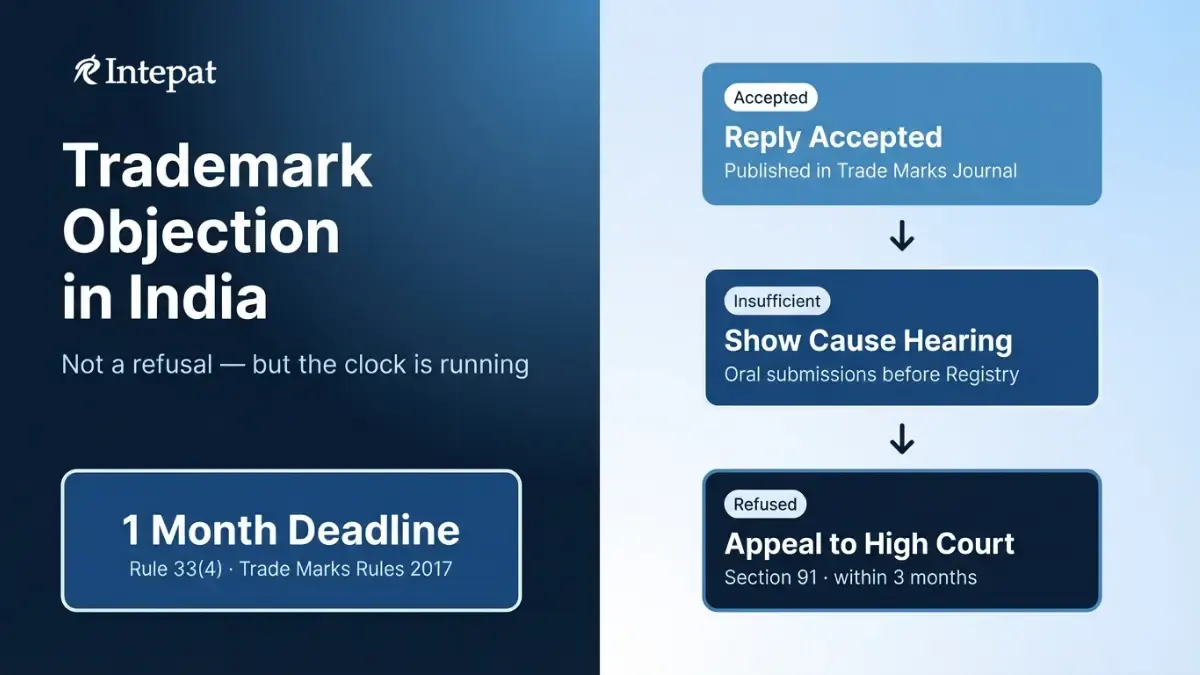
What Happens After You Respond to the Examination Report
Once a reply is filed, the designated officer at the Trade Marks Registry reviews the submission and decides which of three paths the application follows.
If the reply is accepted
The Registry accepts the application for registration and causes it to be advertised in the Trade Marks Journal. This is a common outcome where the reply is well-constructed and properly supported. Publication opens a statutory four-month opposition window under Section 21 of the Trade Marks Act, 1999, during which any third party may file a notice of opposition. If no opposition is filed, the application proceeds to registration.
If the reply is insufficient: show cause hearing
Where the designated officer considers that the written reply does not waive the objections, the application is listed for a show cause hearing under Rule 33(6) of the Trade Marks Rules, 2017. The status on the portal changes to “Ready for Show Cause Hearing.” The applicant or their authorised agent must appear before a Registry officer and make oral submissions. Failure to appear, particularly where no written reply has been filed, may result in the application being treated as abandoned under Rule 33(7).
If the application is refused
Where the Registrar concludes, after the hearing, that the mark is not registrable, an order refusing the application is passed. An applicant aggrieved by a refusal order may appeal to the concerned High Court within three months from the date the order is communicated, under Section 91 of the Trade Marks Act, 1999.
| Practitioner insight: hearing vs written reply |
| Show cause hearings are set down when the written reply is considered insufficient, not automatically. Most objections under Section 9(1) and Section 11 that are well-evidenced and specifically argued are resolved at the written reply stage without requiring a hearing. The hearing stage is best understood as the Registry’s opportunity to ask the applicant to justify, orally, what the written reply did not fully address. |
What to Do Right Now
The steps below are decision-focused, not drafting instructions. Drafting the reply itself is covered in the how to respond to a trademark examination report in India.
- Check the Examination Report: Open the IP India portal, find your application, and download the full Examination Report. Read it in full. Do not rely on the status label alone.
- Identify the objection type: Determine whether the objection is under Section 9 (absolute grounds, about the mark itself), Section 11 (relative grounds, citing an earlier mark), a formality requirement, or a combination. Each type requires a different response strategy.
- Assess whether the application is worth defending: Most objections are worth responding to. An exception arises where the mark conflicts with a well-known registered mark in the same class and no consent is available, or where the mark is objected to on curable Section 9(2) grounds. In those cases, a qualified trademark attorney should assess viability before time is spent on a reply.
- Do not let the deadline pass: If there is any uncertainty about the right course of action, file a request for a hearing within the one-month window. This preserves the application while the strategy is finalised.
Once abandoned, the original filing date cannot be recovered.
Frequently Asked Questions
Not in the sense that the application is at risk of immediate rejection. An objection is a procedural stage, not a final determination, and most objections are resolved through a written reply. What makes it serious is the deadline: the one-month window under Rule 33(4) of the Trade Marks Rules, 2017 is strict, and missing it results in the application being treated as abandoned with no reliable path to restoration. The objection itself is manageable. The deadline is not.
No. Objected means the Examiner has raised concerns that must be addressed in a written reply. The application remains alive. Most Section 9 and Section 11 objections are resolved at the written reply stage. Do not abandon the application without consulting a trademark attorney.
Under Rule 33(4) of the Trade Marks Rules, 2017, you have one month from the date of receipt of the Examination Report. Within that window you can either file a written reply via MIS-R or apply directly for a show cause hearing. If no response is received, the application will typically be treated as abandoned under Section 132 of the Trade Marks Act, 1999.
Objected means the Examiner has raised concerns and is asking for a response. The application is alive. Refused is a status that appears after a show cause hearing where the Registrar has passed an order refusing the application. Refused is a final Registry-level determination. An aggrieved applicant may appeal to the concerned High Court within three months of the order being communicated.
Yes. The TM symbol may be used from the date of filing regardless of examination status. The registered trademark symbol may only be used after the portal status shows Registered. Using it before registration is an offence under the Trade Marks Act, 1999.
The application will typically be treated as abandoned. There is no reliable statutory mechanism to restore an abandoned pending trademark application. The filing date and priority date are permanently lost. A fresh application must be filed from scratch, and any intervening competitor filings take priority.
Section 9 objections cover absolute grounds: marks that lack inherent distinctiveness, are purely descriptive, or fall into a prohibited category. A Section 9(1) objection means the Examiner considers the mark does not meet the registration threshold on its own. The reply must argue either that the mark is inherently distinctive or that it has acquired distinctiveness through extensive prior commercial use, supported by evidence. For the full legal breakdown, see the Section 9 and Section 11 grounds for refusal in India.
Yes, and this is the typical outcome when the reply is specific and properly evidenced. The show cause hearing is triggered only when the written reply is considered insufficient by the designated officer, or when the applicant requests a hearing directly.
The Examination Report is published on the IP India portal at the same time it is dispatched to the agent’s registered service address. You can check it directly under your application number without a login. Because the Registry sends all communications to the single service address on record, you are reliant on your agent to notify you promptly. Checking the portal regularly once the status shows Marked for Exam is the most reliable safeguard. The Trademark Application Status guide explains how to track each stage.
Related Guides
The guides below cover the topics most closely connected to trademark objections in India:
- Trademark Application Status in India: how to read every status code on the IP India portal, including Objected, Ready for Show Cause Hearing, and Refused.
- Section 9 and Section 11 Grounds for Refusal: the full legal framework for absolute and relative grounds, with analysis of how each sub-section is applied in practice.
- How to Respond to a Trademark Examination Report: step-by-step guide on filing MIS-R online, structuring arguments by objection type, preparing an affidavit of use, and attending a show cause hearing.
- Trademark Opposition in India: what happens after the mark is accepted and published, and how third-party opposition proceedings work.
- Trademark Registration in India: Complete Guide: the complete five-stage lifecycle from clearance search to registration certificate.
This article reflects the provisions of the Trade Marks Act 1999 and the Trade Marks Rules 2017 (as amended) as in force in April 2026. Trademark law and Registry practice are subject to change. Readers should seek specific legal advice based on their factual situation.