




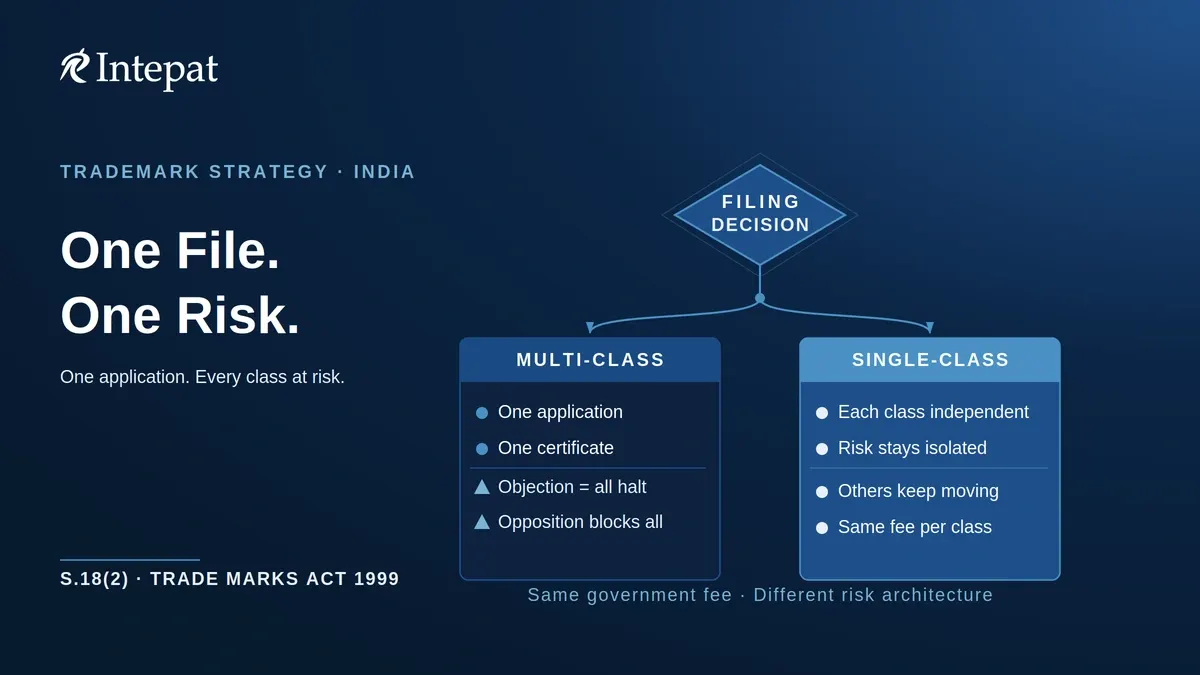
Indian trademark law lets you protect your brand across multiple product or service categories in a single filing. This is called a multi-class trademark application. On the surface it looks efficient: one form, one filing date, one application number. The catch is that one problem in any single category holds up every other category in the same application.
Quick answer: A multi-class application does not reduce your government fees. It reduces paperwork during a smooth filing, but one objection or opposition can delay all your classes together.
This article explains the benefits, drawbacks, and how to choose the right route for your brand. For a full side-by-side comparison, see single-class vs multi-class trademark filing in India.
What a Multi-Class Application Is
India’s trademark system is category-based. There are 45 classes of goods and services, and your registration only protects your brand in the classes you have applied for.
A clothing brand registered in Class 25 does not automatically get registration coverage for retail services in Class 35, even if the business sells through its own store or website. A food brand may need Class 30 for packaged food, Class 35 for its online store, and Class 43 if it also runs cafes or restaurants.
A multi-class application bundles two or more of those categories into a single filing. You fill out one Form TM-A, list each class, and pay the government fee for each one. The Registry assigns one application number, examines everything as a single case, and if all goes well, issues one registration certificate covering every class.
Not sure which classes apply to your business? Use the Trademark Classification Tool or the list of all 45 trademark classes in India before deciding on a filing structure.
The Government Fee: Same Either Way
Filing multi-class does not save you money. The fee is per class regardless of whether you bundle the classes or file them separately.
| Applicant type | E-filing | Physical filing |
| Individual, DPIIT-recognised Startup, or Small Enterprise | Rs 4,500 per class | Rs 5,000 per class |
| Company, LLP, or any other entity | Rs 9,000 per class | Rs 10,000 per class |
Source: First Schedule, Trade Marks Rules 2017. Fee is per class, per mark, payable via Form TM-A.
A startup filing in three classes pays Rs 13,500 whether filing one multi-class application or three separate single-class applications. Note: the reduced fee applies to Small Enterprises as defined under the Trade Marks Rules 2017 and does not extend to Medium Enterprises, even if they hold MSME registration.
Benefits of Filing Multi-Class
One file, one number, one certificate. You track one application number instead of several. Examination notices arrive together. Advertisement happens once. If all classes sail through, you receive one registration certificate at the end.
Less paperwork at the start. The authorisation to your agent is signed once. If you are claiming prior use of your brand, one supporting affidavit covers all classes.
Clean and simple when there are no problems. If your trademark passes examination with no objections and nobody challenges it during the publication window, multi-class filing is genuinely simpler than managing several parallel applications. That simplicity disappears the moment any class hits a problem.
Drawbacks of Filing Multi-Class
All the drawbacks come from one fact: it is one case in the Registry’s records. Whatever stalls any part of it stalls everything.
One objection delays every class. The Examiner reviews all classes together and issues a single report. If they raise an objection against even one class, every class waits. No class jumps ahead. Examination can take a year or more, and a contested objection adds further delay across all classes together. For guidance on what triggers an objection, see common trademark objections in India.
One opposition freezes every class. After your application is published in the Trade Marks Journal, any third party has four months to formally challenge it (Section 21, Trade Marks Act 1999). If they challenge only one class, all your other classes are blocked from proceeding to registration. Opposition proceedings can take a year or longer, and all classes wait together.
Splitting the application costs extra. When one class is challenged, you can separate it into its own file through a divisional application, freeing the rest to proceed. That costs Rs 1,800 (e-filing) or Rs 2,000 (physical), plus your agent’s time. These costs arrive under the pressure of a dispute, not as a planned expense at the time of filing.
All your classes in one basket. A clearance gap in any class, a competitor opposing one class as a tactical move, or a specification error in one class all become problems for your entire portfolio. Separate filings keep each class isolated.
If Trouble Strikes: What Actually Happens
At examination: The Examiner sends one report covering all classes. You have one month to respond. Until the Examiner is satisfied across every class, none of them can advertise. Classes with no issues do not proceed on their own.
At opposition: Once advertised, a four-month window opens for any third party to file a challenge under Section 21 of the Trade Marks Act 1999. If they challenge one class, your other classes are blocked from registering until you split the application or resolve the dispute.
Splitting the application: You file Form TM-M with the divisional fee. The law preserves your original filing date across all divided files, so you do not lose the priority you established when you first filed. Division can be requested at any stage while your application is pending, not only after an opposition arrives. For a detailed walkthrough, see divisional applications for multi-class trademarks.
Single-Class vs Multi-Class: Which Route Should You Choose?
| Your situation | Better route |
| Same brand, closely related classes, strong search clearance | Multi-class application |
| Search found a possible conflict in even one class | Separate applications |
| Unrelated business lines under one owner | Separate applications |
| First trademark filing, expansion plan not yet fixed | Usually separate applications |
| Foreign applicant with priority claim across related classes | Multi-class may suit |
File multi-class when your clearance is solid across every class. If a trademark search finds no conflicts in any of your categories and your brand is distinctive, multi-class filing works well. To run a search yourself first, see how to use the Indian trademark public search.
File multi-class when your classes belong to the same brand story. A bakery brand spanning food products, an online store, and a cafe chain is one commercial identity. Filing together reflects that.
File separately when any class has a risk. One potential conflict is enough reason to keep classes separate. The government fee is identical. If any class runs into trouble, the rest of your portfolio is untouched.
For most first-time filers, separate applications are the safer default. The administrative overhead is slightly higher. The downside protection if anything goes wrong is materially better.
Frequently Asked Questions
No. The fee is per class regardless of how you structure your filing. There is no discount for bundling classes together.
Yes. The Examination Report covers all classes together. All classes wait until every objection is resolved. Classes with no issues cannot proceed on their own.
Yes. A third party can challenge a single class in your application while leaving the others unchallenged. Even so, all your other classes are blocked from proceeding to registration until you either resolve the dispute or split the application.
They are blocked until you file a divisional application on Form TM-M with the divisional fee. Once the application is split, the unaffected classes can continue toward registration.
Rs 1,800 for e-filing or Rs 2,000 for physical filing, per divisional request, on top of the per-class fees already paid at original filing.
No. The law preserves your original filing date across all divided files. New application numbers are issued but your priority date is unchanged.
No. You cannot add new goods or services that were not described in your original application. A class can only be added in the limited situation where the Examiner determines during examination that goods or services you already described fall into an additional class. This is a classification correction, not a way to expand your coverage for a new business activity after filing.
One certificate covering every class that proceeds to registration. If the application is split during prosecution, each divided file gets its own certificate.
For most startups filing their first trademark, separate single-class applications are the safer and equally affordable choice. Run a trademark search first, identify every class you need, and file each separately. If any class runs into a conflict, the others continue unaffected. Multi-class filing is worth considering once you have confirmed clearance across all classes and you are choosing administrative convenience deliberately.