





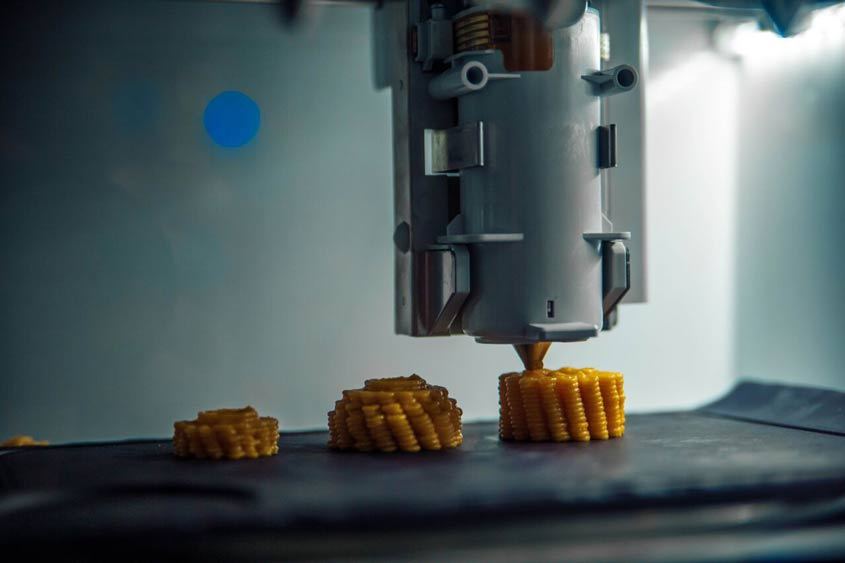
3D printing technology was introduced in the 1980s, and the technology has grown exponentially over the years. It is the technology where a digital file is used to produce physical objects. The object is created by laying down successive layers of materials until the object is created. This process of manufacturing a product is called the additive process. It is opposite to the subtractive process, where the material is cut off step by step until the shape of the object is obtained.
3D Printing helps in producing complex shapes by using lesser materials. The advantage of using this technology is that it reduces cost while developing a product or improvising an older one. Enterprises do not have to spend a lot to make prototypes and can create multiple models of complex elements in-house using this technology.
Basic understanding of the technology
In order to understand how infringement is possible using 3D technology, it is essential to have a basic understanding of how it works. It begins with a 3D model that can be prepared using 3D modeling software tools. Once you have a model, the next step is to create a file for the printer. This is called Slicing – a process where a 3D model is divided into hundreds or thousands of horizontal layers using slicing software. Most printers have a built-in slicer, and one has to feed the raw .stl, .obj, or CAD file. The sliced model fed into the printer is ready to be printed. One may get the object printed just by accessing a digital file like CAD provided by the 3D printer.
Industrial Application of 3D Printing Technology
3D Printing is being rapidly adopted into the production process across industries ranging from agro-food industries and fashion to regenerative medicines and prosthetics. The demand for 3D printing technology is industrial, mainly in nature. It is used for rapid prototypes and rapid manufacturing. It is used in the manufacturing industry to produce custom goods. The technology is used extensively in the automobile, aviation, construction, healthcare, apparel, consumer products, etc. The technology is not new, but it is one of the fastest-growing technologies today. It is evolving rapidly and is bound to change the lifestyle of millennials drastically.
3D Printing and IP Law
3D technology has been a boon to entities across industries. However, there is fear among intellectual property owners that the technology might lead to an increase in the infringement of intellectual property rights considering the simplicity and rapidity with which identical products can be made by just using a digital file. The main concern is using technology to copy any object without the owner’s authorization.
The current debate is whether the current IP laws are sufficient to protect the interests of intellectual property owners or whether there should be a separate law to deal with this technology. It is well-known that IP laws aim to prevent third parties unauthorized use of Intellectual property. Therefore, infringement through any means is not entertained, and it should not matter if the infringement is using 3D technology or other forms. Copyright law protects the right of the author. Therefore, reproduction of the same in any manner without the author’s consent leads to infringement. The same can be addressed by filing an injunction suit. Similarly, a patent protects the technology used in the function and working of an invention, the Designs Act protects the shape, form, or appearance of the industrial design on an object, and the Trademarks Act protects the exclusive right of the proprietor over the mark. Thus, it can be said that unauthorized use as such does not raise any specific issues in the current legal regime.
However, the issue lies in proving infringement. The 3D printing technology is an issue in the patent system similar to that of copyright problems due to the advent of the internet, where sharing books, music files, and other works have become easy. One can share literary, musical, dramatic, and artistic works with just a button. Similarly, a patented object can be printed simply by using 3D technology. In such cases, the unauthorized user can be liable for infringement. But, it is difficult to prove infringement. The reason is that such Printing may be done by anyone, even at home, and may not necessarily be for a commercial purpose.
Illustration of a likely infringement
A hobbyist or a connoisseur may make a CAD file of a patented object. It may upload online, and many people may download it. This may lead to multiple productions of identical products using 3D technology. Does the issue arise as to who should be liable for infringement?
1. Should it be the owner or operator of the 3D printer?
or
2. Whether it should be the owner of the CAD file?
There is no concrete answer to this issue. It varies from case to case and is up to the court’s discretion based on the findings. The courts will look into the purpose of Printing to determine infringement.
In its current form, IP law sufficiently protects both 3D files and those using 3D printing technologies for non-commercial purposes. Indian Copyright Law, in principle, appears to take care of most aspects of 3D Printing. But many issues still need to be addressed. Also, the real implications of the emerging 3D technology and its impact on IP are yet to unfold.