




Filing a patent in individual or company name in India carries direct consequences: the application fee and most other fees differ fivefold, unless the company is a recognised startup, small entity or educational institution; ownership on death or transfer changes; investor-compliance obligations apply. Both are permissible applicant categories with the same infringement remedies, though the available evidence may differ.
The rules on who may apply, what each category pays, how an application or patent moves from one owner to another, and what co-owners may do without each other are in the Patents Act, 1970 and the Patents Rules, 2003, as amended in 2024, and the fee figures below are from Table I of the First Schedule as substituted in March 2024.
Quick answer: If the company already exists and the invention will be commercialised through it, filing in the company’s name is usually cleaner, at five times the fee unless the company is a recognised startup, small entity or educational institution; where the company is not the inventor, it must hold the right to apply, ordinarily by assignment from the inventor. If the company has not yet been incorporated, filing first in the inventor or founder’s name is practical, but the application should be transferred to the company before a funding round, licensing or enforcement, and the fee difference is payable on transfer unless the company is a recognised startup, small entity or educational institution.
Who Can Apply for a Patent in India
Subject to the Act’s reciprocity provision, three classes of person may make the application: any person claiming to be the true and first inventor; any person being the assignee of that inventor in respect of the right to make the application; and the legal representative of any deceased person who, immediately before death, was entitled to apply.
Any of them may apply alone or jointly with any other person.
“Person” includes the Government, and the fee schedule itself distinguishes natural persons, startups, small entities and educational institutions from “other(s)”, so companies and other legal persons may apply in their own name. Where the company is not itself the inventor, its entitlement rests on being the assignee of the inventor’s right to apply, and the proof of that right described below must be furnished.
Every application must state that the applicant is in possession of the invention and must name the person claiming to be the true and first inventor; where the person named as inventor is not the applicant or one of the applicants, it must also carry a declaration that the applicant believes the named person to be the true and first inventor. Where the application is made by virtue of an assignment of the right to apply, proof of that right is furnished with the application or within six months after filing.
Factor 1: Filing Fee
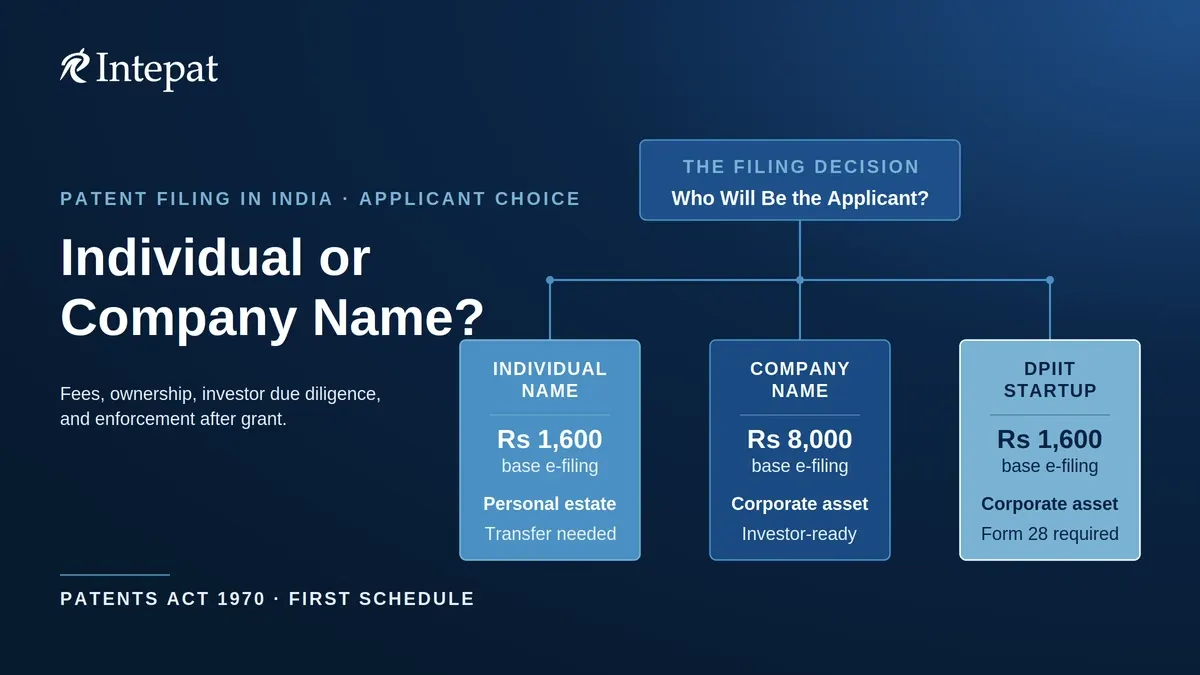
The fee differential is the most immediate practical distinction: a company pays five times what an individual pays for the application fee and for most other fee-bearing steps (the ratio differs on some entries, and is higher for expedited examination), unless it qualifies as a startup, small entity or educational institution.
Table I of the fee schedule, as substituted in March 2024 and verified as of September 2026, prescribes the following application fees.
| Applicant category | Application fee, e-filing | Application fee, physical filing |
| Natural person, startup, small entity or educational institution | ₹1,600 | ₹1,750 |
| Any other person (a company or other organisation), alone or jointly with a natural person, startup, small entity or educational institution | ₹8,000 | ₹8,800 |
Where multiple priorities are claimed, the application fee is a multiple of the base figure for each. Additional fees apply for each sheet of specification beyond 30, excluding sequence listing (₹160 for the reduced fee category of natural persons, recognised startups, small entities and educational institutions, ₹800 for others, by e-filing) and for each claim beyond 10 (₹320 and ₹1,600 by e-filing). The schedule prints separate, higher figures for physical filing. For the complete fee schedule, see the patent fees article, the Intepat patent fees calculator and the Patents Rules as published by the Indian Patent Office.
Joint filing and the higher rate. Where a company files jointly with an individual, startup, small entity or educational institution, the higher rate applies to the whole application. The lower rate applies only when every co-applicant falls within the reduced category.
DPIIT-recognised startups. A startup, for fee purposes, is an entity in India recognised as a startup by the competent authority under the Startup India initiative (in practice, DPIIT recognition), or a foreign entity meeting the same turnover and incorporation-period criteria and filing a declaration to that effect. Startups pay the same fee as natural persons, but every document filed by a startup, small entity or educational institution for which a fee is specified must be accompanied by Form 28. The Rules provide that where a startup or small entity, having filed an application, ceases to be one because the period of its recognition lapses or its turnover crosses the notified threshold, no difference in the scale of fees becomes payable. For the wider fee and procedural position, see the guide to patent filing for startups in India.
Small entities. A company can reach the lower rate without being a startup. For fee purposes a small entity is an enterprise producing goods whose investment in plant and machinery, or a service enterprise whose investment in equipment, does not exceed the limit set for a medium enterprise under the Micro, Small and Medium Enterprises Development Act, 2006. A small entity pays the natural-person rate and, like a startup, files Form 28 with each fee-bearing document.
Speed, not only cost. Eligibility for expedited examination on Form 18A also turns on who the applicant is: the grounds include that the applicant is a startup, that the applicant is a small entity, and that the applicant is a natural person, or on a joint filing that all the applicants are natural persons, where the applicant or at least one of them is female. A company outside those categories must rely on another ground.
Fee difference on transfer. Where an application processed by a natural person, startup, small entity or educational institution is fully or partly transferred to a person outside those categories (for example, a company that is not a startup, small entity or educational institution), the new applicant must pay the difference, if any, in the scale of fees with the request for transfer. The claim to proceed in the new applicant’s name is made on Form 6, at ₹800 or ₹4,000 by e-filing, and the Patent Office Manual, as a statement of practice, computes the difference across all previous proceedings in the matter and refers to filing Form 30 with Form 6 to pay it. A transfer from an individual to a recognised startup does not attract the difference, because both sit within the reduced category.
Factor 2: Investor and Corporate-Governance Requirements
Where investors or employment contracts require IP to vest directly in the company, the choice of applicant is not discretionary, and an unrecorded assignment can create a title issue in due diligence on an early-stage IP schedule.
Employment agreements and IP assignment clauses in shareholder agreements, investment term sheets and shareholder rights agreements commonly require IP to vest directly in the company. An investor conducting due diligence expects a clean IP ownership trail: a patent or application standing in an employee’s name with no recorded assignment creates a cloud on title. Under the Act, an assignment of a patent or of a share in a patent, a mortgage, a licence or the creation of any other interest in a patent is not valid unless it is in writing, the agreement between the parties is reduced to a document embodying all the terms and conditions governing their rights and obligations, and it is duly executed. An oral or implied agreement is not sufficient.
In seed and early-stage transactions, it is common for term sheets or investment agreements to impose a condition that all IP be formally transferred to the company before closing. Where a founder has filed a provisional patent application in individual capacity and a funding round follows before the patent is granted, the application should be transferred to the company by a claim on Form 6 to proceed in the company’s name. If the patent has already been granted, the assignment should be registered on Form 16. Investment documentation may require evidence of the completed transfer or registration before closing.
Factor 3: Ownership Clarity and Licensing
The Act provides that the person or persons registered as grantee or proprietor of a patent have power to assign, grant licences under, or otherwise deal with the patent, subject to the Act’s provisions on co-ownership and to any rights of others entered in the register.
A granted patent is property capable of assignment, licensing and mortgage; a pending application is transferred by an assignment or agreement in writing made by the applicant, or by operation of law. Where the patentee is an individual, title to the patent passes on death by transmission or operation of law; where only an application is pending, it moves in the same way, and the legal representative of the deceased may apply. The person who becomes entitled applies on Form 16 to register the transmission of title, on proof of title to the satisfaction of the Controller, the Patent Office officer who decides the request. A corporate applicant avoids this risk: the patent remains a company asset regardless of changes in the founders’ or directors’ personal circumstances.
Joint applications are permissible. However, where two or more persons are registered as co-proprietors, a licence under the patent shall not be granted and a share in the patent shall not be assigned by one co-proprietor without the consent of the other or others, subject to any agreement in force and to the Act’s other provisions on co-ownership. A joint individual-and-company structure therefore requires the co-proprietors to act together on every licensing and assignment decision, which can create friction in commercial situations.
Factor 4: Enforcement and Remedies
In a suit for infringement, the reliefs a court may grant include an injunction, subject to any terms the court thinks fit, and, at the option of the plaintiff, either damages or an account of profits. The choice between damages and an account of profits is the plaintiff’s.
The Act draws no distinction between an individual and a company patentee in the remedies it makes available for infringement. A company actively commercialising the invention may hold more developed evidence bearing on the assessment of damages, but that is an evidential circumstance, not a legal advantage arising from corporate ownership.
The court may also order that infringing goods, and materials and implements whose predominant use is in the creation of infringing goods, be seized, forfeited or destroyed without payment of compensation.
Transferring a Pending Application or Granted Patent to a Company
The procedure differs depending on whether the patent has been granted or the application is still pending: a pending application is moved by a claim to proceed in the new applicant’s name, a granted patent by registering the assignment in the register of patents.
A pending application moves on an assignment or agreement in writing, or by operation of law; a granted patent needs a written, duly executed assignment.
Before grant: substitution of applicant. Where the application is still pending, the new applicant makes a claim on Form 6 (₹800 or ₹4,000 by e-filing) that, by virtue of an assignment or agreement in writing made by the applicant, the claimant would be entitled to the patent or to the applicant’s interest in it if the patent were then granted. The Controller cannot give that direction unless the assignment or agreement identifies the invention by the application number, or an acknowledgment made by the assignor that the assignment or agreement relates to that application is produced to the Controller, or a court has finally established the claimant’s rights, or the Controller gives enabling directions. Where a fee difference arises because the new applicant falls outside the reduced category, the difference is paid with the request, and the Patent Office Manual refers to Form 30 for that payment. If satisfied, the Controller may direct that the application proceed in the name of the new applicant.
After grant: registration of the assignment. Once a patent has been granted, the assignee becomes entitled by the written assignment and must then apply to have its title registered in the register of patents. The steps are set out below; the Form 16 fee depends on the category of the person applying to be registered.
- Execute a written, duly executed deed of assignment that embodies all the terms and conditions governing the parties’ rights and obligations; an assignment that does not meet this test is not valid.
- Apply on Form 16 to register the assignee’s title. The fee is ₹1,600 per patent (e-filing, reduced category) or ₹8,000 per patent (e-filing, others), verified as of September 2026.
- The Controller, on proof of title, registers the new proprietor and enters the particulars of the instrument in the register.
Except for the purpose of applying for registration or rectifying the register, a document in respect of which no entry has been made in the register is not admitted as evidence of title to a patent unless the Controller or the court, for reasons recorded in writing, otherwise directs. Prompt registration is therefore important for evidential hygiene.
Making the Decision: Patent in Individual or Company Name
The decision depends on the applicant’s position at the time of filing and the anticipated trajectory of the application: whether a company exists yet, whether investors will require corporate ownership, and whether the fee difference on a later transfer is worth avoiding by filing in the company’s name from the start.
File in individual name when: the invention has not yet been commercialised, the company has not been incorporated, there are no investor obligations requiring corporate ownership, and cost control at the provisional stage is a priority. The individual-to-company transfer path remains open, but carries a fee difference (unless the company is a recognised startup, small entity or educational institution) and the administrative steps described above.
File in company name when: the company is already incorporated, investor agreements require corporate IP ownership, the intention is to exploit the patent through the company immediately, or the applicant is a recognised startup and wishes to establish corporate ownership while still paying at the reduced fee rate.
File jointly when: the inventor is an individual who retains an interest, and a company also has a stake in the invention. Joint ownership is permissible, but the co-ownership restrictions on licensing and assignment should be reviewed before adopting this structure.
A practical illustration. A founder files a provisional patent application in her own name before the company is incorporated. Six months later the company is formed and investors ask for IP to sit in the company. The founder executes a written deed of assignment, files a claim on Form 6 while the application is still pending, and pays the fee difference if the company falls outside the reduced category. After the patent is granted, the company is registered as proprietor, and all subsequent licensing and enforcement decisions belong to the company.
| Factor | Individual name | Company name |
| Base e-filing fee | ₹1,600 (natural person) | ₹8,000, unless the company is a recognised startup, small entity or educational institution (₹1,600 with Form 28) |
| Ownership on death | Title passes by transmission or operation of law; Form 16 registers it | Unaffected; the company continues as proprietor |
| Investor due diligence | May require a transfer before funding closes | Cleaner; no transfer step if the company already exists |
| Transfer later | Form 6 while pending, Form 16 after grant; fee difference may apply | Not needed |
| Joint filing with the other category | Higher rate applies when any co-applicant is outside the reduced category | Lower rate only if every co-applicant, the company included, is within the reduced category |
For a broader overview of the rules governing patent applications in India, see patent law in India. Startups considering whether to file directly in India or through the PCT route first can read the dedicated PCT for Indian startups guide. For the filing steps themselves, see the patent filing procedure in India.
Frequently Asked Questions
Yes. While the application is pending, the company claims on Form 6 to proceed in its name, producing the assignment or agreement; if it falls outside the reduced fee category, the difference is payable with the request. After grant, the transfer needs a written, duly executed assignment recording all its terms, then registration of its title on Form 16.
Yes, procedurally. Every application must name the person claiming to be the true and first inventor, and where that person is not an applicant it must carry a declaration of the applicant’s belief in that inventorship. Where the Act provides for mention as inventor, that mention neither confers nor derogates from rights under the patent.
Yes. Startups pay the same fee as natural persons, and Form 28 must accompany each fee-bearing document. The Rules provide that where a startup or small entity, having filed an application, ceases to be one because the period of its recognition lapses or its turnover crosses the notified threshold, no difference in the scale of fees becomes payable.
On the patentee’s death, title to the patent passes by transmission or operation of law. The person who becomes entitled applies on Form 16 to register the transmission of title, on proof of title to the Controller’s satisfaction. The Act also recognises the legal representative of a person entitled to apply immediately before death as able to apply.
Yes. Registration of a person’s title to a patent, or of a document affecting it, on Form 16 carries a fee of ₹1,600 per patent (e-filing, natural person, startup, small entity or educational institution) or ₹8,000 per patent (e-filing, others), and ₹1,750 or ₹8,800 by physical filing, verified as of September 2026.
Yes, where the company has acquired the employee-inventor’s right to apply under an effective assignment or other operative contractual provision; an obligation to assign is not itself a completed assignment. Alternatively the inventor files and later assigns by a written, duly executed assignment. Either way the application must name the employee as the true and first inventor.
A company that did not yet exist could not hold the right. It stays with the inventor or inventors, or anyone already entitled, until assigned. While pending, the company claims on Form 6 with the written assignment; after grant, an assignment not registered on Form 16 is not admitted as evidence of title unless the Controller or a court directs.
Yes. A provisional application is a pending application, and before grant the company may claim on Form 6 to proceed in its name, supported by the assignment or agreement in writing. The complete specification, when filed, proceeds in the company’s name. The fee difference applies if the company falls outside the reduced fee category.
Legal Disclaimer
This post is for informational purposes only and is not legal advice. Statutory provisions are cited for reference based on the Patents Act, 1970 and Patents Rules, 2003 as they stand at September 2026, verified against the instruments listed under Sources, including the Patents (Amendment) Rules, 2024. The fee figures quoted are from Table I of the First Schedule as substituted in March 2024 and are subject to amendment by notification; verify the current schedule with the Indian Patent Office before filing. For advice on a specific invention, consult a registered patent agent.