




On 24 July 2026, the Delhi High Court refused ANI Media’s request to injunct OpenAI. It held that OpenAI’s admitted temporary storage of ANI’s literary works during training engaged the reproduction right, but was protected as fair dealing under Section 52(1)(a) of the Copyright Act 1957. These findings are provisional and the suit continues.
This article addresses Indian law and is based on the text of the ANI vs OpenAI judgment.
Quick answer
- The findings are prima facie: a provisional view reached only for deciding interim relief. The Court recorded that they have no bearing on the final outcome.
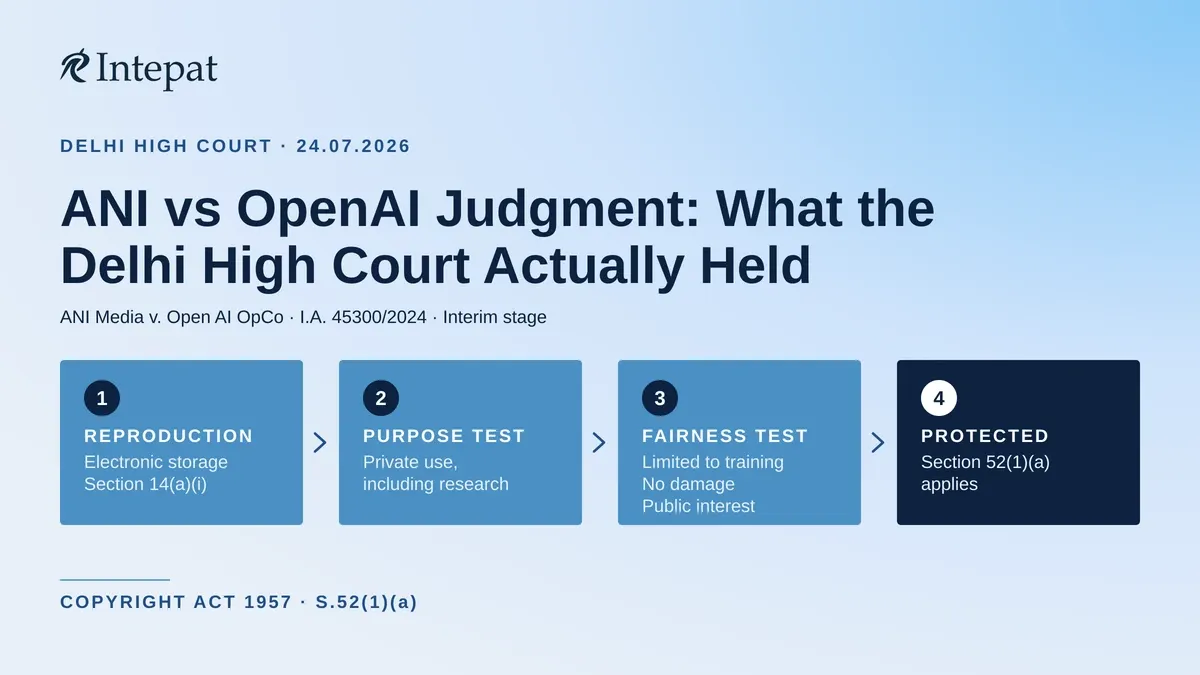
- Electronic storage during training engaged the reproduction right under Section 14(a)(i), but did not constitute infringement because Section 52(1)(a) applied.
- Section 52(1)(a) was applied as a two-step examination: a purpose test and a separate fairness test. Both had to be satisfied.
- The output claim failed on the evidence, not as a rule. Memorisation remains a triable issue.
- ANI’s own USD 7.5 million licence offer helped establish that its claim was compensable in damages.
What did the Delhi High Court decide in ANI v OpenAI?
The judgment answers several separate questions, and conflating them is the commonest error in the coverage.
| Question | Interim result |
| Did electronic storage engage ANI’s reproduction right? | Yes |
| Was the admitted storage protected under Section 52(1)(a)? | Yes, on this record |
| Did the identified outputs infringe? | No prima facie case shown |
| Could the Delhi High Court hear the dispute? | Yes, at this stage and on these facts |
| Was the suit finally decided? | No |
One qualification governs everything that follows. ANI’s pleaded examples post-dated the models’ training cut-offs, recorded as April 2022 for GPT-4 and April 2024 for GPT-4o, and ANI showed no further instances of material from its website being used for training. There was accordingly no factual foundation in the plaint for infringement on the training claim. The Court examined Section 52(1)(a) only because OpenAI admitted ANI’s works were stored at least temporarily during training.
So the fair dealing analysis rests on admitted temporary storage, not on proof that ANI’s articles sat in the training corpus. The application dismissed was I.A. 45300/2024, and the Court stated its observations would have no bearing on the suit’s final outcome. Although an interim application, it was heavily contested, with two amici curiae and six intervenors.
Storage during training was reproduction: the starting point
The analysis does not begin with the exception. It begins with the right.
Section 14(a)(i) gives the owner the exclusive right to reproduce a literary work in any material form, including storing it in any medium by electronic means. The Court traced that wording to the 1994 amendment and held that electronic storage of a literary work amounts to reproduction.
Two points follow for anyone assessing exposure. The provision draws no distinction between temporary and permanent storage, and under Section 51 the purpose is irrelevant. Deleting the material after training does not undo the temporary storage that already occurred.
Because reproduction and fair dealing were intertwined, the Court took them together: storage fell within ANI’s reproduction right, and the admitted storage was then protected under Section 52(1)(a). Our guide to fair use of copyrighted works in India sets out how Section 52 operates generally.
How Section 52(1)(a) was applied: purpose, then fairness
OpenAI’s defence rested on Section 52(1)(a)(i). The Court held that deciding whether the storage fell within the clause required a two-step examination, and both steps had to be satisfied.
The purpose test asks whether the storage was for a purpose the clause specifies: private or personal use, including research. The fairness test then asks separately whether the storage can be considered fair dealing.
The Explanation to Section 52(1)(a), which exempts electronic storage for the clause’s purposes, does not operate on its own. The Court read it as protecting storage subject to the fair dealing test. A dealing that fails on fairness is not rescued by the Explanation, which was itself inserted by the 2012 amendment covered in our note on emerging trends in digital copyright law.
Two further points matter to anyone assessing a dataset. ANI argued the Explanation protects storage only of non-infringing copies; the Court rejected that on the placement of the commas, holding the limitation attaches to incidental storage of a computer programme, not to works stored electronically. Separately, drawing on the distinction in Bartz v. Anthropic between lawfully acquired works and copies taken from unauthorised shadow libraries, the Court noted ANI had not alleged that OpenAI obtained its works from unauthorised sources or by breaking through a paywall, the material being freely available on ANI’s website. Whether the same defence covers pirated, paywalled or access-controlled sources was not decided.
Commercial purpose and “private” use: two separate findings
These are distinct questions in the judgment, and treating them as one produces the wrong reading.
On commercial purpose, the reasoning is statutory construction. Section 52(1) shows the legislature was aware of the commercial and non-commercial distinction and excluded commercial use only in specific cases, clause (ad) being expressly confined to non-commercial personal use. Commercial purpose alone therefore does not disqualify a defendant.
On “private” use, the reasoning differs. The Court declined to read “private” and “personal” as interchangeable, since that would make “private” redundant. Relying on dictionary meanings and on Academy of General Education, Manipal v. B. Malini Mallya, where institutional activity was treated as private use, it held “private” extends beyond individuals to a closed group or a private company.
The use here was private because the works sat in a closed space without public access, available only to the models and not to any human for access or download.
The Court distinguished TIPS Industries v. Wynk because those defendants made the material available to third parties, whereas OpenAI’s use is internal and the training data is never released in natural-language or tokenised form. By inference, a system giving third parties access to the stored corpus would not fit that reasoning.
On “research”, the Court applied the doctrine of updating construction, holding that research is no longer confined to humans and that limiting the exception to human actors would be regressive. The purpose test was satisfied.
What made the dealing “fair”
The fairness test turned on three questions drawn broadly from Article 9 of the Berne Convention, and all three were answered in OpenAI’s favour.
Was the use limited to training? The Court was shown no instance of OpenAI using ANI’s works for any other purpose, and accepted evidence that the models are trained not to reproduce the training material but to generate new responses to novel prompts.
Did it cause economic damage to ANI? Beyond bare averments, nothing showed lost market share or reduced subscription revenue. The Court held the purpose and character of the two uses fundamentally different: ANI’s business is news reporting and syndication, whereas ChatGPT performs many functions, and on news it supplies only a summary or snippet together with a reference back to ANI’s website. Its responses were therefore not substitutes for ANI’s articles.
Did it serve the public interest? The Court found the public benefits considerable, listing assistance with analysing and generating text, improved access to information, support for education and scientific research, translation, and tools for persons with disabilities.
With both tests satisfied, the storage fell within Section 52(1)(a).
Why ANI’s output claim failed on the interim record
The output claim failed on evidence. ANI’s illustrations post-dated the models’ training, so they could not establish memorisation, and the Court found them to be in the nature of live links, likely reflecting retrieval-augmented generation.
RAG is worth defining, because the distinction did the work. It is a process in which the system fetches external material at the time of the user’s query and grounds its answer in that material, rather than relying solely on what it learned during training. Responses not based on trained data cannot support a memorisation claim.
The scope needs care. Whether RAG outputs can infringe as a category was not pleaded and was not decided. The Court nevertheless held the specific outputs before it prima facie non-infringing, because they were not substantially similar to ANI’s works.
The fact and expression distinction carried real weight. There is no copyright in facts themselves, since facts are not created by the author of the work that embodies them, and in news reporting some factual overlap is unavoidable. The comparison the Court ran was therefore between ANI’s expression and ChatGPT’s, not between the underlying facts, and following R.G. Anand v. Delux Films similarity is assessed between the works as a whole rather than isolated parts.
One detail deserves emphasis. ANI’s illustrations were themselves produced by adversarial prompting, inputs designed to force extraction, and still did not yield substantial reproduction. The Court distinguished the Munich decision in GEMA v. OpenAI partly because the verbatim lyric reproduction there followed ordinary, non-adversarial prompts.
Note what the output claim required: substantial reproduction of protected expression. Market substitution was assessed elsewhere, under the fairness limb, not as an element of output infringement.
Jurisdiction: offshore servers did not end the case
ANI defeated OpenAI’s jurisdictional objection on specific connecting factors: ANI’s registered office and principal place of business lie within the Court’s jurisdiction, OpenAI targets its services to users across India, and the allegedly infringing responses were generated in India. The basis was Section 62(2) of the Copyright Act, which lets an owner sue where it resides or carries on business, read with Section 20 of the Code of Civil Procedure.
On the training claim, the Court held that storage on US servers was the terminal step in a chain beginning with access to the works from India and their transmission abroad, and that the Act does not require severing the chain to examine only the last step. Drawing on Blueberry Books v. Google India and Neetu Singh v. Telegram, it held the contrary view would let infringers evade Indian law by shifting that link offshore.
The holding is expressed carefully: it could not be said at this stage that the Court lacked territorial jurisdiction, or that the training claim involved extra-territorial application of the Act. Intervenors included the Indian Music Industry, whose separate concerns we examined in our note on IMI v. OpenAI.
What tipped the balance against an injunction
ANI’s own position told against it at the equities stage.
The Court noted ANI could have blocked OpenAI’s web crawlers and had not done so, while OpenAI had itself blocked ANI’s website from its crawlers and from the ChatGPT search and RAG functions. No material showed lost subscribers or loss from the news syndication business. ANI had offered OpenAI a licence for USD 7.5 million in October 2024, which the Court treated as showing the claim was quantifiable and compensable in money.
Public interest weighed the same way. The Court held an injunction would be detrimental to the growth of AI, particularly LLMs being developed in India, and would adversely affect millions of ChatGPT users, many not paid subscribers. It also observed that developing an LLM would be economically unviable if training required licences from multiple sources.
For content owners the reading is narrow but useful. Where interim relief is sought, contemporaneous evidence of subscriber loss, syndication loss or market displacement can be decisive; bare assertions did not suffice. A prior licence quotation may also undercut a claim that damages are inadequate.
What the Court left open
Three questions were expressly not decided, and each is where the next round will be fought:
- Memorisation and regurgitation. Treated as disputed questions to be determined at trial once the parties lead evidence.
- RAG outputs as a category. Whether outputs produced using retrieval-augmented generation can infringe was not pleaded, so it was not decided.
- Differently sourced datasets. The defence succeeded on freely available material with no allegation of unauthorised sourcing. Pirated or access-controlled sources were not ruled on.
- Ownership of individual works. ANI was held prima facie owner on a sample Professional Services Agreement, but ownership of the individual works was left for trial.
Intepat risk note. Our commercial view, not a holding. The defence that succeeded here was fact-specific: admitted temporary storage, a closed training process, no third-party access to the corpus, freely available source material and no demonstrated market substitution. The judgment should not be treated as clearance to use differently assembled datasets without a fact-specific assessment. For wider context, see our survey of landmark copyright cases in India.
Frequently asked questions
No. The Delhi High Court held prima facie that OpenAI’s admitted temporary storage of ANI’s works during training fell within Section 52(1)(a). ANI had not established that its pleaded articles were used for training. The finding was made to decide an interim application and has no bearing on the final outcome.
No, the opposite. It held that electronic storage of a literary work is reproduction under Section 14(a)(i), covering temporary and permanent storage alike, and would engage Section 51 unless the act falls within Section 52. The storage was protected because the fair dealing defence succeeded on this record.
No. The Court recorded that ANI never alleged that OpenAI obtained its works from unauthorised sources or by breaking through a paywall, and that the material was freely available on ANI’s website. The ruling does not decide the treatment of datasets built from pirated or access-controlled copies.
The pleaded examples post-dated the models’ training cut-offs and appeared to involve retrieval-augmented generation, meaning material fetched at query time rather than reproduced from training. They could not establish memorisation, and the responses were not substantially similar to ANI’s articles.
Not necessarily. On the facts before it, the Delhi High Court held at the prima facie stage that it had jurisdiction despite OpenAI’s overseas servers. The result depended on ANI’s Delhi presence, OpenAI’s services to Indian users, outputs generated in India and the Indian steps in the alleged chain.
Source: This article is based on the text of the judgment in ANI Media Pvt. Ltd. v. Open AI OpCo LLC, I.A. 45300/2024 in CS(COMM) 1028/2024, 2026:DHC:5900, Delhi High Court, Amit Bansal J, reserved 27 March 2026 and pronounced 24 July 2026. The judgment dismissed I.A. 45300/2024 and expressly stated that its observations would have no bearing on the final outcome of the suit. Article prepared August 2026; readers should check the current status of the proceedings before relying on it.
Disclaimer: This article discusses an interim order that did not finally decide the suit. Findings recorded at the interim stage are provisional and may be revised when the suit is finally decided. Nothing here is legal advice or a substitute for advice on specific facts.