




A copyright objection reply works only when it answers the right problem. Two different things stop a copyright application in India, they arrive looking similar, and they call for different answers. One is a letter from the Copyright Office asking you to complete your filing. The other is an objection filed by somebody else.
Both run on rule 70 of the Copyright Rules 2013, the provision that carries a copyright registration application from filing through to entry in the Register. Neither one ends your application by itself. What ends applications is a reply that argues where it should have enclosed a document, or a deadline that passes while the applicant waits for a second letter that does not come.
| Quick answer: |
| A discrepancy letter comes from the Copyright Office after its own formality check and asks you to supply what is missing. An objection comes from a third party inside the thirty-day window that runs from receipt of your application (rule 70(10)). Identify which you have before you draft a word. |
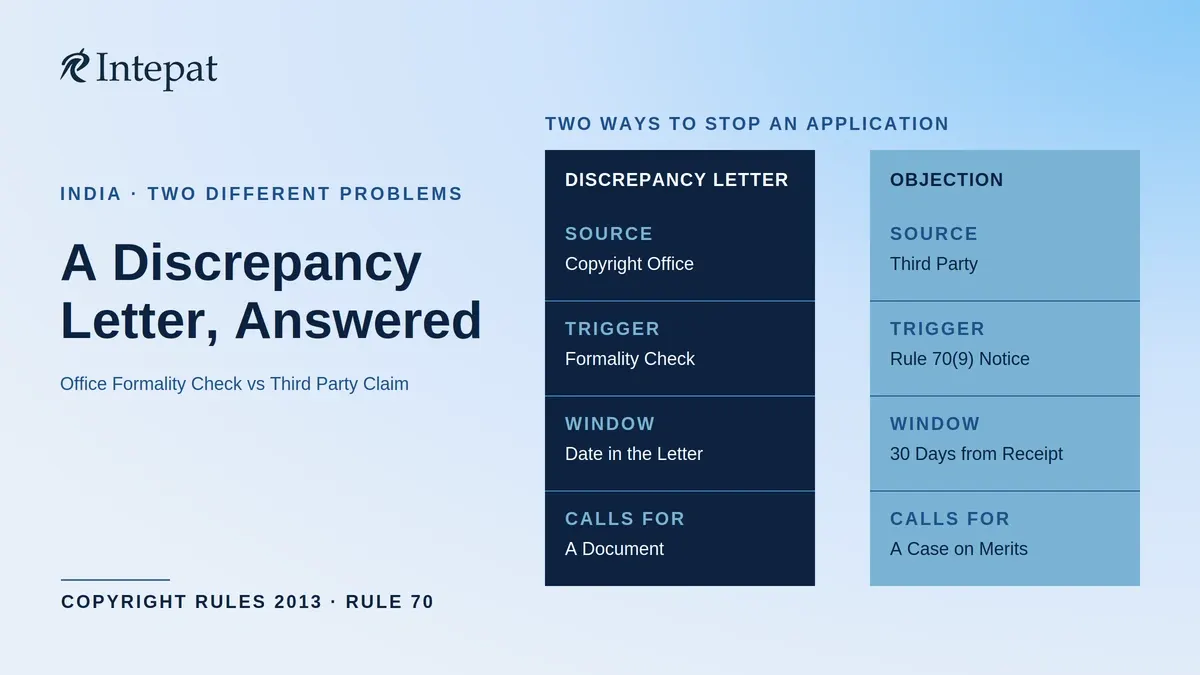
A discrepancy letter and an objection are not the same thing
A discrepancy letter comes from the Copyright Office itself, after the formality check on your Form XIV, and asks you to complete what is missing. An objection comes from a third party inside the thirty-day window that rule 70(10) runs from receipt of your application. The two call for different replies.
The distinction matters because the Office is doing different work in each case. On the discrepancy side it is checking whether your paperwork is complete: two copies of the work, a complete Form XIV, the power of attorney where one applies, and the prescribed fee. Where that check fails, the practice manuals record that a letter for the necessary requirements issues to your communication address, and that the status of the application is updated to “Work Awaited” on the Copyright Office website (per the Practice and Procedure Manual 2018, Artistic Works, section 3.1 and footnote 9).
Watch the inbox as well as the letterbox. Since 30 March 2021, rule 82 provides that every written intimation from the Copyright Office or the Registrar “shall be deemed to have been duly communicated to any person if such intimation is sent to the known address of such person through electronic means or by registered post”. Before that amendment the rule named registered post alone. An intimation sent to the email address on your file is therefore good service, and non-receipt is not an answer if nobody was reading that address.
On the objection side the Office is deciding a contest. Somebody has told the Registrar that they claim an interest in the work or dispute your right to it. That person may be there because you told them: rule 70(9) requires an applicant to give notice of the application to every person who claims or has any interest in the subject matter or disputes the applicant’s rights.
Telling them apart takes about a minute. Read who signed the letter. A discrepancy letter comes from the Copyright Office and lists requirements; it names documents, not disputes. A copyright registration objection concerns somebody else’s claim to the work rather than a gap in your paperwork, so what it calls for is your answer on the merits and not an enclosure.
If you are unsure where your file sits in the sequence, the filing procedure for a copyright application sets out the steps that precede both events. Work from the letter rather than from the status line: “Work Awaited” is the one label the Copyright Office’s published manuals actually define, and they define it as the formality-check outcome described above.
So the two replies look nothing alike. A discrepancy reply is a document you enclose. An objection reply is a case you make. Sending the second where the first was needed costs a cycle, and a cycle here is measured in months.
What triggers a copyright discrepancy letter
The formality check looks for two copies of the work, a complete Form XIV, the power of attorney where one applies, and the prescribed fee. Anything missing produces a letter. The recurring triggers fall into three groups: a certificate the file does not carry, a consent nobody obtained, and a defect in the work or the forms themselves.
The certificate problem catches brand owners who did not know the requirement existed. Where an artistic work is used or is capable of being used in relation to any goods or services, the application must include a statement to that effect and be accompanied by a certificate from the Registrar of Trade Marks that no identical or deceptively similar mark stands registered or applied for by anyone other than the applicant (rule 70(6), and the proviso to section 45(1)).
That requirement sits in the consolidated text of rule 70 published by the Copyright Office, which is worth reading in preference to older reproductions: the words “or services” were added to rule 70(6) only in 2016, and several circulating copies of the Rules still omit them. The overlap this creates between the two registries is covered separately in our note on trade mark and copyright protection.
Which artistic works fall inside that requirement is a practice question, and the manual answers it in terms. Works with the potential to become trade marks, or which are outwardly associated with a brand identity, need the search certificate. The manual names them: brand logos, labels, packaging, designs potentially applicable to goods or services, and cartoons and figurative drawings.
The rest, the manual says, “may be treated” as works for which no search certificate is required, “such as paintings, drawings, sculptures, lithographs, etc.” (Artistic Works manual, section 4, item 3). Read that as a practice default rather than a closed list, because the class the rule fixes turns on how a work is used, not on what kind of artistic work it is. A drawing that a business is about to put on a label is inside the requirement whatever the manual calls it.
Two further points sit in the Form’s own instructions and catch people out. The certificate is mandatory “irrespective of whether trade mark is registered or not”, so an unregistered logo does not escape. And where the work is outside the requirement, the Form does not want silence: the instruction is to “clearly state that the work is neither used nor capable of being used in relation to any goods” (Form XIV, Statement of Particulars instruction 14).
The signature problem is narrower but fatal to the filing as sent. The application is signed by the applicant, and where the owner rather than the author applies, the papers enclose the author’s original no objection certificate (rule 70(3)).
On the manual’s reading of that sub-rule, an application form “shall not be acceptable, if signed by an attorney under whatsoever circumstances” (Artistic Works manual, section 3, footnote 7). A power of attorney is still filed where an attorney acts. It is signed by the applicant and accepted by the attorney, and it does not carry across to the signing of the application forms themselves.
The power of attorney has conditions of its own that a hurried refiling often misses. It “should be on stamp paper duly accepted by attorney/signed by the applicant”, and an “Incomplete POA is not acceptable” (Form XIV, general instruction 7). The Musical Works manual adds that it must be submitted in original, duly stamped and notarised, and the Literary Works manual records that a notarised copy of a notarised power of attorney may not be admitted in place of the original.
How to write a copyright objection reply that closes the file
Answer with the document the rule actually calls for, not a covering explanation. A trade mark search certificate, an author’s no objection certificate and a Designs Act affidavit are each required by a different sub-rule of rule 70, and each carries conditions of its own. Match the trigger to its cure before you draft.
Consents and certificates the file does not carry:
| Trigger | What to enclose | Source |
| Artistic work usable on goods or services, no search certificate | Form TM-C search certificate from the Trade Marks Registry, plus the statement that the work is so used or usable | Rule 70(6); section 45(1) proviso |
| The same, filed more than a year after the certificate issued | A fresh search certificate. Office practice is that the copyright application is filed within one year of the certificate’s date of issue | Artistic Works manual, section 3 (practice, not statute) |
| Owner applied, author is someone else | Original no objection certificate from the author, in the applicant’s favour | Rule 70(3) |
| Publisher is not the applicant | Original no objection certificate from the publisher | Form XIV, Statement of Particulars instruction 9; Artistic Works manual section 3 |
| Work of joint authorship, one author applying | Original no objection certificate from each other author, in the applicant’s favour | Literary Works manual, section 6(f)(ii) |
| Cinematograph film or sound recording | Agreement, or a no objection certificate from every contributing right-holder. Where a music director works with a crew, the manual accepts the music director or directing company signing for them | Form XIV, general instruction 6; Cinematograph manual section 3.9; Sound Recording manual section 4 item 12 |
| Work carries a person’s photograph | Original no objection certificate from the person shown, or an affidavit, consent letter or purchase agreement where the image is stock or fictitious. The manual excepts portraits of public figures that are not objectionable in nature, and does not require one for a photograph on a CD or CD cover where that person holds no rights in the work | Artistic Works manual section 4 items 4 and 10; Cinematograph manual section 4 item 8 |
| Work capable of design registration | Affidavit that the work is not registered under the Designs Act 2000 and has not been applied to an article by an industrial process and reproduced more than fifty times | Rule 70(7); section 15(2) |
Defects in the work or the forms, which no enclosure will cure:
| Trigger | What to do | Source |
| Work does not match the search certificate | File a copy that is identical with the certificate in size, colour and design. A colourway that shifted between the trade mark search and the copyright filing is a defect | Form XIV, general instruction 4 |
| Title or author’s name does not appear on the work | File a fresh copy of the work bearing the title entered in Column 5. A title absent from the work, or wholly different from the Statement of Particulars, is a recorded trigger | Cinematograph manual section 4 item 5; Literary Works manual section 6(d) |
| Form signed by the attorney | Fresh Form XIV and Statement of Particulars signed by the applicant, with a letter of authority or board resolution for a company signatory. The Statement of Further Particulars is not required for a cinematograph film or a sound recording, and the manuals say no discrepancy should issue on it in those categories | Rule 70(3); Artistic Works manual section 3; Cinematograph manual section 4 item 2 |
| Language column left blank | Column 6 of the Statement of Particulars: the languages visible on the work, or the language of the title, or “NIL” where no language is used | Artistic Works manual, section 4 item 12 |
| Several works on one application | Not a withdrawal. The recorded practice is that one work is registered against the existing fee and diary number, and the applicant is asked to submit a fresh copy of the particular work to be registered; the others need their own applications and fees | Rule 70(2); Cinematograph manual section 4 item 1; Artistic Works manual section 4 item 16 |
| Computer programme, code redacted or filed as text on paper | Rule 70(5) has required, since 30 March 2021, at least the first 10 and the last 10 pages of the source code, or the whole of it if under 20 pages, “with no blocked out or redacted portions”. Blacking out proprietary sections is the instinct, and it is the defect | Rule 70(5), as substituted by G.S.R. 225(E) |
Three points of drafting practice apply across both tables. Enclose the document rather than promising it, because a reply that undertakes to file a TM-C search certificate later leaves the file exactly where it was. Do not redact what you enclose: the code rule says so in terms, and the film and sound recording manuals add that “blacking out of consideration amount is not acceptable” in an assignment agreement, because section 19(3) requires the agreement to specify it.
The third point is a judgment call rather than a procedure. Nothing in the Rules or the manuals creates a standing mechanism for extending a discrepancy deadline, so there is no express entitlement to one. The Office has granted extensions before, by public notice rather than on individual request, so asking is not futile even though it is not guaranteed. In practice a written reply sent before the date passes, asking for time and identifying what has been applied for, at least puts the position on the file. It is a better place to argue from than silence, and it costs nothing.
Two worked examples show how the same letter produces different work.
A logo filed without the search certificate
A D2C brand registers its wordmark-and-device logo as an artistic work and receives a discrepancy letter. The cure is not an explanation that the logo is original. It is a TM-C search certificate from the Trade Marks Registry, filed with the statement required by rule 70(6). Three practical points decide whether the reply lands. Office practice is that the copyright application should be filed within one year of the date the search certificate issued (per the Artistic Works manual, section 3), so a certificate obtained for an earlier filing round may already be spent.
The work as filed must also be identical with the certificate “in respect of size/colour/design” (Form XIV, general instruction 4). That is what catches a brand whose colourway moved between the trade mark search and the copyright filing.
And the fee for this class of work is Rs 2,000 per work rather than Rs 500, because item 9(b) of the Second Schedule attaches the higher rate to an artistic work used or usable in relation to goods or services (verified as of August 2026).
A commissioned work filed without the author’s consent
A company commissions a freelance illustrator, applies as owner, and receives a letter. The cure is the illustrator’s original no objection certificate in the company’s favour (rule 70(3)), not the commissioning invoice and not the assignment deed alone. Where the author has died, the papers ordinarily need a notarised affidavit of inheritance or consent from the legal heirs. Where the work also carries a model’s face, a second consent is needed from the model.
How long you have to reply to a copyright discrepancy letter
No operative source fixes a period. The Copyright Rules 2013 set thirty days for third party objections, running from receipt of the application, but say nothing about replying to the Office’s own letter. The 2018 practice manuals are silent on it too. The date written in your letter is the date that governs.
This matters because a good deal of published guidance states a flat thirty-day reply period as though it were law. It is not, on the sources available. A draft guideline for literary works, circulated by the Copyright Office under a public notice inviting stakeholder comments, does propose that the letter require the discrepancy to be removed “within a period of 30 days from the date of receipt of such letter”. That document is a proposal, marked as a draft, and the operative 2018 manual for literary works carries no such clause.
What the record does show is that the Office has fixed deadlines by public notice rather than by standing rule. Its notices of 2017 set a calendar date for discrepancy removal and extended it twice, from 31 January to 15 February and then to 15 March. The notice of 3 March 2017 warned that where an applicant fails to remove the concerned discrepancy the application “shall be recorded without any further correspondence”, with such applicants “at liberty to apply afresh”. Treat that as the realistic downside: silence closes files.
Three periods get conflated, and separating them is worth doing before you diarise anything.
- Thirty days from receipt of the application, the mandatory waiting period for third party objections (rule 70(9) read with rule 70(10)).
- Thirty days from online filing, the period the 2018 Artistic Works manual gives for physical papers to reach the Office, a filing-completion step rather than a reply window; confirm current portal requirements before relying on it for a fresh filing (Artistic Works manual, section 3).
- The date in your discrepancy letter, which is a case-by-case deadline and not a period fixed by the Rules at all.
Objections, inquiry and the hearing you are entitled to
Where an objection arrives in time, or the Registrar is not satisfied your particulars are correct, rule 70(11) permits such inquiry as he or she deems fit, and the entry of such particulars as he or she considers necessary. Rule 70(12) is the protection that matters: the Registrar shall give an opportunity of hearing before rejecting any application.
Read those two sub-rules together and the shape of the process becomes clear. The Registrar is not bound to accept an objection at face value, and is not bound to reject on it. The inquiry is discretionary in form, which means a well-documented reply can end the matter without a hearing at all. Where the Registrar is minded to refuse, the hearing right attaches, and it attaches to any application, not only to contested ones.
The rule 70(12) hearing is worth asking for rather than waiting for. It is the point at which an applicant can meet the Registrar’s actual concern, which need not be the concern the objector raised, and it is the last stage at which the file can be saved without the cost of an appeal.
The bar on an attorney signing the forms does not extend to the hearing. Rule 84 gives a right of audience in any proceedings before the Registrar: “any party may appear and be heard either in person or by a pleader or other person duly authorised by such party”. So the applicant signs the papers personally, and counsel argues the hearing.
An objection reply is therefore built like a short case rather than a checklist. Establish the chain of title from author to applicant. Meet the objector’s claimed interest directly, with dates. Where the objection asserts a competing trade mark, the search certificate you already filed does part of the work for you. Where it asserts prior authorship, the evidence of creation, drafts, files and dates carries more weight than assertion.
Do not treat the entry of particulars as the end point. The process of registration is complete only when a copy of the entries made in the Register of Copyrights is signed and issued by the Registrar or by a Deputy Registrar to whom that authority is delegated (rule 70(13)). Until that copy issues, you hold an application, not a registration.
If the application is refused, the appeal forum changed in 2021
An appeal from a final decision or order of the Registrar of Copyrights lies to the High Court, within three months of the order or decision. The Tribunals Reforms Act 2021 substituted section 72 of the Copyright Act 1957 and closed the Appellate Board route from 4 April 2021. Two widely used texts still show the old position.
The amending provision is section 10 of the Tribunals Reforms Act 2021, which is where the substituted wording has to be read, because it has not been folded into the commonly cited consolidation of the Copyright Act.
The substituted section 72 provides that a person aggrieved by any final decision or order of the Registrar of Copyrights may, within three months from the date of the order or decision, appeal to the High Court. The appeal is heard by a single Judge, who may refer it to a Bench; a further appeal lies to a Bench of the High Court within three months of the single Judge’s order; and in calculating the three months, the time taken in granting a certified copy of the order or record appealed against is excluded (Tribunals Reforms Act 2021, section 10(i)).
Rectification of the Register moved with it. Section 50 governs the making of an entry wrongly omitted, the expunging of an entry wrongly made or remaining on the register, and the correction of an error or defect in it. It now reads “High Court” wherever it read “Appellate Board” (Tribunals Reforms Act 2021, section 10(f)).
Note who may set it in motion. Section 50 opens on an application “of the Registrar of Copyrights or of any person aggrieved”, so an objector whose objection failed and who watched the particulars go on to the Register can move the High Court in their own name. They do not have to persuade the Registrar to move for them. Rule 71(2), by contrast, is drafted only around an application made by the Registrar, which is a second respect in which it has not kept up with the Act.
The Appellate Board provisions went with it. Section 11 did not create a body of its own: it borrowed the Board established under the Trade Marks Act 1999 and made it the Appellate Board for copyright purposes as well.
Section 12, which set that Board’s powers and procedure, is omitted alongside it. Nothing in the Copyright Act now points to the body older guidance still names, which is why an appeal drafted from a pre-2021 precedent goes to a forum that will not hear it.
Two traps keep the old position alive in print, and a practitioner should expect to meet both.
- Rule 71(2) of the Copyright Rules 2013 still directs the Registrar to rectify entries “after an order is being passed by the Board” under section 50. The subordinate rule has not been conformed to the amended Act. The Act governs.
- The India Code consolidated text of the Copyright Act 1957, on its face current to 15 June 2026, omits the Tribunals Reforms Act 2021 from its list of amending Acts altogether, and still prints sections 50 and 72 in their pre-2021 form. Anyone reading only that consolidation will send a refused applicant to a body that no longer hears the appeal.
Correction of a clerical error is a separate and cheaper route that does not involve the court at all. The Registrar may, either suo motu or on the application of any interested person, amend or alter the Register for the entries specified in section 49, after giving the person affected an opportunity to show cause wherever practicable, and must then communicate the amendment made to that person (rule 71(1)).
The application for a change in the particulars entered in the Register goes on Form XV, which rule 70(1) prescribes for that purpose.
Reply or file afresh
Reply where the defect is a document you can produce. File afresh where the work or the applicant is wrong; those are not curable by correspondence. A wrong category is narrower, addressed below. Price a refiling by the class of work before you decide, because the four registration fees in the Second Schedule are not close to each other.
Verified as of August 2026, the Second Schedule charges Rs 500 per work for a literary, dramatic, musical or artistic work (item 9(a)); Rs 2,000 per work for an artistic work used or capable of being used in relation to any goods or services (item 9(b)); Rs 2,000 per work for a sound recording (item 13); and Rs 5,000 per work for a cinematograph film (item 11). A film applicant pricing a refiling at the headline Rs 500 is out by a factor of ten.
There is also a third route the binary framing hides. Where the defective particular has already gone on to the Register, the fix is an application for a change in particulars on Form XV, at Rs 200 per work, or Rs 1,000 for an artistic work used or capable of being used in relation to goods or services (items 10(a) and 10(b)); Rs 2,000 for a cinematograph film and Rs 1,000 for a sound recording (items 12 and 14).
The reply-or-refile decision usually turns on three questions. Is the defect a missing enclosure, or a wrong statement in the application itself? Has the work been filed in the right class? And is the applicant named on Form XIV actually the person entitled to apply?
A missing enclosure is a reply. A wrong applicant is a refiling, because the entity claiming the copyright changes and the consent chain changes with it. A wrong class needs more care than a flat rule allows.
Section 2(p) of the Act defines a musical work by its composition and merely includes graphical notation where one exists; it does not require notation, and section 2(ffa) confirms that a composer’s status does not turn on writing the music down. What the Sound Recording manual does say is that filing a sound recording under the musical work category is itself a discrepancy trigger, because the two are different classes of work with different authors, composer against producer. Follow the letter’s own instructions rather than assume every class mismatch forces a fresh application: the Office treats it as a discrepancy first, and only the letter will say whether it wants a corrected filing or a new one.
Before deciding, check the filing against the requisites for copyright registration rather than against the letter alone, because a letter names the defect the examiner happened to reach first. A second defect discovered after you reply produces a second letter and another cycle. Our note on the cost of registering a copyright in India carries the wider fee schedule if you are pricing a refiling across several works.
One cost is easy to miss. Where the file is for an artistic work usable on goods or services, refiling means a fresh search certificate if the original is approaching its one-year limit, and the Trade Marks Registry sets its own timetable for that. Weigh that lead time against the reply you could send this week.
Frequently Asked Questions
Per the 2018 manual, it means the application failed the formality check and a letter for the missing requirements has issued. That is the only definition the Office’s manuals publish, so read the letter rather than the label. Since March 2021, rule 82 treats an intimation as duly communicated by electronic means or registered post; check your email address.
No. The application is signed by the applicant (rule 70(3)), and the Copyright Office manual states that an application form “shall not be acceptable, if signed by an attorney under whatsoever circumstances”. A power of attorney is still filed where an attorney acts, but it does not extend to signing the application forms.
Office practice is that an application for an artistic work used or capable of being used in relation to goods or services should be filed within one year of the date the search certificate was issued. A certificate older than that will ordinarily need to be obtained again from the Trade Marks Registry before the copyright application can proceed.
Replying to a letter on an existing application is not a fresh application, so the Second Schedule fee is not payable again for the same filing. A fee does fall due where you file afresh, where bundled works need separate applications, and where a particular already on the Register is changed on Form XV.
Copyright Office notices from 2016 and 2017 warned that where an applicant fails to remove the concerned discrepancy, the application “shall be recorded without any further correspondence”, with the applicant free to apply afresh. The manuals themselves say nothing about the consequence. Silence is the outcome to avoid; a holding reply that asks for time is better than none.
No. Rule 70(11) lets the Registrar hold such inquiry as he or she deems fit and then enter such particulars as he or she considers necessary. An objection opens an inquiry, it does not decide it. Rule 70(12) adds that the Registrar shall give an opportunity of hearing before rejecting any application.
Nothing in the Rules or the manuals creates a standing mechanism for extending a deadline, so there is no express entitlement to one, though the Office has granted extensions by notice before. Reply in writing before the date passes, ask for time, and say what has been applied for. That puts your position on the file.
Yes. The bar on an attorney signing stops at the forms. Rule 84 gives a right of audience in any proceedings before the Registrar, so a party “may appear and be heard either in person or by a pleader or other person duly authorised by such party”. You sign the papers yourself and your counsel argues the hearing.
To the High Court, within three months of the order or decision, under section 72 of the Copyright Act 1957 as substituted by the Tribunals Reforms Act 2021. It is heard by a single Judge, with a further appeal to a Bench within three months. Older guidance naming the Appellate Board or Copyright Board is out of date.
Not for a clerical slip. Rule 71(1) lets the Registrar amend the Register for the section 49 entries, suo motu or on any interested person’s application, after an opportunity to show cause wherever practicable. The application goes on Form XV. Section 50 rectification, now in the High Court, is for wrongly made or wrongly omitted entries.
This article explains the law on replying to a copyright objection or discrepancy letter in India as at August 2026 and is for general information only. It is not legal advice. Procedures and fees change; confirm current requirements with the Copyright Office before you act. For advice on your specific work, consult an IP lawyer.
Sources
- Copyright Act 1957 (Act 14 of 1957), sections 2(p), 2(ffa), 15(2), 45, 49, 50 and 72. India Code, Ministry of Law and Justice.
- Copyright Rules 2013, Chapter XIII, rules 70 and 71 (consolidated text with gazette footnotes). Copyright Office, DPIIT.
- Copyright Rules 2013, Chapter XVIII, rules 82 and 84 (consolidated text with gazette footnotes). Copyright Office, DPIIT.
- Copyright Rules 2013, Second Schedule, items 9 to 14 (consolidated text with gazette footnotes). Copyright Office, DPIIT.
- Copyright Rules 2013, Form XIV, general instructions and Statement of Particulars instructions. Copyright Office, DPIIT.
- Tribunals Reforms Act 2021 (Act 33 of 2021), section 10 (Amendment of Act 14 of 1957). India Code, Ministry of Law and Justice.
- Practice and Procedure Manual 2018, Artistic Works, sections 1, 3, 3.1, 3.2 and 4. Copyright Office, DPIIT.
- Practice and Procedure Manual 2018, Literary Works, Examination Process and section 6. Copyright Office, DPIIT.
- Practice and Procedure Manual 2018, Cinematograph Films, sections 3 and 4, and Sound Recordings, section 4. Copyright Office, DPIIT.
- Practice and Procedure Manual 2018, Musical Works, sections 2 and 4. Copyright Office, DPIIT.
- Draft Practice and Procedure Manual (Literary Works), marked “Draft Copy”, circulated under the public notice inviting reviews and comments of stakeholders on draft guidelines. Copyright Office, DPIIT.
- Copyright Office public notice on removal of discrepancies, 3 March 2017.