




Copyright litigation in India entered new territory in 2025 and 2026, as courts confronted questions the Copyright Act, 1957 never anticipated: whether an AI model can be trained on copyrighted news without a licence, how far a musical adaptation can go before it infringes a composer’s moral rights, and whether an algorithm can even be considered for copyright authorship. Five recent proceedings, almost all of them still open, show how Indian courts are approaching these questions right now, not how they have finally been settled.
At a glance
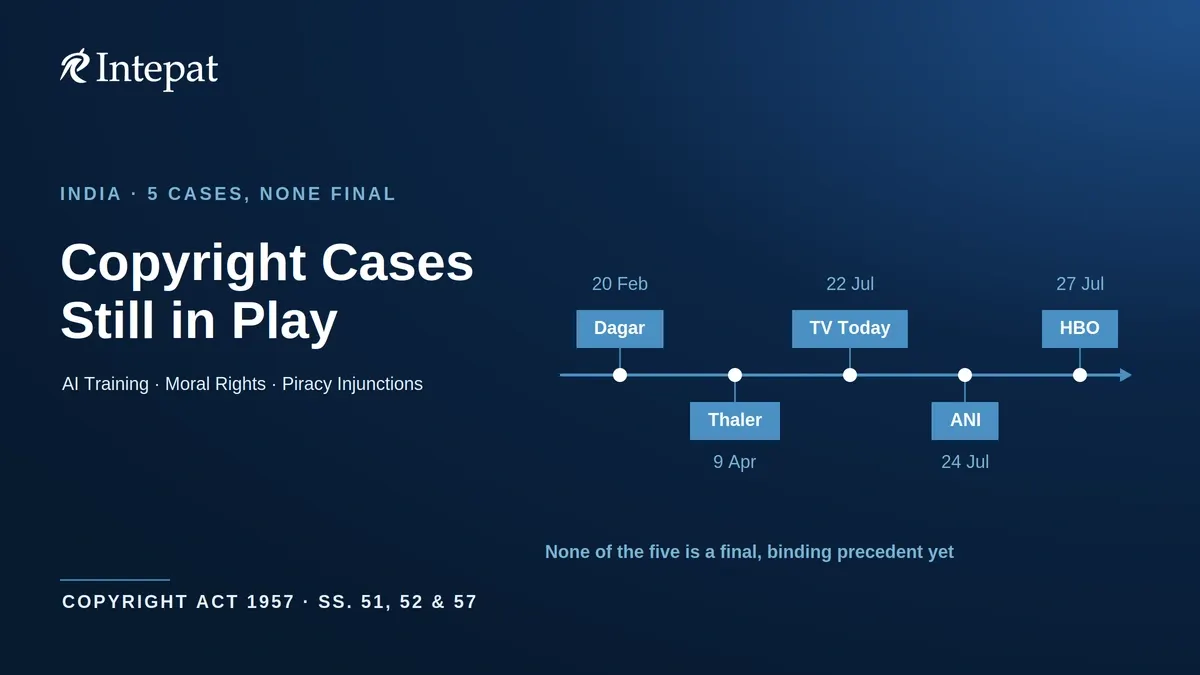
- ANI Media v. OpenAI (interim order, 24 July 2026): on a prima facie view, training an AI model on copyrighted news content was fair dealing under Section 52(1)(a); no interim injunction granted, and the suit continues on a separate claim.
- Dagar v. A.R. Rahman (2025-2026): a single judge’s interim order recognising a moral-rights claim over a musical adaptation was set aside on appeal; the Supreme Court then closed the special leave petition on a negotiated credit arrangement without ruling on the merits, which remain open in the pending Delhi High Court suit.
- HBO v. Streamzy.to (ad-interim order, 27 July 2026): 30 piracy sites blocked, but the court held that only it, not an internet service provider or domain registry, can decide whether a newly found mirror site is genuinely “rogue.”
- TV Today Network v. Meta Platforms (hearing, 22 July 2026): Meta’s counsel undertook in court to reverse two challenged copyright strikes and disclose subscriber information for the accounts behind them; the matter continues.
- Stephen Thaler v. Union of India (order, 9 April 2026): the Copyright Office was asked to actually progress, not decide, a four-year-pending application over AI-generated art, preferably concluding its hearing within eight weeks.
How Indian Copyright Law Moved in 2025-2026
When this article first covered five landmark copyright cases, the defining questions were about moral rights surviving assignment, streaming platforms and statutory licensing, and how far a website-blocking order could reach. Those questions haven’t gone away, but they have been overtaken by cases decided far more recently, and by a new question none of the 2019 cases touched: what happens when the thing accused of copying is not a person or a studio, but a language model.
The five cases below are all live or freshly decided as of late July 2026, and nearly all of them are still moving. The ANI suit continues to trial on a separate claim. The Dagar dispute’s underlying suit remains pending after a Supreme Court-brokered settlement on credits. The HBO injunction is ad-interim, with a further hearing already listed. The TV Today dispute is ongoing. The Copyright Office’s decision on Thaler’s application, if it has issued at all, was not confirmed at the time of writing. None of these is a final, settled precedent. Read together, they are the closest thing available today to a snapshot of how Indian courts are approaching copyright’s newest boundaries, and this page will be updated as each one moves.
ANI Media v. OpenAI: Does Training an AI Model Infringe Copyright?
Status: interim order on one application; the suit continues.
Asian News International sued OpenAI in the Delhi High Court in November 2024 (CS(COMM) 1028/2024), India’s first major AI-copyright suit. ANI alleged that ChatGPT had been trained on its copyrighted news content without a licence, and separately, that ChatGPT sometimes fabricated stories and wrongly attributed them to ANI. Given how novel the issues were, the court appointed two amici curiae, an intellectual property practitioner and a law professor, to assist it.
On 24 July 2026, Justice Amit Bansal declined to grant ANI an interim injunction. On a prima facie view taken for the purposes of that application, the court held that OpenAI’s storage of ANI’s content for training purposes fell within the fair dealing exception under Section 52(1)(a) of the Copyright Act, 1957, which excludes private or personal use including research, criticism or review, and reporting of current events from infringement, and so did not, at this interim stage, amount to infringement under Section 51. The bench also found that the retrieval-augmented outputs it examined were not substantially similar to ANI’s reporting, and that ANI had not shown that its specific articles were used to train the model or that the model had memorised or reproduced its work.
This is an interim finding on one application, not a final ruling that AI training is lawful in India as a general matter. ANI’s separate claim, that the chatbot fabricated content and wrongly attributed it to the agency, remains pending, and the suit as a whole continues. It is also one of a small and fast-growing number of rulings worldwide on whether training a generative AI model on copyrighted material is a permitted use, and reportedly the first from an Indian court, though any global comparison should be read loosely given how quickly this area is moving. For the wider picture, including how a similar question has played out elsewhere, see our coverage of IMI v. OpenAI. For the statutory exception itself, our guide to fair use of copyrighted works in India covers how the fair dealing doctrine under Section 52 is actually applied.
Ustad Faiyaz Wasifuddin Dagar v. A.R. Rahman: A Moral-Rights Dispute That Settled Without a Ruling
Status: underlying suit pending; no court has yet decided the merits.
Ustad Faiyaz Wasifuddin Dagar, representing the lineage of the Dagar family’s Dhrupad tradition, alleged that A.R. Rahman’s song “Veera Raja Veera,” composed for the film Ponniyin Selvan-2, reproduced a family composition, “Shiva Stuti,” without a licence or credit.
On 25 April 2025 (2025:DHC:2907), Justice Prathiba M. Singh granted interim relief: revised credits on OTT and online platforms acknowledging the Dagar family’s composition, a Rs. 2 crore deposit with the court registrar pending trial, and Rs. 2 lakh in costs to the plaintiff. The court grounded this in Section 57 of the Copyright Act, the right to claim authorship and the right to object to a modification prejudicial to honour or reputation, holding that these moral rights represent “the minimum acknowledgement that is required in respect of a copyrighted work.”
That order did not stand. On appeal, a Division Bench of the Delhi High Court set aside the interim relief, holding that “Shiva Stuti” lacked an identifiable author and that the claim had not been made out on a prima facie basis. The dispute then reached the Supreme Court by special leave petition. On 20 February 2026 (SLP(C) No. 4742/2026), a bench led by Chief Justice Surya Kant disposed of the petition on the basis of an agreement between the parties rather than deciding the underlying dispute, expressly recording that it expressed no opinion on the merits and that all issues remained open for the pending suit. The parties settled on revised platform credits describing the song as inspired by the Dagarwani Dhrupad tradition, and the security deposit was increased to Rs. 3 crore pending the outcome of the underlying suit, which continues in the Delhi High Court.
The result is not a judicial finding that this adaptation infringed the Dagar family’s moral rights, and it is not a finding that it didn’t. Every court that touched the merits either found the claim not yet made out or declined to rule on it at all. What actually happened is a negotiated, court-recorded credit arrangement and a continuing security deposit, with the substantive Section 57 question, whether an adaptation like this one infringes an author’s moral rights, still to be decided in the underlying suit. It is a useful illustration of how a moral-rights dispute over a modern film-song adaptation of a classical composition actually plays out procedurally, rather than a precedent for what Section 57 requires in that setting. For the underlying doctrine, see our explainer on moral rights in Indian copyright law.
Home Box Office v. Streamzy.to: How Far Can a Dynamic Injunction Reach?
Status: ad-interim order; next hearing already listed.
The dynamic injunction, an order that lets a rights holder extend an existing website-blocking order to newly discovered mirror or redirect domains without filing a fresh suit each time, originates from the Delhi High Court’s 2019 ruling in UTV Software Communications v. 1337X.TO, a case that headlined this article in its earlier form. That mechanism has been used repeatedly since, against a growing list of piracy operations targeting film, television, and sports broadcast content.
The most recent test of its limits came on 27 July 2026, when Justice Anup Jairam Bhambhani granted an ad-interim injunction in Home Box Office Inc. v. Streamzy.to (CS(COMM) 740/2026, 2026:DHC:5967), blocking 30 identified piracy websites streaming HBO content pending the next hearing. The court allowed the order to be extended to newly discovered mirror, redirect, or alphanumeric websites, but only subject to technical verification by internet service providers and domain name registries and continued oversight by the court; it declined to let intermediaries decide for themselves whether a new site qualifies as “rogue.” Final determinations of infringement, the court held, must rest with the court, not with intermediaries or the plaintiff acting unilaterally, and the blocking measures remain, in the court’s own words, a “pro-tem measure subject to further orders.”
This is a temporary order, not a final judgment, and a further hearing was already listed within days of it being passed. Read against UTV v. 1337X, it looks less like a further expansion of the dynamic injunction doctrine than a course correction on how it is administered: the mechanism that started in 2019 is still available and still growing in scale, but the court is reinforcing that it, not a private intermediary, decides where its boundary sits. For rights holders and platforms alike, our overview of website takedown actions against online IP infringement covers the practical mechanics of pursuing one of these orders.
TV Today Network v. Meta Platforms: When a Platform’s Own Copyright Strike Goes Wrong
Status: pending; based on hearing reports, no numbered order publicly available at the time of writing.
Not every 2025-2026 copyright dispute pits a rights holder against an alleged infringer. TV Today Network, which operates India Today and Aaj Tak, told the Delhi High Court in July 2026 that several of its own social media posts, including ones involving actors Vicky Kaushal, Timothee Chalamet, and Zendaya, had been hit with copyright strikes on Meta’s platforms, filed by anonymous account holders.
At a hearing on 22 July 2026, Meta’s counsel told the court it would “cut the controversy short,” undertaking to reverse the two challenged strikes and hand over Basic Subscriber Information and IP logs for the accounts behind them. The court recorded that undertaking and set deadlines, one month for the strike reversal and two weeks for the subscriber information, so TV Today could try to identify who was responsible. No case number or neutral citation for this proceeding was publicly available at the time of writing, so this account relies on contemporaneous hearing reports rather than a published order; the matter was reported to continue at a further hearing next month.
The case is a reminder that a platform’s own copyright-enforcement tools can be turned against the rights holders they are meant to protect, and that a court can secure both a correction and the identity of whoever filed a challenged strike, without that itself amounting to a finding that every such strike was made in bad faith, since the falsity of the underlying claims was not adjudicated on the merits. It sits alongside, rather than duplicates, the piracy-blocking and AI-training questions above: this is about accountability for a platform’s own enforcement machinery. For help navigating a wrongful takedown or building an enforcement strategy of your own, see Intepat’s copyright enforcement and takedown services.
Stephen Thaler v. Union of India: Pushing the Copyright Office to Rule on AI Authorship
Status: Copyright Office proceeding pending; the court did not decide the authorship question itself.
Stephen Thaler, the developer behind the AI system DABUS, applied to India’s Copyright Office in 2022 to register “A Recent Entrance to Paradise,” an artwork he says DABUS created autonomously. The application sat with the Copyright Office for roughly four years without a final decision.
Thaler moved the Delhi High Court, and on 9 April 2026 (W.P.(C)-IPD 15/2026 and CM 87/2026), Justice Tushar Rao Gedela disposed of the petition after being informed that the Copyright Office had scheduled a hearing for 27 April 2026. The court asked the Registrar of Copyrights to conclude that hearing preferably within eight weeks of the scheduled date, in accordance with law, a request for expedition rather than a mandatory deadline to issue a final decision. The order does not resolve the underlying authorship question, and it was not confirmed, at the time of writing, whether the Copyright Office had ruled following that hearing.
This is worth distinguishing from Thaler’s better-known DABUS patent litigation in India, where the Controller General of Patents refused to name DABUS as an inventor, a position Indian patent authorities have maintained consistent with most other jurisdictions. See our coverage of the DABUS patent-inventorship refusal for that side of the story. The Copyright Office is reported to have taken a similar view in its correspondence with Thaler, that only a natural person can be recognised as an author, though that position has not itself been tested in a reasoned court ruling. Copyright authorship and patent inventorship are governed by different provisions and different policy concerns, and as this case shows, the copyright question remains genuinely open in India.
What These Proceedings Mean Going Forward
Three threads run through all five matters. First, Indian courts are applying the existing, decades-old text of the Copyright Act, fair dealing, moral rights, jurisdiction, and injunctive relief, to fact patterns the Act’s drafters could not have foreseen, rather than waiting for Parliament to legislate specifically for AI or platform accountability. Second, generative AI is now squarely a live copyright issue in India, on both the infringement side, in ANI, and the authorship and registration side, in Thaler, though neither question has actually been decided yet. Third, the older concerns that once defined this space, moral rights, licensing, and piracy enforcement, remain very much active alongside the AI headlines, not displaced by them.
As the status notes above make clear, none of these five matters is a concluded, settled precedent, so treat every holding described in this article as the current interim position, not the final word, and expect this page to be updated as each case moves. If a recent ruling affects how your business handles content, licensing, or takedowns, Intepat’s copyright services team can help you work out what it means for you specifically.
FAQ
Not conclusively settled either way. The Delhi High Court’s 24 July 2026 interim order in ANI Media v. OpenAI held, on a prima facie view for the purposes of that application, that storing news content to train a model fell within the fair dealing exception under Section 52(1)(a). This was an interim-stage finding on one set of facts, and the broader suit remains pending on a separate claim. It is not a blanket rule that all AI training in India is automatically lawful.
Section 57 of the Copyright Act, 1957 lets an author’s legal representatives assert moral rights, the right to be credited and the right to object to a prejudicial distortion, independently of who owns the economic copyright. Whether a specific adaptation actually infringes those rights is a separate, fact-specific question. In the Dagar v. A.R. Rahman dispute, for example, an initial interim order recognising the claim was set aside on appeal for want of a clear finding on authorship, and the Supreme Court later closed the case through a negotiated credit arrangement without ruling on the merits, which remain to be decided in the pending suit.
A dynamic injunction lets a copyright owner extend an existing website-blocking order to newly discovered mirror or redirect domains without filing a fresh suit for each one, a mechanism the Delhi High Court introduced in UTV Software Communications v. 1337X.TO in 2019. Its ad-interim order of 27 July 2026 in HBO v. Streamzy.to kept the mechanism in place but required technical verification by intermediaries and held that only the court, not an internet service provider or domain registry, can make the final call on whether a newly found site is genuinely “rogue.”
Reported hearings suggest so. In TV Today Network v. Meta Platforms, Meta’s own counsel undertook in court to reverse challenged copyright strikes filed against a publisher’s content and to disclose the account details of whoever filed them, and the court recorded deadlines for both. That is a recorded undertaking followed by directions on process, not a final adjudication that the underlying strikes were false or made in bad faith.
This is still undecided. In Stephen Thaler v. Union of India, the Delhi High Court did not rule on whether an AI can be an author; it asked the Copyright Office to preferably conclude a scheduled hearing on Thaler’s long-pending 2022 application within eight weeks. The Office is reported to have taken the position, in correspondence rather than a reasoned order, that only a natural person can be recognised as an author.
The consolidated text, including Sections 51, 52, and 57 discussed above, is available on the government’s India Code portal.
This article is for general informational purposes and does not constitute legal advice. It was last legally reviewed on 28 July 2026. Every case discussed above is either at an interim stage, on appeal, or otherwise unresolved, several within days of this review, and the positions described may be varied, stayed, superseded, or overturned without notice. Verify the current status of any case, including through the court’s own record where a citation is given, before relying on it, and consult a qualified professional for advice on your specific situation.