




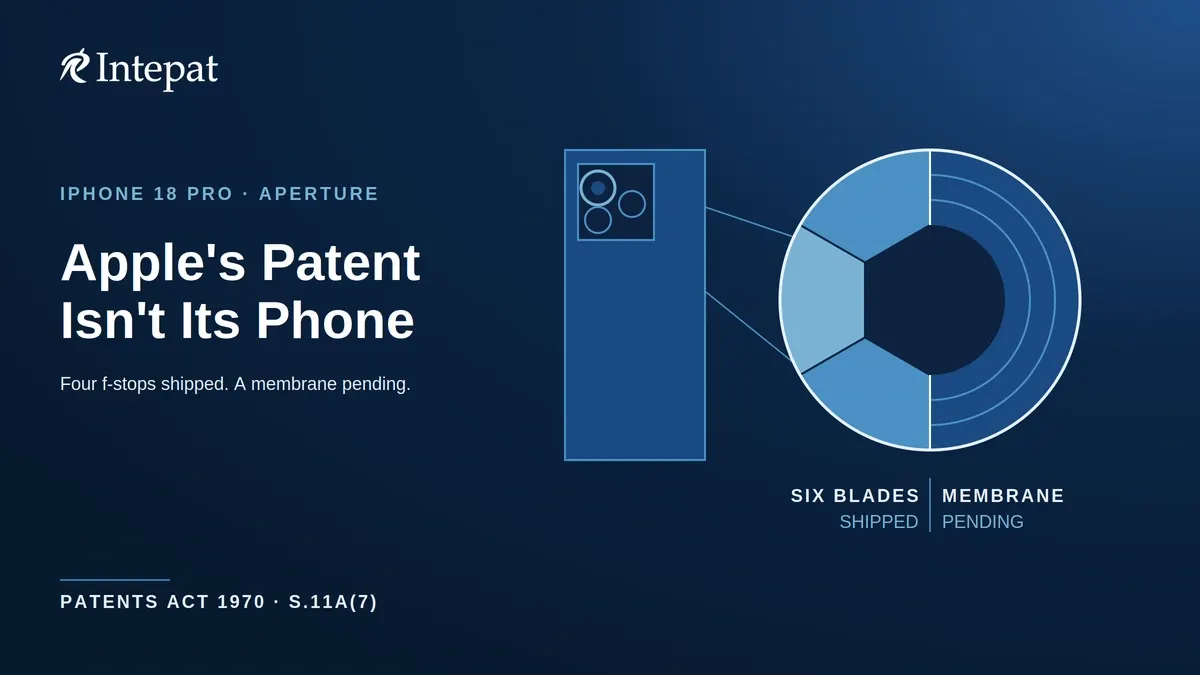
The Apple variable aperture patent now being cited alongside the iPhone 18 Pro is not a patent yet. It is a pending application, and it describes a flexible membrane whose aperture is varied by a rotor turning against a stator, with no blades in it. The phone that went on sale in September 2026 uses six mechanical blades instead.
If you read competitors’ filings to work out what they will launch, that gap is the thing to understand first, because your own Indian filings publish on a statutory clock of their own.
| Quick answer: |
| US 2025/0208484 A1 describes a flexible membrane whose aperture diameter a rotor varies as it turns against a stator, and it is still pending. The shipped camera uses six laser-cut blades. A published filing records where a competitor’s engineers were, not what they will sell. |
What Apple shipped, and what it did not
The iPhone 18 Pro variable aperture sits on one camera only. Apple’s specification reads “48MP Fusion Main with variable aperture (f/1.48, f/1.8, f/2.8, f/4.0)”. The Ultra Wide stays fixed at f/2.2 and the Telephoto at f/2.8. Everything that follows concerns that one main camera.
Apple describes six laser-cut blades of a polymer composite it says it designed, each “thinner than a human hair”, on “a new compact rotor mechanism”. Apple has said that fitting more blades in “becomes difficult to fit them all in” and that six was “the sweet spot”.
Left to itself the camera opens to f/1.48 in low light, holds f/1.8 for portraits and closes to f/4.0 for group photos, with f/1.8 as the default. Any of the four can be picked by hand, and Apple has opened the control to developers. What this amounts to is a miniaturised iris of the kind cameras have used for a century.
What the Apple variable aperture patent actually describes
Apple’s application, US 2025/0208484 A1, published on 26 June 2025, has no blades in it. A flexible membrane forms the aperture, and an electromagnetic actuator, magnets on a rotor against a coil array on a stator, turns one against the other to vary that aperture’s diameter.
Its background section is candid about the problem. Blade assemblies, it says, carry “many moving parts creating a high risk of failure”, they “occupy a significant amount of x, y, and z space in the camera module”, they “produce a hexagonal opening when in the fully actuated position”, and they are “unable to fully close the aperture”. Those four drawbacks are what the membrane approach is aimed at.
The description is specific about materials and dimensions. The membrane may be silicone, a fluorocarbon, a fluorosilicone, a polyacrylate, a nitrile or a neoprene among others, and must be “optically opaque so as to prevent light from passing therethrough”. Thickness is given as no more than about 100 µm and no less than about 30 µm, with about 50 to 100 µm stated elsewhere. Above roughly 175 µm, a thickness the stated range already excludes, the description warns that the folds produced during actuation “may begin to” cost the membrane its circular close and leave an octagonal or hexagonal shape instead.
Worth noting for later: the description does not stop at one actuator. It names piezoelectric and shape-memory alloy actuators as alternatives.
One point of continuity survives into the product. The application turns a rotor against a stator; Apple describes the shipped mechanism as rotor-driven too, which is as far as Apple’s own words go. The aperture element is what changed. And everything quoted above is description. A specification’s claims, the numbered list at its end, are what fixes what a patent stops others doing, and this application’s claims could not be retrieved on any route tried for this piece.
Apple has worked this problem three ways since 2014
Reading one application alone gives a misleading picture of where a company stands. This is at least the third distinct route Apple has taken to the same functional outcome, and the second it has been shown to have filed on.
| Approach | Document | Status | Mechanism |
| Electro-optic | US 9,851,613 B2, priority February 2014, granted December 2017 | Granted | An electro-optic aperture including an electrochromic element, “sandwiched between a front lens and a rear lens”. No moving parts |
| Soft membrane | US 2025/0208484 A1, priority December 2023, published June 2025 | Pending | A membrane turned by a rotor against a stator. No blades |
| Mechanical iris | No Apple filing publicly identified | Shipped September 2026 | Six laser-cut polymer composite blades on a compact rotor |
That third row is a silence, not a fact. A filing made near the launch would still be inside the publication window described in the next section, so no publication is not the same as no filing. The two documented filings are nearly ten years apart by priority date, and the route that reached customers is the one closest to established practice. That is what a functioning patent portfolio looks like from outside: it brackets the option space rather than announcing a roadmap.
Why a published application lags the product by years
A published application is old news by the time anyone reads it, and the lag is set by statute rather than strategy. In the United States an application “shall be published… promptly after the expiration of a period of 18 months from the earliest filing date for which a benefit is sought” (35 USC 122(b)(1)(A)).
One escape route in that section is a nonpublication request. It must be made upon filing, and only by an applicant certifying the invention “has not and will not be the subject of an application filed in another country, or under a multilateral international agreement, that requires publication of applications 18 months after filing”. Apple filed a PCT application in this family on 21 December 2024, so that route was closed to it.
India runs the same kind of rule with different levers. Save as otherwise provided, an application is not ordinarily open to the public for the period prescribed under Section 11A(1) of the Patents Act 1970. An applicant who wants it out sooner asks the Controller, before that period expires, under Section 11A(2), which is the route the early publication request follows.
There is no Indian equivalent of the American opt-out. Publication is withheld only in the three cases Section 11A(3) lists: a secrecy direction is in force, the application has been abandoned, or it is withdrawn three months before the period expires. Withdrawal is the deliberate one, and its three-month lead time is what a founder reconsidering in favour of secrecy has to plan around.
Publication is not only exposure, and the upside has a statutory basis. From the date of publication until grant, Section 11A(7) gives the applicant “the like privileges and rights as if a patent for the invention had been granted on the date of publication”, with the first proviso that no infringement proceedings may be instituted until the patent is granted. Accelerating publication starts that clock early. A pending application is a live asset for that reason, and nothing about the iPhone 18 Pro says Apple has abandoned the membrane route for a later generation.
The field was already crowded before Apple’s priority date
Physical variable aperture in a phone is not new, and what counts is not what shipped before the iPhone but what existed before Apple’s priority date of 22 December 2023. Three rivals are usually named, and dating each one against that date rather than against the launch changes the picture.
Samsung announced a two-position mechanism on the Galaxy S9 on 25 February 2018, described in its own announcement as “Dual Aperture” with “F1.5 mode and F2.4 mode”. Huawei’s Mate 50 Pro advertises an “Adjustable Physical Aperture of 10 sizes” from an “F1.4 ultra-large aperture”.
Xiaomi’s 14 Ultra specifies an “f/1.63-f/4.0 stepless variable aperture”, but it launched globally on 25 February 2024, two months after Apple’s priority date, so it is context rather than prior art against this family. Sorting the field by priority date rather than by launch date is the first thing a prior art search does.
That matters in India in a specific way. Section 2(1)(l) treats an invention as new only where it has not been anticipated by publication in any document “or used in the country or elsewhere in the world” before the filing date of the complete specification. Novelty here is absolute and worldwide: a rival’s launch in Seoul counts, and so does your own demonstration anywhere.
Huawei’s published application WO 2024/036447 A1 recites “main blades defining central and fixed apertures” and “supplemental blades defining minimum and maximum apertures”. It was filed on 15 August 2022, well before Apple’s priority date, though it did not publish until 22 February 2024. Whether an application filed earlier but published later bites against a given priority date turns on provisions beyond Section 2(1)(l) and is a question for your agent rather than an assumption. Either way the interesting question is rarely the concept but the structure, and how a claim is construed decides what a structural claim is worth.
How Indian law would frame the same mechanism
An Indian examiner would test novelty first, then inventive step. Section 2(1)(ja) defines that as a feature involving “technical advance as compared to the existing knowledge or having economic significance or both” and making the invention “not obvious to a person skilled in the art”.
Section 3(f) sits alongside it, putting outside the definition of invention “the mere arrangement or re-arrangement or duplication of known devices each functioning independently of one another in a known way”. Rotors, stators, magnet-and-coil actuators and elastomer membranes are each individually known, so an examiner may reach for the clause. It bites only where the known devices each function independently in a known way, though, not merely because the components are known. The Manual makes the same point about obviousness at paragraph 09.03.03.02: it is not sufficient to conclude that an invention is obvious merely because individual parts taken separately are known.
On the clause itself, the Manual at 09.03.05.06 frames the question around working interrelation. Where old integers placed together have some working interrelation producing a new or improved result, there could be patentable subject matter in that interrelation; merely placing them side by side so that each performs its own function independently of the others is not a patentable combination. The Manual carries a wider formulation too, from Lallubhai Chakubhai v Chimanlal and Co (AIR 1936 Bom 99): a combination is patentable where its elements produce a new result or arrive at an old result in a better, more expeditious or more economical manner. A device doing a known thing in a genuinely better way is not disqualified. The Manual attributes the working-interrelation approach to Biswanath Prasad Radhey Shyam v Hindustan Metal Industries (1979) 2 SCC 511. All of this is Registry practice commentary rather than statute, and yields to the Act on any conflict.
Clearing Section 3(f) is not the end of it. The Manual adds that a combination must be more than a mere workshop improvement and must independently satisfy the test of inventive step. Whether twisting one ring against another to form an optical aperture is a working interrelation producing a new result is arguable either way, which is why it is worth settling before the specification is drafted, not after the first examination report.
What an Indian applicant should take from this
File on the alternatives you rejected, not only the one you like. Apple’s own membrane specification at least discloses them, naming piezoelectric and shape-memory alloy actuators beside the magnet-and-coil arrangement it describes in detail.
What its claims cover is a separate question this piece cannot answer. Write structural claims, though, because the function was old before you arrived and the specific arrangement is what you own.
Build the filing programme around the publication date rather than the grant date, and confirm the current prescribed period with your agent, since it is fixed by the Rules rather than the Act. If any part of that programme involves filing abroad, Section 39 requires a resident to obtain the Controller’s written permit before making a foreign application, unless an Indian application for the same invention was filed at least six weeks earlier and no secrecy direction is outstanding.
And read a competitor’s published application as evidence of where their engineers were two years ago, not as a preview of next year’s product. The two Apple filings visible in 2025 would have told a reader that Apple was working the aperture problem hard. Neither would have said what the phone would contain.
None of this needs a budget to begin. Published applications and grants are searchable free through Espacenet, Patentscope and, for Indian filings, InPASS. What free search will not give you is the shape of the field, which is where a patent landscape analysis and a considered filing strategy start.
This article is general information and not legal advice, stated as at September 2026. Patentability turns on the specific disclosure, the claims as drafted and the prior art cited in a given examination, and nothing here should be relied on for any particular application. For advice on a specific invention or filing programme, speak to a registered patent agent.
Sources
- Apple Inc, “Apple debuts iPhone 18 Pro and iPhone 18 Pro Max”, Apple Newsroom, 9 September 2026. https://www.apple.com/newsroom/2026/09/apple-debuts-iphone-18-pro-and-iphone-18-pro-max/
- Apple Inc, iPhone 18 Pro and 18 Pro Max Technical Specifications, camera section. https://www.apple.com/iphone-18-pro/specs/
- “Apple explains why the iPhone 18 Pro has a variable aperture”, PetaPixel, 19 September 2026. https://petapixel.com/2026/09/19/apple-explains-why-the-iphone-18-pro-has-a-variable-aperture/
- US Patent Application Publication 2025/0208484 A1, “Camera Module With Variable Lens Aperture With Soft Membrane”, Apple Inc, application 18/976,130, published 26 June 2025. https://patents.google.com/patent/US20250208484A1/en
- US Patent 9,851,613 B2, “Electro-optic variable aperture lens”, Apple Inc, granted 26 December 2017. https://patents.google.com/patent/US9851613B2/en
- WO 2024/036447 A1, “Variable aperture device for camera module and product including the same”, Huawei Technologies Co Ltd, filed 15 August 2022, published 22 February 2024. https://patents.google.com/patent/WO2024036447A1/en
- 35 U.S.C. § 122(b), Cornell Legal Information Institute. https://www.law.cornell.edu/uscode/text/35/122
- The Patents Act 1970, ss. 2(1)(ja), 2(1)(l), 3(f), 11A and 39, as amended to 1 August 2024.
- Manual of Patent Office Practice and Procedure, CGPDTM, version 3.0, 26 November 2019, paragraphs 09.03.03.02 and 09.03.05.06.
- Samsung Electronics, “Built for the Way We Communicate Today: Samsung Galaxy S9 and S9+”, 25 February 2018. https://news.samsung.com/global/built-for-the-way-we-communicate-today-samsung-galaxy-s9-and-s9-plus
- Huawei Technologies, HUAWEI Mate 50 Pro product page. https://consumer.huawei.com/uk/phones/mate50-pro/
- Xiaomi, Xiaomi 14 Ultra specifications. https://www.mi.com/global/product/xiaomi-14-ultra/specs/
- “Xiaomi 14 Ultra launched globally with Leica quad camera and a stepless variable aperture”, Digital Camera World. https://www.digitalcameraworld.com/news/xiaomi-14-ultra-launched-globally-with-leica-quad-camera-and-a-stepless-variable-aperture