




Prior art is everything publicly published, used, or known before your patent application’s filing or priority date. Indian law tests it two ways: one document can defeat novelty on its own, but the Patent Office may combine several documents to defeat an inventive step. A prior art search finds this material before you rely on its absence.
This article states Indian law under the Patents Act 1970, as amended through August 2024, the Patents Rules 2003, as amended through November 2025, and the Manual of Patent Office Practice and Procedure, Version 3.0; no later amendment affecting prior art search has been notified. A prior art search matters at three points: before you file, when the Examiner runs one; after grant, when a granted claim can still be attacked on prior art the Examiner missed; and before you launch, when the same techniques, aimed at other people’s claims, start a separate freedom-to-operate check, whether your own product would infringe a claim someone else holds.
Quick answer
- Prior art is everything publicly published, presented, used, or otherwise disclosed before your filing or priority date, in patents and in ordinary technical literature. The Patents Act does not define “prior art” as a term; only the Manual of Patent Office Practice and Procedure does.
- One prior art document can defeat novelty by itself. The Office may combine several documents to defeat an inventive step, but only where a document itself points the skilled person toward combining them.
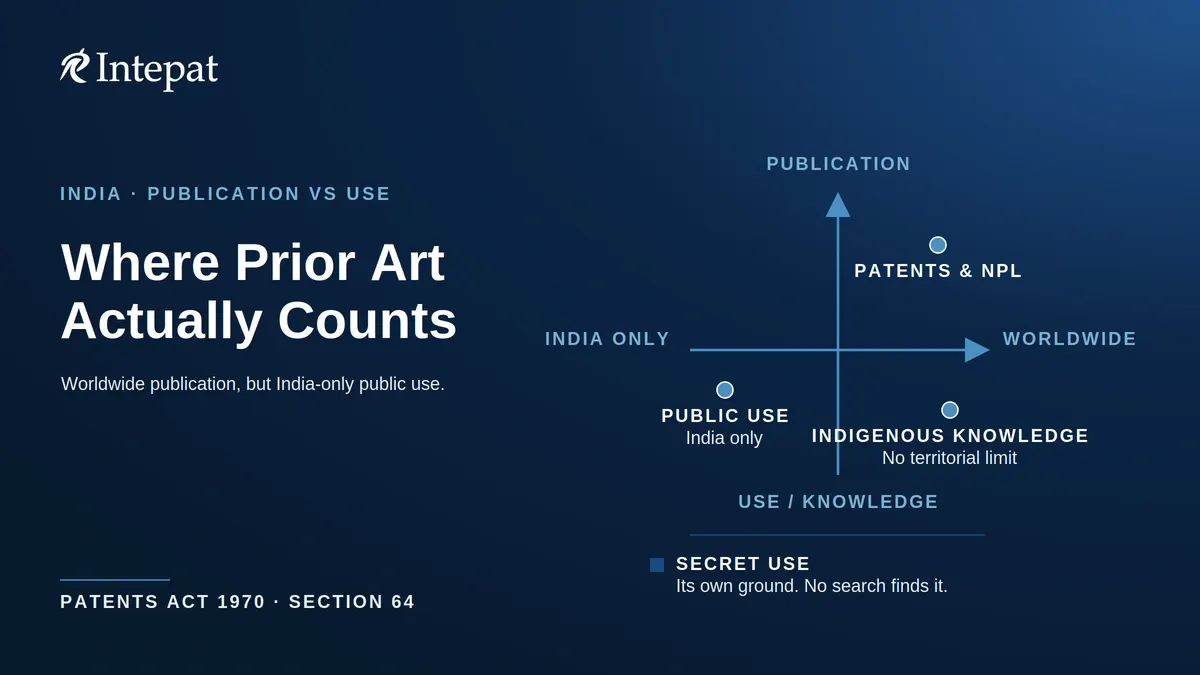
- Publication counts worldwide. Public use or public knowledge counts only in India for the grounds patents are actually challenged on; secret use in India is treated as a separate, independent risk of its own.
- Grant is not clearance. The law is explicit that the Examiner’s search “shall not be deemed in any way to warrant the validity of any patent,” so prior art you never searched for can still surface after grant.
- No search replaces judgment. The Patent Office’s own guidance on AI-assisted search keeps a human in charge: any AI-assisted output “shall be critically reviewed, assessed and adopted only after the officer is personally satisfied as to its correctness, relevance and appropriateness.”
What counts as prior art under Indian law
Prior art means everything publicly published, used, or otherwise made known before your filing or priority date, in patents and in ordinary technical literature such as papers, manuals, and websites. That is a working definition, not a statutory one. The Patents Act 1970 does not define the phrase “prior art”; its own operative language is anticipated, state of the art, and publicly known or publicly used. The definition practitioners actually search against comes from the Manual of Patent Office Practice and Procedure instead: an invention is novel “if it has not been disclosed in the prior art, where the prior art means everything that has been published, presented or otherwise disclosed to the public before the date of filing/priority date of complete specification.”
That definition covers two distinct bodies of material. Patent literature is the granted patents and published applications in the Indian Patent Database, which the Examiner searches from 1912 onward, plus the equivalent foreign collections. Non-patent literature, usually shortened to NPL, is everything else: journal articles, conference papers, theses, standards, product manuals, websites. NPL matters disproportionately, because researchers routinely publish before they file a patent, so a paper can anticipate an invention long before any matching application turns up in a database search. A search confined to patent databases misses that material by design, not by accident.
The Examiner’s own search covers two different questions when your application is reviewed, and only one of them is prior art in the everyday sense. The first checks whether your invention was already publicly known anywhere, through a patent or ordinary publication. The second is a prior-claiming check: whether somebody else already filed, or already holds an earlier priority date for, the same invention in an application that was not yet public when you filed. That second risk will not show up in an ordinary prior art search at all, since the earlier application was still secret at your filing date.
How prior art defeats novelty, and defeats an inventive step differently
Prior art does not do the same job for novelty and for inventive step, and the difference decides how a search should be built. For novelty, the Manual sets a strict, single-document test: a prior art disclosure only defeats novelty if “all the features of the invention under examination are present in the cited prior art document,” and disclosure can be explicit or implicit, but “mosaicing of prior art documents is not allowed” for this purpose. You cannot stitch two references together to argue an invention was not new; one reference has to carry the whole thing.
For inventive step, the rule reverses. Mosaicing is permitted here, but only “if the cited prior art provides lead to the skilled person to combine the teachings thereunder,” judged as at the filing or priority date. Something in the prior art itself has to point a skilled person toward the combination; hindsight from the invention does not count. One asymmetry is worth knowing before you read a search report: a generic disclosure does not necessarily anticipate a specific one (the Manual’s own example is that a metal spring may not take away the novelty of a copper spring), but a specific disclosure does take away the novelty of a generic one (a copper spring does take away the novelty of a metal spring).
The “person skilled in the art,” a hypothetical competent worker rather than an unusually inventive one, belongs to inventive step specifically; novelty’s test above never invokes a skilled person at all. For inventive step, the Manual draws on the Supreme Court’s judgment in Biswanath Prasad Radhey Shyam v. Hindustan Metal Industries, then sets out its own working checklist: identify the skilled person and their general knowledge at the priority date, identify what the claim actually adds, and ask whether the gap between the prior art and the claim would have been obvious to that person without already knowing the answer.
Publication anywhere, but public use only in India
Section 64 of the Act sets out the grounds for revoking a patent, and where the prior art has to come from is not the same for every kind of disclosure it covers. Getting this wrong is the most common way a founder misjudges their own risk. Publication, whether in a patent specification or in ordinary literature, counts wherever in the world it happened. Public use and public knowledge count only if they happened in India. A product quietly on sale in Germany for years before your filing date will not count against you unless it was also published somewhere.
One twist matters for process patents. If your patent covers a process, or a product made using that process, importing a product made abroad by that process into India counts as use in India from the date it arrives, unless the import was only a short trial. The same rule applies when a granted patent is opposed rather than revoked, so it shapes an Examiner’s or opponent’s view before grant, not only a court’s view after.
Secret use is a different risk again. Using an invention secretly in India before your priority date can, on its own, be enough to revoke a patent, with no publication or public knowledge needed at all. Only three narrow situations take secret use off the table: a genuine trial or experiment, Government use after you disclosed the invention, and someone else’s use after your disclosure but without your consent. The same rule that shields secret trials and personal documents from counting as evidence for novelty or inventive step also excludes secret use itself from that analysis, but none of that stops secret use from being its own, independent ground for revocation, so secret use outside those three situations stays a live risk that no prior art search will ever find, since by definition it was never published.
Two further grounds sit entirely outside the India-only limit, and a thorough search brief should not ignore them. A claim can be challenged for anticipation by knowledge held within a local or indigenous community, in India or anywhere else, with no territorial limit. And the Act’s own definition of a new invention is broader still, speaking of publication or use “in the country or elsewhere in the world.” In practice, patents are actually challenged on the narrower, India-only grounds described above, which is why this guide follows their line, but flag both wider categories in your own search brief rather than assume the India-only limit is the whole story.
When your own earlier disclosure doesn’t count against you
India has no general grace period. If you publish, demonstrate, or sell your own invention before you file, that disclosure ordinarily counts against your own later application, the same as if it were anyone else’s. The Act carves out five narrow exceptions, and a prior art search should be read against them, not just against the general anticipation of invention rules, which set out each exception’s conditions in full:
- Disclosure obtained from you without your consent. Not anticipation, provided you filed as soon as reasonably practicable after learning of it, and had not commercially worked the invention in India other than for reasonable trial.
- Disclosure to Government for investigation. Not anticipation.
- Display or use, with your consent, at a Central-Government-notified exhibition, or a paper you read (or publish with your consent) before a learned society. Not anticipation if you file within twelve months of the exhibition opening, or the paper being read or published, but claiming this exception is not automatic: it requires a separate request on Form 31, with the prescribed fee.
- Public working in India within one year before your priority date, by you or with your consent. Not anticipation if it was genuinely for reasonable trial and it was reasonably necessary, given the invention’s nature, for that trial to be carried out in public.
- Matter already in your provisional specification. Stays protected if anyone uses or publishes it, with or without your involvement, any time after you filed that provisional.
None of this shifts the burden onto the Examiner. The Manual is explicit that once a document is cited as an anticipation, “the onus of proving that the same is not to be an anticipation by reason of Section 29-34, lies on the applicant.” A search that finds your own earlier disclosure is not necessarily bad news, but expect to argue the exception yourself, not assume the Office will apply it for you.
Why a granted patent doesn’t mean your prior art risk is over
Grant is not the finish line. The law is explicit that the Examiner’s own search “shall not be deemed in any way to warrant the validity of any patent.” Grant means that search did not turn up disqualifying prior art. It is not a certificate that none exists.
The law gives you several ways to close that gap using prior art the Examiner missed:
- Before grant. File a representation opposing the application.
- Within one year of the publication of grant. File a post-grant opposition.
- After that window. The same prior art can still support a full revocation petition to the High Court, with no comparable time limit, or a defence in an infringement suit.
- At any time after grant. If the invention was already claimed, with an earlier priority date, in another Indian patent, the prior-claiming risk covered earlier has its own post-grant version: the patent can be revoked.
Whether a competitor’s granted patent is worth worrying about, or your own newly granted patent is as strong as it looks, is what an invalidity search answers, using the same concepts aimed at a claim already granted. The patent invalidity search guide covers those grounds and routes, in India and elsewhere, in detail.
There is a second reason to search even when you are not the applicant. The law protects a defendant who proves they were unaware of the patent and had no reasonable grounds to believe it existed, by blocking damages or an account of profits against them, though a court can still grant an injunction either way. A documented search that turns up a blocking patent removes that defence going forward. This is a freedom-to-operate question, whether a product infringes someone else’s claim, not the novelty or inventive-step question this article otherwise covers; the two searches share technique but ask different legal questions. Searching earlier, so you can design around what you find, protects you more than searching never.
Where to run a prior art search, once you know what counts
No single database reaches everything described above, so the search has to be built from several. InPASS, the Patent Office’s own tool, is the natural starting point for the Indian Patent Database itself. WIPO’s PatentScope has carried India’s national collection since 2018, alongside the PCT collection. Espacenet covers patent documents from a wide range of national and regional offices, though its own operator calls it “an entry-level, internet-based patent document search service” and warns that “a null result from an espacenet search, for example, should not be interpreted as freedom of action.” Google Patents is useful for a first pass and for its reach into non-patent literature, but as of this writing India is not on its own list of offices it indexes full text from, so a keyword sitting only in the body of an Indian specification cannot be relied on to surface there.
Classification searching is the counterweight to keyword recall: it survives the vocabulary problem keyword search cannot, since two documents describing the same idea in different words still share a classification code. The Indian Patent Office classifies on the International Patent Classification, and the Manual lists classification as the first thing an Examiner records about their own search. The mechanics of running keyword, classification, and citation searches, and comparing free tools against paid platforms, are covered in Intepat’s guide to patent search techniques and tools; this article is about what the search is for, not how to click through it. If the open question is which search to commission at all, the guide to the types of patent search maps each type to the decision it serves.
Search itself is changing. The Patent Office’s own guidance on AI in examination is direct about where the human stays in charge: “the Examiner or Controller shall remain fully responsible for every official act performed in the course of search and examination which involves the use of AI in any manner,” and any AI-assisted output “shall be critically reviewed, assessed and adopted only after the officer is personally satisfied as to its correctness, relevance and appropriateness.” The USPTO ran a differently shaped pilot of its own, now closed: petitions were accepted from October 2025 until an extended deadline of June 1, 2026. An AI tool searched and ranked prior art, sent the ranked notice to the applicant, and placed a copy in the application file, where the examiner considered it alongside, not in place of, the examiner’s own search. Either way, the tools are getting faster at finding candidate documents; deciding whether a candidate actually anticipates your claim is still a judgment call, not a search-engine result.
What a search brief should capture
Whoever runs your search, in-house or an outside firm, should be able to show their work in the same way an Examiner’s own file does:
- Classification. The classification codes used to scope the search.
- Search strategy. How the search was structured and run.
- Keywords. The keywords used, including synonyms and technical variants.
- Databases. The databases consulted, for patent and non-patent literature separately.
- Findings. The documents found, together with the analysis regarding patentability, not just a list of hits.
- Limitations. Any limitation, such as unclear claims, that kept the search from being complete.
That is Patent Office practice, not law (the Manual’s own preface says it carries no “force and effect of law”), but it is still the closest published benchmark for what a thorough search record looks like. A private search brief that cannot answer those same questions cannot be defended later, to a buyer, an opponent, or your own management.
The search has a second destination besides your own filing decision. It needs to reach your patent drafter, since your specification has its own duty to name “the closest prior art known to the applicant” whenever your invention improves on an existing product or process, so whatever the search finds should not just sit in a file.
There is a practical reason not to treat this as paperwork. The Patent Office’s own examination capacity is not keeping pace with filings: its 2024-25 annual report records 110,375 patent applications filed, up about 19.75 percent on the year before, against 90,971 requests for examination filed and only 40,606 disposed of in the same period. That gap means you cannot assume the Examiner’s own search will reach your application quickly, or cover every source a dedicated private search would. The brief is what lets you, rather than the queue, decide how thorough your search needs to be.
Before you file, what a clean result does and doesn’t tell you
A search that comes back clean narrows your risk. It does not remove it, and the databases say so themselves. WIPO’s own guidance on patent information states plainly that “at present no database has complete coverage of all patent documents ever published worldwide.” Recently filed applications add a structural blind spot: an application is ordinarily not published until eighteen months from its filing or priority date, so a competitor’s application filed, or claiming a priority date, just before yours can still defeat you through the prior-claiming rule covered earlier, and no search, however thorough, can see it before it publishes.
None of this is a reason to skip a prior art search; it is a reason to read the result correctly. A clean result means nothing was found within the limits of the databases searched, the languages covered, and the still-unopened eighteen-month window. It supports a filing decision. It does not warrant one, in exactly the sense grant itself does not.
Frequently asked questions
Prior art is everything publicly published, presented, used, or otherwise disclosed to the public before your patent application’s filing or priority date, whether in a patent, a journal article, a product manual, or public use. The Patents Act does not define the term; the Manual of Patent Office Practice and Procedure does, and the Examiner runs their own prior art search when reviewing your application.
No authoritative source draws a firm line between the two terms, and the distinction between a prior art search and a patentability search is usually a matter of scope: a prior art search gathers the documents, while a patentability search applies a legal assessment, novelty, inventive step, and subject-matter eligibility, on top of them.
No. A prior art search asks whether your invention is novel and involves an inventive step. A freedom-to-operate search asks whether making, using, or selling your product would infringe someone else’s granted claim. The two use similar techniques but answer different legal questions, and a clean result in one does not answer the other.
Not for novelty: the Manual states that mosaicing several documents together is not allowed there, so one document has to disclose the whole invention on its own. For inventive step, the Office can combine documents, but only where the prior art itself would have led a skilled person to combine them at the relevant date, not with hindsight from your invention.
No. The law is explicit that the Examiner’s search “shall not be deemed in any way to warrant the validity of any patent.” A granted claim can still be attacked on prior art, within a year of the publication of grant through a post-grant opposition, or afterward through a revocation petition or an infringement defence.
India has no general grace period, so your own earlier disclosure is ordinarily prior art against your own application. The law carves out narrow exceptions, including a twelve-month window after a notified exhibition or a paper read before a learned society, but the burden of proving an exception applies sits with you, not the Examiner.
Start with InPASS for the Indian Patent Database, WIPO’s PatentScope for the Indian collection alongside the PCT record, and Espacenet, which calls itself entry-level rather than professional. As of this writing, Google’s own patent search does not index Indian specifications in full text. A self-run search is a useful first screen, not a substitute for a professional patentability or freedom-to-operate opinion.
This article explains prior art and prior art search under Indian patent law as at August 2026 and is for general information only. It is not legal advice. The statutory periods discussed here, including the twelve-month window under section 31 and the one-year window for post-grant opposition under section 25(2), run strictly, and missing one can cost you the remedy. Confirm the current position and, for advice on your specific invention, consult a registered patent agent.