




A photograph qualifies as an artistic work under the Copyright Act 1957, and copyright arises automatically on creation. Ownership belongs first to the photographer, subject to several exceptions in Section 17. This article explains who owns copyright in a photograph in India, what rights apply, how long protection lasts, and when use is permitted without consent.
Quick Answer The person who takes a photograph is ordinarily the first copyright owner under Section 17 of the Copyright Act 1957. Where a photograph is commissioned for valuable consideration, the commissioning party is the first owner by default. Copyright in a photograph lasts for the lifetime of the photographer plus sixty years. Reproducing, distributing, or publishing a photograph without the owner’s permission is infringement. Fair dealing under Section 52(1)(a) is available for private use, criticism, and reporting of current events.
What Counts as a Photograph for Copyright Purposes
Section 2(c) of the Copyright Act 1957 defines “artistic work” to include “a painting, a sculpture, a drawing (including a diagram, map, chart or plan), an engraving or a photograph, whether or not any such work possesses artistic quality.” Section 2(s) defines “photograph” as including a photo-lithograph and any work produced by any process analogous to photography, but not any part of a cinematograph film.
Two points from these definitions matter in practice. First, a photograph does not need to display any particular aesthetic quality to receive copyright protection: the statute explicitly removes artistic quality as a requirement. Second, the definition covers any process analogous to photography, which in current practice includes digital capture. A still frame extracted from a video or film falls outside the definition of “photograph” because Section 2(s) excludes any part of a cinematograph film. That does not make the still free to use: copying or publishing it may still infringe the copyright in the cinematograph film under Section 14(d) of the Act, which expressly includes the right to make a photograph of any image forming part of the film.
For copyright to subsist in any artistic work, Section 13(1)(a) of the Act requires that the work be original. The Act does not define originality for photographs, but the courts have settled on a standard of skill and judgment: some element of creative or technical choice by the photographer, such as framing, angle, lighting, or moment of capture, brings a photograph within the requirement.
Who Is the First Owner of Copyright in a Photograph
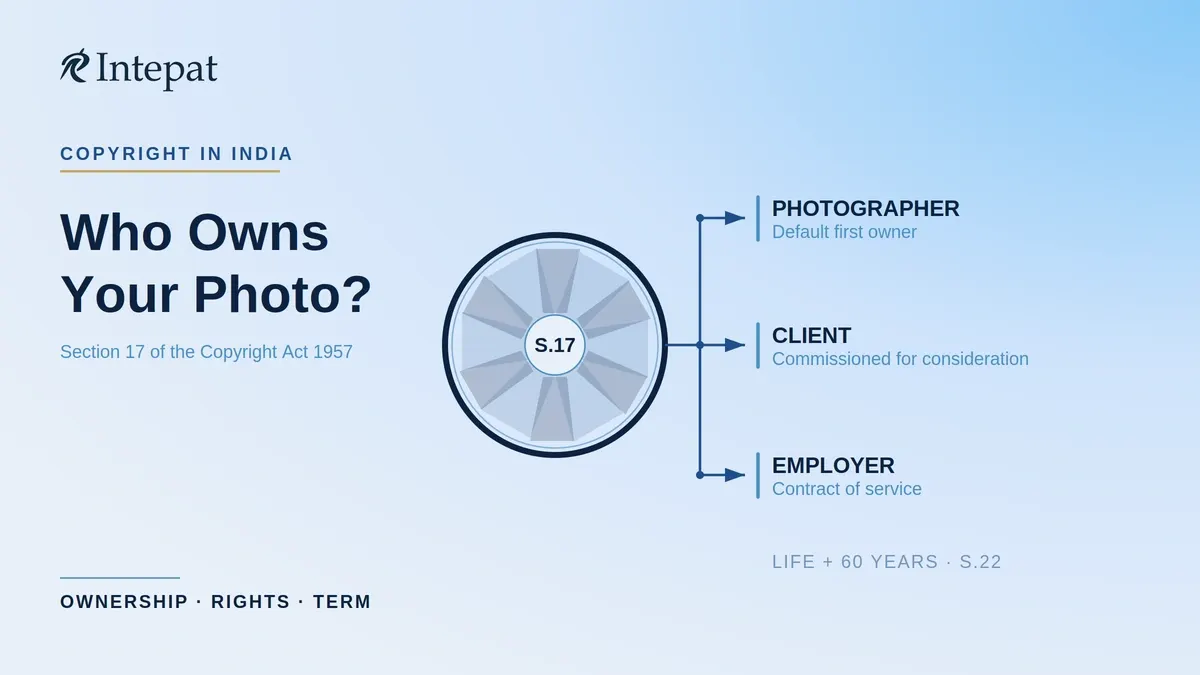
The default rule under Section 17 of the Copyright Act 1957 is that the author of a work is the first owner of copyright. Section 2(d)(iv) identifies the author of a photograph as “the person taking the photograph,” meaning the photographer. Section 17 contains several provisos that displace this default. The two most relevant in photography disputes are commissioned photographs and photographs taken in the course of employment.
Commissioned photographs. Section 17, proviso (b) provides that where a photograph is taken for valuable consideration at the instance of any person, that person is, in the absence of any agreement to the contrary, the first owner of the copyright. Two conditions must be satisfied: the photograph must have been taken in exchange for valuable consideration, and the commission must have been at the instance of the commissioning party. The provision is a default, not a mandatory rule: the parties may agree to allocate ownership differently in their contract.
Employment. Section 17, proviso (c) provides that where a work is made in the course of an author’s employment under a contract of service or apprenticeship, and neither proviso (a) nor proviso (b) applies, the employer is, in the absence of any agreement to the contrary, the first owner of the copyright. A staff photographer shooting images as part of their employment duties would not ordinarily own the copyright in those images. Proviso (a) carves out a specific sub-case for works created by journalists employed by newspapers or periodicals: the employer holds the copyright only for publication in that periodical and its reprints; in all other respects the author remains the first owner.
Ownership in practice: four common situations.
A client who hires and pays a photographer for a wedding, product shoot, or corporate event is ordinarily the first copyright owner of the resulting photographs, unless the contract says otherwise.
A staff photographer employed by a business owns the copyright in images taken as part of their employment duties, but that copyright belongs to the employer by default.
A freelance photographer retains copyright by default if there is no agreement requiring assignment. A usage licence granted to the client is not the same as a transfer of ownership: the photographer can grant a client the right to use specific photographs without giving up copyright.
A photographer who uploads their own images to a social media platform retains copyright. The platform receives a licence under its terms of service but does not acquire ownership.
Ownership is not the same as permission to use. A person may have a licence to use a photograph for a specific purpose, such as a website, brochure, or social media post, without owning the copyright. The contract or licence should specify which uses are permitted, for how long, and in which territories. Where a contract is silent, the scope of permission is interpreted narrowly.
Photographs of people. Copyright ownership in a photograph is separate from the rights of the person appearing in it. A photographer who owns the copyright may still face constraints when using a photograph commercially or in a way that identifies the subject without consent. Privacy, publicity, and related rights are not governed by the Copyright Act 1957 but may be relevant under other law.
These provisions are often not reflected in the agreements photographers sign with clients or employers. Freelance photographers should ensure their engagement letters address copyright allocation, licensing scope, and territory explicitly.
What Rights Does the Copyright Owner Hold
Section 14 of the Copyright Act 1957 defines copyright as the exclusive right to do or authorise the doing of certain acts in respect of a work or any substantial part of it. For an artistic work, which includes a photograph, Section 14(c) of the Act grants the exclusive right to reproduce the work in any material form, including storing it in any medium by electronic or other means, depicting a two-dimensional work in three dimensions, and depicting a three-dimensional work in two dimensions.
This reproduction right covers printing, scanning, digital copying, uploading, and any other act of fixing the photograph in a new form. Anyone who performs any of these acts in relation to the photograph without the owner’s authorisation risks copyright infringement. The Act’s broader framework also governs distribution and communication of the work to the public through other provisions.
Author’s special rights. Separately from the exclusive economic rights, Section 57 of the Act recognises the author’s special rights. These rights operate independently of the author’s copyright and continue even after the copyright has been assigned in whole or in part. Under Section 57(1), the author of a work has the right to claim authorship and the right to restrain or claim damages in respect of any distortion, mutilation, modification, or other act in relation to the work that would be prejudicial to the author’s honour or reputation. These rights belong to the author personally, not to the copyright owner, and are exercisable by the author’s legal representatives after the author’s death.
How Long Does Copyright Last in a Photograph
Following the Copyright (Amendment) Act 2012, the dedicated section on photographs (formerly Section 25) was omitted. Photographs now fall within the general term for artistic works under Section 22, which provides that copyright subsists for the lifetime of the author and for sixty years from the beginning of the calendar year next following the year in which the author dies.
The author of a photograph is the person who took it, under Section 2(d)(iv), and the term under Section 22 is calculated from that person’s death. This applies even where the first owner of the copyright is not the photographer: where a client or employer holds copyright by virtue of Section 17, the term of that copyright is still measured by the photographer-author’s lifetime, not the owner’s. First ownership and authorship are distinct under the Act, and Section 22 fixes the term by authorship.
Two special-category exceptions apply where the Act provides a different term. Government works, as defined in Section 2(k), follow Section 28: sixty years from the beginning of the calendar year following the year of first publication. Works of public undertakings, as defined in Section 17(dd), follow Section 28A: the same publication-based sixty-year term. Neither of these applies to ordinary commercial commissioners of photographs such as private companies, agencies, or individual clients, whose photographs remain governed by Section 22.
For photographs taken and published before the Copyright Act 1957 came into force on 21 January 1958, the earlier copyright law governed the term.
What Uses of a Photograph Are Permitted Without the Owner’s Consent
Not every use of a copyright-protected photograph amounts to infringement. Copyright attaches to the work and any substantial part of it, so a use of an insubstantial portion may fall outside infringement entirely. Beyond that, Section 52 of the Act lists specific acts that are not infringement.
The category most relevant to photographs is fair dealing, found in Section 52(1)(a), which permits fair dealing with any work (other than a computer programme) for:
- private or personal use, including research;
- criticism or review of that work or of any other work;
- reporting of current events and current affairs, including the reporting of a lecture delivered in public.
India’s fair dealing framework is narrower than the American “fair use” doctrine. A use that does not fall within one of the listed fair dealing purposes must fit another specific Section 52 exception, or avoid taking a substantial part of the work. There is no open-ended general exception for minor or harmless uses. The term “fair dealing” is not defined in the Act, and whether a particular use is fair turns on factors the courts have drawn from English and Indian case law, including the quantum and value of the material taken, the purpose of the use, and the likely effect on the market for the original work.
Section 52(1)(t) separately permits making or publishing a photograph of a sculpture or work of artistic craftsmanship that is permanently situated in a public place or in premises accessible to the public. A photograph taken of a publicly situated sculpture therefore does not infringe the copyright in the sculpture. Section 52(1)(u) is a distinct provision covering the inclusion of such works in a cinematograph film or television broadcast.
For detailed guidance on the distinction between fair dealing and infringement, including the judicial tests the courts apply, see the Intepat article on fair dealing under the Copyright Act.
How Platform Terms and Third-Party Sharing Interact with Copyright
Sharing a photograph on a social media platform operates under two legal layers: the copyright law of India and the platform’s terms of service.
From a copyright standpoint, a photographer who uploads their own photographs to a platform retains their copyright. Most platform terms include a broad licence granted to the platform for the purposes of hosting, displaying, and distributing the content. The grant of that licence does not transfer ownership. The photographer remains the copyright owner and can still enforce their rights against parties who use the photograph outside the platform’s licensed scope.
Where a user reposts or downloads and re-uses another person’s photograph without consent, that act is likely to constitute infringement under Section 51, because it amounts to reproducing and communicating the work to the public without the owner’s authorisation and without falling within any Section 52 exception. The fact that a photograph was publicly visible on a social media profile does not constitute an implied licence to reproduce it elsewhere.
Platforms that host user-generated content may have qualified protection under the Information Technology Act 2000 as intermediaries, but this protection is conditional on compliance with due diligence requirements and does not insulate users who upload infringing content.
Registering Copyright in Photographs
Registration of copyright in India is optional: copyright arises automatically at the point of creation of an original work and does not depend on registration. An entry made in the Register of Copyrights under Section 45 of the Act, read with Section 48, serves as prima facie evidence of the particulars entered in the Register. A registered owner seeking to enforce their rights in court benefits from this evidentiary advantage, since the burden of establishing ownership is lighter.
For photographers who create commercially valuable images, registration provides a practical layer of protection beyond the automatic right. The process for copyright registration in India, including the applicable form, fees, and procedure, is addressed separately on this site.
Protecting Photographs from Unauthorised Use
Beyond legal rights, photographers commonly use practical measures to assert and protect their copyright. These include embedding authorship metadata in image files, applying visible or invisible digital watermarks, and including copyright notices on published images. None of these is a legal requirement, but they create a factual record of authorship and signal to potential users that the work is protected.
Where infringement occurs, the copyright owner may seek civil remedies under Section 55 of the Act, including an injunction, damages, or an account of profits. Criminal liability under Section 63 may also arise where infringement is knowing and deliberate.
The originality threshold and enforcement landscape for photographs and other artistic works are examined in detail in the Intepat article on originality under the Copyright Act.
Frequently Asked Questions
Registration is not required for copyright to subsist in a photograph. Under the Copyright Act 1957, copyright arises automatically when an original photograph is created. Registration under Section 45 of the Act is optional, and Section 48 provides that the Register of Copyrights is prima facie evidence of the particulars entered in it, which strengthens enforcement.
Where a photographer is hired and paid to take wedding photographs, the client is ordinarily the first copyright owner, not the photographer. Section 17, proviso (b) of the Copyright Act 1957 provides that a photograph taken for valuable consideration at a person’s instance belongs to that person, in the absence of any contrary agreement.
Payment triggers Section 17, proviso (b), which gives the commissioning party first ownership by default. This applies only where the photograph was taken at the commissioner’s instance and for valuable consideration. A general retainer may not satisfy both conditions. A written contract specifying copyright ownership is the safest approach.
Using another person’s photograph on a publicly accessible blog is unlikely to qualify as fair dealing under Section 52(1)(a) of the Copyright Act 1957. Private personal use under that provision covers personal research and study, not publication. Reproducing a photograph on a blog without the owner’s consent is ordinarily infringement.
Where an employee takes photographs in the course of employment under a contract of service, the employer is, in the absence of any agreement to the contrary, the first owner of the copyright under Section 17, proviso (c) of the Copyright Act 1957. A freelance contractor is not in employment for this purpose.
Copyright lasts for the lifetime of the photographer and for sixty years from the beginning of the calendar year following the year of the photographer’s death, under Section 22 of the Copyright Act 1957. This term runs from the author’s death, not the owner’s, regardless of whether the copyright is held by a commissioner or employer.
Taking a photograph of a sculpture permanently situated in a public place does not infringe the sculptor’s copyright: Section 52(1)(t) of the Copyright Act 1957 permits this. The resulting photograph is its own copyright work and belongs to the photographer who took it.
This article explains the law on copyright in photographs in India as at June 2026 and is for general information only. It is not legal advice. For advice on your specific work or dispute, consult a qualified IP practitioner.