




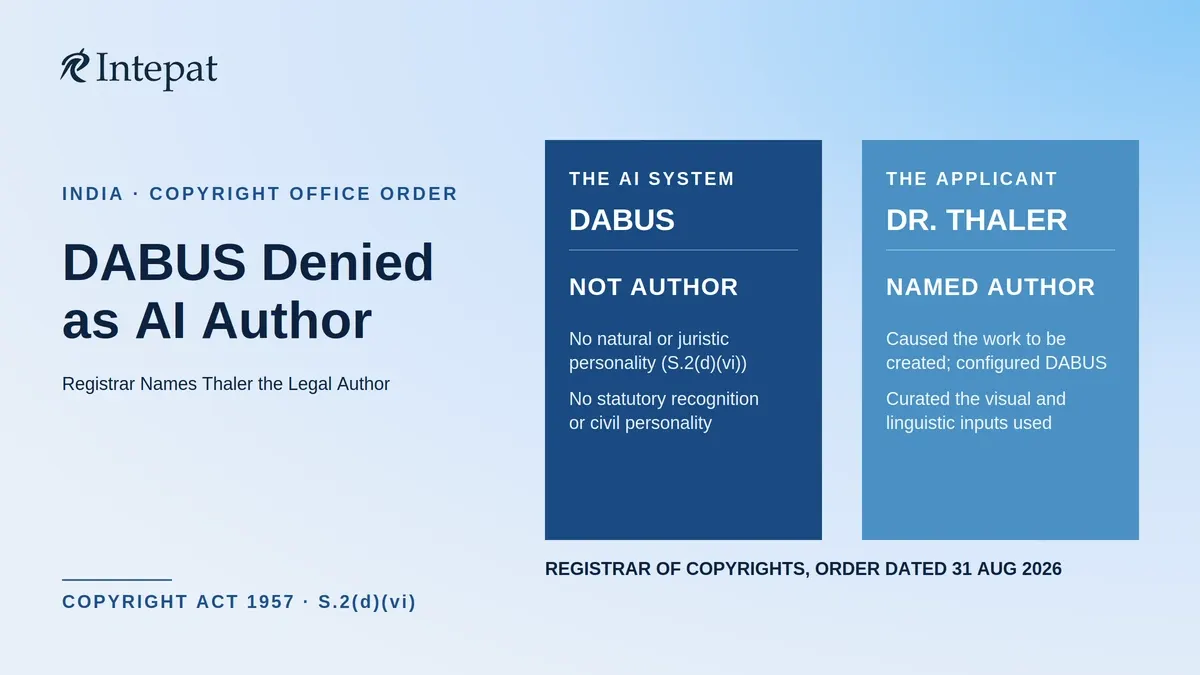
The Registrar of Copyrights has rejected Dr. Stephen L. Thaler’s application to register the artistic work “A Recent Entrance to Paradise” with his AI system, DABUS, entered as author. The order, dated 31 August 2026 under Diary No. 9356/2022-CO/A, holds that DABUS cannot be recorded as author under Section 2(d)(vi) of the Copyright Act, 1957, because it is not a natural or juristic person; that Dr. Thaler, on the facts he pleaded, is the person who caused the work to be created; and that the application still fails because it was maintained on the DABUS-as-author basis even after the Applicant was offered the chance to amend it.
This order was passed on an application under Section 45 of the Copyright Act, 1957 read with Rule 70 of the Copyright Rules, 2013. It does not decide whether AI-generated works can be copyrighted as a class; the Registrar confines the determination to this application’s facts.
What was filed, and why the Office flagged it
The application, filed 3 May 2022, named DABUS as author, described the work as first published in 2016 in the USA, and named Dr. Thaler as seeking rights. Finding no natural or juristic person identified as author, the Office issued a discrepancy letter on 31 July 2023. The Applicant’s response of 25 August 2023 did not satisfy the Office; a Rule 70(12) hearing process followed on 29 April, 25 May and 24 June 2026, and Ms. Rajeshwari Hariharan, Senior Advocate, was appointed amicus curiae on 13 May 2026.
At the 24 June 2026 hearing, the Applicant was offered the chance to amend the particulars to name Dr. Thaler as author, and declined; an alternative, naming Thaler as author only if DABUS also received official recognition as “generator,” was never put as an unconditional correction. That refusal is what the rejection turns on.
The Applicant’s account of how the work was made
DABUS is described as an AI system of interconnected neural network modules generating outputs “without real-time human intervention at the stage of output generation, and without any text prompt.” The visual inputs were photographs personally taken by Dr. Thaler; the linguistic inputs were curated thesaurus entries and sentences; Dr. Thaler also supplied textual descriptions linking the two. The Applicant characterised Thaler’s role as “antecedent” and “upstream,” with DABUS as the “immediate and operative cause” of the work.
Finding A: originality under Section 13 is satisfied, on this record
The first issue the Registrar determines is whether a work produced without a human consciously determining its final expressive form could be “original” under Section 13(1)(a). The test is drawn from University of London Press v. University Tutorial Press [1916] 2 Ch 601 (originality concerns expression, not the idea) and Eastern Book Company v. D.B. Modak, (2008) 1 SCC 1 (a minimal degree of creativity is required, not novelty). Applying that standard, the Registrar holds the work’s arrangement of colours, tonal variations and compositional elements was not supplied to DABUS in final form and is not shown to reproduce a pre-existing work: “the fact that the work was generated through algorithmic or computational processes cannot, by itself, render the resulting expression unoriginal.”
Two qualifications matter: the finding is expressly confined “for the limited purpose of the present registration proceedings,” and the absence of evidence of copying reflects the record before the Registrar, not an affirmative finding of independent creation.
Finding B: Section 2(d)(vi) attributes authorship to the person who causes the work to be created
This is the order’s central holding. Section 2(d)(vi) defines the author of a computer-generated artistic work as “the person who causes the work to be created.” Section 2(d) is treated as “a self-contained scheme of statutory attribution” allocating authorship to a specific person for each class of work, not to whoever last touches the output. The Applicant’s “upstream cause” versus “immediate cause” distinction is rejected as absent from the statute: a system performing the last generative step does not exclude the person who brought about the creation of the work.
The Registrar draws expressly non-binding support from the “effective cause” or “mastermind” test in Aalmuhammed v. Lee, 202 F.3d 1227 (9th Cir. 2000), and Burrow-Giles Lithographic Co. v. Sarony (1884). Applying it, the Registrar finds Dr. Thaler conceived and created DABUS, configured its operation, personally supplied and curated the inputs, and initiated the process, with no other person identified as having done these acts: “Dr. Thaler is the person who caused this particular work to be created within Section 2(d)(vi), although DABUS performed the immediate computational generation of its final visual form.” DABUS’s autonomy after activation does not displace this: autonomy in execution is not conception, and the process operated within architecture Dr. Thaler established.
Three further arguments fail on their own terms. The analogy to Section 2(d)(v)/2(uu) (a company producer as film author) is misconceived: a producer is author as the film’s business and creative mastermind, not merely for being non-natural, and DABUS was not shown to meet that standard. The “same word, same meaning” canon (Raghubans Narain Singh v. Uttar Pradesh Government, AIR 1967 SC 465) does not help: “person” must carry the same legal meaning throughout the Act, natural or already-recognised juristic, and DABUS is neither. The deity/next-friend analogy, though not pressed, is distinguished: representation presupposes legal personality that already exists; DABUS has “no statutory recognition, no civil personality… and no legal capacity independent of its human creator or controller.”
The Applicant’s reliance on a 9 February 2024 Rajya Sabha reply, that the existing framework is adequate for AI-generated works without a separate rights category, is held to confirm only that Section 2(d)(vi) itself suffices, not that the AI system may be named author. Result: “DABUS cannot be entered as author under Section 2(d)(vi),” while Dr. Thaler is the person capable of being identified as statutory author of this work.
Finding C: the ownership claim, as pleaded, has no statutory route
A second defect arose from the application as pleaded: DABUS as author, Dr. Thaler as owner, with no applicable statutory exception or valid transfer. Section 17 makes the author the first owner, subject to specified exceptions. The Applicant relied on Section 17(b) (first ownership vests in the person at whose instance and benefit specified works, such as a photograph, are made for consideration), arguing no assignment from DABUS was needed since Thaler owns and controls the system. The Registrar, following the amicus curiae, holds Section 17(b) confined to the categories it states, creating no general rule that ownership or control of a computer system confers copyright in its outputs; and since DABUS cannot be a legal person, it cannot hold or assign copyright under Sections 18 and 19, which require a written, signed assignment, and no other statutory route was established.
The particulars as verified cannot be entered, but the order distinguishes this from Thaler’s capacity to own the work outright: “If Dr. Thaler is correctly identified as the statutory author, Section 17 would ordinarily operate to make him the first owner.” The objection is maintained against the particulars as framed, not against Thaler’s capacity under a corrected authorship entry.
Finding D: the “generator” remarks-column request was not accepted
The Applicant’s alternative, conditional submission, that Thaler be entered as author with a remark noting DABUS as generator, was declined primarily for procedural and case-specific reasons, alongside a substantive limit. Procedurally: the verified particulars still named DABUS as author, with no amended Form filed; the proposal was itself conditional on DABUS receiving official recognition, never an unconditional correction; and the Registrar cannot substitute an author the Applicant declined to adopt. Substantively, a remarks entry “cannot be employed to confer, directly or indirectly, authorship, ownership, legal personality or any other statutory status” on an AI system. The order does not foreclose the route generically: a separate, properly formulated request for a legally neutral provenance entry remains open, its “maintainability and merits… expressly left open.”
What the order holds, and what it leaves for Parliament
| Point | Holding |
| Originality | Satisfies the limited threshold under Section 13, on the material presently on record. |
| DABUS as author | Not a natural or juristic person; cannot be entered as author under Section 2(d)(vi). |
| Dr. Thaler as author | On his own factual account, he is the person who caused the work to be created. |
| The filed particulars | DABUS as author and Thaler as owner are inconsistent with Sections 2(d)(vi) and 17-19; cannot be entered. |
| Remarks column | No descriptive reference to DABUS can confer author status or cure the application as filed. |
| Legislative prerogative | Extending legal personhood or authorship to autonomous AI is a matter for Parliament, not administrative reinterpretation. |
The rejection follows because the application, “as verified and maintained, seeks registration upon the legally untenable basis that DABUS is the author,” a “deliberate and continuing case despite notice, hearing and an express opportunity to amend.” The order states this “does not preclude Dr. Stephen L. Thaler from pursuing such remedy as may be available in law” on correctly identified particulars; the procedure for that remedy is not specified.
Reading the order
The order does not hold AI-generated works categorically uncopyrightable; the originality finding runs the other way, on this record. Nor does it settle AI legal personhood generally, confining the ruling to the facts pleaded. On those facts, Thaler’s cumulative, work-specific acts bore a sufficiently direct and substantial relationship to the work’s creation for him to be its cause. That is not a general rule that an AI system’s developer, owner or operator will necessarily be author of every output; the causative nexus must be assessed on the facts of the particular work, not on ownership of the system alone.
For the registration process itself, see our guide to the copyright registration procedure in India. For the wider AI and copyright debate, see IP law for artificial intelligence in India and AI training and copyright in India: the DPIIT hybrid model; a separate dispute over AI training data is analysed in the ANI vs OpenAI judgment.
Intepat’s copyright team advises applicants on authorship and ownership particulars before filing, including AI-generated works, through our copyright registration services.
This analysis explains the position taken by the Copyright Office in this order on AI authorship and copyright registration in India as at September 2026 and is for general information only. It is not legal advice. Procedures and fees change; confirm current requirements with the Copyright Office before you act. For advice on your specific work, consult an IP lawyer. This analysis is based on the full text of the order cited; it is a summary for general information and not a substitute for reading the order in your own matter.
Case identity (for reference)
- Diary No.: 9356/2022-CO/A, filed 3 May 2022
- Category of work: Artistic
- Title of work: “A Recent Entrance to Paradise”
- Applicant: Dr. Stephen L. Thaler
- Amicus Curiae: Ms. Rajeshwari Hariharan, Senior Advocate (appointed 13 May 2026)
- Hearings: 29 April 2026, 25 May 2026, 24 June 2026
- Order date: 31 August 2026
- Forum: Registrar of Copyrights, Prof. (Dr.) Unnat P. Pandit, The Copyright Office, New Delhi
- Outcome: Application rejected; DABUS held not entitled to be entered as author under Section 2(d)(vi) of the Copyright Act, 1957