




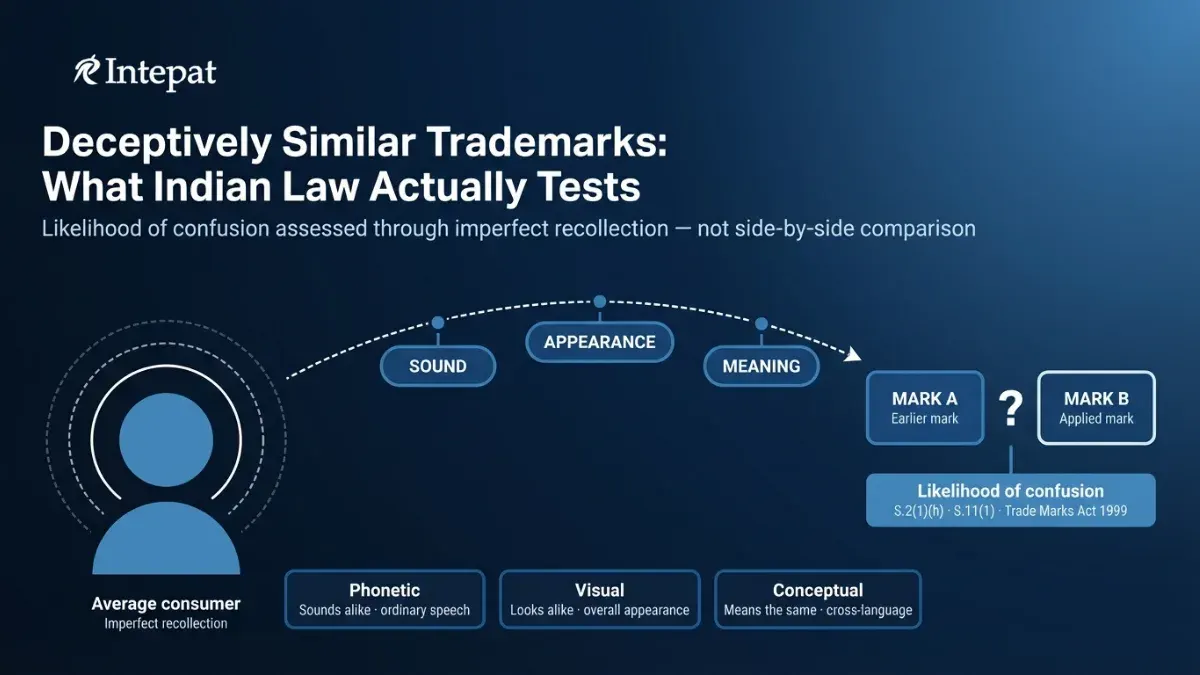
Deceptively similar trademarks are marks that so nearly resemble an earlier or competing mark as to be likely to deceive or cause confusion, as defined under Section 2(1)(h) of the Trade Marks Act, 1999. The test covers three dimensions: how the marks sound, how they look, and whether they convey the same idea or concept to an average consumer with imperfect recollection. Resemblance in any one or more of those dimensions can be sufficient to support a finding of similarity, provided the statutory requirements of identity or similarity of goods or services and likelihood of confusion are also met. Many applicants assume that changing a few letters or choosing a different font will be enough to avoid a conflict. Courts and the Registry do not see it that way, and understanding exactly what the law tests is the first step to building a mark that survives examination.
What Deceptively Similar Trademarks Mean Under the Trade Marks Act, 1999
Section 2(1)(h) of the Trade Marks Act, 1999 defines a deceptively similar mark as one that so nearly resembles another mark as to be likely to deceive or cause confusion. The definition is deliberately open-ended. The Act does not require the marks to be identical, nor does it require proof that actual confusion has already occurred. Likelihood of confusion is sufficient, and that likelihood is assessed at the point of application, not after the mark has been in use.
The registration bar sits in Section 11(1), which provides that a trade mark shall not be registered if, because of its identity with an earlier trade mark and similarity of goods or services, or because of its similarity to an earlier trade mark and the identity or similarity of goods or services, there exists a likelihood of confusion on the part of the public, which includes the likelihood of association with the earlier trade mark. The likelihood of confusion arises from the interaction of mark similarity and goods or services similarity; the statute addresses several identity and similarity combinations rather than imposing a rigid two-condition formula. A mark that is similar to an existing mark but covers entirely unrelated goods may not trigger a Section 11(1) objection, though other grounds may still apply. In practice, the test under Section 11(1) operates as: similarity of marks combined with similarity of goods or services, assessed through the lens of likelihood of confusion.
The Office of the Controller General of Patents, Designs and Trade Marks (CGPDTM) applies this test at the examination stage. When an examiner raises a deceptive similarity objection, the applicant has an opportunity to respond through a formal trademark examination report response explaining why the marks are sufficiently distinct. That response must engage with the specific grounds raised, not simply assert that the marks are different.
| Three routes to a deceptive similarity objection under the Trade Marks Act, 1999 |
| Section 11(1) bars registration where the applied-for mark is identical or similar to an earlier trade mark and the goods or services are identical or similar, creating a likelihood of confusion. This is the primary route through which deceptive similarity is assessed at examination. |
| Section 11(2) provides extended protection for well-known trade marks, allowing objection even where the goods or services are not similar, if use of the later mark would take unfair advantage of or be detrimental to the distinctive character or repute of the well-known mark. |
| Section 11(3) preserves objections and rights based on passing off, copyright, and other earlier rights, independent of registration. A prior user who has not registered their mark can still resist a later conflicting application on these grounds. |
The Three Dimensions Courts Use to Test Trademark Similarity
Indian courts and the Trade Marks Registry test trademark similarity across three dimensions: phonetic resemblance, visual appearance, and similarity of idea or concept. No single dimension is decisive on its own; the overall impression created by the competing marks is what matters. The rules for comparing two marks were settled by Parker J in the Pianotist case ((1906) 23 RPC 774) and have been consistently applied by Indian courts and the Registry since. The Manual of Trade Marks published by the CGPDTM expressly adopts these rules. Comparison must be made from the point of view of a person of average intelligence and imperfect recollection. The mark must be considered as a whole; no meticulous or letter-by-letter analysis is required, and a side-by-side comparison is not the correct test. The question is whether the overall impression left by one mark would be likely to cause confusion with the impression left by the other.
Three dimensions of similarity are applied, often in combination:
Phonetic Similarity
Two marks are phonetically similar if they sound alike when spoken aloud by an average consumer. The test accounts for the way marks are pronounced in ordinary speech, not in careful dictionary recitation. A consumer who hears a mark mentioned in conversation, or who remembers it imperfectly after seeing it once, may recall only its approximate sound. Lakme and LikeMe, Mahindra and Mahendra, and PUMA and COMA are all examples where sound alone, or sound in combination with other factors, carried the similarity finding.
Visual Similarity
Visual similarity covers the overall appearance of the marks as seen in the marketplace: the arrangement of letters or elements, the device or figurative components, and where relevant the colours used. Device marks are examined with reference to the Vienna Codification system maintained by the Registry, an international classification framework for figurative elements that supports the examination workflow by grouping marks with similar pictorial features for comparison. A mark that uses a different typeface but the same word structure, or a logo that uses a similar geometric arrangement in similar colours, may be found visually similar even where no individual element is identical.
Similarity of Idea
This is the dimension that surprises most applicants. Two marks can be deceptively similar in India even when they look completely different and sound nothing alike, if they convey the same idea or concept to the average consumer. Courts have consistently held that literal translations of a mark into another language, or marks that represent the same object or concept through different words, may be deceptively similar. A mark meaning “sun” in Hindi and a mark meaning “sun” in Sanskrit can conflict. A mark depicting a bird by its English name and a mark depicting the same bird by its Hindi name can conflict. This is not a peripheral doctrine: it has been applied by the Delhi High Court and reflects the multilingual reality of the Indian marketplace.
How the Trade Marks Registry Examiner Applies the Deceptive Similarity Test
The Trade Marks Registry examiner applies the deceptive similarity test by searching for earlier conflicting marks across phonetic, visual, and figurative dimensions. The examiner then assesses whether the overall impression of the applied-for mark is likely to cause confusion with any earlier mark covering the same or similar goods or services. When an application is received, the examiner conducts a search of the register for earlier marks that are identical or similar, covering identical or similar goods or services. For word marks, this search is phonetic as well as literal. For device marks, the examiner may use the Vienna Codification along with other search tools, though examination practice is not limited to that classification system. Where composite marks are involved, the examiner considers whether any element of the applied-for mark is prominent or dominant, while maintaining the principle that the mark must be assessed as a whole; dominant elements can inform the analysis but do not displace the requirement of overall mark comparison.
The Manual of Trade Marks identifies three factors as most relevant to the examination: the similarities and differences between the respective trademarks, how distinctive the earlier mark is, and the degree of similarity between the respective goods or services. A highly distinctive earlier mark commands broader protection. A mark that has been in use for decades and acquired a secondary meaning in the minds of consumers will be treated as more vulnerable to dilution by a similar new mark. Applicants who face a Section 11 objection should note that the examiner is not required to find that actual confusion has arisen; the examination standard requires only that confusion be probable.
Where goods or services covered by the competing marks are identical, the threshold for similarity of marks is lower. Where the goods or services are similar but not identical, the marks must be more closely similar before an objection is likely to be upheld. The class of consumer matters too: goods purchased quickly and cheaply in high volumes attract a lower standard of care than goods purchased after deliberation, so the confusion threshold is easier to reach for everyday consumer products than for specialised or high-value goods.
Five Deceptively Similar Trademark Cases from Indian Courts
Indian courts have found deceptive similarity on the basis of phonetic resemblance, device and colour similarity, and translation equivalents, in each case looking beyond surface differences to the overall impression the competing marks leave on an average consumer. Indian courts have built up a body of case law that gives practical content to the statutory test. The following cases illustrate where the similarity line has been drawn across different types of marks and different bases for similarity.
Lakme Ltd v. Subhash Trading (Delhi High Court)
In this Delhi High Court injunction-stage decision, the plaintiff sold cosmetic products under the Lakme mark and the defendant used the mark LikeMe for the same class of products. The court found a resemblance between the two words, including phonetic similarity, and held that there was a likelihood of deception and confusion in the mind of a buyer. As an interim decision rather than a final adjudication on merits, it illustrates how Indian courts have repeatedly recognised that phonetic resemblance can be sufficient to establish the requisite similarity in the right factual setting, particularly where the goods are identical.
M/s Mahashian Di Hatti Ltd v. Mr. Raj Niwas (Delhi High Court)
The plaintiff sold spices and condiments under the MDH mark, used with a distinctive device in a red background. The defendant used an abbreviated mark, MHS, in a similar device format. The court found the marks similar in both their word elements and their device elements, and held that the combination was likely to cause confusion and deception. The case illustrates that similarity of device, colour, and arrangement can each contribute to a deceptive similarity finding, and that courts look at the overall commercial impression rather than isolating any single element.
Mahendra and Mahendra Paper Mills Ltd v. Mahindra and Mahindra Ltd (Supreme Court, 2002)
In (2002) 2 SCC 147, the Supreme Court held that the mark Mahendra and Mahendra was phonetically similar to the earlier mark Mahindra, which had been in continuous use for five decades and had acquired a distinctive secondary meaning in the Indian market. The court refused registration of the later mark on the basis of phonetic similarity alone. The case is significant for two reasons: it confirms that phonetic similarity can override visual differences, and it shows that a mark with a long history of use and acquired distinctiveness attracts stronger protection against similar marks.
M/s Surya Roshini Ltd v. M/s Electronic Sound Components Co (Delhi High Court)
The Delhi High Court held that the marks Surya and Bhaskar were deceptively similar, even though the two words look and sound entirely different. Both words are established translations of the word sun, one from Sanskrit and one from Hindi. The court applied the idea similarity test and found that an Indian consumer familiar with either language would associate both marks with the same concept, making confusion between them probable. This case is the clearest judicial statement of the translation equivalents doctrine in Indian trademark law.
M/s Bhatia Plastics v. M/s Peacock Industries Ltd (Delhi High Court)
The marks Peacock and Mayur were held to be deceptively similar on the same basis: both refer to the same bird, one in English and one in Hindi. The court applied the idea similarity principle and found that the marks conveyed the same concept to the average Indian consumer regardless of the language used. Taken together with Surya Roshini, this case confirms that the translation equivalents doctrine operates consistently across both word marks and marks referring to objects or living creatures. The doctrine is applied contextually and not automatically: Indian courts assess the probable consumer impression in the actual market context rather than applying a mechanical translation rule, and the question is always whether the relevant consumer, in the relevant market, would be likely to associate the two marks with the same source.
How Deceptive Similarity Affects Your Trademark Application in India
A deceptive similarity finding at the examination stage blocks registration under Section 11(1) of the Trade Marks Act, 1999 and triggers a formal objection that the applicant must answer with substantive arguments, not a simple denial. A deceptive similarity objection at the examination stage is not the end of the road, but it is a significant procedural obstacle that requires a substantive, evidence-based response. The applicant must show either that the marks are not in fact similar when assessed against the correct legal standard, or that the goods and services are sufficiently different that no likelihood of confusion arises, or both. Prior use rights can also be relevant and carry independent statutory weight: under Section 34 of the Trade Marks Act, 1999, a prior user can override a later registration, and Section 11(3) separately preserves rights based on passing off and earlier rights. The procedural value of prior-use evidence nevertheless depends on the stage and the nature of the cited obstacle: its utility in overcoming a cited registration at examination differs from its role in asserting superior rights in contested opposition proceedings.
If the application is accepted and published in the Trade Marks Journal, it may then face opposition from third parties, at which point the evidentiary burden becomes heavier. The opponent will typically adduce evidence of use, reputation, and instances of actual or potential confusion. Applicants who run a comprehensive trademark clearance search strategy before filing, covering all three dimensions of similarity, are in a materially stronger position than those who rely on a narrow word-for-word search alone. That means checking phonetic variants, locating device marks through figurative classification, and identifying idea equivalents including cross-language translations. Applicants filing in India also need to account for the multilingual reality of the marketplace: a mark that reads as entirely original in English may translate directly into a conflicting concept in Hindi, Tamil, Bengali, or another major Indian language.
The well-known trademark provisions under Section 11(2) of the Act provide additional protection to marks that have acquired cross-class recognition. A mark can be recognised as well-known either by a court in proceedings or by the Registrar under Rule 124 of the Trade Mark Rules, 2017 on an application by the proprietor. Owners of well-known trademarks can oppose a similar mark even where the goods or services are not identical or similar, if use of the later mark would take unfair advantage of or be detrimental to the distinctive character or repute of the well-known mark. This extended protection applies to marks like those of major consumer brands and increases the risk for applicants choosing marks with any phonetic, visual, or conceptual overlap with an established well-known mark.
Applicants involved in a deceptive similarity dispute should also be aware of the relationship between trademark similarity and infringement. A mark that narrowly survives examination may still expose its owner to trademark infringement claims in court, particularly where the earlier mark is well established. Even if a mark proceeds to registration, an earlier rights holder can still challenge use or registration through infringement, passing off, or rectification proceedings depending on the facts.
Protecting Your Brand Starts with a Deceptive Similarity Check
The deceptive similarity test in India is wider than most applicants expect. Courts do not confine it to marks that look or sound the same; they apply it to marks that mean the same thing, represent the same concept, or are literal translations of each other. The multilingual dimension of the Indian market makes this particularly relevant, because a mark that reads as entirely original in English may map directly onto an existing mark in another Indian language. A prior user who has been trading under a mark for years also carries rights that affect the registrability of any later-filed similar mark, regardless of whether that prior user has formal registration.
The practical takeaway is that a clearance search limited to identical or near-identical word matches is not sufficient preparation for filing in India. Phonetic variants, idea equivalents, and cross-language translations all need to be checked. Applicants who skip that step before filing often discover the gap only after an examination report has been issued, at which point the options for resolving the conflict are narrower and the costs are higher.
Intepat IP conducts comprehensive trademark clearance and registration searches covering phonetic, visual, and idea similarity across all relevant classes before filing, so applicants understand the risk landscape before committing to a mark.
Similarity outcomes in India are highly fact-sensitive and often turn on the overall commercial impression created by the competing marks.
Disclaimer: This article reflects the position under Indian trademark law as at March 2026 and is intended as general information only; readers should seek specific legal advice based on their factual situation.
Frequently Asked Questions
Yes. Phonetic similarity is one of the recognised modes of assessing similarity of marks under Section 11(1) of the Trade Marks Act, 1999. The Registry’s examination process is designed to identify earlier conflicting marks, including phonetic and figurative similarities. If the marks sound alike when spoken by a person of average intelligence with imperfect recollection, and the goods or services are the same or similar, the examiner is likely to raise an objection regardless of how different the marks look in writing.
Yes. Indian courts have consistently held that marks which are literal translations of each other can be deceptively similar, even where the words look and sound completely different. The idea similarity test asks whether the marks convey the same concept to the average Indian consumer. Given that consumers in India are frequently bilingual or multilingual, two marks referring to the same object or concept in different languages carry a real risk of being found deceptively similar.
The applicant receives an examination report setting out the grounds of objection, including the specific earlier marks cited. Under Rule 33 of the Trade Mark Rules, 2017, the applicant ordinarily has one month from receipt of the examination report to file a response; failure to respond within that period can result in the application being treated as abandoned. The response must argue why the marks are not deceptively similar, or why the goods or services are sufficiently different to preclude a likelihood of confusion. If the response does not satisfy the examiner, the matter may proceed to a hearing. If refusal is maintained, the applicant can challenge the order before the appropriate High Court under Section 91 of the Trade Marks Act, 1999, as amended by the Tribunals Reforms Act 2021, which substituted the High Court for the erstwhile Appellate Board. The appeal must ordinarily be filed within three months of communication of the refusal order, subject to the court’s discretion to condone delay.
Class is relevant but not determinative. Under Section 11(1), both similarity of marks and similarity of goods or services must be established. Where the goods or services are in different classes and are genuinely unrelated, a Section 11(1) objection is unlikely to succeed. However, the boundaries between classes are not always a reliable guide to whether goods are similar in commercial reality. Nice classification is an administrative filing framework; the similarity inquiry remains commercial and consumer-facing. Courts look at whether the goods or services are competitive or complementary, whether they are likely to be distributed through the same channels, and whether consumers are likely to assume a common trade origin. Additionally, for marks that qualify as well-known under Section 11(2), the protection extends across all classes.
The sophistication of the likely consumer is a relevant factor. The Manual of Trade Marks expressly identifies the class of purchasers and their degree of care in purchasing as one of the criteria courts and the Registry consider. Where the goods are specialised, high-value, or directed at a professional or technically trained audience, a higher standard of care can be attributed to the purchaser and the threshold for confusion is harder to meet. However, the standard is set by the average consumer in the relevant class, not by the most careful consumer. A general consumer goods market will be assessed against the purchasing habits of a typical, not an especially attentive, buyer.