




A well-known trademark in India is a mark so widely recognised within a relevant section of the public that its use by a third party on any goods or services would likely be taken as indicating a connection with the original proprietor. That recognition carries a specific legal consequence: the mark receives protection across all goods and services classes, not only the class in which it is registered. This protection applies only where use of a competing mark would take unfair advantage of, or cause detriment to, the well-known mark’s reputation or distinctive character. The formal route to obtaining this status runs through trademark registration services and Rule 124 of the Trade Marks Rules, 2017, which allows a proprietor to apply directly to the Registrar. This article reflects Indian trademark law as at March 2026; readers should seek specific legal advice based on their factual situation.
| At a glance: |
| Well-known trademark recognition in India requires a Form TM-M application filed online with a fee of INR 1,00,000 (First Schedule, Trade Marks Rules, 2017). Once granted, the mark receives cross-class protection against registration of similar marks and against infringement of its distinctive character or repute. The Office of the Controller General of Patents, Designs and Trade Marks (CGPDTM) maintains the official list, which contained over 280 marks as at 10 February 2025. |
What is a well-known trademark under Indian law?
A well-known trademark, as defined in Section 2(1)(zg) of the Trade Marks Act, 1999, is a mark that has become so known to a substantial segment of the public that uses the relevant goods or receives the relevant services that its use by any person in relation to other goods or services would be likely to be taken as indicating a connection in the course of trade or rendering of services between those goods or services and a person using the mark in relation to the first-mentioned goods or services. In practical terms, this means that when a mark is sufficiently famous within its consumer base, a third party using the same or a similar mark anywhere, even on unrelated goods, risks being seen as connected to the original owner.
The definition does not require recognition by the public at large. Recognition among the relevant consumers, persons involved in distribution channels, or the business circles dealing with the goods or services to which the trademark applies is sufficient under Section 11(7) of the Act. Indian courts have applied this standard to marks including Rolex, Whirlpool, and Benz, recognising their well-known status on the basis of recognition within the relevant consumer segment rather than population-wide awareness. The CGPDTM maintains a publicly accessible list of well-known trademarks on ipindia.gov.in; as at 10 February 2025, that list contained over 280 marks. Readers can use Intepat’s trademark classification tool to identify the relevant class before assessing whether a particular mark on the list covers the goods or services in question.
What protection does a well-known trademark receive?
Understanding what a well-known trademark is worth legally depends on what protection the status actually confers. The Trade Marks Act, 1999 provides protection at two distinct levels: against the registration of marks that conflict with the well-known mark, and against infringement of the well-known mark’s distinctive character or repute, even where the infringing use is on entirely different goods or services.
Protection against registration of similar marks
Section 11(2) of the Act provides that a trademark shall not be registered if it is identical with or similar to an earlier trademark that is a well-known trademark in India, even where the proposed mark covers goods or services that are not similar to those covered by the well-known mark, provided that the use of the later mark without due cause would take unfair advantage of, or be detrimental to, the distinctive character or repute of the earlier trademark. The condition is not automatic: the Registrar must be satisfied that use of the later mark would cause either unfair advantage or detriment. The Registrar is also required, under Section 11(10) of the Act, to protect a well-known trademark against identical or similar marks when considering any application for registration or any opposition filed in respect of such an application.
Protection against infringement and dilution
Section 29(4) of the Act applies to any registered trademark and provides that a person infringes a registered trademark if that person uses a mark identical with or similar to the registered trademark in relation to goods or services which are not similar to those for which the trademark is registered, where such use is likely to take unfair advantage of, or be detrimental to, the distinctive character or repute of the registered trademark. Well-known status strengthens enforcement under this provision because the mark’s established reputation makes the detriment or unfair advantage argument materially easier to sustain. The three forms of harm this provision addresses are trademark dilution by blurring (erosion of the mark’s distinctive character through association with dissimilar goods or services), tarnishment (harm to the mark’s repute through association with inferior or objectionable goods or services), and free-riding (extracting commercial benefit from the mark’s reputation without authorisation). A proprietor can pursue indirect trademark infringement proceedings for any of these three forms without needing to establish likelihood of confusion in the conventional sense.
Criteria for determining a well-known trademark — Section 11(6) and 11(7)
The Registrar applies a defined set of criteria when determining whether a trademark qualifies as well-known. These criteria derive directly from Section 11(6) and Section 11(7) of the Trade Marks Act, 1999, which reflect India’s obligations under the Agreement on Trade-Related Aspects of Intellectual Property Rights. No single factor is determinative; the Registrar weighs all of them together, and may take into account any other fact considered relevant.
The five Section 11(6) factors
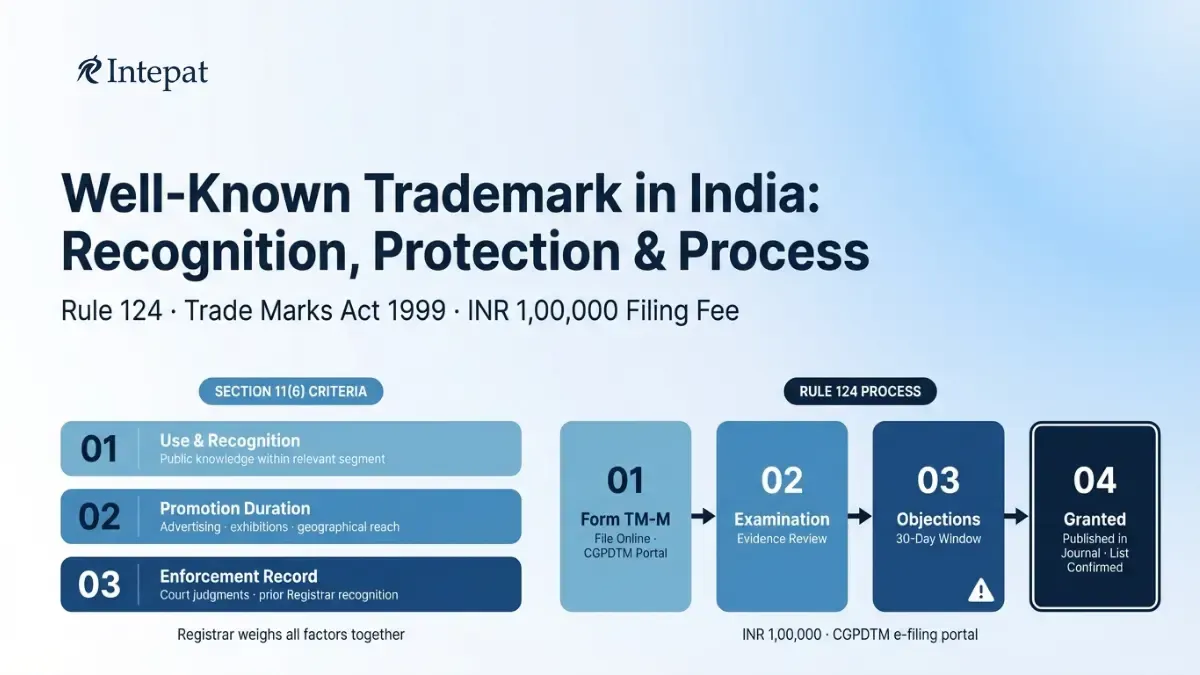
Section 11(6) sets out five factors: public knowledge and recognition of the trademark (including recognition built through promotion in India); duration, extent, and geographical reach of use; duration, extent, and geographical reach of promotion including advertising and exhibition appearances; registration history in India or elsewhere to the extent it reflects use or recognition; and the record of successful enforcement, including prior recognition by any court or Registrar. Section 11(7) adds three further indicators the Registrar must consider when assessing the relevant public: the number of actual or potential consumers, the number of persons in distribution channels, and the business circles dealing with the relevant goods or services. The table below sets out all criteria in the statute’s own language.
| Provision | What the Registrar considers |
| Section 11(6)(a) | Knowledge or recognition of the trademark in the relevant section of the public, including knowledge acquired in India as a result of promotion of the trademark. |
| Section 11(6)(b) | The duration, extent, and geographical area of any use of the trademark. |
| Section 11(6)(c) | The duration, extent, and geographical area of any promotion of the trademark, including advertising or publicity and presentation at fairs or exhibitions of the goods or services to which the trademark applies. |
| Section 11(6)(d) | The duration and geographical area of any registration of, or any application for registration of, the trademark, to the extent they reflect use or recognition of the trademark. |
| Section 11(6)(e) | The record of successful enforcement of rights in that trademark, in particular the extent to which the trademark has been recognised as a well-known trademark by any court or Registrar. |
| Section 11(7) | Number of actual or potential consumers of the goods or services; number of persons involved in the channels of distribution; the business circles dealing with the goods or services to which the trademark applies. |
What the Registrar cannot require — Section 11(9)
Section 11(9) of the Act expressly prohibits the Registrar from requiring, as a condition for determining a trademark to be well-known, that the trademark has been used in India, that the trademark is registered or has a pending application in India, or that the trademark is well known to the public at large in India. These are statutory bars on preconditions, not discretionary guidelines. A foreign mark with no India registration, no India application, and no India-wide recognition can still satisfy the criteria if the relevant consumer segment in India knows the mark through spill-over reputation, meaning the recognition that a mark acquires in a country as a result of its use and promotion in other markets, even before the brand has a formal commercial presence there.
How to apply for well-known trademark recognition in India
Rule 124 of the Trade Marks Rules, 2017 introduced a direct Registry pathway for well-known trademark recognition that any person can now access without first commencing court proceedings. Before the 2017 Rules, recognition required a judicial declaration obtained through litigation. The two routes now operate independently: a court declaration in the course of infringement or passing-off proceedings, and a Rule 124 application to the Registrar. Both produce valid well-known recognition, but only the Registry route results in inclusion in the CGPDTM’s published list of well-known trademarks.
Who can apply — and the Section 11(9) gap for foreign marks
Rule 124 states that any person may file a request for well-known trademark recognition. Section 11(9) of the Act prohibits treating India registration, India application, or India use as preconditions, which means a foreign mark holder can in principle apply. The practical difficulty is that Form TM-M as currently designed requires an Indian application number, creating an administrative barrier for foreign marks that have no filed application in India. This is a procedural limitation in the form’s design, not a statutory override of Section 11(9). A foreign proprietor in this position may consider filing a base trademark application in India solely to satisfy the form’s administrative requirement, while making clear that the substantive well-known claim rests on the Section 11(6) criteria. Alternatively, well-known recognition can be sought through the court route in the course of infringement proceedings, where no India application number is required.
The Rule 124 process step by step
The applicant files a request on Form TM-M, which must be submitted online through the CGPDTM e-filing portal at ipindia.gov.in. The prescribed fee under the First Schedule of the Trade Marks Rules, 2017 is INR 1,00,000 per mark. The request must be accompanied by a statement of case setting out the applicant’s claim and all evidence and documents relied upon. The Registrar may call for further documents or evidence as considered necessary.
After initial examination, the Registrar may invite objections from the general public. Under Rule 124(4), any person may file an objection within 30 days of the date of invitation of such objection. The Trade Marks Rules, 2017 do not prescribe the procedure to be followed after an objection is filed, which means contested applications can remain pending for extended periods. Where no objection is filed, or after the objection process is resolved, the mark is published in the Trade Marks Journal under Rule 124(5). Once published, the Registrar includes the trademark in the official list of well-known trademarks.
What evidence the Registrar requires — and in what order
In practice, the Registrar places weight on evidence that demonstrates quantified, documented recognition across the Section 11(6) factors. The strongest category is primary evidence: multi-year sales turnover data supported by invoices, market share figures, and consumer recognition surveys conducted among the relevant public. These materials directly address Section 11(6)(a) and (b) and give the Registrar measurable indicators of the mark’s standing.
Secondary evidence supports and contextualises the primary category: advertising expenditure broken down by year and media type, sustained media coverage naming the mark, brand valuation reports prepared by independent valuers, and prior court judgments or ex parte injunctions granted in the mark’s favour. These materials address Section 11(6)(c) and (e). Supporting evidence consists of existing trademark registrations in India and internationally, addressing Section 11(6)(d). Registration certificates carry the least weight and are consistently insufficient when presented without the primary and secondary categories.
Why well-known trademark applications are refused
The evidentiary threshold for well-known trademark recognition is high, and applications fail for identifiable, recurring reasons. The most common is reliance on registration certificates as the primary evidence of recognition. A certificate records that a mark was registered; it does not establish that a relevant section of the public knows and associates the mark with a single source. The Registrar requires evidence of actual public recognition, and registration status without market data does not supply it.
Applications also fail when advertising and promotion expenditure is asserted but not quantified. The Section 11(6)(c) factor requires evidence of the duration, extent, and geographical area of promotion. A general assertion of national advertising, without year-wise expenditure figures and supporting media records, does not satisfy this factor. Consumer recognition surveys are not mandatory, but their absence leaves the recognition claim without an independent measure of public awareness.
Third-party objections filed under Rule 124(4) present a separate procedural challenge. Because the Trade Marks Rules, 2017 do not set out a clear resolution procedure for contested applications, an objection can leave an application pending indefinitely. An applicant whose mark has a prior enforcement history, including injunctions obtained in trademark proceedings, is significantly better placed to overcome an objection because that history directly satisfies the Section 11(6)(e) factor.
Where the Registrar refuses a well-known trademark application, the proprietor may appeal to the High Court under Section 91 of the Trade Marks Act, 1999. The Intellectual Property Appellate Board, which previously handled such appeals, was abolished by the Tribunals Reforms Act, 2021; jurisdiction now vests in the relevant High Court. Proprietors who want to check whether a competing mark already appears on the Registry’s well-known list, or to review prior enforcement records before filing, can run a trademark public search in India before submitting the application.
Haldiram India Pvt. Ltd. v. Berachah Sales Corporation — Section 11(6) applied
The 2024 Delhi High Court decision in Haldiram India Pvt. Ltd. v. Berachah Sales Corporation & Ors. (CS(COMM) 495/2019, decided 2 April 2024, neutral citation 2024:DHC:2517) illustrates how courts apply the Section 11(6) criteria to an established Indian brand. The decision also follows the ISKCON well-known trademark line of authority on cross-class protection.
The defendants had incorporated a company named Haldiram Restro Pvt. Ltd. and filed trademark applications in Class 43 covering food and drink services. The plaintiff traced the mark to 1941 and produced evidence of use in two forms: a V-shaped logo and an oval-shaped logo, both registered in multiple classes. Justice Prathiba M. Singh applied Section 2(1)(zg) and worked through all five Section 11(6) factors: continuous use since 1941; multiple domestic and international registrations; sustained advertising and media presence; and a record of prior enforcement proceedings. The court applied the spill-over reputation doctrine, confirming that the mark’s recognition extended into geographical markets where the plaintiff did not hold active registrations, because consumers in those regions were already familiar with the brand.
The court granted a decree of permanent injunction, declared HALDIRAM and the oval-shaped mark as well-known in relation to food items, restaurants, and eateries, directed the CGPDTM to reject the defendants’ pending trademark applications, and awarded INR 50 lakhs in damages and INR 2 lakhs in costs. The decision establishes that evidentiary completeness across all Section 11(6) factors is determinative: duration of use does not carry an application on its own; the plaintiff succeeded because it produced documented evidence of recognition across each of the five criteria, not merely because the mark was old.
What well-known trademark status requires in practice
Well-known trademark status is not conferred by longevity or fame in the abstract. The Registrar and the courts require evidence of recognition that is documented, quantified, and mapped to the statutory criteria in Section 11(6). A mark that has been in use for decades but whose owner has not maintained records of sales, advertising expenditure, consumer reach, and enforcement history will face the same evidentiary obstacles as a younger mark. The practical implication is that building a well-known trademark case is an ongoing exercise in record-keeping, not a filing event triggered at a single point in time.
Proprietors assessing whether their mark meets the threshold, or building the evidence record ahead of a Rule 124 application, can consult with Intepat’s trademark team through trademark registration services.
Frequently asked questions
Judicial recognition does not equal automatic administrative listing. The Delhi High Court addressed this in Tata Sia Airlines Limited v. Union of India (Delhi High Court, May 2023), a case concerning the mark VISTARA. The court held that a judicial declaration of well-known status does not result in automatic inclusion in the Registry’s list. Registry listing is a procedural step, not an automatic consequence of a judicial declaration. The proprietor must separately file Form TM-M with the prescribed fee of INR 1,00,000. The Registrar is not required to re-examine the mark or demand fresh evidence where a court has already made the declaration, but the filing and fee remain mandatory.
Section 11(9) of the Trade Marks Act, 1999 bars the Registrar from treating India registration, India application, or India use as preconditions for a well-known determination. Recognition depends on spill-over reputation within India: whether the relevant consumer segment in India knows and associates the mark with a single source, even without formal domestic presence. The practical barrier is that Form TM-M currently requires an Indian application number. A foreign proprietor without any India application should take advice on whether to file a base application first or to pursue recognition through the court route in infringement proceedings.
No formal pre-qualification threshold is stated in the Trade Marks Act, 1999 or the Trade Marks Rules, 2017. The Registrar assesses each application on its evidence. In practice, marks that succeed tend to share three characteristics: documented use over a sustained period (typically more than five years with consistent commercial activity), quantified evidence of recognition among the relevant public rather than only among competitors, and a demonstrated enforcement history that shows the mark has been defended. A brand owner who can produce primary evidence across Section 11(6)(a), (b), and (c) is in a materially stronger position than one who relies on registration certificates and brand longevity alone.
A mark included in the Registry’s list may be removed if the Registrar finds that it was erroneously included. Before any removal, Rule 124 of the Trade Marks Rules, 2017 requires the Registrar to afford the proprietor an opportunity for a personal hearing in accordance with the principles of natural justice. The Act does not provide for automatic delisting on grounds of non-use or loss of recognition after the mark is included; removal requires a positive finding of erroneous inclusion.
The CGPDTM published an updated list on 10 February 2025, which is publicly accessible on the ipindia.gov.in portal and contained over 280 marks. The list is updated periodically and can be accessed directly through the CGPDTM’s trade mark public search system.
This article reflects Indian trademark law as at March 2026 and is based on the Trade Marks Act, 1999 and Trade Marks Rules, 2017. Readers should seek specific legal advice based on their factual situation.