




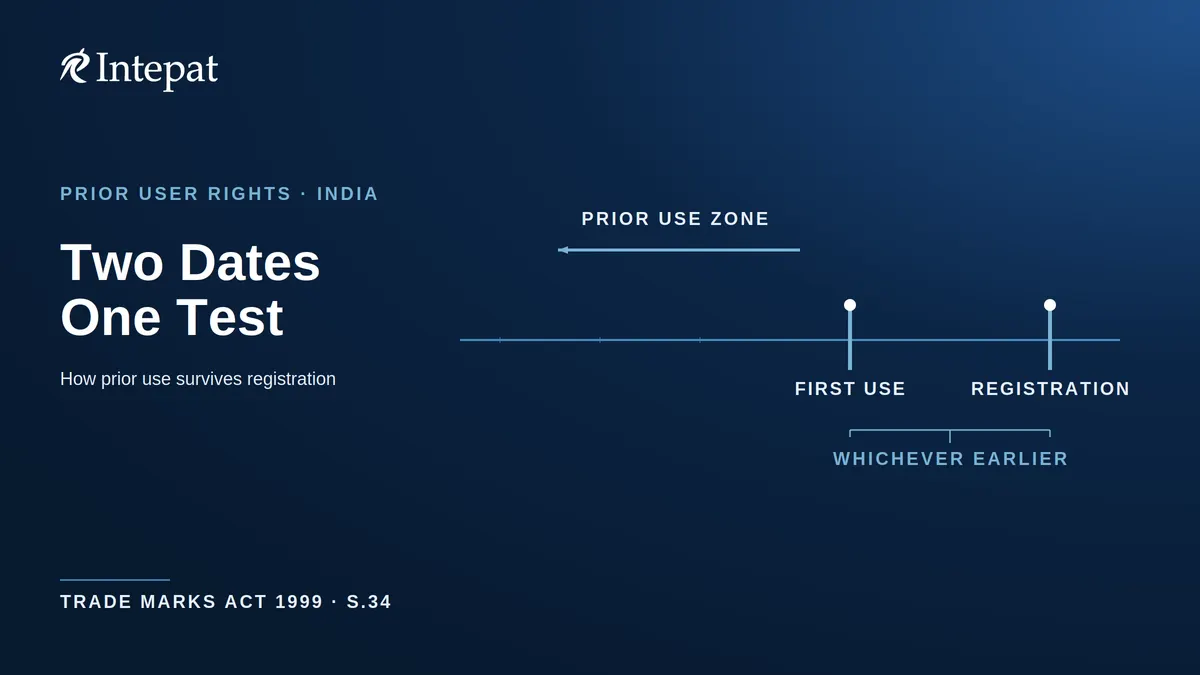
In India, prior user rights under Section 34 of the Trade Marks Act 1999 can protect your continuous use against a later registration, but only where your use began before both the registered proprietor’s first use and the registration date. The comparison is with whichever of those two dates is earlier. The Supreme Court calls this the first user rule.
The two-date test
Section 34 protects your continuous use only if that use began before both:
- the registered proprietor’s own use of the mark for the relevant goods or services; and
- the registration date.
The comparison is with whichever of those two dates is earlier.
| Quick answer |
| 1. Section 34 is principally a defence. It stops a registered proprietor from restraining your continuous prior use for the goods or services in which you have that use, and it blocks the Registrar from refusing your own later application on the sole ground of the earlier registration. It does not, on its own, let you sue for infringement. 2. The prior use must be within India, continuous, and for the goods or services in which prior use is proved. 3. Contemporaneous documents decide these cases: dated sales invoices identifying the mark, ledger books, dealer testimony, and packaging with dates. 4. The claim you can bring yourself is passing off under Section 27(2), if you had goodwill before the defendant’s adoption, plus misrepresentation and likely damage. |
What Section 34 of the Trade Marks Act 1999 protects
Section 34 of the Trade Marks Act 1999 is titled “Saving for vested rights.” It has two operative parts.
The first says the proprietor or registered user of a registered trade mark cannot interfere with any person’s use of an identical or nearly resembling mark, where that person (or someone who held the mark before them) has continuously used the mark for the goods or services in question, from a date earlier than (a) the registered proprietor’s own first use, or (b) the registration date, whichever is earlier.
The subject is “any person,” not only a proprietor: assignees, successors, and inheritors of the mark are covered.
The second part says the Registrar shall not refuse to register the second-mentioned mark by reason only of the earlier registration, once such prior use is proved.
Section 34 begins with overriding words (“Nothing in this Act”). In S. Syed Mohideen v P. Sulochana Bai, (2016) 2 SCC 683, the Supreme Court relied on Section 28’s opening words (“Subject to the other provisions of this Act”) to hold that a registered proprietor’s exclusive-use right is qualified by Section 34.
Five requirements to claim prior user rights in India
Five requirements drawn from Section 34:
First, continuous use. In Peps Industries v Kurlon Limited, 295 (2022) DLT 527, the Delhi High Court held that occasional or disjointed use will not carry a Section 34 defence, even where the earlier date is documented. See our note on continuous versus intermittent use.
Second, an identical or nearly resembling mark for the goods or services in which prior use is proved. The protection extends only to those goods or services, not automatically to every allied category.
Third, use within India. Section 34’s “continuously used” language is anchored in Indian territory by the statutory context and the territorial principle applied to trade mark rights in India.
Fourth, use by the person claiming the defence, or by someone who held the mark before them. A licensee’s use may or may not count as use by the licensor, depending on the licence terms and control.
Fifth, your use must predate both the registered proprietor’s first use and the registration date, whichever is earlier. If the proprietor began using the mark in 2018 and obtained registration in 2019, a defendant claiming use from 2016 passes the test only if continuous use from 2016 is proved. If registration had been in 2015, the defendant’s 2016 use would fail despite predating the proprietor’s own use.
The Supreme Court’s first user rule and the Prius territoriality principle
In S. Syed Mohideen v P. Sulochana Bai, (2016) 2 SCC 683, the plaintiff’s family had used “Iruttu Kadai Halwa” from the early 1900s, decades before the defendant obtained a similar registration. The Court held that the rights of a prior user are superior to those of registration.
Neon Laboratories Ltd v Medical Technologies Ltd, (2016) 2 SCC 672, is often cited as a straightforward Section 34 case. It was not. Neon applied to register ROFOL in 1992; Medical Technologies began using PROFOL in 1998; Neon commenced actual use only in 2004. Because Medical Technologies’ use began after Neon’s registration date, the literal two-date test was not satisfied. The Supreme Court nevertheless protected Medical Technologies on passing off and first-in-the-market grounds. Section 34 and passing off can run in different directions on the same facts.
Territoriality is addressed in Toyota Jidosha Kabushiki Kaisha v Prius Auto Industries Ltd, (2018) 2 SCC 1. Toyota launched PRIUS globally from 1997 but sold it in India only from 2010. Prius Auto had used the mark in India from April 2001 and registered it in 2002. The Supreme Court refused Toyota’s passing off claim because it had not established goodwill in India before Prius Auto’s use. A foreign proprietor must show goodwill in India, not just international reputation.
Recent Delhi High Court developments on prior use, 2025 to 2026
What these cases mean for a business owner
- Being first is not enough; you must show continuous use in India.
- Your use must have begun before both the proprietor’s first use and the registration date.
- Scattered invoices may not prove continuity.
- Registration and passing off can pull in different directions.
- A registered proprietor’s later non-use does not automatically extinguish the registration.
MAYO (28 July 2025). In Bodhisattva Charitable Trust v Mayo Foundation for Medical Education and Research, FAO(OS)(COMM) 73/2024, a Division Bench held that priority of use is not a defence to infringement unless every element of Section 34 is proved: the defendant’s use must predate both the plaintiff’s first use and the registration date.
PRINCETON (2025). In The Trustees of Princeton University v Vagdevi Educational Society, 2025:DHC:8654-DB, a Division Bench found Princeton the prior user in India based on reputation and use from 1911, and restrained Vagdevi from opening new institutions under the mark despite its local use since 1991.
STELLA (July 2025; reversed March 2026). In Products and Ideas (India) Pvt. Ltd. v Nilkamal Limited, CS(COMM) 715/2024, a Single Judge accepted Stella Industrial Co. Ltd.’s Section 34 defence on Indian sales from 2013. A Division Bench in FAO(OS)(COMM) 111/2025 reversed, holding that four invoices could not prove continuous prior use.
NOKUF (5 January 2026). In Sana Herbals Private Limited v Mohsin Dehlvi, FAO(COMM) 77/2025, a Division Bench refused Sana Herbals an interim injunction: Sana Herbals (incorporated in 1997) could not show goodwill preceding Dehlvi Remedies’ adoption of NOKUF in 1994, and Dehlvi’s registration remained legally effective unless removed under Section 47. The Court held that non-use of a registered mark, without more, is not a passing off defence a plaintiff can invoke; that remedy lies in Section 47 rectification.
FIELDMARSHAL (6 February 2026). In Thukral Mechanical Works v PM Diesels Private Limited, LPA 320/2024, a Division Bench dealt with conflicting infringement and passing-off rights on the same mark (the “Kerly impasse”). Jain Industries registered FIELDMARSHAL in 1965 but never used it, assigning to Thukral in 1986; Thukral commenced use in 1988. PM Diesels had used the mark from 1975. PM Diesels succeeded in passing off (goodwill built before Thukral’s use); Thukral succeeded in infringement (earlier valid registration).
Parle 20-20 (10 March 2026). In Parle Products Private Limited v The Registrar of Trade Marks, C.A.(COMM.IPD-TM) 49/2025, both parties had applied for “20-20” on a “proposed to be used” basis; neither had used the mark before filing. Avon Agro filed one week before Parle in September 2007; Parle launched biscuits in 2008. The Court decided the dispute under Section 18 as a registration-priority question, held the earlier filing date determinative, and distinguished Neon Laboratories and S. Syed Mohideen as passing off authorities.
Section 34 as defence, passing off as the prior user’s own claim
Section 34 is defensive. It tells the registered proprietor what he cannot do; it does not, by itself, let the prior user sue.
The claim a prior user can bring is passing off under Section 27(2), if the classical elements are made out: goodwill in India before the defendant’s adoption, misrepresentation, and likely damage. A prior user meeting these elements can sue a later registered proprietor for passing off, despite the defendant’s registration.
The Supreme Court in S. Syed Mohideen read Sections 27(2), 28, and 34 together and held that a passing off action premised on prior user goodwill is unaffected by any registration. A prior user facing an infringement suit may plead Section 34 as defence and, where the facts permit, file a passing off counterclaim. The tests are not identical: Section 34 turns on continuity and the two-date test; passing off turns on goodwill, misrepresentation, and damage. Failure under one does not automatically determine the other.
The outer limits: Section 33 acquiescence and Section 12 honest concurrent use
Two provisions limit the position at the edges.
Section 33 acquiescence. Where the proprietor of an earlier trade mark has knowingly acquiesced for a continuous period of five years in the use of a registered trade mark, Section 33(1) bars an invalidity challenge or objection to the later use, unless the later registration was not applied in good faith. Section 33(2) also prevents the later registered proprietor from opposing continued use of the earlier mark. The result may be coexistence rather than extinguishment of the earlier user’s continued use.
Section 12 honest concurrent use. Section 12 permits the Registrar, in cases of honest concurrent use, to allow more than one proprietor to register identical or similar marks for the same or similar goods or services, subject to conditions. Section 12 lets two parties coexist on the register; Section 34 lets one party use despite another person’s registration. See our note on honest concurrent use under Section 12.
Proving continuous use: evidence that works in Indian courts
Every Section 34 case turns on evidence. Indian courts, especially at the interim stage, look for contemporaneous documents created in the ordinary course of business.
Usually strongest. Dated sales invoices identifying the mark and the goods; purchase orders, delivery challans, and customer correspondence referring to the mark; dated packaging and product photographs connected to actual sales; dated advertising invoices; and government tenders, licences, and approvals using the mark publicly.
Helpful supporting evidence. Audited accounts, tax records, or certified turnover statements linked to sales under the mark through invoices, ledger entries, or delivery records; dealer confirmations backed by purchase orders; and website or marketplace archives with reliable dates.
Usually weak on its own. Undated packaging, self-generated spreadsheets, unsupported affidavits, unauthenticated screenshots, and isolated invoices with unexplained gaps. In the NEHA cosmetics litigation (C.O.(COMM.IPD-TM) 355/2021, decided May 2025), the Delhi High Court held that mark use must manifest in the public domain, not remain confined to internal documentation.
Rule 25(2) of the Trade Marks Rules 2017 requires an affidavit of use where the application is filed on a user basis. Filing on “proposed to be used” despite existing use creates a serious inconsistency, and may require particularly cogent evidence later to explain the earlier declaration when relying on an actual user date.
Rectification and non-use cancellation as related legal steps
Section 47 non-use cancellation. Under Section 47(1)(b), where a registered mark has been on the register for five continuous years without bona fide use up to a date three months before the application, any person aggrieved may apply for removal, subject to statutory exceptions. The application may be filed before the Registrar or the competent High Court (following abolition of the Intellectual Property Appellate Board by the Tribunals Reforms Act 2021). See our note on non-use cancellation.
Section 57 rectification. Where the register is incorrect, for instance because registration was granted despite prior rights under Section 11 or Section 18, any person aggrieved may apply for rectification before the Registrar or the High Court.
When validity is challenged in an infringement suit. Section 124 prescribes a specific procedure. If rectification is already pending, the suit is stayed. If none is pending, the suit court must first find that the invalidity challenge has an arguable basis, frame an issue, and adjourn for three months. If no application to the High Court is filed within that period, the invalidity plea is treated as abandoned. Section 125 requires the rectification to be made only to the High Court.
What to do if you discover a conflicting registration
If you discover a later identical or similar registration for the same goods or services, three steps come first.
Assemble the evidence. Pull together documents that prove continuous use in India from the earliest date: dated invoices, ledger pages, packaging with printed dates, and dealer records. Patchy years become defensive weaknesses.
Map the timeline. Compare your first documented use with (a) the registered proprietor’s first documented use, and (b) the registration date. Your use must predate the earlier of the two. A proposed-to-use filing by the proprietor does not automatically strengthen your position; the registration date may still fall before your first use.
Consider your options. Depending on the facts, available responses may include a Section 34 defence, a passing off counterclaim (if goodwill and misrepresentation can be proved), non-use removal under Section 47, or rectification under Section 57. Where validity is challenged in an infringement suit, the Sections 124–125 procedure applies. Under Section 134(1), infringement, registered-mark claims, and passing off must be filed in a court not inferior to a District Court; Section 134(2)’s plaintiff-friendly forum applies only to infringement and registered-mark claims, so a standalone passing off suit follows ordinary jurisdiction rules. See our note on the forum for a trademark infringement action. Section 135 sets out the remedies available.
Timing matters. The Section 33 five-year period can produce coexistence rather than a clean win. Early counsel review is more valuable than a later grievance.
Frequently asked questions
Section 34 protects a person who proves continuous use of a mark beginning before both the registered proprietor’s first use and the registration date. In other words, the prior user must have started using the mark before whichever of those two events happened first, for the specific goods or services in which the use is proved.
Section 34 is defensive; it does not, on its own, let the prior user sue the registered proprietor. The claim the prior user can bring is passing off under Section 27(2), if the classical elements are proved: goodwill in India before the defendant’s adoption, misrepresentation, and likely damage. Remedies include injunction, damages or profits, and delivery-up.
No. Section 34 requires continuous use of the mark in India. Where a foreign proprietor brings a passing off claim, Toyota Jidosha Kabushiki Kaisha v Prius Auto Industries, (2018) 2 SCC 1, requires proof that the mark had acquired sufficient goodwill or commercial presence in India before the defendant’s adoption. Foreign reputation alone is not enough.
Contemporaneous business documents are what courts rely on: dated sales invoices identifying the mark and the goods, ledger extracts, dealer testimony backed by purchase orders, packaging with printed dates, advertising invoices, and first-sale evidence. Unauthenticated advertising, self-serving affidavits, and sporadic records with long gaps do not, on their own, clear the bar.
Section 34 is a defence. It stops a registered proprietor from restraining a prior user’s continuous use. Section 27(2) preserves the passing off action, which requires goodwill, misrepresentation, and likely damage. Prior users often plead Section 34 as defence and passing off as counterclaim in the same suit, but the two rest on different legal tests.
Yes. Under Section 47(1)(b), where the mark has been on the register for a continuous period of five years without bona fide use up to a date three months before the application, any person aggrieved may apply for removal, subject to statutory exceptions. The freestanding application may be filed before the Registrar or the High Court.
Following the Tribunals Reforms Act 2021, freestanding applications under Sections 47 and 57 may be filed before the Registrar or the competent High Court. Where the validity of a registration is challenged in an infringement suit, Section 125 requires the rectification to be made to the High Court, and Section 124 governs the procedure for the suit court.
Disclaimer: This article summarises the position under Indian trade mark law as at July 2026. It is a general reference for founders, in-house counsel, and other informed readers, and is not a substitute for advice on a specific dispute. Outcomes under Section 34 turn on the documentary record in each case, on the specific goods or services involved, and on the timing of use and registration. A prior use claim raised without preparation of the underlying evidence is unlikely to succeed. Practitioners handling a live conflict should consult Indian trade mark counsel with sight of the actual documents. Nothing in this article should be read as advice on any pending matter.