




Design cancellation in India lets anyone with an interest ask the Controller to remove a registered design from the register. You can do it at any time after registration. There is no window that closes, so an old registration can be challenged as readily as a new one.
This guide is for businesses that face a competitor’s registered design, and for owners whose own registration is under attack. It covers who can apply, the five grounds, the steps, the fees and what happens next.
Quick answer: To cancel a registered design in India, any person interested files a petition in Form 8 before the Controller of Designs, with a statement of their interest and the facts relied on. The five grounds are prior registration in India, prior publication, lack of novelty or originality, non-registrability, and not being a design at all. The fee is Rs 1,500 for natural persons and qualifying startups and small entities, and Rs 6,000 for others. Appeal lies to the High Court.
Who can file to cancel a registered design
Any person interested may file. The law does not define the phrase, but your petition must explain the nature of your interest. A competitor that sells similar products, or a business that has been threatened with a piracy claim, may be able to show one.
You do not have to wait. A petition can be filed at any time after the design is registered, however long ago that was.
The five grounds for design cancellation in India
The Act lists five grounds, and a petition can rely on one or several. You ordinarily support each ground with affidavit evidence. If the proprietor opposes, they answer with evidence of their own.
The first ground is prior registration: the same design was already registered in India before this one. Search the Indian register for it.
The second is prior publication. The design was published in India or anywhere else before the date of registration. A design is registered as of its Indian filing date or, where a convention priority claim made within six months was allowed, the earlier foreign filing date. The question is what was public before that date.
The third is that the design is not new or original. “Original” means the design came from its author, and it includes old designs that are new in their application.
The fourth is that the design is not registrable under the Act. For example, a design that is not significantly distinguishable from known designs, or a combination of them, should not have been registered.
The fifth is that it is not a design at all. The legal definition protects only features of shape, configuration, pattern, ornament or composition of lines or colours, applied to an article by an industrial process, that in the finished article appeal to and are judged solely by the eye. It excludes a mode or principle of construction, a mere mechanical device, a trade mark, a property mark and an artistic work.
Prior publication turns on evidence you can go and look for. Earlier catalogues, websites, foreign design records and product listings can all help, provided you can show they were public before the filing or priority date and that they disclose the challenged design. Our guide to novelty and originality of design explains how prior disclosure is judged, and our guide to the WIPO Global Design Database shows where to search.
How the cancellation procedure works
The procedure before the Controller is mostly written. Evidence is given by affidavit unless the Controller directs otherwise, and the Controller may take oral evidence instead of, or as well as, affidavits, or allow cross-examination on an affidavit.
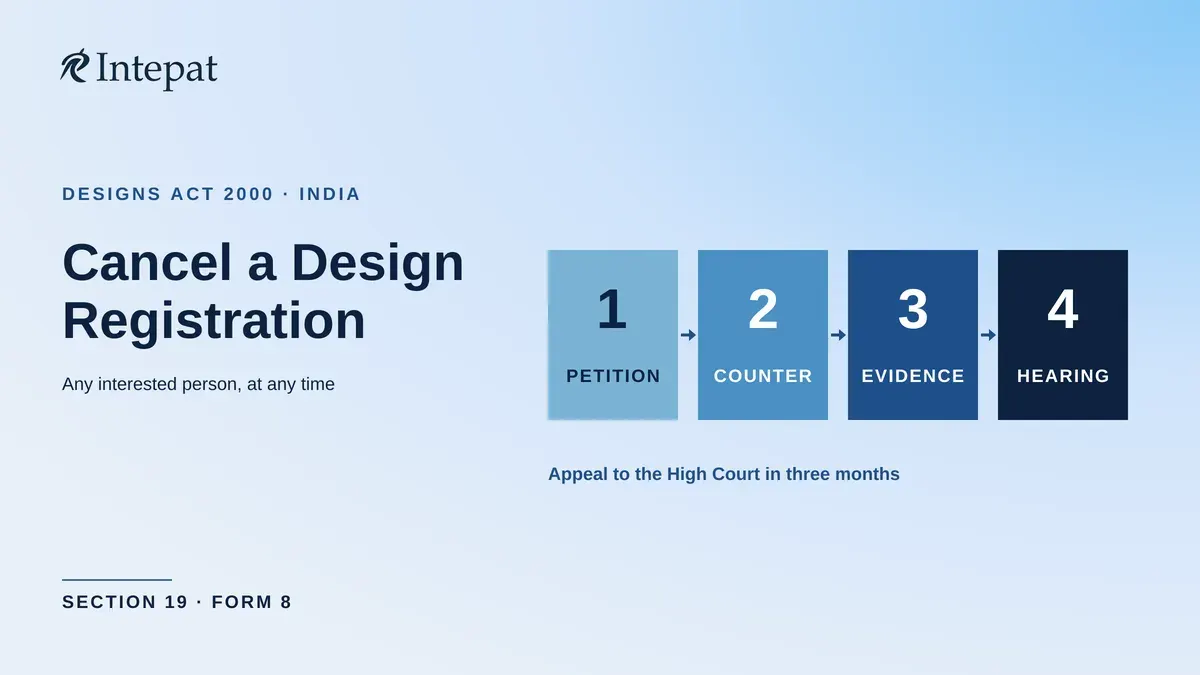
You start by filing a Form 8 petition in duplicate, with a statement and your evidence, also in duplicate. The statement sets out your interest and the facts you rely on, so build your evidence before you file rather than after. The filing of the petition is published in the Official Journal of the Patent Office, and, if you are not the registered proprietor, the Controller sends a copy of the petition, statement and evidence to the proprietor.
If the proprietor wants to oppose, they file a counter-statement with their evidence within the time the Controller sets, and send you a copy at the same time. You may then file evidence in reply, by affidavit, confined to matters raised in the proprietor’s evidence. No further evidence is filed unless the Controller allows or directs it.
Once the statements and evidence are in, the Controller fixes a hearing and gives the parties at least ten days’ notice. A party who wants to be heard files a notice in Form 20. If you intend to refer to a publication at the hearing, give the Controller and the other side at least five days’ notice of your intention, together with details of the publication. The Controller may decide without a hearing if neither party wants to be heard or neither attends. The decision is notified to the parties and published in the Official Journal.
Time is tight. The counter-statement and evidence, and the reply evidence, ordinarily get one month each. The Controller can extend a period only by special order on a petition with the fee, and the extension cannot exceed three months in aggregate. Documents in another language need an attested English translation, filed in duplicate.
The Controller may also refer the petition to the High Court, which then decides it.
| Step | Form | Natural person, startup or small entity | Others |
|---|---|---|---|
| Petition for cancellation | Form 8 | Rs 1,500 | Rs 6,000 |
| Notice of intention to attend the hearing | Form 20 | Rs 500 | Rs 2,000 |
| Petition to extend time | No numbered form | Rs 500 | Rs 2,000 |
| Costs cap for the petition item alone (hearing days, affidavits and citations are capped separately) | Not applicable | Rs 1,000 | Rs 4,000 |
Verified as of November 2026 against the First Schedule (entries 9, 21 and 26) and Fourth Schedule (entry 2) to the Designs Rules 2001, as substituted by the Designs (Amendment) Rules 2021. The complete schedule is the First Schedule to the Designs Rules, listed under Sources; our design fee guide explains the fee categories and main fees.
You pay the “Others” rate if any joint petitioner falls outside the natural person, startup and small entity categories. If you claim startup or small-entity status, file Form 24, with the documents it asks for, with each fee-bearing form. The Controller may award such costs as are reasonable in the circumstances, within the limits the Fourth Schedule sets for each item.
After the Controller’s decision
An appeal lies to the High Court from any order the Controller makes on a cancellation petition. It must be filed within three months of the order. The time taken to obtain a copy of the order is not counted.
If the petition succeeds, the registration is cancelled. If it fails, the registration stays on the register.
Cancellation as a defence to a piracy suit
You do not have to file a petition to rely on these grounds. If you are sued for design piracy, every ground of cancellation is also available to you as a defence. Once you raise one, the suit is transferred to the High Court for decision.
Choosing between a petition and a court defence is a strategy question. A petition before the Controller carries a modest official fee and can be filed before any dispute reaches court. A defence keeps everything in one forum but moves the case up to the High Court. Our guide to liability for design infringement covers the other side of a piracy claim.
If you own the design under attack, check your filing records and earliest disclosures first. Those are often decisive. Rectification of the register is a separate process and cannot be used to cancel a registration. See also registrable and non-registrable designs.
FAQ
Any person interested (Designs Act 2000, section 19(1)). The Act does not define the term, so your Form 8 statement, filed with your evidence, must set out the nature of your interest and the facts you rely on (Designs Rules 2001, rule 29(1)). Competitors and businesses facing a piracy allegation may qualify.
No. A petition may be presented at any time after the design is registered (section 19(1)). Within the proceeding, though, the counter-statement and evidence, and the reply evidence, ordinarily get one month each, extendable by special order on a petition by up to three months in aggregate (rule 29(9), as amended in 2008).
Prior registration in India, prior publication anywhere, lack of novelty or originality, non-registrability, and not being a design under section 2(d) (section 19(1)(a) to (e)). Because a design is registered as of its filing date, or its priority date where a claim made within six months was allowed (sections 5(6) and 44; rule 30(3)), publication before that date is what counts.
The Form 8 fee is Rs 1,500 for natural persons, startups and small entities, and Rs 6,000 for others (First Schedule, entry 9). A Form 20 notice to attend the hearing costs Rs 500 for natural persons, startups and small entities, or Rs 2,000 for others (entry 21). Professional fees and evidence costs are extra, and the Controller may award costs (rule 43).
Yes. An appeal lies to the High Court from any order of the Controller under section 19 (section 19(2)). It must be filed within three months of the order, excluding the time taken to obtain a copy of it (section 36(1) and (2)). The Controller may also refer a petition directly to the High Court.
This article explains design cancellation in India as at November 2026 and is for general information only. It is not legal advice. Official fees, forms and procedures change; confirm current figures with the Designs Office of IP India before you file. For advice on a specific registration or dispute, consult an IP attorney.
Sources
- The Designs Act, 2000, Government of India, IP India, read 14 November 2026.
- The Designs Rules, 2001, consolidated, IP India, read 14 November 2026.
- The Designs (Amendment) Rules, 2021, G.S.R. 45(E), 25 January 2021, Gazette of India, read 14 November 2026.
- Manual of Designs Practice and Procedure, Office of the Controller General of Patents, Designs and Trade Marks, read 14 November 2026.